
Introduction
The construction, infrastructure, and real estate sectors form the backbone of any developing economy. At the heart of this massive machine are civil engineering professionals who transform architectural blueprints into sprawling highways, iconic skyscrapers, and massive transit networks.
If you are a student standing at the crossroads of your education, or a working professional aiming to climb the corporate ladder, a critical question inevitably arises: Diploma vs BTech Civil – Which is Best for Career growth?
Choosing between a 3-year Diploma in Civil Engineering (Polytechnic) and a 4-year Bachelor of Technology (B.Tech) or Bachelor of Engineering (B.E.) in Civil Engineering alters your entry point, job profile, salary trajectory, and everyday responsibilities on a construction site. This highly exhaustive, field-tested guide analyzes both pathways from an engineering standpoint, incorporating practical on-site scenarios, calculations, market realities, and clear career paths.

Defining the Core Profiles: Diploma vs BTech Civil
To make an informed choice, you must first understand the fundamental differences in how these two academic streams prepare you for the construction field.
The Diploma in Civil Engineering Profile
A Diploma program is highly vocational, practical, and execution-oriented. It aims to create site-level execution supervisors. Diploma holders learn the “how-to” aspects of construction. They excel at managing daily labor forces, executing simple field layouts, setting up leveling instruments, reading working drawings, and ensuring manual compliance with pre-determined structural details.
- Duration: 3 years (after 10th grade) or 2 years via lateral entry (after 12th science or ITI).
- Primary Focus: Field supervision, surveying, daily material testing, and labor management.
The BTech in Civil Engineering Profile
A BTech program is highly analytical, theoretical, and management-driven. It aims to develop planning, design, and project management capabilities. BTech engineers learn the “why” and “how-to-optimize” aspects of engineering. They interpret advanced building codes, design concrete and steel structures, run finite element analysis software, manage complex project schedules, and optimize cash flows.
- Duration: 4 years (after 12th grade) or 3 years via lateral entry (after a Diploma).
- Primary Focus: Structural design, estimation, contracts management, billing engineering, project planning, and quality assurance.
Structural Site Applications and Core Field Engineering Formulas
Whether you are a Diploma site supervisor checking daily layouts or a BTech project manager evaluating monthly structural billing, both roles require a solid command over core engineering mathematics. Below are the standard, clean plain-text equations applied daily on site to verify execution compliance and control structural budgets.
Steel Reinforcement Unit Weight Calculation
Steel bars arrive at construction sites in standard 12-meter bundles. To check billing and avoid truck-loading fraud, the unit weight must be verified instantly using the standard bar diameter formula:
- Unit Weight of Steel Bar per Meter (in kg/m) = (d x d) / 162
- Where d = Diameter of the TMT steel bar in millimeters (mm).
- Total Weight of Steel Bar = Unit Weight x Total Length of the Bar (in meters).
Field Compaction and Dry Density Formula
Before laying a foundation or constructing a highway embankment, the soil must be compacted. The field engineer must determine the Dry Density to ensure the earth can carry heavy building loads without settling:
- Bulk Density = Total Weight of Soil Sample / Total Volume of Soil Sample
- Dry Density = Bulk Density / (1 + (Moisture Content / 100))
Plinth Area and Carpet Area Calculations
During billing and estimation, building areas are classified systematically:
- Plinth Area = Built-up Covered Area Measured at Floor Level (Includes wall thicknesses and balconies).
- Carpet Area = Plinth Area – Area of External and Internal Walls – Area of Pillars/Columns.
Essential Unit Conversions for Structural Engineers
On-site engineers constantly bridge the gap between academic drawings (metric units) and local material supply chains (traditional units). Memorizing these clean conversions prevents costly ordering mistakes.
| From (Drawing/Standard Unit) | To (Site/Market Unit) | Conversion Multiplier | Operational Site Use Case |
|---|---|---|---|
| Meter (m) | Feet (ft) | Multiply by 3.281 | Column spacing, grid markings |
| Millimeter (mm) | Inch (in) | Divide by 25.4 | Steel rebar diameter verification |
| Square Meter (sqm) | Square Feet (sqft) | Multiply by 10.764 | Plastering area, tile layout billing |
| Cubic Meter (cum) | Cubic Feet (CFT) | Multiply by 35.314 | Coarse aggregate and sand ordering |
| Cubic Feet (CFT) | Brass | Divide by 100 | Bulk earth excavation and quarry sand billing |
| KiloNewton (kN) | Kilogram (kg) | Multiply by 101.971 | Structural load conversion check |
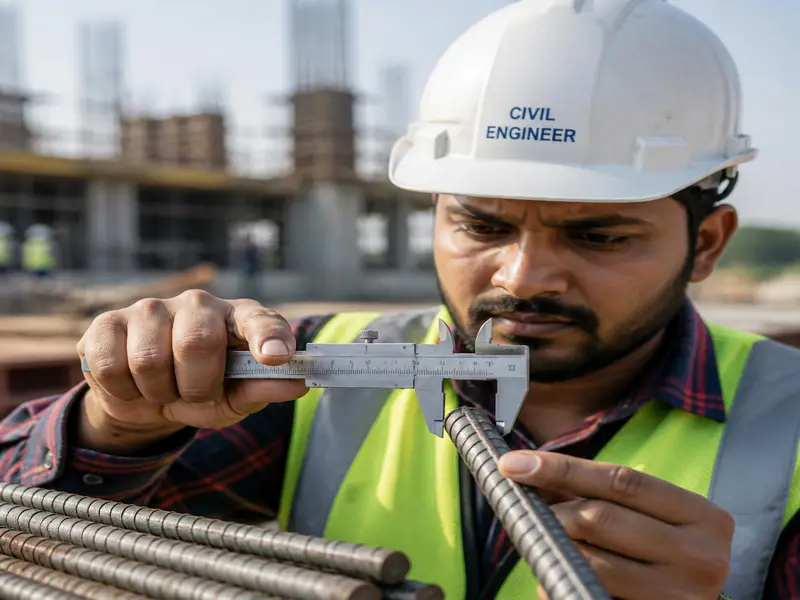
Practical On-Site Calculation Examples with Real-World Numbers
Let’s look at how a Diploma engineer (focusing on on-site execution) and a BTech engineer (focusing on planning and material verification) work together to execute and verify critical site components using math.
Example A: Steel Reinforcement Weight Checking
An order of 16mm diameter TMT steel bars arrives at the site for an upcoming column casting schedule. The layout drawing requires 45 pieces of these bars, each cut to a precise height of 4.5 meters. Calculate the exact structural weight to verify the supplier’s delivery bill.
Step 1: Calculate the unit weight of a 16mm steel bar per meter.
- Unit Weight = (d x d) / 162
- Unit Weight = (16 x 16) / 162
- Unit Weight = 256 / 162 = 1.580 kg/m
Step 2: Calculate the cumulative running length of the steel reinforcement needed.
- Total Length = Number of Bars x Cut Length per Bar
- Total Length = 45 bars x 4.5 meters = 202.5 meters
Step 3: Compute the final structural weight.
- Total Weight = 202.5 meters x 1.580 kg/m = 319.95 kg (approximately 3.20 Quintals)
Site Application: The Diploma supervisor counts the bars on the truck to ensure exactly 45 pieces exist at 4.5m lengths, while the BTech billing engineer verifies that the supplier’s weight ticket matches the calculated 320 kg to approve payment.
Example B: Soil Compaction Quality Check
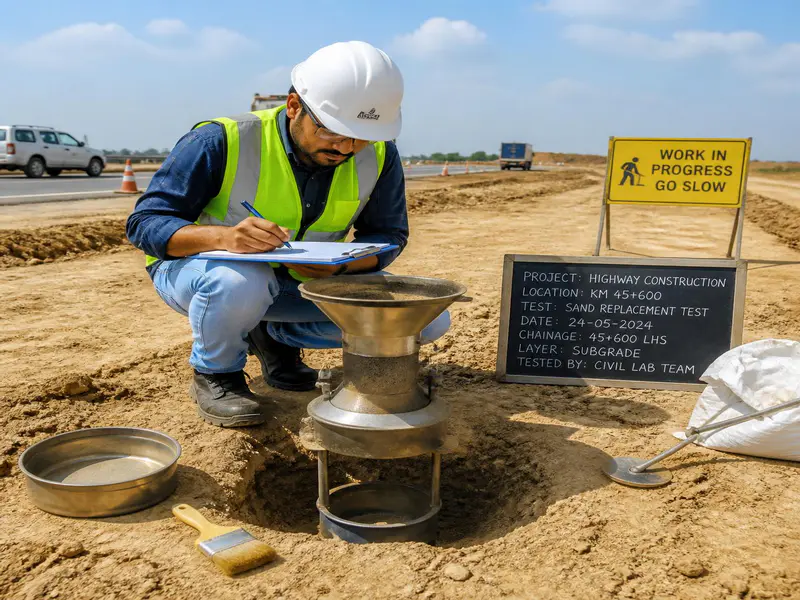
A highway embankment or a structural foundation pit needs backfilling. The laboratory Proctor compaction test reports that the target Maximum Dry Density (MDD) for this soil is 1.85 grams per cubic centimeter (g/cc). The field engineer performs a sand replacement core cutter test to check if the soil is properly rolled. The extracted soil volume is 1000 cubic centimeters, weighing 2000 grams. The rapid moisture meter indicates the water content is 12%.
Step 1: Calculate the Bulk Density of the soil sample.
- Bulk Density = Soil Weight / Soil Volume
- Bulk Density = 2000 grams / 1000 cc = 2.00 g/cc
Step 2: Calculate the Field Dry Density.
- Field Dry Density = Bulk Density / (1 + (Moisture Content / 100))
- Field Dry Density = 2.00 / (1 + (12 / 100))
- Field Dry Density = 2.00 / 1.12 = 1.785 g/cc
Step 3: Evaluate the Compaction Percentage against quality control standards.
- Compaction Percentage = (Field Dry Density / Laboratory Target MDD) x 100
- Compaction Percentage = (1.785 / 1.85) x 100 = 96.48%
Site Application: If the infrastructure project specification requires a minimum of 95% compaction, the BTech Quality Assurance (QA) engineer approves the layer based on these calculations. If it falls short, the Diploma supervisor instructs the roller operator to run additional passes.
Civil engineers also work in building construction and infrastructure projects.
Extensive On-Site Quality Control Framework and Material Wastage Factors
A major part of any civil engineering career is controlling costs and ensuring structural strength. The table below lists the daily quality checks, expected material wastage benchmarks, and standard engineering precautions that form the core of field execution.
| Engineering Milestone | Critical Quality Check Methodology | Standard Wastage Allowance | Professional Engineering Precaution |
|---|---|---|---|
| Concrete Reinforcement | Verify concrete cover blocks (25mm for slabs, 40mm for columns) are placed before pouring. | 2.5% to 4.0% (mainly cutting scrap) | Ensure lap lengths match structural structural codes (typically 50d). Never place lap joints at maximum bending zones. |
| Brick Masonry | Perform a water absorption test on raw bricks. Ensure they soak for 24 hours before layout. | 3.0% to 5.0% (due to corner breakages) | Maintain horizontal mortar joint thicknesses between 10mm to 12mm. Rake joints out before mortar cures for plaster bonding. |
| Excavation & Backfilling | Verify the bottom foundation level is clear of loose organic mud or tree roots. | 5.0% to 8.0% (bulking of loose soil) | Implement sturdy timber shoring or step back trench slopes if depth exceeds 1.5 meters to prevent sidewall cave-ins. |
| Roof Slab Casting | Conduct a standard slump cone test to monitor water-cement ratio and workability. | 1.0% to 2.0% (spillage during pouring) | Maintain systematic water curing for at least 7 to 10 days to maximize final compressive strength. |
Head-to-Head Comparison: Diploma vs BTech Civil
The following comprehensive evaluation summarizes how both educational paths translate to career progression, financial packages, and day-to-day work profiles.
Educational Investment and Entry Points
- Diploma in Civil: Fast, economical entry route. Ideal for students wanting to support their family financially right after 10th grade. Offers immediate employment opportunities in execution roles within 3 years.
- BTech in Civil: Long-term academic investment requiring 4 years of study after 12th grade. Requires a larger upfront budget but opens advanced technical doors in corporate planning, international consultancy, and structural modeling.
Work Profiles and Core Tasks on Site
- Diploma Job Profile: Site Supervisor, Junior Surveyor, Assistant Quantity Estimator, Lab Testing Technician. The day involves tracking physical labor turnout, checking rebar placements, maintaining store asset registers, and managing concrete mixers.
- BTech Job Profile: Assistant Project Manager, Billing Engineer, Structural Design Engineer, Estimation and Tendering Manager, QA/QC Lead. The day involves interpreting structural drawings, writing project change orders, clearing contractor bills, and coordinating with architectural consultants.

Comprehensive Comparison Matrix
| Career Parameter | Diploma in Civil Engineering | BTech / BE in Civil Engineering |
|---|---|---|
| Course Eligibility | After 10th Grade (via State Polytechnic Exams) | After 12th Grade with PCM (via JEE, State CETs) |
| Program Duration | 3 Years | 4 Years |
| Primary Skill Focus | Ground-level execution, manual surveying, supervision | Structural modeling, budget analysis, project management |
| Initial Salary (India) | INR 1.5 Lakhs to INR 2.8 Lakhs per annum | INR 3.5 Lakhs to INR 7.0 Lakhs per annum (Higher from Tier-1 institutes) |
| Highest Initial Job Title | Junior Engineer (JE), Site Supervisor, Lab Assistant | Graduate Engineer Trainee (GET), Assistant Design Engineer |
| Top Corporate Employers | Local builders, subcontractors, public works contractors | L&T Construction, Tata Projects, Afcons, Shapoorji Pallonji, RITES |
| Government Job Pathways | SSC JE, State PSC JE, Railway Recruitment Board (RRB) JE | UPSC ESE (IES), State PSC Assistant Engineer (AE), GATE PSU roles |
| Long-Term Career Cap | Typically peaks at Senior Site Engineer or Project Manager | Can reach Project Director, Chief Structural Consultant, VP, or COO |
Career Paths and Growth Trajectories
Public Sector and Government Opportunities
Both paths offer clear routes into coveted government roles, but they enter at different structural tiers:
- The Diploma Track: You qualify for Junior Engineer (JE) roles across major departments like Central Public Works Department (CPWD), Military Engineer Services (MES), Indian Railways, and State Irrigation or Roads wings. These exams focus primarily on practical field questions, estimation basics, and surveying methodologies.
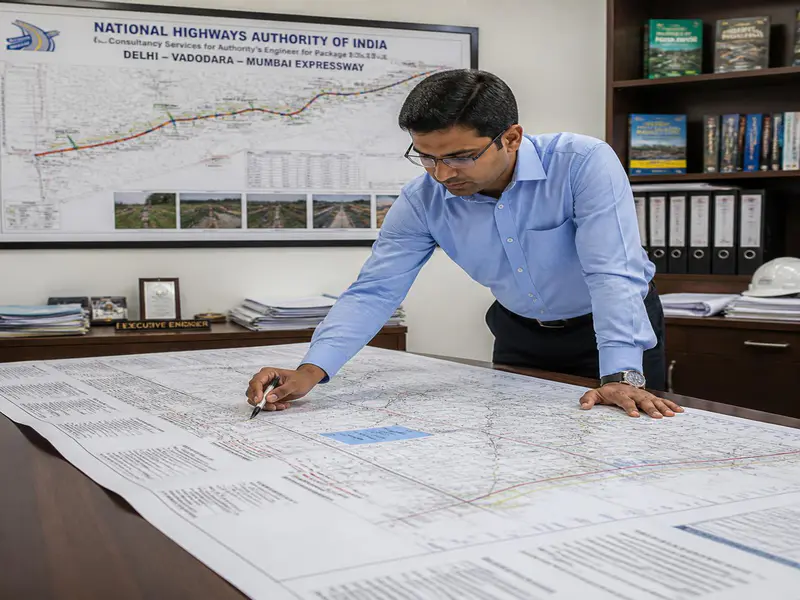
- The BTech Track: You can bypass the JE tier entirely and apply directly for Assistant Engineer (AE) or Executive Engineer paths. You are eligible to sit for the highly prestigious UPSC Engineering Services Examination (ESE) to enter the Indian Engineering Services (IES). Alternatively, high scores on the Graduate Aptitude Test in Engineering (GATE) unlock high-paying management positions across premier Public Sector Undertakings (PSUs) like NHAI, NTPC, ONGC, and IOCL.
Private Sector Corporate Growth
In corporate construction companies, a BTech qualification often speeds up promotional tracks:
- A Diploma holder starting as a Site Supervisor might take 7 to 10 years of consistent, hard on-site work to reach a Senior Site Engineer position.
- A BTech Graduate Engineer Trainee (GET) often hits that same tier within 2 to 4 years, moving rapidly into specialized business tracks like Project Contracts, International Tendering, or Strategic Supply Chain Management.
The Hybrid Pathway: Lateral Entry BTech
If you start with a Diploma due to financial or personal constraints, your career path is far from limited. Most Indian state universities offer a Lateral Entry Scheme. This path allows top-performing Diploma graduates to slide directly into the 2nd year (3rd semester) of a BTech program. This hybrid approach gives you an exceptional competitive edge: you combine the practical, boots-on-the-ground site execution skills of a Diploma with the deep structural engineering knowledge of a BTech degree.
Frequently Asked Questions (FAQs)
Q1. Can I switch from a Diploma to a BTech program later if my financial situation improves?
Yes, absolutely. Every state in India features a structured Lateral Entry system (such as ECET or state-specific lateral entrance tests). This path permits Diploma holders to enter directly into the second year of a BTech program, meaning you do not lose any academic years.
Q2. Is a BTech Civil degree mandatory to start my own construction and contracting firm?
No, a BTech is not legally required to become a contractor. Many successful Class-A government and private contractors hold a Diploma. A Diploma provides excellent practical knowledge in surveying, billing, and labor management, which form the bedrock of running a profitable construction business. However, certain large-scale public tenders require corporate firms to employ full-time BTech engineers to oversee operations.
Q3. Which profile is preferred for structural design roles using software like STAAD Pro or ETABS?
Structural design firms almost exclusively hire BTech graduates, and often prefer candidates with an MTech in Structural Engineering. Structural design requires an advanced grasp of mechanics, structural dynamics, and finite element modeling that goes far beyond the basic drafting covered in a Diploma syllabus.
Q4. Can a Diploma Civil engineer clear the UPSC Indian Engineering Services (IES) exam?
No. The minimum eligibility criterion to sit for the UPSC Engineering Services Examination (ESE/IES) is a full four-year Bachelor’s Degree in Engineering (BTech/BE). Diploma holders can instead target the SSC Junior Engineer (JE) or regional State PSC JE examinations.
Q5. Are there international job opportunities in the Gulf (UAE, Qatar, Saudi Arabia) for Diploma holders?
Yes, there is consistent demand for experienced Diploma holders in the Middle East for roles like Senior Site Supervisors, Quantity Surveyors, and BIM/CAD Draftsmen. However, visa processing for high-level management titles (like Project Manager or Chief Consultant) generally requires a recognized BTech degree certified by the Ministry of External Affairs.
You can also explore engineering career guidance from the AICTE official website.
Conclusion: Making Your Final Decision
The choice between Diploma vs BTech Civil ultimately depends on your immediate financial priorities, career timeline, and personal professional style.
- Choose a Diploma in Civil Engineering if you prefer hands-on site execution, want to enter the workforce quickly, have a limited initial budget, or plan to build a career in field supervision or contracting.
- Choose a BTech in Civil Engineering if you lean toward structural planning, large-scale project economics, advanced computational design, and want to target top-tier corporate roles, high-ranking government executive positions, or international design consultancies.
Both paths are vital to the construction industry. A successful project requires the strategic vision of a BTech engineer just as much as it relies on the execution skills of a Diploma field professional.

Shakeel T is a qualified Civil Engineer and Structural Consultant with extensive on-site experience in residential and commercial building construction. Specializing in material estimation, cost budgeting, and structural safety guidelines, he has successfully managed multiple real estate projects from foundation to finishing. Through this blog, Shakeel shares field-tested civil engineering thumb rules, IS Code practices, and practical site tips to help home builders execute their projects efficiently and within budget.
Education: Diploma in Civil Engineering
Expertise: Quantity Surveying, Material Estimation, Structural Design, and Site Management.