
Introduction
Accurate material estimation is the backbone of any successful construction project. Underestimating concrete volume leads to costly delivery delays, cold joints, and disrupted labor schedules. Overestimating fills your site with expensive waste and eats into your profit margins.
Whether you are a site engineer, a quantity surveyor, or a DIY builder, mastering the concrete calculator formula is an essential skill. This comprehensive guide breaks down the exact mathematical formulas, provides step-by-step calculation examples for structural elements (slabs, beams, and footings), explains crucial unit conversions, and shares on-site professional practices to ensure your estimates match real-world requirements perfectly.
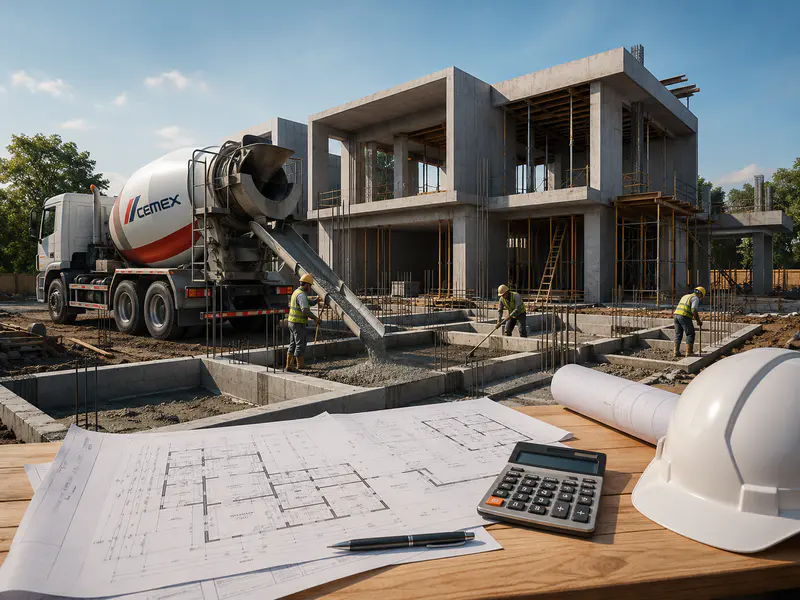
The Core Mathematics of Concrete Estimation
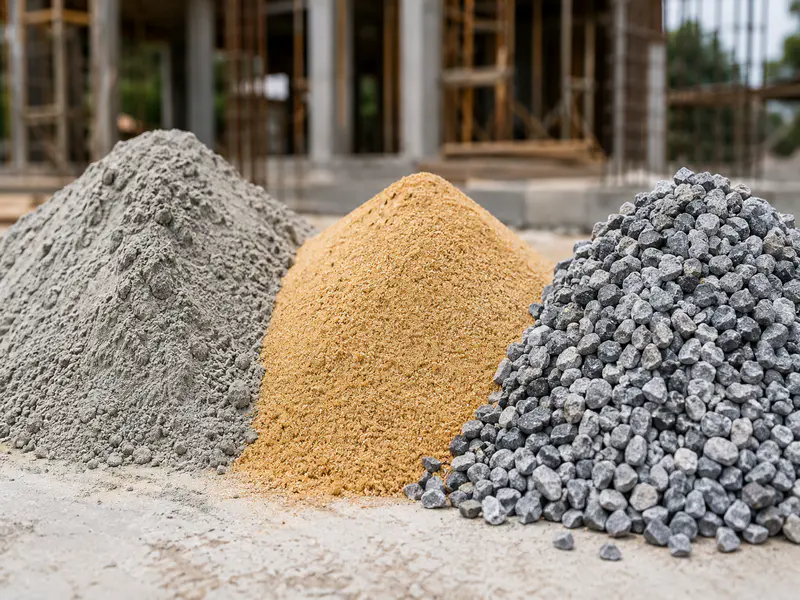
To calculate concrete volume, you must understand the difference between two distinct states of material: Wet Volume and Dry Volume.
- Wet Volume: This is the actual physical space or volume of the structural mold (shuttering/formwork) that needs to be filled with freshly mixed, liquid concrete.
- Dry Volume: Concrete is made by mixing dry ingredients: cement, sand (fine aggregate), and gravel (coarse aggregate). When water is added, these dry particles pack together tightly, and the air voids between them collapse. This causes the total volume to shrink.
To account for this shrinkage and the voids between dry particles, engineers use a standard conversion factor. Dry volume is always calculated as 54% greater than wet volume.
The Master Equations (Plain Text)
Use these fundamental formulas for your manual calculations:
- Wet Volume Formula:
Wet Volume = Length x Width x Thickness (or Depth) - Dry Volume Conversion Formula:
Dry Volume = Wet Volume x 1.54
Once you determine the total Dry Volume, you can calculate the individual quantities of cement, sand, and aggregate based on your specific concrete mix ratio.
Understanding Concrete Mix Ratios
Concrete strength is determined by its nominal or design mix ratio (Cement : Sand : Aggregate). Below are the standard nominal mixes used in structural engineering:
- M15 Mix (1 : 2 : 4): Total Parts = 1 + 2 + 4 = 7 (Used for leveling courses, paths)
- M20 Mix (1 : 1.5 : 3): Total Parts = 1 + 1.5 + 3 = 5.5 (Standard for regular slabs, beams, footings)
- M25 Mix (1 : 1 : 2): Total Parts = 1 + 1 + 2 = 4 (Used for heavy-duty structural elements)
Component Calculation Formulas
To extract individual material quantities from the dry volume:
- Cement Volume = (Dry Volume x Cement Ratio Part) / Total Parts
- Sand Volume = (Dry Volume x Sand Ratio Part) / Total Parts
- Aggregate Volume = (Dry Volume x Aggregate Ratio Part) / Total Parts
For reinforcement quantity calculation, you can also read our detailed Steel Weight Calculation for Slab guide.
Step-by-Step Structural Calculations
Let’s apply the concrete calculator formula to the three most common reinforced cement concrete (RCC) elements: Slabs, Beams, and Footings. For uniformity and ease of learning, we will use an M20 concrete mix (1 : 1.5 : 3) for all practical examples.
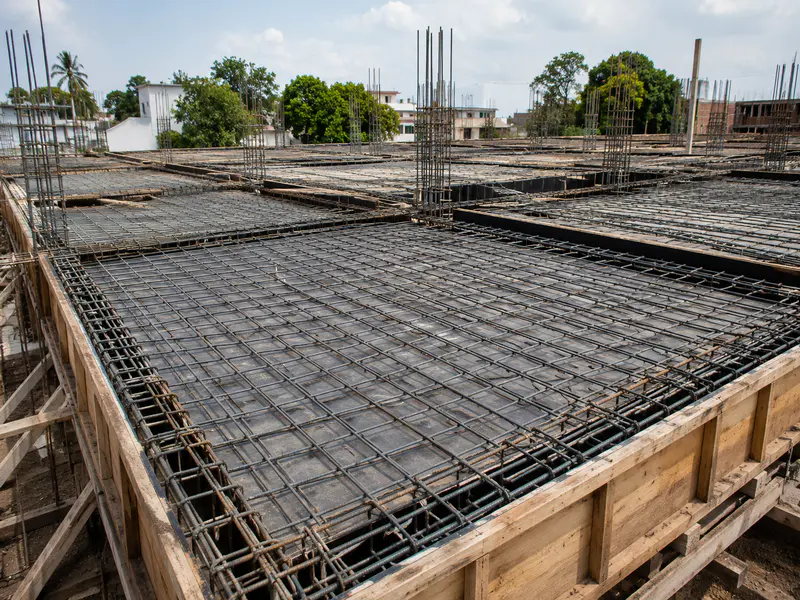
Part A: How to Calculate Concrete for a Slab
Slabs are horizontal structural elements with large surface areas and relatively thin profiles.
Step-by-Step Example:
- Slab Dimensions: Length = 10 meters, Width = 8 meters, Thickness = 0.15 meters (150 mm)
- Concrete Mix: M20 (Ratio = 1 : 1.5 : 3), Total Parts = 5.5
1. Calculate Wet Volume:
- Wet Volume = Length x Width x Thickness
- Wet Volume = 10 x 8 x 0.15
- Wet Volume = 12 Cubic Meters (m³)
2. Calculate Dry Volume:
- Dry Volume = Wet Volume x 1.54
- Dry Volume = 12 x 1.54
- Dry Volume = 18.48 Cubic Meters (m³)
3. Calculate Cement Quantity:
- Cement Volume = (18.48 x 1) / 5.5 = 3.36 m³
- Since the density of standard cement is 1440 kg/m³:
Weight of Cement = 3.36 x 1440 = 4,838.4 kg - Standard bag weight is 50 kg:
Number of Cement Bags = 4,838.4 / 50 = 96.76 Bags (Round up to 97 Bags)
4. Calculate Sand Quantity:
- Sand Volume = (18.48 x 1.5) / 5.5
- Sand Volume = 5.04 Cubic Meters (m³)
5. Calculate Coarse Aggregate Quantity:
- Aggregate Volume = (18.48 x 3) / 5.5
- Aggregate Volume = 10.08 Cubic Meters (m³)
Part B: How to Calculate Concrete for a Beam
Beams are long horizontal members designed to carry lateral loads. Unlike slabs, their width and depth are more closely proportioned.
Step-by-Step Example:
- Beam Dimensions: Length = 6 meters, Width = 0.3 meters (300 mm), Depth = 0.45 meters (450 mm)
- Concrete Mix: M20 (Ratio = 1 : 1.5 : 3), Total Parts = 5.5
1. Calculate Wet Volume:
- Wet Volume = Length x Width x Depth
- Wet Volume = 6 x 0.3 x 0.45
- Wet Volume = 0.81 Cubic Meters (m³)
2. Calculate Dry Volume:
- Dry Volume = Wet Volume x 1.54
- Dry Volume = 0.81 x 1.54
- Dry Volume = 1.2474 Cubic Meters (m³)
3. Calculate Cement Quantity:
- Cement Volume = (1.2474 x 1) / 5.5 = 0.2268 m³
- Weight of Cement = 0.2268 x 1440 = 326.59 kg
- Number of Cement Bags = 326.59 / 50 = 6.53 Bags (Round up to 7 Bags)
4. Calculate Sand Quantity:
- Sand Volume = (1.2474 x 1.5) / 5.5
- Sand Volume = 0.3402 Cubic Meters (m³)
5. Calculate Coarse Aggregate Quantity:
- Aggregate Volume = (1.2474 x 3) / 5.5
- Aggregate Volume = 0.6804 Cubic Meters (m³)
Part C: How to Calculate Concrete for a Footing
Footings transfer the structural load down to the soil. Foundations can be simple isolated blocks or complex trapezoids. This example covers a standard isolated rectangular block footing.
Step-by-Step Example:
- Footing Dimensions: Length = 2 meters, Width = 2 meters, Depth/Height = 0.6 meters
- Concrete Mix: M20 (Ratio = 1 : 1.5 : 3), Total Parts = 5.5
1. Calculate Wet Volume:
- Wet Volume = Length x Width x Depth
- Wet Volume = 2 x 2 x 0.6
- Wet Volume = 2.4 Cubic Meters (m³)
2. Calculate Dry Volume:
- Dry Volume = Wet Volume x 1.54
- Dry Volume = 2.4 x 1.54
- Dry Volume = 3.696 Cubic Meters (m³)
3. Calculate Cement Quantity:
- Cement Volume = (3.696 x 1) / 5.5 = 0.672 m³
- Weight of Cement = 0.672 x 1440 = 967.68 kg
- Number of Cement Bags = 967.68 / 50 = 19.35 Bags (Round up to 20 Bags)
4. Calculate Sand Quantity:
- Sand Volume = (3.696 x 1.5) / 5.5
- Sand Volume = 1.008 Cubic Meters (m³)
5. Calculate Coarse Aggregate Quantity:
- Aggregate Volume = (3.696 x 3) / 5.5
- Aggregate Volume = 2.016 Cubic Meters (m³)
Unit Conversions and Quantities Reference Table
Material vendors use different localized metric and imperial units across regional markets. A professional site engineer must be able to convert these values instantly.
Vital Conversion Metrics
- 1 Cubic Meter (m³) = 35.3147 Cubic Feet (CFT)
- 1 Brass = 100 Cubic Feet (CFT) = 2.831 Cubic Meters (m³)
- Density of Dry Sand = Roughly 1600 kg per m³ (varies based on moisture)
- Density of Coarse Aggregate = Roughly 1500 to 1600 kg per m³
- Density of Cement = 1440 kg per m³
Material Requirements per 1 Cubic Meter (m³) of Concrete
The table below provides a quick reference for the materials required to mix exactly 1 m³ of concrete across different common grades using standard plain text calculations.
| Concrete Grade | Nominal Mix Ratio | Cement Bags (50kg) | Sand Volume (CFT) | Coarse Aggregate (CFT) |
|---|---|---|---|---|
| M15 | 1 : 2 : 4 | 6.3 Bags | 15.54 CFT | 31.08 CFT |
| M20 | 1 : 1.5 : 3 | 8.1 Bags | 15.00 CFT | 30.00 CFT |
| M25 | 1 : 1 : 2 | 11.1 Bags | 13.72 CFT | 27.44 CFT |
Site-Level Application, Quality Control, and Adjustments
Theoretical math works perfectly on paper, but actual building sites introduce real-world variables. Use these professional practices to adjust your calculations.
Incorporating the Concrete Wastage Factor
Never order or mix the exact mathematical volume. Structural dimensions swell slightly under the weight of wet concrete, and material is regularly lost during handling, mixing, transport, and spillage.
- Standard Structural Wastage Allowance: Add 5% to 10% to your calculated wet volume before converting to dry volume or ordering from a Ready-Mix Concrete (RMC) supplier.
- Adjusted Volume Formula:
Final Wet Volume Order = Calculated Wet Volume x 1.05 (for 5% wastage)
On-Site Quality Control Protocols
Before you allow concrete to pour into your carefully calculated formwork, perform these two critical quality assurance checks:
1. Slump Test (Workability Check)
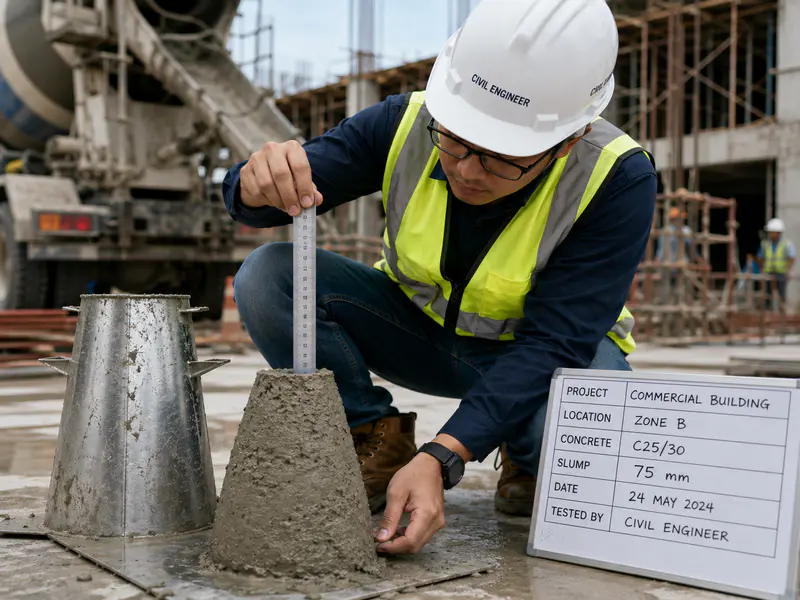
Fill a standard slump cone in four layers, tamping each layer 25 times. Lift the cone vertically and measure how far the concrete settles downward.
- Mass Pouring / Footings: 25 mm to 75 mm slump.
- Slabs and Beams (Pumpable Concrete): 75 mm to 125 mm slump.
- Precaution: Excessive slump indicates an over-hydration of the mix, which significantly reduces structural compressive strength.
2. Cube Testing (Compressive Strength Verification)
Cast 150 mm x 150 mm x 150 mm concrete cubes during the pour. Store them in curing tanks on site.
- Test the cubes under a calibrated compression testing machine at Day 7 (should hit roughly 65% to 70% of target strength) and Day 28 (must hit 100% of specified structural strength, e.g., 20 N/mm² for M20 concrete).
Critical Engineering Precautions
- The Reinforcement Volume Rule: Steel rebar takes up space within the formwork. For regular estimating, engineers do not subtract the steel volume because the formwork deflection (bulging out) usually equals or exceeds the volume of embedded steel.
- Bulking of Sand: Wet sand expands in volume by up to 25% due to surface moisture films. If you are volumetric batching on-site, increase your dry sand volume proportionally to prevent making a physically weak, grout-poor concrete mix.
Frequently Asked Questions (FAQs)
What is the 1.54 factor in the concrete calculator formula?
The 1.54 factor is the dry volume conversion constant. When dry cement, sand, and aggregate particles mix with water, the voids between them collapse. The volume shrinks by roughly 54%. Multiplying the wet volume of your structure by 1.54 ensures you buy enough dry raw materials to fill the formwork.
Does the volume of steel reinforcement need to be subtracted from the concrete volume?
In everyday estimation, no. Steel bars usually account for only 1% to 2% of the overall structural volume. This small volume is typically offset by slight bowing, minor leakage, or bulging of the temporary wooden/steel formwork during the casting process.
How do I calculate concrete volume for a circular column?
To calculate concrete for a circular pillar, use the cylinder volume formula in plain text:Volume = 3.1416 x (Radius x Radius) x Height.
Once you calculate this wet volume, apply the 1.54 dry factor to extract your raw material quantities.
How many bags of cement are needed for 1 cubic meter of M20 concrete?
Exactly 1 cubic meter of M20 concrete requires roughly 8.1 bags of standard 50 kg cement, along with 15 cubic feet of fine sand and 30 cubic feet of coarse stone aggregates.
What happens if too much water is added to the calculated concrete mix?
Adding extra water makes concrete easier to pour, but it ruins the water-cement ratio. As the excess water evaporates out of the setting structure, it leaves a network of microscopic voids. This dramatically reduces the compressive strength of the element and leads to premature shrinkage cracking.
As per IS 456:2000 (Plain and Reinforced Concrete Code), concrete mix design and structural calculations must follow standard guidelines.
Conclusion
Accurately applying the concrete calculator formula is an absolute requirement for managing cost, quality, and time on any construction project. By understanding how to move from wet structural volume to dry raw material volumes using the 1.54 multiplier, you can confidently source materials for slabs, beams, and foundations. Always account for site wastage, keep a close eye on moisture adjustments for sand, and use systematic quality checks to ensure your project stands strong for decades to come.

Shakeel T is a qualified Civil Engineer and Structural Consultant with extensive on-site experience in residential and commercial building construction. Specializing in material estimation, cost budgeting, and structural safety guidelines, he has successfully managed multiple real estate projects from foundation to finishing. Through this blog, Shakeel shares field-tested civil engineering thumb rules, IS Code practices, and practical site tips to help home builders execute their projects efficiently and within budget.
Education: Diploma in Civil Engineering
Expertise: Quantity Surveying, Material Estimation, Structural Design, and Site Management.