
Introduction
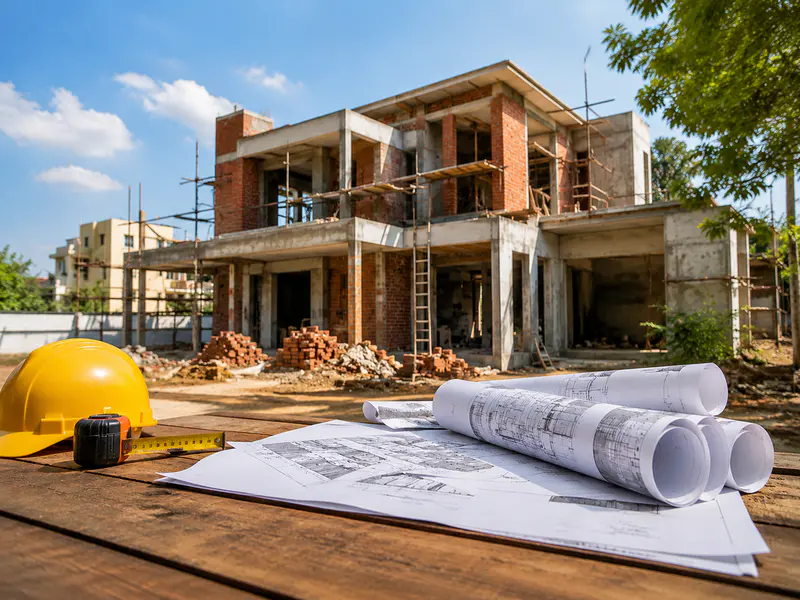
Building your dream home is a milestone achievement, but it comes with a complex web of financial and technical decisions. In 2026, the construction landscape in India has evolved dramatically due to shifting material costs, advanced technologies, and new regulatory standards.
Understanding the exact construction cost per sq ft in India is critical before you break ground. Miscalculating these expenses leads to budget overruns, delayed projects, or compromised structural safety.
This comprehensive engineering guide breaks down current building costs, core mathematical formulas, step-by-step estimates, quality control checks, and real-world site tips to keep your project on schedule and within budget.
Average Construction Cost per Sq Ft in India (2026)
Construction costs in India vary significantly based on the quality of materials, finish types, and the city tier where you build. Contractors classify residential construction into three primary categories:
Class A (Luxury/Premium Quality)
- Cost Range: Rs. 1,800 to Rs. 2,500+ per sq ft
- Specifications: High-grade Ready Mix Concrete (RMC), premium brands of steel (TATA Tiscon, JSW), Italian marble or high-end vitrified tiles, teak wood doors, premium modular kitchens, automated electrical systems, and branded plumbing fixtures (Kohler, Jaquar premium).
Class B (Standard/Medium Quality)
- Cost Range: Rs. 1,400 to Rs. 1,800 per sq ft
- Specifications: Standard site-mixed concrete (M20 grade), standard TMT steel bars, quality vitrified flooring, flush doors with laminate, standard modular kitchen provisions, and reliable plumbing/electrical fittings (Finolex, Anchor, Hindware).
Class C (Economy/Budget Quality)
- Cost Range: Rs. 1,100 to Rs. 1,400 per sq ft
- Specifications: Ordinary country bricks, local sand, lower-grade cement, basic ceramic tile flooring, basic paint, and local or non-branded bathroom and electrical fittings.
Cost Breakdown by Component
A standard residential building budget is typically distributed across these core components:
- Civil Works (Structure, Brickwork, Plastering): 50% to 55% of the total budget.
- Finishing Works (Flooring, Painting, Windows, Doors): 25% to 30% of the total budget.
- MEP Works (Mechanical, Electrical, Plumbing): 15% to 20% of the total budget.
Structural Construction Material Consumption Rules
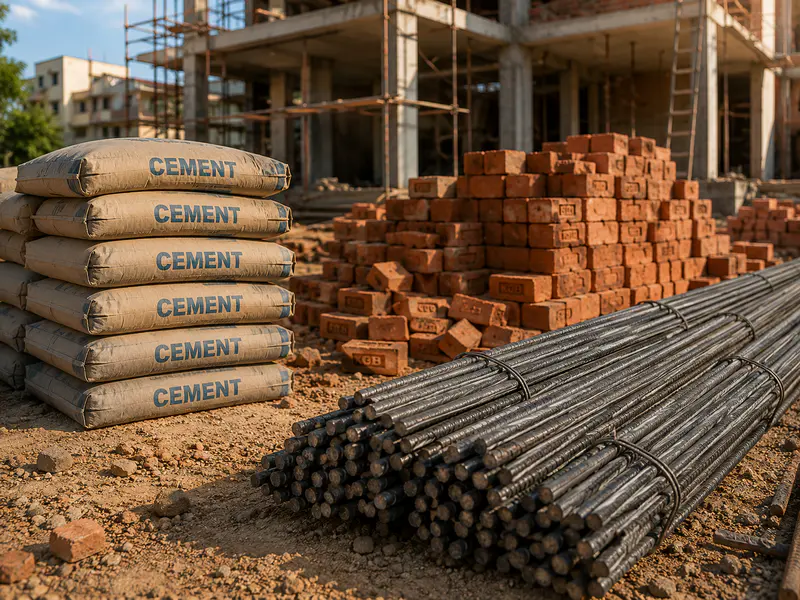
Civil engineers use standard thumb rules derived from the National Building Code (NBC) of India to make quick material estimates. For every 1 square foot of built-up area, the approximate material consumption is:
- Cement: 0.4 track to 0.45 bags per sq ft
- Steel: 3.5 kg to 4.5 kg per sq ft
- Sand: 1.2 to 1.5 cubic feet (CFT) per sq ft
- Aggregate (Coarse): 1.1 to 1.3 cubic feet (CFT) per sq ft
- Bricks: 20 to 24 bricks per sq ft (for standard 9-inch and 4.5-inch wall combinations)
Core Mathematical Formulas for Construction Estimation
To calculate material volumes accurately, you must use standard volumetric engineering formulas. Do not use shortcut percentages without verifying volumetric requirements.
Concrete Volume Calculation
Concrete is measured and ordered in its wet state but calculated using dry ingredients. Concrete shrinks when water is added. To compensate, engineers use a dry volume conversion factor of 1.54.
- Wet Volume = Length x Width x Thickness
- Dry Volume = Wet Volume x 1.54
Material Ratio Formula (For Cement, Sand, Aggregate)
For a specific mix ratio (e.g., M20 mix which is 1 part cement : 1.5 parts sand : 3 parts aggregate):
- Total Ratio Parts = Cement Part + Sand Part + Aggregate Part
- Volume of Specific Material = (Ratio Part of Material / Total Ratio Parts) x Dry Volume
Steel Weight Formula
To find the weight of steel bars on-site based on their length and diameter:
- Weight of Steel Bar per Meter = (Diameter x Diameter) / 162
- Total Weight = Weight per Meter x Total Length of the Bar in Meters
(Note: Diameter is measured in millimetres).
To understand steel requirement calculation in detail, read the article “Steel Weight Calculation for Slab – Complete Civil Engineering Step-by-Step Guide (With Examples)”.
Step-by-Step Construction Cost Estimation Examples
Let us calculate the material requirements and costs for a 1,000 sq ft built-up area house using standard Class B construction rules for 2026.
Example A: General Material Cost Breakdown for a 1,000 Sq Ft House
Using our structural thumb rules, let us estimate the requirements and costs for a 1,000 sq ft home:
1. Cement Calculation
- Requirement: 1,000 sq ft x 0.43 bags/sq ft = 430 bags
- Average Cost (2026): Rs. 420 per bag
- Total Cement Cost: 430 x 420 = Rs. 1,80,600
2. Steel Calculation
- Requirement: 1,000 sq ft x 4 kg/sq ft = 4,000 kg (4 Tons)
- Average Cost (2026): Rs. 70 per kg
- Total Steel Cost: 4,000 x 70 = Rs. 2,80,000
3. Sand Calculation
- Requirement: 1,000 sq ft x 1.3 CFT/sq ft = 1,300 CFT
- Average Cost (2026): Rs. 65 per CFT
- Total Sand Cost: 1,300 x 65 = Rs. 84,500
4. Coarse Aggregate Calculation
- Requirement: 1,000 sq ft x 1.2 CFT/sq ft = 1,200 CFT
- Average Cost (2026): Rs. 55 per CFT
- Total Aggregate Cost: 1,200 x 55 = Rs. 66,000
5. Bricks Calculation
- Requirement: 1,000 sq ft x 22 bricks/sq ft = 22,000 bricks
- Average Cost (2026): Rs. 9 per brick
- Total Bricks Cost: 22,000 x 9 = Rs. 1,98,000
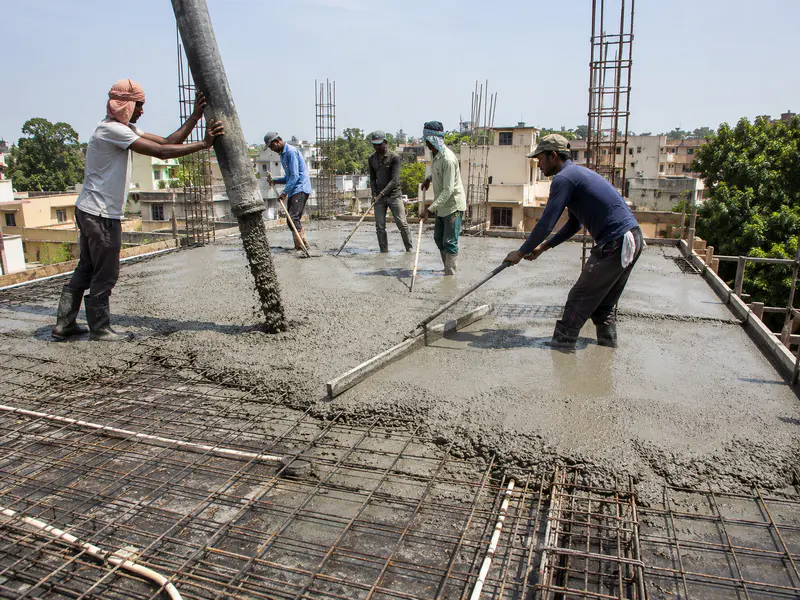
Example B: Concrete Slab Casting Calculation (Slab Size: 30ft x 40ft x 5 inches)
Let us calculate the exact material required to cast a standard residential roof slab measuring 30 feet by 40 feet with a thickness of 5 inches using M20 grade concrete (Ratio 1 : 1.5 : 3).
Step 1: Convert all dimensions to feet
- Length = 30 feet
- Width = 40 feet
- Thickness = 5 inches = 5 / 12 = 0.416 feet
Step 2: Calculate Wet Volume
- Wet Volume = 30 x 40 x 0.416 = 499.2 Cubic Feet (CFT)
- Convert CFT to Cubic Meters (cum): 499.2 / 35.315 = 14.136 cum
Step 3: Calculate Dry Volume
- Dry Volume = 14.136 x 1.54 = 21.77 Cubic Meters
Step 4: Calculate Component Quantities (M20 Ratio: 1 + 1.5 + 3 = 5.5 total parts)
- Cement Volume = (1 / 5.5) x 21.77 = 3.958 Cubic Meters
- Since 1 cubic meter of cement equals 28.8 bags:
- Total Cement Bags = 3.958 x 28.8 = 114 Bags
- Sand Volume = (1.5 / 5.5) x 21.77 = 5.937 Cubic Meters
- Convert to CFT: 5.937 x 35.315 = 209.6 CFT
- Aggregate Volume = (3 / 5.5) x 21.77 = 11.874 Cubic Meters
- Convert to CFT: 11.874 x 35.315 = 419.3 CFT
Standard Unit Conversions for Construction
Materials arrive at site in various local and commercial units. Use this quick reference table to convert units accurately and avoid supplier fraud:
| Material Type | From Unit | To Unit | Multiplication Factor |
|---|---|---|---|
| Volume | Cubic Meter (cum) | Cubic Feet (CFT) | Multiply by 35.315 |
| Volume | Brass (Local Indian Unit) | Cubic Feet (CFT) | 1 Brass = 100 CFT |
| Volume | Brass | Cubic Meter (cum) | 1 Brass = 2.83 cum |
| Weight | Metric Ton | Kilograms (kg) | Multiply by 1,000 |
| Weight | Quintal | Kilograms (kg) | 1 Quintal = 100 kg |
| Area | Square Meter | Square Feet (sq ft) | Multiply by 10.764 |
| Length | Meter | Feet | Multiply by 3.281 |
A complete explanation about different foundation types used in construction, read the article “Types of Foundation in Construction – Complete Guide with Explanation and Examples.”
Real-World Site Quality Controls and Wastage Mitigation
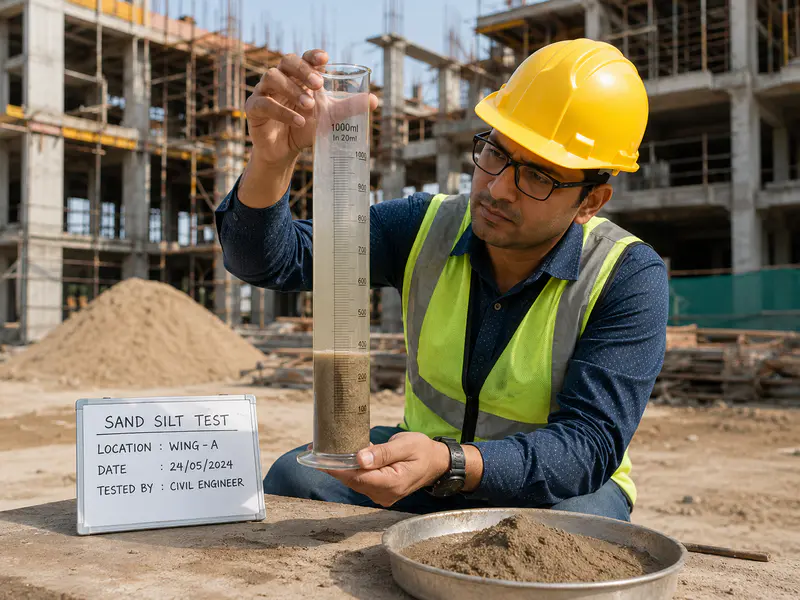
Managing material quality and minimizing site wastage can save you up to 10% of your total construction cost. Implement these professional civil engineering protocols on your site:
On-Site Quality Tests
- Cement Quality Check: Open a random bag from the delivery truck. Insert your hand inside; it must feel cool. Drop a small pinch of cement into a bucket of water. It must float for a few moments before sinking. Reject any cement that contains hard lumps.
- Sand Silt Test: Take a graduated glass cylinder, fill it with sand up to the 50ml mark, add water up to the 100ml mark, and shake vigorously. Let it settle for one hour. The silt layer forming on top of the sand must not exceed 8% of the total height. High silt content weakens concrete bonding.
- Brick Water Absorption Test: Weigh five random dry bricks from a batch. Submerge them completely in clean water for 24 hours. Remove and weigh them again. The wet weight must not exceed the dry weight by more than 20%.
Wastage Factors and Management
Always add a predefined wastage margin when ordering materials to prevent work stoppages, but monitor your contractors to ensure they do not exceed these industry standard thresholds:
- Steel Wastage Margin: Allow 3% to 5% for cutting layouts and lap lengths. Ensure bar binders use a detailed Bar Bending Schedule (BBS) to optimize structural cuts.
- Cement Wastage Margin: Allow 1% to 2%. Store bags on raised wooden planks inside a completely dry, weather-proof room. Stack them no higher than 10 bags to prevent compaction lumps.
- Brick and Tile Wastage Margin: Allow 5% to 8% due to handling breakage and custom corner cuts. Ensure workers unload bricks carefully instead of tipping them directly out of dumper trucks.
Frequently Asked Questions (FAQs)
What is the average construction cost per sq ft in India in 2026?
The average construction cost ranges from Rs. 1,400 to Rs. 1,800 per sq ft for a standard Class B home. This varies based on your city, material selections, labor availability, and structural choices.
How much does it cost to build a 1,000 sq ft house in India?
For a standard Class B finish, a 1,000 sq ft house will cost between Rs. 14,00,000 and Rs. 18,00,000. This estimate generally covers civil structure, basic electrical, plumbing, flooring, and painting works, but excludes land acquisition, boundary walls, and major municipal approval fees.
What is the difference between built-up area and carpet area?
Carpet area is the net usable floor space inside the walls where you can lay a carpet. Built-up area includes the carpet area plus the thickness of inner and outer walls, balconies, and utility ducts. Construction costs are always calculated on the total built-up area.
How can I reduce my home construction cost without losing quality?
You can lower costs by choosing locally sourced materials, avoiding complex geometric building designs, using fly-ash or AAC blocks instead of red clay bricks, and procuring finishing items like tiles and sanitary ware directly from wholesale markets instead of through intermediaries.
Is labor cost included in the construction cost per sq ft?
Yes. Standard turnkey contract quotes per square foot include both material supply and labor costs. If you choose a labor-only contract model, the labor fee generally accounts for Rs. 250 to Rs. 350 per sq ft of the total built-up area.
The official CPWD document containing standard rates for civil construction works, including materials, labor, and specifications. It is widely used for cost estimation, BOQ preparation, and tendering of government projects.

Conclusion
Calculating the accurate construction cost per sq ft in India requires balancing practical engineering principles with smart budget management. By mastering fundamental material consumption rates, performing routine on-site quality verifications, and monitoring structural wastage, you can prevent expensive mid-project corrections and protect your financial investment.
Always hire a certified structural engineer to design your building foundations and frame before starting construction. A well-planned project saves both money and time, ensuring your home remains structurally sound and safe for generations.

Shakeel T is a qualified Civil Engineer and Structural Consultant with extensive on-site experience in residential and commercial building construction. Specializing in material estimation, cost budgeting, and structural safety guidelines, he has successfully managed multiple real estate projects from foundation to finishing. Through this blog, Shakeel shares field-tested civil engineering thumb rules, IS Code practices, and practical site tips to help home builders execute their projects efficiently and within budget.
Education: Diploma in Civil Engineering
Expertise: Quantity Surveying, Material Estimation, Structural Design, and Site Management.