
Introduction
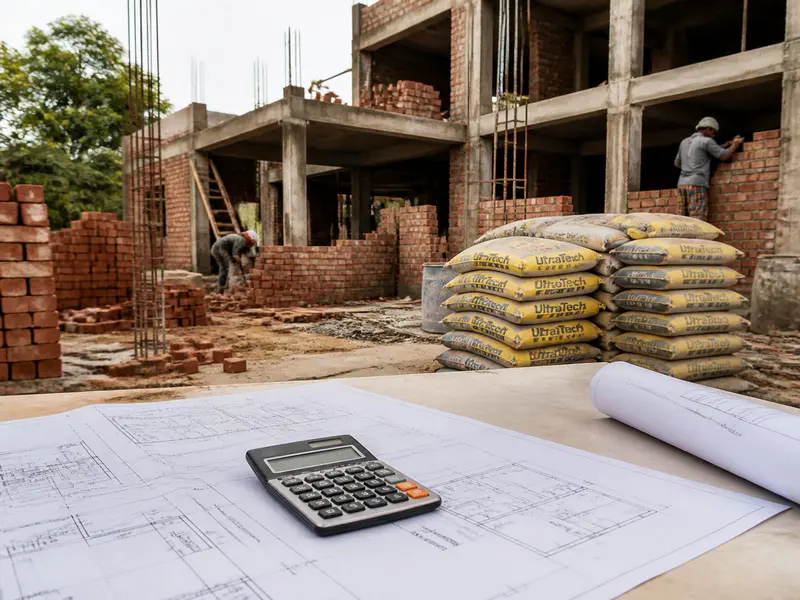
Building a home is a dream that millions of Indians work toward for decades. It is a deeply emotional journey, but financially, it can be a terrifying minefield if you enter without proper planning. In 2026, the construction sector in India is experiencing a massive boom. While infrastructure development is reaching new heights, it has also brought along a significant spike in the prices of basic raw materials like cement, structural steel rebar, river sand, and skilled labor.
For an individual house owner or a beginner civil engineer, estimating the accurate House Construction Cost in India is no longer just about multiplying a rough number by the plot area. It requires deep technical calculation, a clear understanding of material grades, and strict control over structural wastage on-site. Failing to plan your costs properly can lead to construction halts, poor material choices, or severe financial debts halfway through the project.
This comprehensive guide breaks down the house construction cost matrix for 2026. Written from decades of hands-on, on-site construction management experience, this guide eliminates heavy textbook formulas and replaces them with real-world site calculations, material metrics, and practical cost-saving tips to help you build your dream home within budget.
Factors Influencing House Construction Costs in 2026
The final price tag of a residential building depends on several highly dynamic variables. Understanding these components early allows you to balance costs without compromising structural safety.
+-------------------------------------------------------------+


|              HOUSE CONSTRUCTION COST DRIVERS                |
+-------------------------------------------------------------+


|  -- Plot Location (Metro vs. Tier-2 City Logistics)         |
|  -- Soil Condition (Shallow Footings vs. Deep Pile Foundation)|
|  -- Construction Class (C-Class, B-Class, Premium A-Class)  |
|  -- Material Grade Selection (Fe500D Steel vs. PPC Cement)  |
+-------------------------------------------------------------+
1. Geographical Location and Logistics
Building a house in metro cities like Mumbai, Bangalore, Delhi, or Hyderabad costs significantly more than building the same structure in Tier-2 or Tier-3 towns. In major metro hubs, local municipal permit fees are steep, labor union rates are highly regulated, and navigating narrow city lanes with heavy concrete transit mixers increases transportation logistics costs.
2. Ground Soil Profile and Foundation Needs
The nature of the soil on your plot directly dictates your underground construction expenses. If your plot features firm, gravelly, or rocky soil, you can use simple, inexpensive, isolated shallow foundations. However, if your land contains soft expansive clay, loose river silt, or waterlogged marsh mud, you will have to install expensive deep pile foundations or a heavily reinforced raft matrix to ensure the house doesn’t sink.
3. Classification of Construction Quality
In the Indian real estate market, construction quality is broadly classified into three categories, each carrying its own distinct price range per square foot of built-up area:
- C-Class (Budget Construction): Uses basic local bricks, low-tier tiles, local plumbing fixtures, and standard cement brands. It is suitable for simple single-story homes in rural regions.
- B-Class (Standard Construction): The most common choice for middle-class urban families. It uses high-quality fly-ash or red clay bricks, branded vitrified tiles, branded plumbing lines (like Finolex or Supreme), and premium structural cements.
- A-Class (Premium / Luxury Construction): Features high-end architectural designs, premium Italian marble or granite flooring, automated smart electrical networks, teak wood frames, and premium structural steels (like Tata Tiscon or JSW Neosteel).
Average Construction Cost Per Square Foot in India (2026 Estimates)
To help you perform initial budgeting, the table below provides the average construction cost per square foot across India in 2026. These numbers include the cost of both materials and labor combined.
| Construction Class | Average Cost Range (Per Sq. Ft. of Built-Up Area) | Common Inclusions & Specifications |
|---|---|---|
| C-Class (Budget) | INR 1,300 to INR 1,600 / sq. ft. | Local sand, local bricks, basic ceramic tiles, standard local sanitaryware. |
| B-Class (Standard) | INR 1,700 to INR 2,200 / sq. ft. | Premium TMT bars, branded PPC/OPC cement, vitrified floor tiles, concealed conduits. |
| A-Class (Luxury) | INR 2,500 to INR 4,500+ / sq. ft. | Structural glass, Italian marble, modular kitchens, home automation, premium teak wood. |
Learn how to calculate cement quantity using our Concrete Calculator Formula guide
Core Mathematical Formulas for Quick Site Estimation
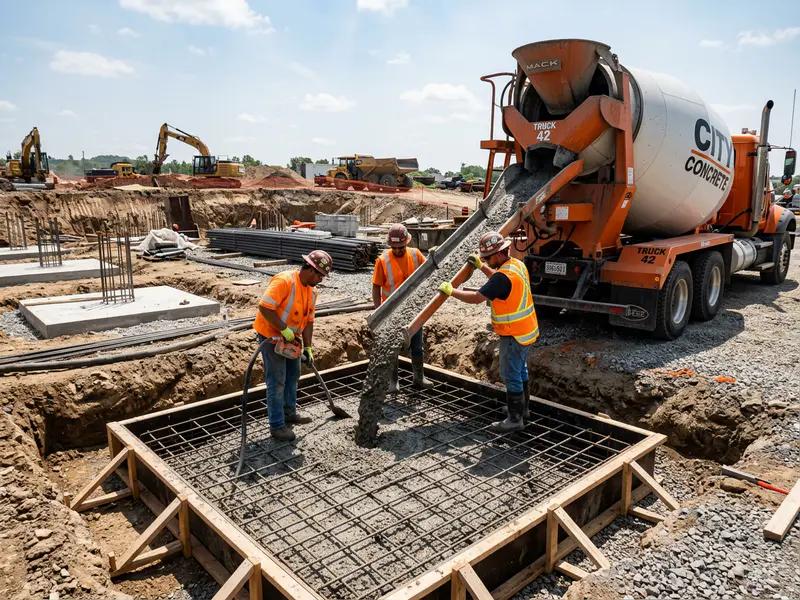
accurate volumetric calculation helps in ordering the exact amount of concrete required for foundation pads, preventing costly material wasteAs an expert builder, you must verify material quantities on paper before issuing purchase orders to retail vendors. Use these plain-text mathematical formulas to perform instant structural checks.
1. Total Built-Up Area Formula
Do not confuse plot area with built-up area. Built-up area includes the thickness of walls, balconies, utility zones, and common staircase passages across every single floor.
- Total Built-Up Area = Ground Floor Area + First Floor Area + Balcony Areas
2. The Civil Engineering 65/35 Material-Labor Split
On a typical residential project in India, the total budget splits cleanly along a predictable ratio:
- Material Procurement Cost = Total Construction Budget x 0.65
- Labor Contracting Cost = Total Construction Budget x 0.35
3. Structural Steel Weight per Metre Check
To ensure delivered steel bars have not been thinned out or under-rolled by the manufacturer, calculate the standard weight using this equation:
- Weight per Metre (kg/m) = (Diameter x Diameter) / 162
Where “Diameter” is the nominal thickness of the reinforcement bar in millimetres.
4. Concrete Volumetric Formula
To calculate the concrete mix requirements for slabs, columns, or foundations:
- Volume of Concrete (Cubic Metres) = Length x Width x Thickness
Step-by-Step Practical Estimation Examples
Let us translate these engineering principles into two concrete, real-world field examples with actual numbers to show you how budgets work on-site.
Example 1: Budget Estimation for a 1,500 Sq. Ft. B-Class G+1 Home
A client wants to build a standard B-Class double-story house with a total built-up footprint of 1,500 square feet in a suburban Indian town.
The Cost Calculation Steps:
- Select the Average Cost Factor: For standard B-Class construction in 2026, let us take an average mid-point cost of INR 1,900 per square foot.
- Calculate Total Construction Cost:
- Total Estimated Budget = 1,500 sq. ft. x INR 1,900 = INR 2,850,000 (28.5 Lakhs)
- Break Down Materials vs. Labor Costs:
- Material Component (65%) = INR 2,850,000 x 0.65 = INR 1,852,500
- Labor Component (35%) = INR 2,850,000 x 0.35 = INR 997,500
Essential On-Site Material Consumption Tally:
Based on standard consumption constants, a 1,500 sq. ft. home will typically require the following material split:
- Cement Needed (0.4 Bags per sq. ft.): 1,500 x 0.4 = 600 Bags of Cement
- Steel Needed (4 kg per sq. ft.): 1,500 x 4 = 6,000 kg (6 Metric Tons) of Steel Rebar
- Bricks Needed (25 Bricks per sq. ft.): 1,500 x 25 = 37,500 Bricks
Example 2: Concrete Volume and Costing for a Foundation Pour
Let us calculate the exact cost of concrete required to cast 15 isolated foundation footing pads for a house framework.
Design Specifications:
- Size of each footing pad = 1.5 metres length x 1.5 metres width x 0.4 metres thickness.
- Total number of footings = 15
- Market rate of Ready-Mix Concrete (RMC) with pump delivery in 2026 = INR 5,500 per Cubic Metre.
The Step-by-Step Calculation:
- Calculate Volume of a Single Footing Pad:
- Volume = 1.5 x 1.5 x 0.4 = 0.9 Cubic Metres
- Calculate Total Volumetric Need for 15 Pads:
- Total Net Volume = 0.9 x 15 = 13.5 Cubic Metres
- Add 3% Concrete Safety Wastage Margin:
- Gross Concrete Order = 13.5 x 1.03 = 13.905 Cubic Metres
- Calculate Material Procurement Cost:
- Total Material Cost = 13.905 Cubic Metres x INR 5,500 = INR 76,477.50
Crucial Metrics and Commercial Conversions for Site Managers
Indian raw material suppliers frequently switch back and forth between traditional trade scales and official metric units. Use this conversion chart to handle procurement orders smoothly on-site.
| Unit from Blueprint Drawings | Commercial Market Supply Unit | Conversion Multiplication Factor | On-Site Use Case Example |
|---|---|---|---|
| Cubic Metres (m3) | Cubic Feet (CFT) | Multiply by 35.314 | Verifying loose sand or aggregate truck volumes |
| Cubic Metres (m3) | Brass | Multiply by 0.353 | Paying excavation and stone masonry laborers |
| Kilograms (kg) | Metric Tons (MT) | Multiply by 0.001 | Wholesale structural steel billing checks |
| Kilograms (kg) | Quintals | Multiply by 0.010 | Buying reinforcement steel from retail distributors |
| Metres (m) | Feet (ft) | Multiply by 3.280 | Checking room internal wall lengths with a tape measure |
| Inches (in) | Millimetres (mm) | Multiply by 25.400 | Checking rebar diameters with a vernier caliper |
Site Quality Controls and Material Wastage Minimization
Managing paper budgets is straightforward, but physical construction sites introduce real-world variables. To keep your project running within budget, you must enforce strict site quality control measures.
1. The Core Rebar Inspection Check
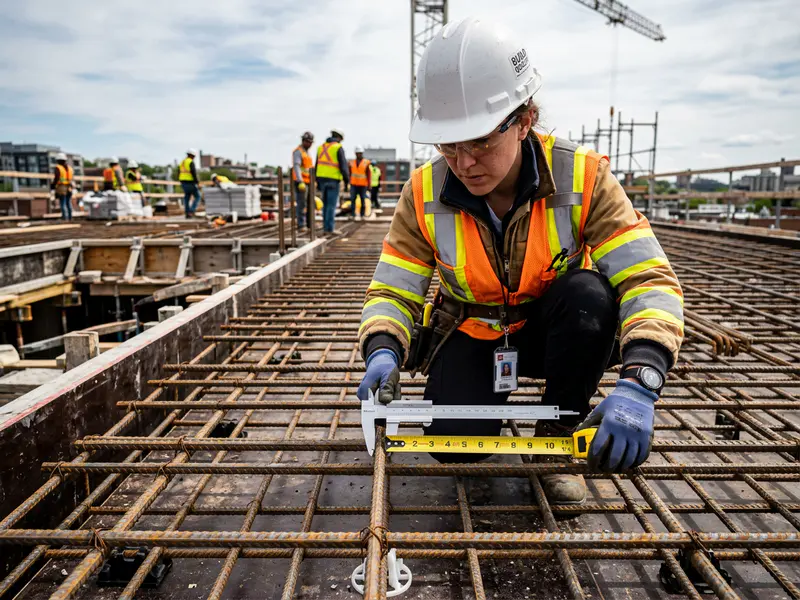
Before authorizing any concrete pour for slabs or beams, the site supervisor must run a quality inspection of rebar diameter and spacing before authorizing the concrete pour.
- The Check: Use a vernier caliper to confirm that the installed bar thicknesses match the structural engineer’s designs. Contractors often try to widen bar spacing by 20mm to 30mm across large slabs to save on steel. This practice leaves the structure weak and prone to micro-cracking under load.
- Action: Ensure that all spacing variations remain within a tight plus or minus 10mm tolerance window before signing the pour card.
2. Structural Overlaps (Lapping Lengths)
Standard rebar bundles are manufactured to a maximum length of 12 metres (40 feet). If your slab or beam span is longer, you must lap two bars side by side.
- The Tension Lap Rule: Always enforce a minimum lap length of 50 times the diameter of the bar (50D).
- Application: If you are splicing a 12mm rebar, the overlap length must be at least 50 x 12mm = 600mm (0.6 metres). Factor this extra material requirement into your steel order estimations to avoid sudden shortages.
3. Concrete Cover Block Discipline
Never let contractors place steel mats directly against raw timber shuttering boards or excavation dirt.
- The Spacer Fix: Tie pre-cast concrete spacer blocks underneath the rebar meshes at 1-metre grid intervals.
- Cover Dimensions: Slabs require a 20mm clear cover; beams require 25mm to 40mm; columns require 40mm; and foundations buried in raw soil require a minimum 50mm thick concrete cover layer to protect the steel from underground moisture and rusting.
+-------------------------------------------------------------+


|               PRE-POUR REBAR SITE CHECKLIST                 |
+-------------------------------------------------------------+


|  [ ] Caliper Check: Verify actual rebar bundle diameters.    |
|  [ ] Tape Measurement: Check bar spacing against structural prints.|
|  [ ] Spacer Integration: Verify 50mm clear cover blocks in footings. |
|  [ ] Splice Verification: Check that lapping equals 50D length.      |
+-------------------------------------------------------------+
Practical Cost-Saving Strategies Without Compromising Safety
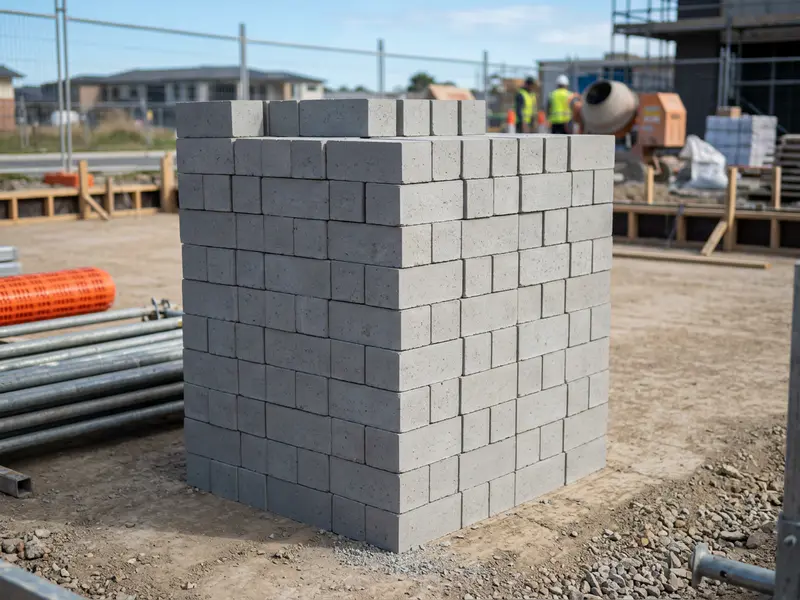
You do not have to reduce the quality of your building components to save money. Instead, focus on minimizing waste and optimizing your construction schedule.
- Avoid Altering Floor Layouts Mid-Way: Changing wall layouts or moving bathroom pipe channels after the brickwork or slabs are already cast creates massive structural demolition waste and doubles your labor expenses. Finalize your 3D models before starting excavation.
- Purchase Core Raw Materials Directly: Avoid letting your local labor contractors buy your cement and steel. They often add hidden markup commissions. Purchase your materials in bulk directly from wholesale authorized distributors to secure deep trade discounts.
- Opt for Fly-Ash Bricks Over Red Clay Bricks: Fly-ash bricks are manufactured using industrial by-products, making them eco-friendly and highly cost-effective. Because they are molded uniformly in factories, they feature perfectly sharp edges. This clean shape reduces the amount of expensive cement plaster mortar needed to smooth out your walls later.
If you are planning construction, read our complete guide on Civil Engineering Career and Salary in India
Frequently Asked Questions (FAQs)
1. What is the average house construction cost in India for a 2,000 sq. ft. home in 2026?
For a standard B-Class double-story home built at an average rate of INR 1,900 per square foot, the total construction cost will range between INR 38 Lakhs to INR 42 Lakhs. This estimate includes structural frameworks, basic interior plumbing, electrical rough-ins, flooring, and basic exterior painting. It excludes premium interior woodwork, custom modular kitchens, and land acquisition costs.
2. Why is the quality inspection of rebar diameter and spacing before authorizing the concrete pour considered a critical step?
Because once wet concrete is poured into the formwork, the internal steel reinforcement skeleton is permanently hidden away. If a contractor used thinner rebar or widened the spacing to cut costs, it becomes impossible to see or fix the mistake without expensive structural demolition. Conducting a strict check with a tape measure and caliper before the pour is your final gateway to ensuring structural safety.
3. What is the difference between a material-rate contract and a lump-sum labor contract?
In a material-rate contract, you hand over the entire building responsibility to a contractor who buys all materials and provides labor, charging you a fixed price per square foot. In a lump-sum labor contract, you purchase all the cement, steel, bricks, and sand yourself, paying the contractor a smaller fixed fee per square foot purely to manage their masonry and carpentry labor crews.
4. How much extra budget should I allocate for foundation works if my plot contains soft black cotton soil?
Soft expansive clay soils like black cotton soil expand when wet and shrink during dry summers, which can easily crack standard shallow foundations. To prevent this issue, you must bypass the soft soil using deep pile foundations or a heavy raft slab framework. This adjustment can add an extra INR 1.5 Lakhs to INR 3.5 Lakhs to your initial substructure budget.
5. What are the typical hidden costs that catch house owners by surprise during construction?
The most common hidden expenses include municipal building plan approval fees, temporary electricity and water connection deposits, borehole drilling and water pump installations, structural soil testing lab fees, boundary wall construction, and premium architectural consultation taxes. Always set aside an extra 10% financial cushion to handle these unexpected expenses.
Construction practices in India are generally based on guidelines from the National Building Code (NBC) and standards issued by the Bureau of Indian Standards (BIS).
Conclusion
Accurately calculating your House Construction Cost in India requires balancing structural design demands with real-world material management. By understanding cost-per-square-foot classifications, verifying material volumes on paper, and enforcing strict site quality controls, you can eliminate expensive mistakes and keep your project running smoothly within budget.
Prioritize a comprehensive quality check of your reinforcement frameworks, protect your structural steel with proper cover blocks, and handle material orders via clear unit conversions. These practical habits ensure your home stays safe, structurally sound, and financially viable for years to come.

Shakeel T is a qualified Civil Engineer and Structural Consultant with extensive on-site experience in residential and commercial building construction. Specializing in material estimation, cost budgeting, and structural safety guidelines, he has successfully managed multiple real estate projects from foundation to finishing. Through this blog, Shakeel shares field-tested civil engineering thumb rules, IS Code practices, and practical site tips to help home builders execute their projects efficiently and within budget.
Education: Diploma in Civil Engineering
Expertise: Quantity Surveying, Material Estimation, Structural Design, and Site Management.