
Introduction
The success of any construction project relies heavily on the bridge between theoretical blueprints and physical reality. That bridge is the Site Engineer. A site engineer is the backbone of a construction project, ensuring that designs are executed accurately, safely, and within budget constraints. Whether it is a high-rise commercial building, a sprawling residential complex, or critical infrastructure like bridges and highways, the site engineer oversees daily operations with technical precision.

For civil engineering graduates, stepping onto a construction site for the first time can be overwhelming. The transition from classroom theories to on-site execution requires a deep understanding of project management, material science, quality standards, and manpower coordination.
This comprehensive guide breaks down the essential roles, daily responsibilities, technical calculations, and quality check systems that every successful site engineer must master.
Core Roles and Responsibilities of a Site Engineer
The duties of a site engineer shift constantly throughout the day, requiring quick problem-solving and excellent communication skills. Their primary responsibilities can be divided into five core areas:

Site Layout and Setting Out
Before any excavation begins, the site engineer must establish accurate reference points. Using advanced surveying instruments like Total Stations, Auto Levels, and digital theodolites, they transfer the dimensions from the structural drawings onto the actual ground. This process, known as setting out, ensures the building footprint aligns perfectly with legal boundaries and architectural plans.
Daily Supervision and Progress Tracking
A site engineer monitors everyday activities on-site to ensure work progresses according to the project schedule. They assign tasks to sub-contractors, supervisors, and labor crews. At the end of every shift, they compile a Daily Progress Report (DPR) that tracks material consumption, labor turnout, and completed workloads.
Quality Control and Inspection (QA/QC)
A site engineer must ensure that all structural elements meet the specified engineering standards. They check reinforcement steel placing, formwork stability, and concrete mix proportions. They are responsible for executing mandatory field tests and collecting samples for lab testing before any major structural pour.
Material Management and Inventory Control
Delays often occur due to material shortages or poor storage conditions. The site engineer calculates material requirements in advance, raises purchase requisitions, checks the quality of incoming materials, and monitors wastage limits.
Health and Safety Compliance
Construction sites are inherently hazardous. The site engineer enforces the company’s health, safety, and environment (HSE) policies. They ensure all workers wear proper Personal Protective Equipment (PPE), clear potential tripping hazards, and maintain safe scaffolding installations.
Essential Mathematical Formulas for Site Engineers
A site engineer must perform quick, accurate mental math and manual calculations on the field. Below are the standard plain-text engineering formulas used daily for material estimates:
Concrete Volume Calculation
- Total Wet Volume = Length x Width x Thickness
- Dry Volume of Concrete = Wet Volume x 1.54
(Note: 1.54 is the multiplication factor used because dry concrete ingredients shrink by roughly 54% when water is added.)
Mortar Volume for Brickwork
- Dry Volume of Mortar = Wet Volume of Mortar x 1.33
Unit Weight of Steel Bars
- Weight of Steel per Meter = (D x D) / 162
(Where D is the diameter of the steel bar in millimeters. The resulting unit weight is in kilograms per meter.)
Shuttering Area Calculation
- Shuttering Area = Perimeter x Height (or Contact Area of concrete with the formwork)
Practical Step-by-Step Material Estimation Examples
To understand how these formulas apply to real-world scenarios, let us look at three practical site calculations with concrete numbers.
Example 1: Concrete Material Estimation for a Slab
Suppose you need to cast a concrete slab with the following dimensions:
- Length = 10 meters
- Width = 5 meters
- Thickness = 0.15 meters (150 mm)
- Concrete Mix Ratio = M20 (1 : 1.5 : 3 — 1 part Cement, 1.5 parts Sand, 3 parts Aggregate)
Step-by-Step Calculation:
- Calculate Wet Volume:
Wet Volume = 10 x 5 x 0.15 = 7.5 Cubic Meters (m3) - Calculate Dry Volume:
Dry Volume = 7.5 x 1.54 = 11.55 Cubic Meters - Sum of Ratio Ingredients:
Sum = 1 + 1.5 + 3 = 5.5 - Calculate Volume of Cement Required:
Volume of Cement = (1 / 5.5) x 11.55 = 2.1 Cubic Meters
Since 1 bag of cement equals 0.035 Cubic Meters:
Number of Cement Bags = 2.1 / 0.035 = 60 Bags - Calculate Volume of Sand Required:
Volume of Sand = (1.5 / 5.5) x 11.55 = 3.15 Cubic Meters - Calculate Volume of Coarse Aggregate Required:
Volume of Aggregate = (3 / 5.5) x 11.55 = 6.30 Cubic Meters
Example 2: Weight Calculation of Steel Reinforcement
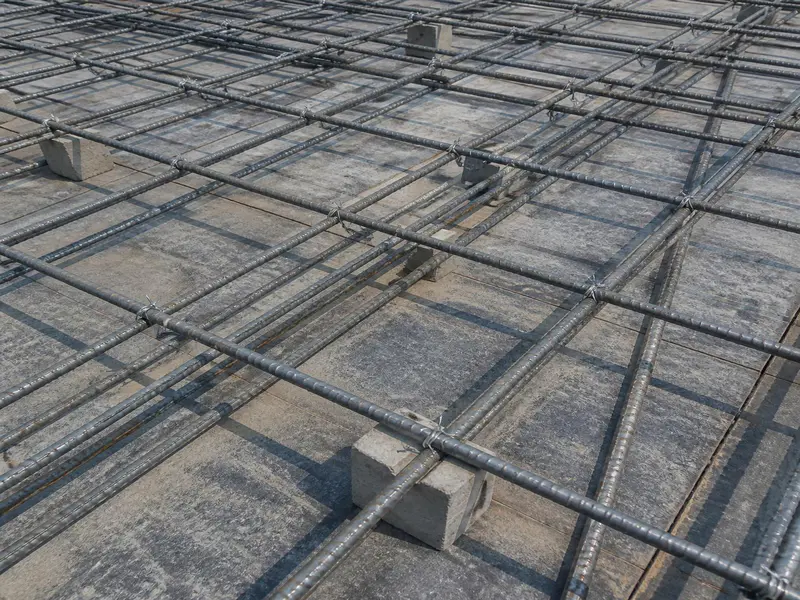
You are checking a reinforcement beam layout and notice it requires 15 steel bars of 16mm diameter, each measuring 12 meters in length. You need to verify the total weight for the inventory logs.
Step-by-Step Calculation:
- Find Unit Weight of 16mm Bar:
Unit Weight = (16 x 16) / 162 = 256 / 162 = 1.580 kg/meter - Calculate Total Length of Steel Needed:
Total Length = 15 bars x 12 meters = 180 meters - Calculate Total Weight:
Total Weight = 180 meters x 1.580 kg/meter = 284.4 kg (or 0.284 Metric Tons)
Example 3: Brick and Mortar Calculation for a Wall
Estimate the number of standard bricks and mortar needed for a brick wall with these dimensions:
- Length = 5 meters
- Height = 3 meters
- Thickness = 0.23 meters (230 mm wall)
- Standard Modular Brick Size = 0.19m x 0.09m x 0.09m
- Brick Size with Mortar (10mm thick joint) = 0.20m x 0.10m x 0.10m
Step-by-Step Calculation:
- Calculate Total Volume of the Wall:
Wall Volume = 5 x 3 x 0.23 = 3.45 Cubic Meters - Calculate Volume of One Brick with Mortar:
Volume = 0.20 x 0.10 x 0.10 = 0.002 Cubic Meters - Calculate Number of Bricks Required:
Number of Bricks = 3.45 / 0.002 = 1,725 Bricks
(Add 5% wastage: 1,725 x 1.05 = 1,811 Bricks) - Calculate Volume of Bricks Without Mortar:
Actual Volume of 1,725 Bricks = 1,725 x (0.19 x 0.09 x 0.09) = 1,725 x 0.001539 = 2.655 Cubic Meters - Calculate Wet Volume of Mortar:
Wet Mortar Volume = Total Wall Volume – Actual Brick Volume
Wet Mortar Volume = 3.45 – 2.655 = 0.795 Cubic Meters
(Apply the 1.33 dry factor to find dry material needs: 0.795 x 1.33 = 1.057 Cubic Meters of dry mortar mix)
Site engineers also help estimate project costs using methods similar to construction cost per sq ft in India calculations.
Key Unit Conversions Every Site Engineer Must Know
Materials arrive on site in various commercial units depending on local supply standards. A site engineer must seamlessly convert between these units to check invoices and cross-verify structural drawings.
Conversion Factors Reference Table
| From Unit | To Unit | Multiplication Factor | Example Application |
|---|---|---|---|
| Cubic Meters (m3) | Cubic Feet (CFT) | 35.3147 | Converting bulk sand or aggregate volume |
| Cubic Meters (m3) | Brass | 0.3531 | Local metric measuring for earthwork and stone |
| Brass | Cubic Feet (CFT) | 100.00 | Standard truckload billing conversions |
| Kilograms (kg) | Quintals | 0.0100 | Checking structural steel bundles |
| Kilograms (kg) | Metric Tons (MT) | 0.0010 | Processing bulk reinforcing steel invoices |
| Square Meters (m2) | Square Feet (sq ft) | 10.7639 | Measuring plastering, flooring, or painting areas |
| Millimeters (mm) | Inches | 0.0393 | Reading mixed metric/imperial structural plans |
Site Quality Controls, Checklists, and Testing
A structural drawing is only as good as its execution. Site engineers must implement strict quality control procedures before, during, and after structural processes.
On-Site Concrete Quality Checklist
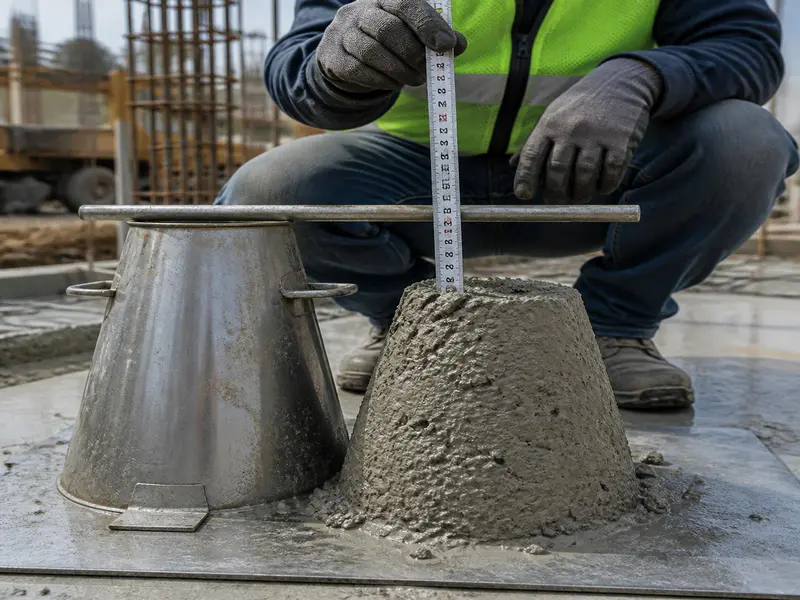
- The Slump Test: Conducted for every incoming transit mixer to measure concrete workability and water-cement consistency. For regular slabs and beams, a slump value between 75mm to 125mm is typically expected.
- Cube Sampling: Collect a minimum of 6 concrete cubes (150mm x 150mm x 150mm) for every 50 cubic meters of concrete poured. Test 3 cubes at 7 days (expected strength around 67%) and 3 cubes at 28 days (expected 100% characteristic strength).
- Cover Blocks: Ensure concrete cover blocks are placed beneath and alongside reinforcement bars before pouring. (e.g., 20mm for slabs, 25mm for beams, 40mm for columns, and 50mm for footings) to protect steel from corrosion.
Rebar and Formwork Inspections
- Check that the steel bar diameter matches the structural schedule precisely.
- Confirm lap lengths match structural requirements (typically 40D to 50D, where D is the bar diameter).
- Ensure formwork is sealed with foam tape or putty at joints to prevent slurry leakage during compaction.
- Verify vertical alignment (plumbness) of columns using a plumb-bob or optical laser level.
Managing Material Wastage Factors
Material costs account for over 60% of a construction project’s total budget. A site engineer must monitor and minimize material waste on site. The standard allowable wastage limits used during planning include:
- Structural Steel: 3% to 5% (mainly from cutting scrap bars)
- Cement Concrete: 2% to 3% (due to transport spillage and handling)
- Bricks/Blocks: 5% (due to breakage during unloading and cutting)
- Sand and Aggregates: 4% to 5% (due to moisture absorption and site storage losses)
Real-World Professional Site Tips
- Maintain a Detailed Site Diary: Document every unexpected event, including weather delays, sudden material shortages, or conflicting dimensions on architectural drawings. This written log serves as vital documentation if contractual disputes arise later.
- Check Dimensions in Reverse: When setting out structures, never measure from just one single reference baseline. Check distances from two opposing boundaries to verify accuracy and catch errors before excavation.
- Watch the Water-Cement Ratio: Workers often add extra water to concrete mixes to make it easier to pour and spread. Guard against this practice, as adding unapproved water dilutes the paste and drastically reduces the final strength of the concrete structure.
Frequently Asked Questions (FAQs)
What is the difference between a Site Engineer and a Project Manager?
A Site Engineer focuses on daily technical execution, layout accuracy, and immediate quality checks on the field. A Project Manager operates at a higher level, handling budget forecasting, contractual agreements, high-level scheduling, and client management.
Why is the dry volume of concrete taken as 1.54 times the wet volume?
When concrete ingredients (cement, sand, and stone aggregates) are dry, they contain voids or microscopic air pockets between the individual particles. When water is added, these particles dissolve and settle together into a denser state. This volume reduction requires multiplying the desired wet volume by a factor of 1.54 to find the correct dry material quantities.
How much lap length is typically provided in reinforcement steel?
Lap length depends heavily on whether a bar is under tension or compression forces. Generally, for beams and slabs, a standard lap length ranges between 40D to 50D (where D represents the diameter of the bar). Always consult the structural notes provided by the structural engineer before approving installations.
What is a Clear Cover, and why is it crucial in RCC structures?
Clear cover is the distance between the outermost surface of the concrete and the outer edge of the embedded steel reinforcement bar. It protects the structural steel from moisture and air exposure, preventing oxidation, rust expansion, and concrete spalling.
What immediate action should a site engineer take if a concrete cube test fails?
If 28-day cube tests fall below required strengths, notify the project manager and structural consultant immediately. The site team will typically order non-destructive testing (NDT), such as a Rebound Hammer test or Ultrasonic Pulse Velocity (UPV) test, or extract core samples from the actual structure to confirm structural safety before deciding on remedial steps.
Read also: Rebar & Steel Engineering Guidelines
Conclusion
The role of a site engineer requires balancing technical skill, clear communication, and constant vigilance. By mastering structural layouts, maintaining accurate material calculations, enforcing safety rules, and following quality checklists, you ensure your project stays structurally sound and on schedule. Continuous learning and attention to detail on the field are what turn a beginning supervisor into a seasoned construction specialist.

Shakeel T is a qualified Civil Engineer and Structural Consultant with extensive on-site experience in residential and commercial building construction. Specializing in material estimation, cost budgeting, and structural safety guidelines, he has successfully managed multiple real estate projects from foundation to finishing. Through this blog, Shakeel shares field-tested civil engineering thumb rules, IS Code practices, and practical site tips to help home builders execute their projects efficiently and within budget.
Education: Diploma in Civil Engineering
Expertise: Quantity Surveying, Material Estimation, Structural Design, and Site Management.