
Introduction
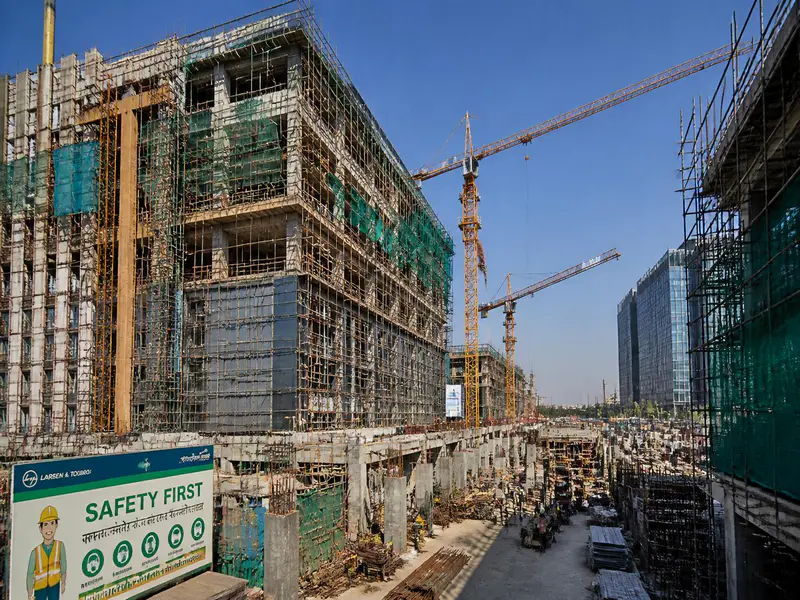
A construction site is a dynamic, high-risk environment where massive structural loads, heavy machinery, and human labor intersect daily. At the center of this complex ecosystem is the site engineer. While engineers are trained to focus on productivity, timelines, and material optimization, their primary structural responsibility is safety.
A single oversight, an unverified calculation, or a ignored safety check by an engineer can trigger catastrophic structural failures, leading to fatal site accidents. Navigating these hazards requires understanding how structural calculations directly connect to on-site safety.
This comprehensive guide breaks down critical Site Engineer Mistakes in Construction, complete with real-world engineering formulas, step-by-step load calculations, and site quality control frameworks to prevent structural and human accidents.

Industrial Safety Helmet for Construction Work
A safety helmet is an important personal protective equipment (PPE) for construction sites and other work areas where head protection is required.
Check Price on AmazonDisclosure: This is an affiliate link. If you purchase through this link, CivilGuide.in may earn a small commission at no additional cost to you.
Core Mathematical Formulas for Structural Safety & Site Load Verification
Many site accidents occur because engineers treat temporary structures, such as scaffolding, formwork shuttering, and excavation shoring, as non-structural elements. They calculate loads improperly, leading to structural collapses. Below are the essential, plain-text engineering formulas that every site engineer must calculate and verify before executing high-risk activities.
Shuttering Formwork Load Verification
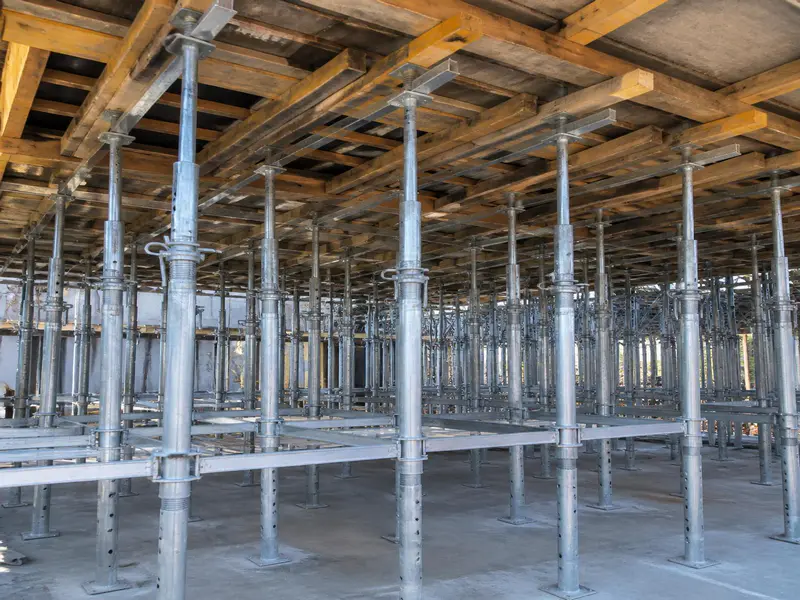
When pouring a concrete slab, the temporary scaffolding props must support the dead load of wet concrete, steel reinforcement, and the live load of construction workers and machinery.
- Total Load on Formwork = Dead Load of Concrete + Reinforcement Load + Construction Live Load
- Dead Load of Concrete = Volume of Concrete x Density of Reinforced Cement Concrete (RCC)
- Standard Density of RCC = 2500 kg per Cubic Meter (or 25 kN per cubic meter)
- Construction Live Load (Standard baseline for safety) = 250 kg per Square Meter (or 2.5 kN per square meter)
Soil Lateral Earth Pressure for Excavation Trenching
When digging deep trenches for foundations or basements, the surrounding soil exerts lateral pressure against the trench walls. If an engineer fails to design shoring for this pressure, a sudden cave-in occurs.
- Active Earth Pressure (Pa) = 0.5 x Ka x Density of Soil x (Height of Trench x Height of Trench)
- Coefficient of Active Earth Pressure (Ka) = (1 – sin(Angle of Internal Friction)) / (1 + sin(Angle of Internal Friction))
- Standard Dry Soil Density = 1800 kg per Cubic Meter (or 18 kN per cubic meter)
Hook Load Safety Factor for Tower Cranes
Overloading a crane or rigging assembly causes snapping accidents.
- Safe Working Load (SWL) = Ultimate Tensile Strength / Factor of Safety
- Factor of Safety (FOS) for Rigging/Lifting Components = Minimum 5.0
Understanding the roles and responsibilities of a site engineer is important for construction safety.
Essential Unit Conversions for Safety Calculations
Misinterpreting units between structural design offices and field execution teams can lead to disastrous errors. A site engineer must easily convert structural stress, force, and weight units across different metrics.
| From (Design Code Unit) | To (On-Site/Market Unit) | Conversion Multiplier | Practical Safety Application |
|---|---|---|---|
| Newton per Square Millimeter (N/mm2 or MPa) | Kilogram per Square Centimeter (kg/cm2) | Multiply by 10.197 | Verifying concrete cube compressive strength limits |
| KiloNewton (kN) | Kilogram (kg) | Multiply by 101.971 | Checking the capacity of props, jacks, and crane winches |
| Metric Ton (MT) | Kilograms (kg) | Multiply by 1000 | Total load checking of structural steel frameworks |
| Cubic Meter (cum) | Cubic Feet (CFT) | Multiply by 35.314 | Calculating the total weight of wet concrete volume per pour |
| Meter (m) | Feet (ft) | Multiply by 3.281 | Checking safe fallback distances and trench deep bounds |
| KiloNewton per Square Meter (kN/m2) | Pounds per Square Foot (psf) | Multiply by 20.885 | Evaluating temporary scaffolding plank load limits |
Step-by-Step Practical Load Calculation Examples
Let us analyze two real-world scenarios where precise engineering calculations prevent catastrophic on-site accidents.
Example A: Preventing Slab Formwork Collapse
A site engineer is preparing to cast a commercial roof slab with an area of 12 meters by 10 meters and a thickness of 200mm (0.20 meters). The temporary MS scaffolding props are spaced such that each individual prop supports a tributary area of 1.2 square meters. Each prop has a verified safe load-carrying capacity of 2500 kg (24.5 kN). Calculate the actual load per prop to verify if the setup is safe against collapsing.
Step 1: Calculate the total wet concrete volume.
- Volume = Length x Width x Thickness
- Volume = 12m x 10m x 0.20m = 24 Cubic Meters (cum)
Step 2: Calculate the dead load of the wet RCC slab.
- Total Dead Load = Volume x RCC Density
- Total Dead Load = 24 cum x 2500 kg/cum = 60,000 kg
Step 3: Calculate the design construction live load across the slab area.
- Total Area = 12m x 10m = 120 Square Meters
- Total Live Load = Area x Standard Live Load Baseline
- Total Live Load = 120 sqm x 250 kg/sqm = 30,000 kg
Step 4: Compute the total combined load on the formwork structure.
- Total Structural Load = Dead Load + Live Load
- Total Structural Load = 60,000 kg + 30,000 kg = 90,000 kg
Step 5: Calculate the actual load exerted on a single prop based on its tributary area.
- Load per Square Meter = Total Combined Load / Total Area
- Load per Square Meter = 90,000 kg / 120 sqm = 750 kg/sqm
- Actual Load on One Prop = Load per Square Meter x Prop Tributary Area
- Actual Load on One Prop = 750 kg/sqm x 1.2 sqm = 900 kg
Step 6: Evaluate the safety margin.
- 900 kg (Actual Load) is significantly less than 2500 kg (Safe Capacity).
- Conclusion: The scaffolding setup is structurally safe. If the engineer had incorrectly spaced the props at 4-meter tributary intervals, the load per prop would spike to 3000 kg, causing a sudden, catastrophic slab collapse during concrete placement.
Example B: Trench Excavation Shoring Check
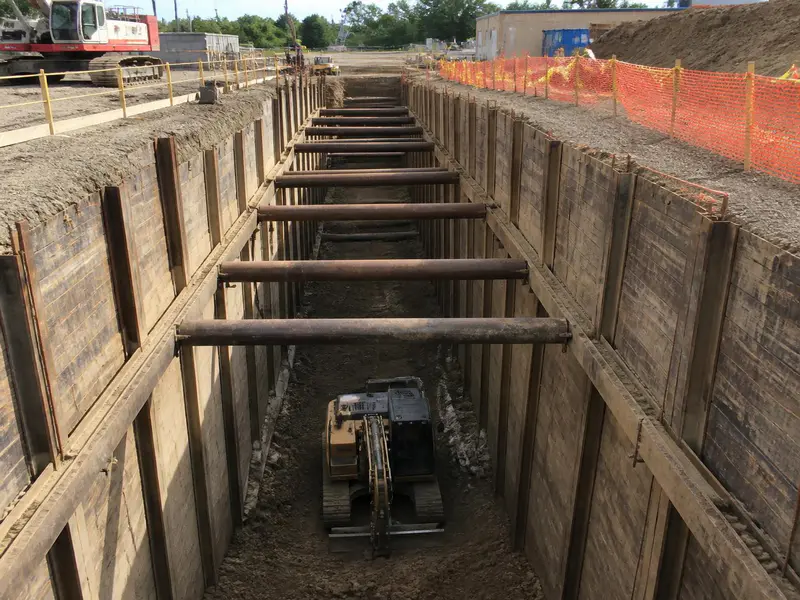
An engineer must oversee the excavation of a deep foundation trench that is 4 meters deep in a loose, sandy soil zone. The soil has an angle of internal friction of 30 degrees and a density of 1800 kg per cubic meter. Calculate the active earth pressure per meter length of the trench to determine the required strength of the protective shoring walls.
Step 1: Compute the Coefficient of Active Earth Pressure (Ka).
- Ka = (1 – sin(30)) / (1 + sin(30))
- Since sin(30) = 0.5:
- Ka = (1 – 0.5) / (1 + 0.5) = 0.5 / 1.5 = 0.333
Step 2: Calculate the maximum active lateral earth pressure (Pa) at the base of the 4-meter trench.
- Pa = 0.5 x Ka x Density x (Height x Height)
- Pa = 0.5 x 0.333 x 1800 kg/cum x (4m x 4m)
- Pa = 0.1665 x 1800 x 16
- Pa = 299.7 x 16 = 4795.2 kg per meter length of the trench wall.
Safety Application: A pressure of nearly 4.8 tons per meter length will instantly crush or suffocate workers if the trench collapses. The site engineer must use this calculation to select steel sheet piles or robust timber shoring that can withstand a minimum lateral force of 4800 kg/m. Skipping shoring in a 4-meter deep sandy trench is a critical mistake that frequently causes fatal cave-ins.
Proper knowledge of building materials used in construction is important for site engineers.
Top 5 Fatal Site Engineer Mistakes and Prevention Methods
Understanding where engineers fail on-site allows project teams to deploy targeted quality controls and engineering precautions.
1. Stripping Formwork and Shuttering Too Early
- The Mistake: Driven by aggressive schedule targets, engineers often order the removal of under-slab props before the concrete achieves its design structural strength.
- The Danger: The immature concrete cannot support its own dead load, resulting in sudden deflections, micro-cracking, or total structural failure.
- On-Site Testing & Precaution: Never remove formwork based on guesswork. Always check lab test results for concrete cubes cast alongside the structural component. Ensure the concrete meets the minimum stripping strengths outlined in regional building codes (e.g., 70% of target characteristic strength for spans under 4.5 meters).
2. Ignoring Soil Conditions and Surcharge Loads Near Open Excavations
- The Mistake: Stacking heavy materials, such as excavated earth, clay bricks, or TMT steel bundles, directly along the edge of an open, un-shored excavation zone. Operating heavy machinery, like excavators or concrete transit mixers, right next to the trench edge.
- The Danger: The weight of these items creates a massive surcharge load that exceeds the soil’s lateral capacity, triggering a sudden slope failure and burying workers inside the trench.
- On-Site Testing & Precaution: Maintain a strict “Surcharge Free Zone” extending at least 1.5 meters away from the top edge of any excavation. Implement daily visual checks for tension cracks along the crest of the slope.
3. Inadequate Verification of Scaffolding Sole Plates and Bracing
- The Mistake: Erecting multi-tier scaffolding towers directly on loose, uncompacted earth or soft mud without utilizing solid wooden sole plates. Failing to connect longitudinal and cross diagonal couplers (cross bracing).
- The Danger: When concrete or workers load the scaffolding, individual steel legs sink unevenly into the soft mud. This differential settlement causes the entire scaffolding matrix to buckle and collapse.
- On-Site Testing & Precaution: Scaffolding legs must rest on structural steel base plates placed on top of thick, solid wooden sole boards. Perform a mandatory plumb-line vertical alignment check on every tier of scaffolding.
4. Overlooking Lap Length Alignment and Cover Block Placement
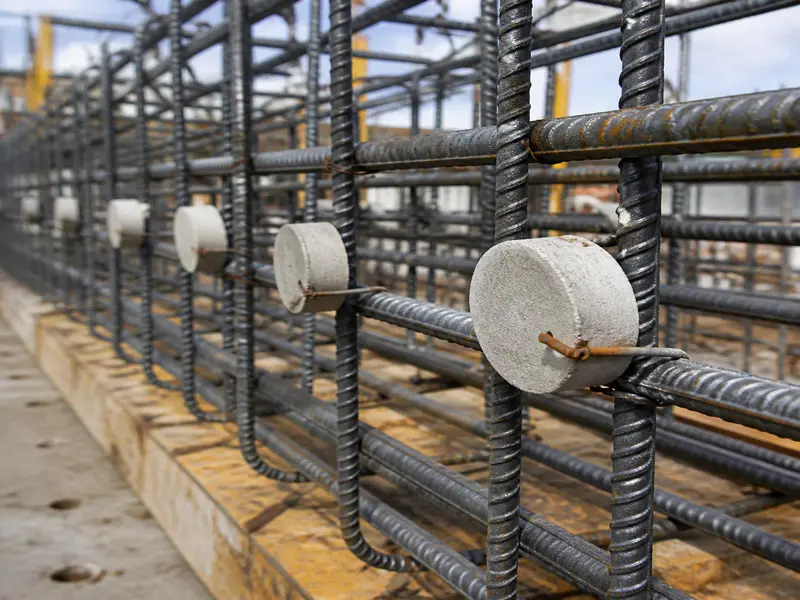
- The Mistake: Allowing steel fixers to lap all structural column reinforcement bars at the exact same horizontal level, or neglecting to place concrete cover blocks before casting.
- The Danger: Lapping bars at a single location creates a weak plane susceptible to buckling under seismic or wind loads. Omitting cover blocks causes the steel to shift against the shuttering face, exposing it to air and moisture. This leads to rust, concrete spalling, and long-term structural collapse.
- On-Site Testing & Precaution: Stagger reinforcement bar lap joints systematically so that no more than 50% of bars lap at any single cross-section. Use precast concrete spacer blocks with a compression strength that matches the overall concrete mix.
5. Blind Reliance on Visual Material Approvals Without Lab Verification
- The Mistake: Approving structural concrete pours or structural steel tie-ins based on visual appearance alone, without performing mandatory field quality checks.
- The Danger: Substandard cement batches or high-silt sand can compromise concrete strength by more than 40%, creating weak elements that can fail under full design loads.
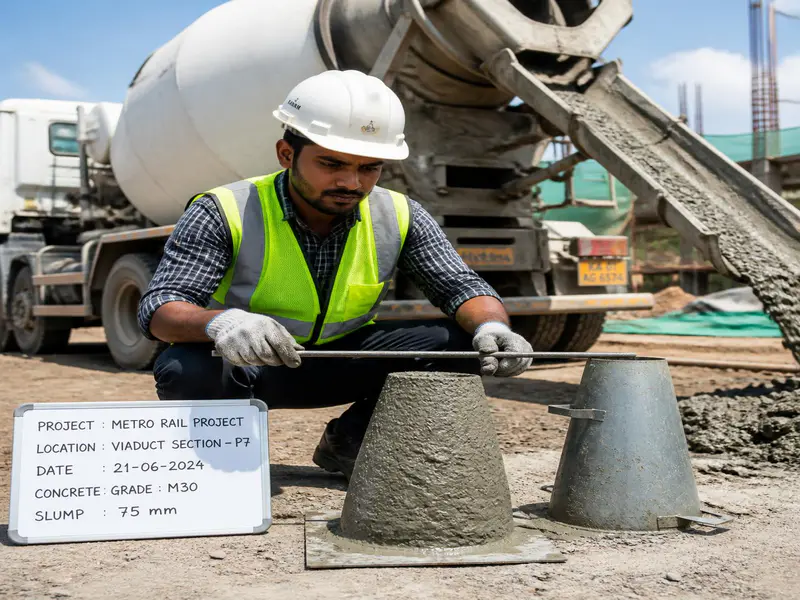
- On-Site Testing & Precaution: Enforce strict field testing protocols for every batch of incoming material, including slump testing for workability and cube casting for compression testing.
Comprehensive Site Quality Control and Permissible Safety Factors
Maintaining a safe construction site requires keeping variances within strict tolerances. The table below outlines critical safety benchmarks, permissible limits, and the exact reasons why errors lead to accidents.
| Execution Element | Critical Safety Quality Check | Permissible Field Tolerance | On-Site Accident Reason if Limit is Violated |
|---|---|---|---|
| Scaffolding Columns | Verticality plumb check using a standard magnetic spirit level or plumb bob. | Maximum 3mm deviation per 1 meter of height | Eccentric vertical loading occurs, leading to scaffolding buckling. |
| Structural Concrete Cover | Measuring distance from the outer formwork face to the internal steel rebar matrix. | Minus 0mm to Plus 5mm variance | Exposed steel corrodes, causing concrete spalling and structural failure. |
| Foundation Excavation | Visual inspection for ground tension cracks and water seepage at the base. | Zero cracks permitted within a 1.5m perimeter radius | Unchecked cracks indicate imminent slope failure or trench cave-ins. |
| Crane Rigging Wire Slings | Physical inspection for broken wire strands, deformation, or surface corrosion. | Zero broken strands allowed in any single strand lay | Wire ropes snap suddenly under load, dropping materials on workers below. |
| Concrete Core Slump | Performing an on-site slump cone test for every incoming concrete transit mixer batch. | Plus or Minus 25mm from design mix design target | High slump indicates excessive water, reducing concrete strength. |
Comprehensive Frequently Asked Questions (FAQs)
Q1. What is the leading cause of scaffolding failures supervised by site engineers?
The leading cause is the lack of proper base support and missing diagonal cross-bracing. Engineers often allow workers to assemble steel scaffolding pipes directly on uncompacted dirt or soft soil without utilizing thick wooden sole plates or base plates. This lack of support causes individual scaffolding frames to sink unevenly under load, which destabilizes the structure and leads to collapses.
Q2. How long must a site engineer wait before ordering the removal of shuttering props beneath a typical roof slab?
For a standard residential or commercial slab spanning up to 4.5 meters, props must remain in place for a minimum of 7 days. For structural spans exceeding 4.5 meters, the props must remain fully engaged for at least 14 days. If you are dealing with heavy structural beams spanning over 6 meters, props must not be stripped before 21 days, provided the concrete test cubes have verified that the material has achieved its required 28-day compressive design strength.
Q3. Why does high silt content in river sand pose a safety risk for structural masonry and plastering?
Building codes specify that the silt content in river sand must never exceed 8% by volume. If sand contains excessive silt, it prevents the cement paste from bonding properly with the sand particles. This weaker bond leads to extensive shrinkage cracks, low compressive strength, and hollow zones in walls, which can cause plaster or brick masonry to fail and peel away.
Q4. What immediate steps should a site engineer take if tension cracks appear near an excavation edge?
The engineer must immediately halt all construction work inside the trench and evacuate all personnel from the area. Move all heavy equipment, vehicles, and stacked materials away from the excavation edge to eliminate surcharge loads. The trench walls must be stabilized using mechanical shoring braces or by sloping the earth back to a safe angle before workers re-enter the zone.
Q5. Can a site engineer use water-cement adjustments on-site to make concrete easier to pour?
No. Adding unmetered water to ready-mix or site-mixed concrete to improve workability is a critical mistake that weakens the material. Every extra liter of water added beyond the strict mix design parameters destroys the target water-cement ratio, significantly lowering the final compressive strength of the concrete. To improve workability without sacrificing strength, use approved chemical admixtures like plasticizers or superplasticizers.
Safety standards and awareness programs are promoted by the National Safety Council.
International construction safety guidelines are provided by OSHA
Conclusion
On a construction site, safety and structural engineering are fundamentally linked. Site engineer mistake such as stripping formwork too early, neglecting trench shoring, omitting cover blocks, or ignoring load calculations are structural errors that can lead to fatal accidents.
By applying rigorous mathematical verification, executing systematic material quality checks, and maintaining zero-tolerance safety standards for temporary structures, site engineers can eliminate preventable hazards. Prioritizing quality control over aggressive production targets ensures that projects are delivered safely and remain structurally sound over time.

Shakeel T is a qualified Civil Engineer and Structural Consultant with extensive on-site experience in residential and commercial building construction. Specializing in material estimation, cost budgeting, and structural safety guidelines, he has successfully managed multiple real estate projects from foundation to finishing. Through this blog, Shakeel shares field-tested civil engineering thumb rules, IS Code practices, and practical site tips to help home builders execute their projects efficiently and within budget.
Education: Diploma in Civil Engineering
Expertise: Quantity Surveying, Material Estimation, Structural Design, and Site Management.