
Introducation
Estimation and costing in civil engineering is one of the most important subjects. It helps engineers calculate the quantity of materials, labour cost, and total project cost before starting construction work. Proper estimation and costing ensure that construction projects are completed within budget and without material shortage. Every civil engineer, diploma student, and site supervisor must have good knowledge of estimation and costing.
Estimation is an important part of construction planning because it helps engineers determine the approximate cost and quantity of materials required before starting the project. A proper estimation includes details such as the quantity of cement, steel, sand, aggregates, bricks, labour charges, and other construction expenses. By preparing accurate estimates, engineers can avoid unnecessary spending and ensure efficient use of resources. Estimation also helps clients understand the financial requirements of a project before construction begins. This makes it easier to plan budgets and arrange funds for smooth execution of construction work.
What is estimation in civil engineering?
Estimation is the process of calculating the quantity of materials and labour required for construction work. It helps in determining how much cement, sand, steel, bricks, and other materials are needed for a project. Estimation also helps in calculating the total cost of construction before starting the project.
Estimation is done based on drawings and specifications of the building. It plays a very important role in planning and execution of construction work.
What is costing?
Costing is the process of calculating the total cost of construction work. It includes cost of materials, labour charges, equipment cost, transportation, and other expenses. Costing helps in preparing the budget for construction projects.
Without proper costing, construction projects may face financial loss and delays. Costing ensures that the project is completed within the planned budget.
Importance of estimation and costing in civil Engineering
Estimation and costing are very important for successful completion of construction projects. It provides many advantages:
- Helps in planning construction work
- Determines total project cost
- Helps in material procurement
- Avoids wastage of materials
- Helps in tender process
- Controls project budget
- Ensures proper management
Estimation and costing also help engineers prepare proper project schedules and resource planning. When the estimated quantities of materials and labour are known in advance, project managers can plan construction activities efficiently. This reduces delays and ensures that materials are available at the construction site when required. Proper estimation also helps in comparing different construction alternatives and selecting the most economical method. In large infrastructure projects, accurate estimation plays a vital role in controlling project costs and avoiding financial losses.
Proper estimation and costing help engineers to complete projects efficiently and economically.
Types of estimates in civil engineering
There are different types of estimates used in construction projects depending on project stage and requirements.
Preliminary estimate
Preliminary estimate is prepared at the initial stage of project planning. It gives an approximate cost of construction based on plinth area or cubic rate. It helps the owner to decide whether the project is feasible or not.
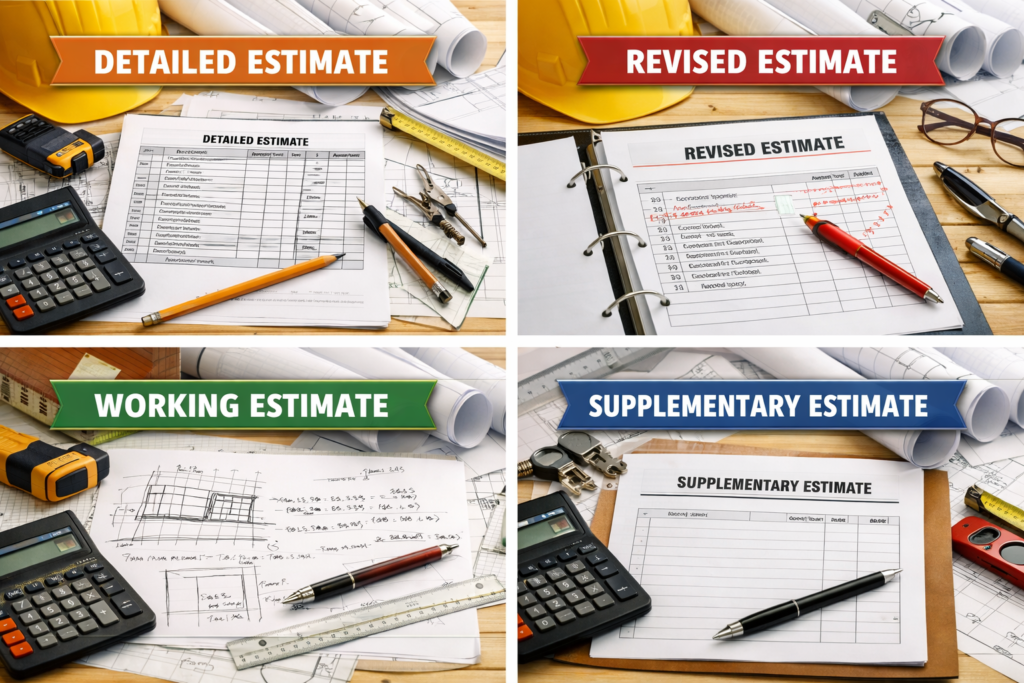
Detailed estimate
Detailed estimate is prepared using detailed drawings and specifications. It includes exact quantity and cost of each material required for construction. Detailed estimate is prepared before starting construction work.
Revised estimate
When the cost of project increases due to changes in design or material rates, revised estimate is prepared. It shows the updated cost of the project.
Supplementary estimate
Supplementary estimate is prepared when additional work is added to an existing project. It includes cost of extra items not included in original estimate.
What is BOQ (Bill of Quantities)?
BOQ stands for Bill of Quantities. It is a document that contains detailed quantity of materials and cost required for construction work. BOQ is used for tendering and billing purposes. Contractors use BOQ to quote rates for construction work.
BOQ helps in comparing contractor quotations and selecting the best contractor for the project.
To understand how these estimates are prepared, it is also important to learn about Model Estimate for Civil Engineers, which explains the major cost components in building projects.
What is rate analysis?
Rate analysis is the process of determining cost per unit of work. It includes material cost, labour cost, equipment charges, transport cost, and contractor profit. Rate analysis helps in fixing the rate of construction items like brickwork, plastering, concrete, and excavation.
Proper rate analysis helps in accurate costing and budgeting of construction projects.
Role of Estimation in Construction Projects
Estimation plays a major role in the successful completion of construction projects. It helps engineers determine the total project cost and plan construction activities effectively. Without proper estimation, construction projects may face budget shortages, delays, and material wastage.
Accurate estimation also helps contractors prepare tender documents and quotations for construction projects. Clients and project owners rely on these estimates to select suitable contractors and approve project budgets.
In addition, estimation helps in resource management by identifying the quantity of materials, labour, and equipment required for construction work. This allows engineers to plan procurement and construction schedules properly.
Therefore, estimation is considered one of the most important steps in civil engineering project planning and management.
Methods of estimation
There are different methods used for estimation in construction:
Centre line method
In this method, total centre line length of walls is calculated to find quantity of excavation and masonry work. It is suitable for symmetrical buildings.
Long wall and short wall method
In this method, length of long walls and short walls is calculated separately to determine quantity of work. It is commonly used for building estimation.
Plinth area method
Plinth area method is used for approximate cost calculation. Cost is calculated based on plinth area of building and rate per square meter.
Estimation methods and construction practices are generally based on standards provided by the Bureau of Indian Standards (BIS) and the National Building Code of India (NBC).
What is contingency in estimation?
Contingency is an extra amount added in estimation to cover unexpected expenses during construction. Usually 3% to 5% of total cost is added as contingency. It helps in managing unforeseen costs.
Factors affecting construction cost
Construction cost depends on many factors:
- Quality of materials
- Labour charges
- Location of project
- Transportation cost
- Design complexity
- Market rate of materials
Engineers must consider all these factors while preparing estimation and costing.
Tips for accurate estimation
To prepare accurate estimation and costing, follow these tips:
- Study drawings carefully
- Use correct formulas
- Check material rates
- Include labour cost
- Add contingency amount
- Avoid calculation mistakes
Accurate estimation helps in smooth execution of construction projects without financial problems.
Steps Involved in Preparing Estimation for Construction
Preparing an accurate estimate is an important task in civil engineering projects. Engineers must follow several steps to ensure that the estimated quantities and costs are correct.
The first step in preparing an estimate is studying the construction drawings carefully. Engineers must review architectural drawings, structural drawings, and specifications to understand the complete scope of the project. This helps in identifying all the construction activities involved in the project.
The next step is taking detailed measurements from the drawings. Measurements of different structural components such as foundations, columns, beams, slabs, walls, and flooring are calculated. These measurements are usually taken using standard methods of measurement used in civil engineering.
After taking measurements, engineers calculate the quantities of materials required for construction. Materials such as cement, steel, sand, aggregates, bricks, and concrete are calculated based on the dimensions obtained from the drawings. Accurate quantity calculation helps in avoiding material shortages during construction.
The next step is calculating labour and equipment costs. Labour charges may vary depending on the location and type of construction work. Equipment costs may include machinery such as mixers, cranes, or excavation equipment used on the construction site.
Once the quantities and labour costs are calculated, engineers prepare the total cost estimate. This includes the cost of materials, labour, equipment, transportation, and other miscellaneous expenses.
Finally, the estimate is reviewed and verified to ensure accuracy. Proper estimation helps in planning the project budget, arranging funds, and completing construction work without financial problems.
Frequently Asked Questions (FAQs)
1. What is estimation in civil engineering?
Estimation in civil engineering is the process of calculating the quantity and cost of materials, labour, and equipment required for construction work.
2. Why is estimation important in construction?
Estimation helps engineers plan project budgets, manage resources, and avoid material wastage during construction.
3. What is the difference between estimation and costing?
Estimation calculates the approximate quantities and cost of materials, while costing determines the total project expenditure including labour and overhead costs.
4. What is BOQ in civil engineering?
BOQ (Bill of Quantities) is a document that lists all materials, quantities, and costs required for a construction project.
Conclusion
Estimation and Costing in Civil Engineering is an essential part of planning and executing any construction project successfully. Proper Estimation and Costing in Civil Engineering helps engineers to determine the exact quantity of materials, labor requirements, and overall project cost before starting the work. By using accurate Estimation and Costing in Civil Engineering, wastage of materials can be minimized and projects can be completed within the planned budget and time. Therefore, learning Estimation and Costing in Civil Engineering is very important for every civil engineer and student to achieve better project management and quality construction.

Shakeel T is a civil engineering enthusiast and founder of CivilGuide.in. He specializes in construction estimation, quantity surveying, and practical civil engineering calculations. Through CivilGuide, he shares real-world construction knowledge, calculators, and step-by-step guides to help students and site engineers improve their technical skills.