
Introducation
Building your dream home is a lifetime investment. While architectural designs and aesthetic finishes catch the eye, the true strength of your house lies buried deep within its skeletal framework: the concrete.
If you get your concrete mix ratio wrong, your structure faces serious risks. These range from minor hairline shrinkage cracks to catastrophic structural failures.
As a civil engineer who has spent years supervising concrete pours on high-rise and residential sites, I can tell you that concrete is not just a random mixture of cement, sand, and stone. It is a precise chemical and structural compound.
This comprehensive guide will teach you everything you need to know about the concrete mix ratio. We will cover standard engineering grades, step-by-step material calculations, and crucial on-site quality tests.

1. What is a Concrete Mix Ratio and Why Does It Matter?
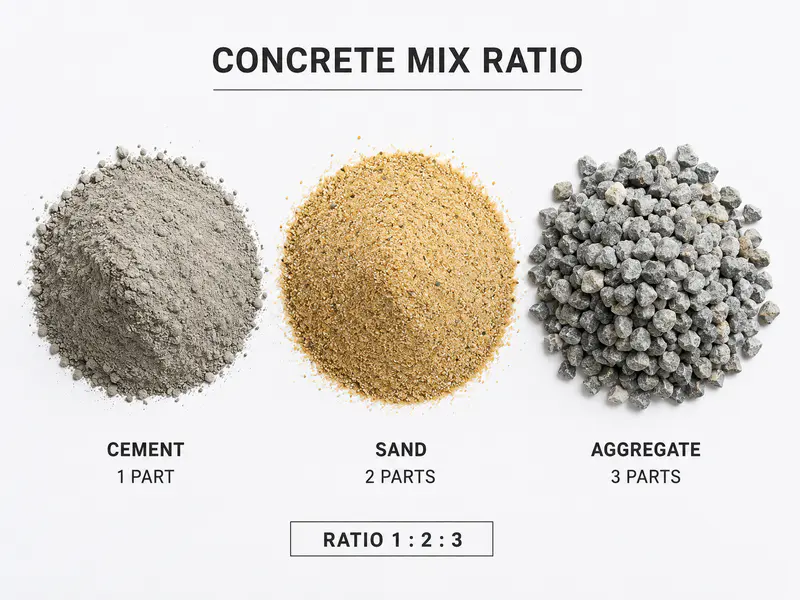
A concrete mix ratio is the proportion of cement, sand (fine aggregate), and gravel (coarse aggregate) used to create a specific strength of concrete. It is typically expressed as a three-part ratio, such as 1:2:4.
Understanding the Ratio Component (1:2:4 Example)
- 1 Part Cement: The binding agent that glues the mixture together when activated by water.
- 2 Parts Sand (Fine Aggregate): Fills the microscopic voids between the larger stones.
- 4 Parts Gravel/Crushed Stone (Coarse Aggregate): Provides the bulk mass and compressive strength.
The Science of Strength: Nominal vs. Design Mixes
In residential house construction, engineers categorize concrete into two distinct types:
- Nominal Mix Concrete: These are fixed standard proportions recommended by building codes (such as IS 456:2000 or ACI guidelines) for small-scale residential construction. You do not need laboratory testing for these. They are suitable for standard loads.
- Design Mix Concrete: For complex or high-rise structures, the mix proportions are engineered in a laboratory. This process tests the specific properties of locally available materials. It helps achieve precise performance requirements.
The Role of the Water-Cement Ratio
The most critical factor in concrete strength is the water-cement ratio. This is the weight of water divided by the weight of cement.
- Too much water: It makes concrete easier to pour, but leaves voids when it evaporates. This can reduce the strength of your concrete by up to 50%.
- Too little water: The cement will not fully hydrate, and the concrete will become honeycombed and unworkable.
- The Sweet Spot: For standard residential applications, maintain a water-cement ratio between 0.45 and 0.55.
You can also use our Concrete Quantity Calculator to estimate the required amount of cement, sand, and aggregate for your project.
Standard Concrete Mix Ratios and Grades
Concrete is graded based on its compressive strength after 28 days of proper curing. In metric systems, it is denoted by the letter “M” (for Mix) followed by the characteristic strength in Megapascals (MPa) or Newtons per square millimetre (N/mm2). In imperial systems, it is often classified by its target Pounds per Square Inch (PSI).
The table below shows the standard concrete grades used in house construction, along with their volumetric mix ratios and typical applications.
Concrete Grade and Mix Ratio Summary Table
| Concrete Grade | Nominal Mix Ratio (Cement : Sand : Aggregates) | Approximate Strength (28 Days) | Typical House Construction Application |
|---|---|---|---|
| M5 | 1 : 5 : 10 | 5 MPa (725 PSI) | Lean concrete under foundations, leveling courses |
| M7.5 | 1 : 4 : 8 | 7.5 MPa (1087 PSI) | Plain Cement Concrete (PCC) for flooring base |
| M10 | 1 : 3 : 6 | 10 MPa (1450 PSI) | Boundary walls, non-structural pathways, patio slabs |
| M15 | 1 : 2 : 4 | 15 MPa (2175 PSI) | Plinth beams, courtyard paving, single-story columns |
| M20 | 1 : 1.5 : 3 | 20 MPa (2900 PSI) | Standard Residential Grade: RCC Slabs, beams, columns |
| M25 | 1 : 1 : 2 | 25 MPa (3625 PSI) | Heavy-load columns, foundations, water tanks, retaining walls |
The Core Mathematical Formulas for Concrete Calculation
To calculate how many bags of cement, cubic feet of sand, and tons of aggregate you need, you must master the fundamental rule of concrete volume transformation: The Dry Volume Factor.
When you mix dry cement, sand, and stone with water, the fine particles of cement and sand slip into the voids between the large stones. Because of this consolidation, the volume shrinks.
To get 1 cubic meter of wet, compacted concrete, you need roughly 1.54 cubic meters of dry materials.
The Master Formulas (Plain Text)
- Dry Volume of Concrete = Wet Volume x 1.54
- Sum of Ratio Proportions = Cement Part + Sand Part + Aggregate Part
- Volume of Cement = (Cement Part / Sum of Ratio Proportions) x Dry Volume
- Volume of Sand = (Sand Part / Sum of Ratio Proportions) x Dry Volume
- Volume of Coarse Aggregate = (Aggregate Part / Sum of Ratio Proportions) x Dry Volume
- Number of Cement Bags = Volume of Cement / 0.0347 (For 50kg bags measured in cubic meters)
You can also learn about Estimation and Costing in Civil Engineering, used during construction planning
Step-by-Step Practical Calculation Examples
Let us look at two real-world examples that you can apply directly to your construction site.
Example 1: Concrete Volume for an M20 Grade Roof Slab (Metric)
Suppose you need to cast a reinforced concrete roof slab with the following dimensions:
- Length = 10 meters
- Width = 5 meters
- Thickness = 0.12 meters (120 mm)
- Concrete Grade = M20 (Ratio = 1 : 1.5 : 3)
Step 1: Calculate the Wet Volume
- Wet Volume = Length x Width x Thickness
- Wet Volume = 10 x 5 x 0.12 = 6 Cubic Meters (m3)
Step 2: Convert Wet Volume to Dry Volume
- Dry Volume = Wet Volume x 1.54
- Dry Volume = 6 x 1.54 = 9.24 Cubic Meters
Step 3: Calculate the Material Requirements
- Sum of Ratio Proportions = 1 + 1.5 + 3 = 5.5
Cement Calculation:
- Volume of Cement = (1 / 5.5) x 9.24 = 1.68 Cubic Meters
- Since 1 bag of 50kg cement equals 0.0347 cubic meters:
- Number of Bags = 1.68 / 0.0347 = 48.41 bags (Round up to 49 Bags)
Sand (Fine Aggregate) Calculation:
- Volume of Sand = (1.5 / 5.5) x 9.24 = 2.52 Cubic Meters
Coarse Aggregate Calculation:
- Volume of Aggregate = (3 / 5.5) x 9.24 = 5.04 Cubic Meters
Example 2: Concrete Volume for Foundation Footings (Imperial)
Let us calculate the material requirements for 5 foundation footings using an M15 grade mix (1:2:4) for a residential porch.
- Dimensions of 1 Footing = 4 feet x 4 feet x 1 foot
- Total Number of Footings = 5
Step 1: Calculate Total Wet Volume
- Volume of 1 Footing = 4 x 4 x 1 = 16 Cubic Feet (CFT)
- Total Wet Volume for 5 Footings = 16 x 5 = 80 Cubic Feet (CFT)
Step 2: Convert Wet Volume to Dry Volume
- Dry Volume = 80 x 1.54 = 123.2 Cubic Feet (CFT)
Step 3: Calculate the Material Requirements
- Sum of Ratio Proportions = 1 + 2 + 4 = 7
Cement Calculation:
- Volume of Cement = (1 / 7) x 123.2 = 17.6 Cubic Feet
- Since 1 bag of standard cement equals 1.226 Cubic Feet:
- Number of Bags = 17.6 / 1.226 = 14.35 bags (Round up to 15 Bags)
Sand Calculation:
- Volume of Sand = (2 / 7) x 123.2 = 35.2 Cubic Feet (CFT)
Coarse Aggregate Calculation:
- Volume of Aggregate = (4 / 7) x 123.2 = 70.4 Cubic Feet (CFT)
Unit Conversions Essential for Material Purchasing
On-site suppliers sell materials using different regional units like Cubic Meters, Cubic Feet (CFT), Tons, or Brass. If you do not understand these conversions, suppliers might overcharge you. Use these conversion factors to verify your numbers.
Key Conversion Factors
- 1 Cubic Meter (m3) = 35.3147 Cubic Feet (CFT)
- 1 Brass = 100 Cubic Feet (CFT) = 2.831 Cubic Meters
- Density of Cement = 1440 kg/m3 (28.8 kg per cubic foot)
- Density of River Sand = 1600 kg/m3 to 1700 kg/m3 (45 kg to 48 kg per cubic foot)
- Density of Coarse Aggregates = 1500 kg/m3 to 1650 kg/m3 (42 kg to 46 kg per cubic foot)
Handy Conversion Reference Table
| From Unit | To Unit | Multiply By | Real-World Application Example |
|---|---|---|---|
| Cubic Meters (m3) | Cubic Feet (CFT) | 35.315 | Converting structural concrete volume to sand supplier units |
| Cubic Feet (CFT) | Brass | 0.01 | Ordering large dumper trucks of aggregate or gravel |
| Cubic Meters (m3) | Metric Tons (Sand) | 1.65 | Estimating the total weight capacity needed for delivery trucks |
| Cubic Feet (CFT) | Cement Bags | 0.815 | Checking your on-site cement store balance based on volume |
On-Site Quality Control, Testing, and Precautions
You can calculate your mix ratios perfectly, but the concrete will still fail if the site execution is poor. Follow these engineering guidelines to protect your structural integrity.
1. The Slump Test (Workability Check)

Before you pour any batch of concrete into your beams or columns, run an on-site Slump Cone Test.
- Fill a standard slump cone with fresh concrete in four layers, tamping each layer 25 times.
- Lift the cone vertically and measure how much the concrete sinks.
- For residential slabs and beams, your target slump should be between 75 mm and 125 mm.
- If the concrete slumps completely into a flat puddle, it has too much water and should be rejected.
2. Sieve Analysis and Bulking of Sand
Never use sand contaminated with agricultural soil or clay mud. Clay particles weaken the bond between the cement paste and aggregate.
Be aware of the bulking of sand. When dry sand gets damp from atmospheric moisture, a thin film of water pushes the sand grains apart. This can increase its apparent volume by up to 25%. If you measure your sand by volume on a rainy day without adjusting for bulking, you will accidentally use less sand than required. This makes your mix stone-heavy and hard to work with.
3. Concrete Compaction and Honeycombing

Air bubbles trapped inside poured concrete create micro-pores that reduce its strength.
- Always use a mechanical needle vibrator to compact the concrete inside your formwork.
- Do not leave the vibrator in one spot for more than 10 to 15 seconds. Over-vibrating causes the heavy stones to settle at the bottom, while the water and cement slurry rise to the top (segregation).
- Improper vibration results in honeycombing, which leaves raw stones exposed and structural rebar prone to rusting.
4. Wastage Multipliers
Always add a wastage margin to your final volume calculations to account for site spills, uneven formwork, and mortar stuck inside mixer drums:
- Hand Mixing / Small Site Mixer: Add 5% to 7% extra volume.
- Ready-Mix Concrete (RMC) Pumps: Add 3% to 5% extra volume.
7. Frequently Asked Questions (FAQs)
Can I use ordinary sea sand for concrete mix ratios?
No. Sea sand contains high levels of chlorides and salts. These salts corrode the internal steel reinforcement bars (rebar) inside your concrete. This corrosion causes the concrete to crack and spall over time. Always use clean river sand or crushed manufactured sand (M-Sand).
What is the difference between OPC and PPC cement in mix ratios?
Ordinary Portland Cement (OPC) cures quickly and develops strength fast, making it ideal for structural columns and beam frameworks. Portland Pozzolana Cement (PPC) cures more slowly, generates less heat, and resists moisture well. This makes PPC ideal for mass foundations, residential roof slabs, and plastering work. You can use the same volumetric mix ratios for both.
Why does concrete crack a few days after pouring?
Cracks that appear within 24 to 72 hours are usually caused by plastic shrinkage. If water evaporates too quickly from the surface due to hot weather or high winds, the concrete shrinks and cracks. You can prevent this by shading the concrete and starting the water curing process as soon as the concrete sets.
Is an M20 mix ratio safe for a two-story residential house?
Yes. An M20 mix ratio (1:1.5:3) is the standard recommended grade for foundations, beams, columns, and slabs in standard two-story residential builds. For three or more stories, use M25 or higher for the lower-level columns and foundations.
How many days should concrete be cured with water?
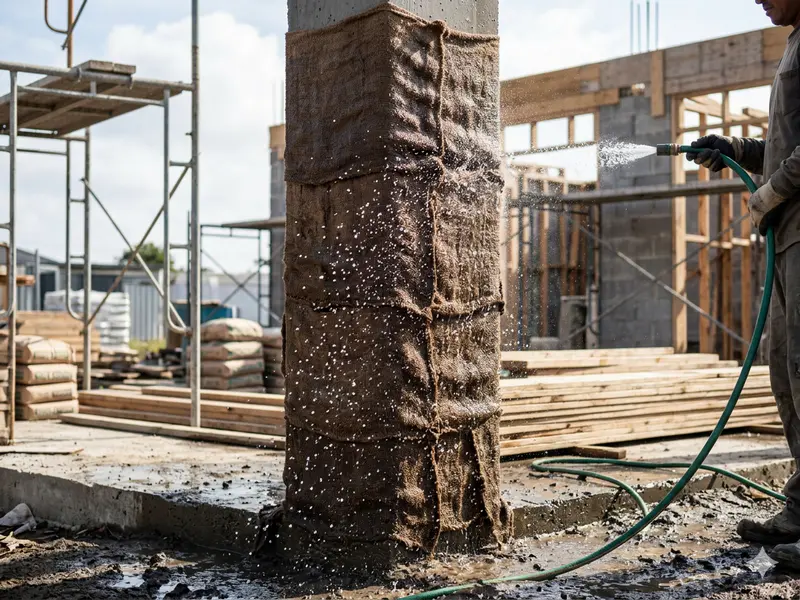
Concrete should be kept continuously damp for at least 7 to 10 days to achieve its target strength. For structures using blended cements like PPC, extend the curing period to 14 days. Proper water curing ensures the chemical hydration process continues until the concrete reaches its full design strength.
Concrete construction practices generally follow guidelines recommended by the Bureau of Indian Standards (BIS) and the National Building Code of India for safe and durable structures.
Conclusion
The safety and longevity of your home depend directly on your concrete mix ratio. For standard residential builds, using an M20 mix (1:1.5:3) balances structural strength with cost-effectiveness.
Do not let your site team guess the proportions using unmeasured shovels. Use calibrated measuring boxes (Farams), maintain a strict water-cement ratio, and ensure proper water curing for at least 10 days. Investing time and care into your concrete mix today will ensure your home stands strong for generations.

Shakeel T is a qualified Civil Engineer and Structural Consultant with extensive on-site experience in residential and commercial building construction. Specializing in material estimation, cost budgeting, and structural safety guidelines, he has successfully managed multiple real estate projects from foundation to finishing. Through this blog, Shakeel shares field-tested civil engineering thumb rules, IS Code practices, and practical site tips to help home builders execute their projects efficiently and within budget.
Education: Diploma in Civil Engineering
Expertise: Quantity Surveying, Material Estimation, Structural Design, and Site Management.