
Introducation
Every successful construction project starts with two simple questions: How much material do we need? And how much will it cost?
In civil engineering, finding the exact answers to these questions is called Estimation and Costing in civil engineering. Whether you are building a small residential house, a high-rise apartment, or a massive highway, accurate estimation ensures that your project stays within budget, meets quality standards, and finishes on time.
This guide provides an exhaustive look into the world of estimation, quantities, rates, and real-world calculation methods. It is written in simple, accessible language for site engineers, students, contractors, and quantity surveyors.
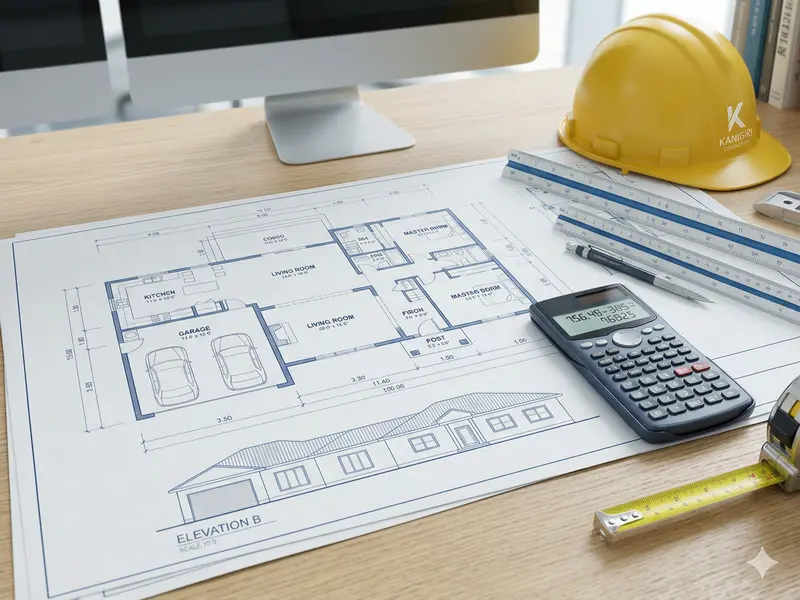
What is Estimation and Costing in Civil Engineering?
Estimation is the process of calculating the quantities of various materials and labor required for a construction project before the actual work begins.
Costing is the process of multiplying those calculated quantities by their respective market rates to find the total financial expenditure of the project.
Why Is It Essential in Construction?
- Budget Control: It helps clients and financial institutions understand the total money required to complete the structure.
- Material Procurement: It provides an exact shopping list of materials (like cement, steel, sand, and bricks) so you do not order too much or too little.
- Tendering Process: Contractors use estimates to submit financial bids and compete for government or private construction contracts.
- Time Management: By knowing the total volume of work, project managers can estimate how many laborers are needed and how long the project will take.
- Alternative Designs: If the initial estimate exceeds the client’s budget, engineers can alter materials or design elements to reduce costs.
The Key Difference Between Estimate and Actual Cost
A common misunderstanding is that an estimate is the final price tag. In reality, there is a distinct difference between the two:
- The Estimate: This is a probable cost calculated before construction starts. It is based on structural drawings, assumptions, historical data, and current market rates.
- The Actual Cost: This is the exact money spent after the project is fully completed. It is determined by tracking actual bills, receipts, labor daily wages, and unexpected site challenges.
An expert estimator aims to keep the difference between the estimated cost and the actual cost within a safe margin of plus or minus 5%.
Types of Estimates Used in Civil Engineering
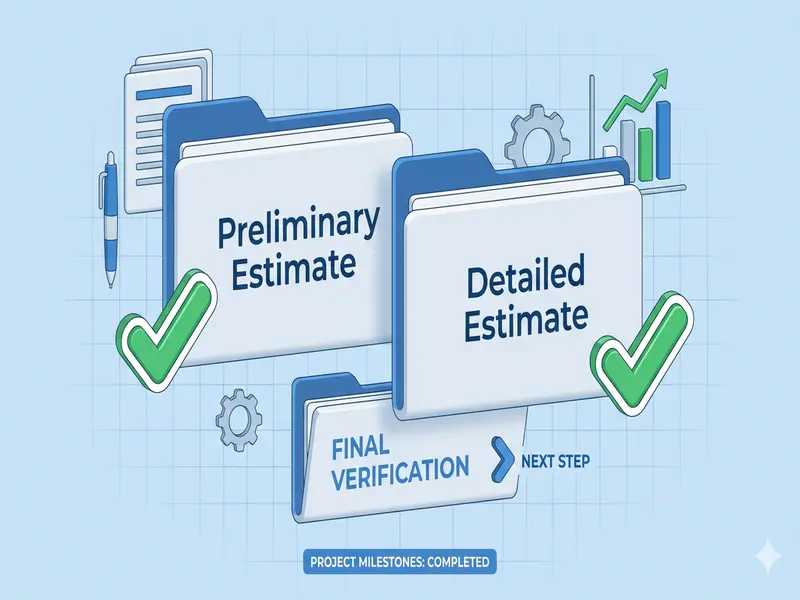
Depending on the stage of the project and the level of detail available, civil engineers use different types of estimates.
1. Approximate (Preliminary or Rough Cost) Estimate
This is a quick estimate prepared at the very beginning of a project when detailed drawings are not yet available. It helps the client decide if the project is financially viable.
- Plinth Area Method: The total built-up floor area (plinth area) is multiplied by a standard prevailing rate per square meter or square foot.
- Cubic Content Method: This factors in the height of the building as well. Total Volume (Length x Width x Height) is multiplied by a local cubic rate. This method is much more accurate than the plinth area method.
- Unit Base Method: Used for specialized structures. For example, estimating a hospital cost based on the “cost per bed,” or a school based on the “cost per student.”
2. Detailed Estimate
This is the most accurate and comprehensive type of estimate. It is prepared only after the final structural drawings, architectural designs, and site condition reports are fully approved.
To understand how these estimates are prepared, it is also important to learn about Model Estimate for Civil Engineers, which explains the major cost components in building projects.
A detailed estimate consists of two main parts:
- Details of Measurements (Quantity Sheet): Explains the dimensions and totals of all work items.
- Abstract of Estimated Cost (Cost Sheet): Multiplies the quantities by calculated rates to arrive at the final financial figure.
3. Revised Estimate
If the original detailed estimate increases by more than 5% due to unexpected material price jumps or design changes during active construction, a revised estimate must be submitted for new financial approvals.
4. Supplementary Estimate
When a client requests a major addition to the project that was completely missing in the original plan (for example, adding a swimming pool to a housing project mid-way), a supplementary estimate is created.
The Essential Data Required for Preparing an Estimate
To write a flawless, highly accurate, detailed estimate, an engineer must collect four specific components:
- Drawings: Complete architectural plans, elevations, cross-sections, and detailed structural blueprints.
- Specifications: Clear instructions detailing the quality of materials, the ratio of concrete mixes, the brand of steel, and the methods of workmanship.
- Rates: A comprehensive list of current local market rates for materials, transport, equipment rentals, and labor wages. Government projects utilize a standardized book called the Schedule of Rates (SOR).
- Site Conditions: Access to the plot, soil type (which changes foundation depth requirements), and water table levels.
Core Mathematical Formulas for Structural Volume
To calculate materials, you must master the fundamental mathematical equations for volume and area. All measurements on modern sites should be done in clean, readable plain text without complex formatting codes.
Standard Volume Equation
- Volume = Length x Width x Thickness (or Height)
- Unit of Measurement: Cubic Meters (cu.m) or Cubic Feet (CFT)
Standard Area Equation
- Area = Length x Width
- Unit of Measurement: Square Meters (sq.m) or Square Feet (sq.ft)
Concrete Mix Materials Formulation
When calculating the raw ingredients for concrete (Cement, Sand, and Coarse Aggregate), you must convert Wet Volume to Dry Volume. Dry aggregate materials contain air voids, so they shrink when mixed with water.
- Dry Volume of Concrete = Wet Volume x 1.54
- This means we add a 54% safety factor to account for dry material shrinkage.
Step-by-Step Practical Calculation Examples
Let us apply these engineering formulas to real-world scenarios with concrete numbers.

Example 1: Material Estimation for a Concrete Slab
Problem Scenario: Calculate the quantities of cement bags, sand, and coarse aggregate required to cast a solid concrete roof slab with dimensions 10 meters long, 5 meters wide, and 0.15 meters (150 mm) thick. The concrete mix design ratio specified is M20 (1 : 1.5 : 3).
Step 1: Calculate the Wet Volume of Concrete
- Wet Volume = Length x Width x Thickness
- Wet Volume = 10 x 5 x 0.15 = 7.5 Cubic Meters (cu.m)
Step 2: Convert to Dry Volume
- Dry Volume = Wet Volume x 1.54
- Dry Volume = 7.5 x 1.54 = 11.55 Cubic Meters
Step 3: Understand the Mix Ratio Parts
- The ratio is 1 (Cement) : 1.5 (Sand) : 3 (Aggregate)
- Total Sum of Ratio Parts = 1 + 1.5 + 3 = 5.5
Step 4: Calculate Cement Quantity
- Cement Volume = (Cement Ratio / Total Ratio) x Dry Volume
- Cement Volume = (1 / 5.5) x 11.55 = 2.1 Cubic Meters
- Since 1 bag of cement occupies exactly 0.035 cubic meters:
- Total Cement Bags = 2.1 / 0.035 = 60 Bags
Step 5: Calculate Sand Quantity
- Sand Volume = (Sand Ratio / Total Ratio) x Dry Volume
- Sand Volume = (1.5 / 5.5) x 11.55 = 3.15 Cubic Meters
Step 6: Calculate Coarse Aggregate Quantity
- Aggregate Volume = (Aggregate Ratio / Total Ratio) x Dry Volume
- Aggregate Volume = (3 / 5.5) x 11.55 = 6.3 Cubic Meters
Example 2: Material Estimation for a Brick Wall
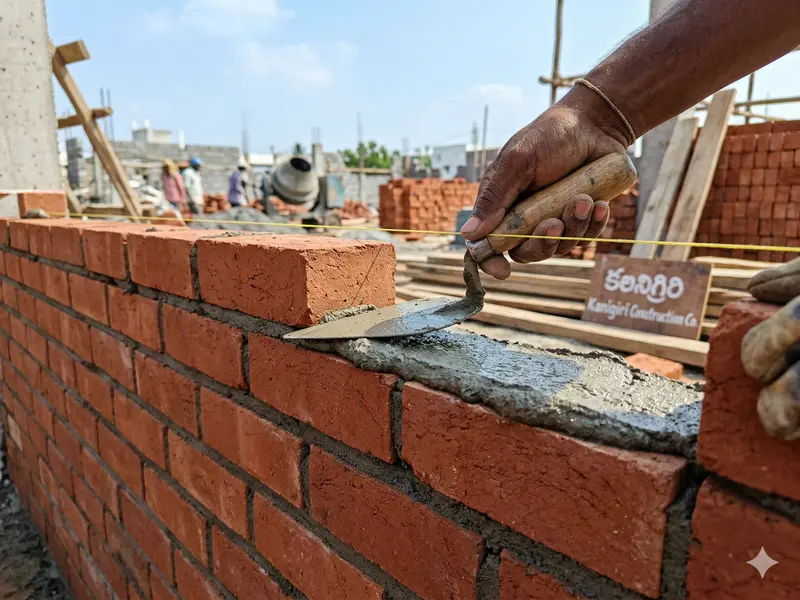
Problem Scenario: Estimate the total number of standard bricks and mortar needed for a brick wall that is 6 meters long, 3 meters high, and 0.23 meters (230 mm) thick. The mortar mix ratio is 1:4.
Step 1: Calculate the Total Wall Volume
- Wall Volume = Length x Height x Thickness
- Wall Volume = 6 x 3 x 0.23 = 4.14 Cubic Meters
Step 2: Calculate the Number of Bricks
- Standard modular brick size with mortar joints is 0.2m x 0.1m x 0.1m.
- Volume of 1 brick with mortar = 0.2 x 0.1 x 0.1 = 0.002 Cubic Meters
- Total Bricks Required = Total Wall Volume / Volume of 1 Brick
- Total Bricks Required = 4.14 / 0.002 = 2,070 Bricks
Step 3: Calculate Mortar Volume
- An industry rule of thumb states that mortar occupies roughly 30% of the total brickwork volume.
- Wet Mortar Volume = 4.14 x 0.30 = 1.242 Cubic Meters
- Convert to Dry Mortar Volume (using a 1.33 adjustment factor for dry sand/cement powder):
- Dry Mortar Volume = 1.242 x 1.33 = 1.652 Cubic Meters
Step 4: Calculate Cement Bags for Mortar
- Ratio sum = 1 + 4 = 5
- Cement Volume = (1 / 5) x 1.652 = 0.330 Cubic Meters
- Total Cement Bags = 0.330 / 0.035 = 9.43 Bags (Round up to 10 Bags)
Measurement Units and Conversion Systems
Different building materials are measured, tracked, and billed using different metrics based on their physical characteristics. The table below lists standard measurement methods alongside essential field conversion factors.
Standard Units of Measurement for Construction Work
| Item of Work | Primary Metric Unit | Description / Scope |
|---|---|---|
| Earthwork Excavation | Cubic Meters (cu.m) | Volume of soil removed from ground |
| Concrete in Foundation | Cubic Meters (cu.m) | Total volume of concrete poured |
| Brickwork in Walls | Cubic Meters (cu.m) | Structural masonry volume |
| Plastering / Painting | Square Meters (sq.m) | Surface area coverage |
| Damp Proof Course (DPC) | Square Meters (sq.m) | Flat horizontal moisture barrier |
| Reinforcement Steel | Metric Tons or kg | Total weight of reinforcing rebars |
| Woodwork for Doors/Windows | Cubic Meters or sq.m | Frame volume or shutter surface area |
Common Structural Conversion Factors
| To Convert From | To | Multiply By |
|---|---|---|
| Cubic Meters (cu.m) | Cubic Feet (CFT) | 35.3147 |
| Square Meters (sq.m) | Square Feet (sq.ft) | 10.7639 |
| Metric Tons | Kilograms (kg) | 1000 |
| Metric Tons | Pounds (lbs) | 2204.62 |
| Kilograms (kg) | Pounds (lbs) | 2.2046 |
Rate Analysis and Additional Project Cost Factors
Rate Analysis is the process of determining the cost per unit of work for an item (e.g., how much does 1 cubic meter of brickwork cost?). It is determined by analyzing the cost of raw materials, labor wages, machinery usage, and transport logistics.
However, an estimate is incomplete without factoring in hidden project costs. You must add these standardized percentages to your base calculations:
1. Contractor’s Profit and Overhead Costs
Contractors do not work for free, and they have to run offices, pay engineers, and maintain equipment. A standard addition of 10% to 15% of the total material and labor cost is included in the estimate to account for contractor profits and overheads.
2. Contingencies
Contingencies are unexpected expenses that occur during construction, such as sudden flooding requiring extra pumps, design corrections, or unexpected soil issues. Engineers add a safety buffer of 3% to 5% of the total project cost to handle these situations.
3. Work-Charged Establishment
This accounts for temporary staff hired specifically for the duration of the project, such as site watchmen, storekeepers, and manual checkers. A margin of 1.5% to 2% is added to the estimate for this purpose.
Site Quality Control, Auditing, and Waste Reduction Tips
An expert estimator must work closely with the site supervisor to ensure the estimated budget remains accurate during active execution.
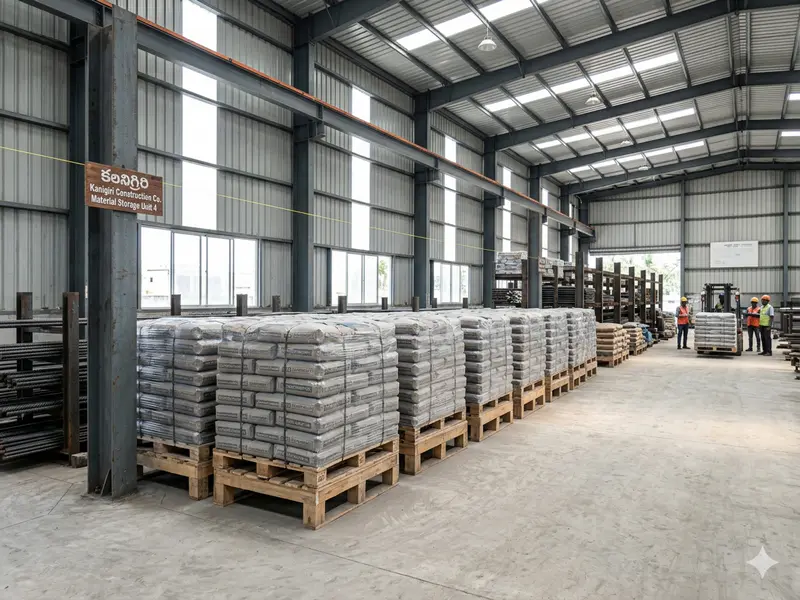
On-Site Waste Control Strategies
- The 5% Material Wastage Rule: Always include a small material wastage buffer in your raw material calculations (usually 2% to 5%). If the site wastes more than this, profits vanish.
- Proper Storage Controls: Cement bags must be stored in a dry, moisture-free warehouse elevated off the ground. Wet cement hardens into lumps and must be thrown away, causing massive budget overruns.
- Rebar Off-Cut Sorting: Ensure the steel yard saves short pieces of cut steel. They can often be reused to make spacers, chairs, or short stirrups instead of being tossed into the scrap pile.
Field Auditing for Materials
Perform surprise material audits by comparing the delivery receipts with actual work completed on the floor. For example, if your estimate says a slab needs 60 bags of cement, but the site team used 75 bags, investigate immediately. They are either mixing the concrete incorrectly or experiencing material theft.
Frequently Asked Questions (FAQs)
1. What is the difference between a rough estimate and a detailed estimate?
A rough estimate is prepared in the initial project phases using general dimensions (like total floor area) to establish an approximate budget. A detailed estimate is completed using final structural drawings, itemizing every single component to calculate a highly precise final cost.
2. What is the Schedule of Rates (SOR)?
The Schedule of Rates is a comprehensive book published periodically by government engineering bodies (like the Public Works Department). It contains standard determined rates for various materials, labor activities, and transport costs based on localized economic indicators.
3. Why do we add 54% extra volume when calculating concrete materials?
When cement, sand, and aggregate particles are dry, they contain millions of microscopic air pockets. When water is added, the particles collapse together into the gaps, reducing the total volume. We add 54% extra dry material to ensure that after mixing with water, the final concrete fills the structural mold completely.
4. What happens if a project budget exceeds the initial estimate?
If the project cost jumps by more than 5% during execution, the engineer must draft a Revised Estimate. This document details the exact reasons for the cost increase (such as material inflation or layout modifications) to secure new funding approvals.
5. Are labor costs fixed in civil engineering estimation?
No, labor costs vary heavily based on geographical location, the skill level required (skilled masons vs. general manual labor), and market demand. Estimators utilize localized labor constants (output per day) to forecast total manpower expenses.
Estimation methods and construction practices are generally based on standards provided by the Bureau of Indian Standards (BIS) and the National Building Code of India (NBC).
Conclusion
Mastering Estimation and Costing is a core requirement for delivering profitable, safe, and efficient civil engineering projects. By combining accurate structural dimensions with realistic rate analysis and strict waste-reduction strategies, you protect your clients from financial shortfalls and keep your construction company profitable.
Always verify your dimensions, stay updated on current market material values, and maintain clear records on-site to ensure financial success.

Shakeel T is a qualified Civil Engineer and Structural Consultant with extensive on-site experience in residential and commercial building construction. Specializing in material estimation, cost budgeting, and structural safety guidelines, he has successfully managed multiple real estate projects from foundation to finishing. Through this blog, Shakeel shares field-tested civil engineering thumb rules, IS Code practices, and practical site tips to help home builders execute their projects efficiently and within budget.
Education: Diploma in Civil Engineering
Expertise: Quantity Surveying, Material Estimation, Structural Design, and Site Management.