
Introduction
Cement required for plastering 100 sq ft wall is one of the most important calculations in house construction. Plastering gives a smooth and strong finish to walls and protects them from weather and moisture. Proper cement calculation helps in cost estimation, material planning, and avoiding wastage at construction site.
Many house owners and civil engineers want to know how much cement is required for plastering walls. If cement quantity is not calculated correctly, it may increase construction cost or delay work. This guide explains cement required for plastering 100 sq ft with simple formulas and examples.
Plastering is usually done after brickwork or blockwork to create a smooth and durable wall surface. Proper plastering improves the appearance of the wall and protects it from moisture, weather damage, and cracks. Before starting plastering work, it is important to estimate the cement and sand required for plastering to avoid material shortage or wastage during construction.
This guide explains the cement required for plastering 100 sq ft wall with simple formulas, practical examples, and step-by-step calculations used by civil engineers.
Knowing the cement required for plastering 100 sq ft wall helps engineers estimate construction materials accurately and control project costs.
What is Plastering in Construction?
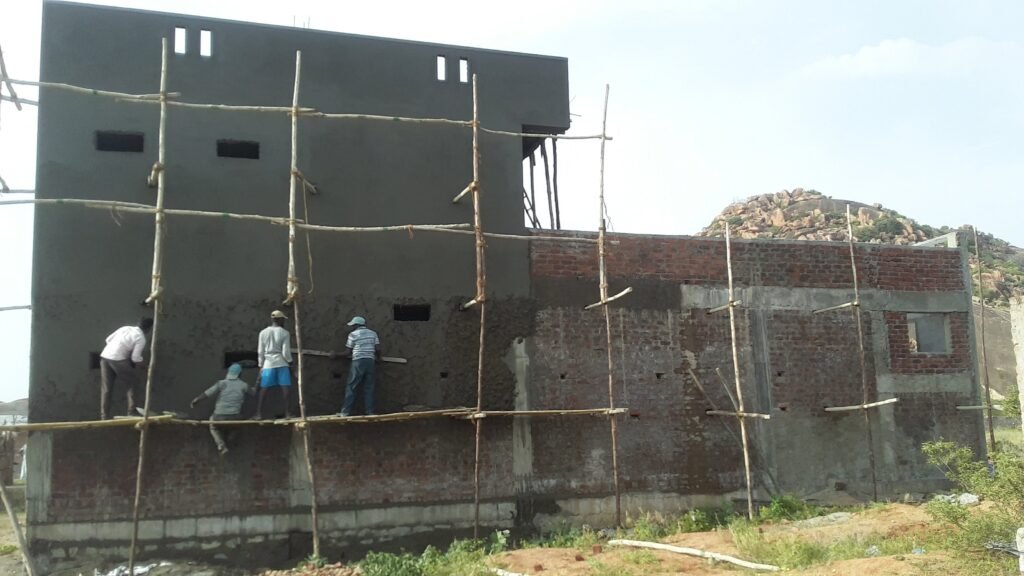
Plastering is the process of applying cement mortar on walls and ceilings to get a smooth surface. It also protects walls from rain, heat, and dust.
Types of plastering:
- Internal wall plaster
- External wall plaster
- Ceiling plaster
Cement mortar is prepared by mixing cement, sand, and water.
Types of Plastering Used in Construction
Different types of plastering are used in building construction depending on the surface condition and required finish.
1. Cement Plaster
Cement plaster is the most commonly used plaster in residential buildings. It is prepared by mixing cement, sand, and water in specific ratios such as 1:4 or 1:6. Cement plaster provides good strength, durability, and weather resistance.
2. Lime Plaster
Lime plaster is made using lime, sand, and water. It was widely used in traditional construction before cement became common. Lime plaster provides good workability and flexibility.
3. Gypsum Plaster
Gypsum plaster is a modern plastering material that is used for interior wall finishing. It provides a smooth surface and requires less curing compared to cement plaster.
Among these types, cement plaster is the most widely used plastering method in house construction.
Standard Thickness of Plaster
Plaster thickness plays an important role in cement calculation.
Standard thickness used in construction:
- Internal plaster = 12 mm
- External plaster = 15 mm to 20 mm
For calculation, normally 12 mm thickness is considered.
Common Plaster Thickness Used in Construction
Plaster thickness may vary depending on the type of construction and surface condition. However, the following thicknesses are commonly used in residential buildings:
| Location | Plaster Thickness |
|---|---|
| Internal walls | 12 mm |
| External walls | 15 mm |
| Ceiling plaster | 6 mm |
| Rough brick wall | 15–20 mm |
For most residential wall plastering calculations, 12 mm thickness is considered standard.
Cement Mortar Ratio for Plastering
Common cement mortar ratios used:
- 1:4 (cement : sand) – standard plaster
- 1:5 – internal walls
- 1:6 – low strength plaster
Most commonly used ratio = 1:4
How to Calculate Plastering Area
Before calculating cement and sand quantity, the total plastering area must be calculated.
Formula:
Plaster Area = Length × Height
Example:
If a wall length is 10 ft and height is 10 ft
Plaster area = 10 × 10
Plaster area = 100 sq ft
Openings like doors and windows should be deducted from the total wall area to get an accurate plastering quantity.
According to Bureau of Indian Standards (BIS) guidelines, cement mortar ratios such as 1:4 and 1:6 are commonly used for wall plastering in building construction.
Plastering Material Calculation Formula
The quantity of cement and sand required for plastering can be calculated using the following formula.
Wet Volume of Plaster
Wet Volume = Area × Thickness
Dry Volume
Dry Volume = Wet Volume × 1.33
Dry volume is considered because materials expand after mixing.
Cement Quantity
Cement = Dry Volume × (Cement Ratio / Total Ratio)
Sand Quantity
Sand = Dry Volume × (Sand Ratio / Total Ratio)
This formula helps engineers calculate plastering materials accurately for any wall area.
Cement Required for 100 Sq Ft Plastering
Let us calculate cement required for plastering 100 sq ft wall.
Step 1: Convert sq ft to sq meter
1 sq meter = 10.764 sq ft
100 sq ft = 9.29 sq meter
Step 2: Calculate plaster volume
Thickness = 12 mm = 0.012 m
Volume = Area × Thickness
Volume = 9.29 × 0.012
Volume = 0.111 m³
Add 30% extra for wastage and uneven surface:
Dry volume = 0.111 × 1.30
Dry volume = 0.144 m³
Step 3: Cement and Sand Calculation (1:4)
Total ratio = 1 + 4 = 5
Cement = (1/5) × 0.144
Cement = 0.0288 m³
1 cement bag = 0.0347 m³
Cement bags = 0.0288 / 0.0347
Cement required = 0.83 bags
So cement required for plastering 100 sq ft ≈ 1 bag
Sand Required
Sand = (4/5) × 0.144
Sand = 0.115 m³
Cement Required for Different Plastering Areas
| Area | Cement Required |
|---|---|
| 100 sq ft | 1 bag |
| 500 sq ft | 5 bags |
| 1000 sq ft | 10 bags |
This estimation is based on 12 mm plaster thickness and 1:4 cement mortar ratio.
Actual requirement may vary depending on wall surface condition and plaster thickness.
Final Material Required for 100 Sq Ft Plastering
For 12mm plaster thickness (1:4 ratio):
- Cement = 1 bag
- Sand = 0.11 to 0.12 m³
- Water = as required
This is standard site calculation.
Cement Required per Sq Ft Plastering
Civil engineers often estimate plastering materials using square foot area for quick calculation.
For standard wall plaster with 12 mm thickness and 1:4 cement mortar ratio:
- Cement required per sq ft ≈ 0.01 bag
- Sand required per sq ft ≈ 0.0011 m³
Example:
For 100 sq ft plastering
Cement required
= 100 × 0.01
= 1 bag of cement
This method helps engineers quickly estimate plastering materials during site planning.
Cement Required for 1000 Sq Ft Plastering
Quick method:
100 sq ft → 1 bag cement
1000 sq ft → 10 bags cement
So for full house plastering, cement required is higher.
Factors Affecting Cement Quantity
Cement required for plastering depends on:
- Wall surface condition
- Plaster thickness
- Mortar ratio
- Wastage at site
- Mason work quality
Rough walls consume more cement.
Cost of Plastering 100 Sq Ft
Average cement price = ₹420 per bag
Cement cost = ₹420
Sand cost = ₹200 approx
Labour cost = ₹1500–₹2500
Total plaster cost for 100 sq ft = ₹2200–₹3000 approx.
Construction Cost per Sq Ft in India
Factors Affecting Plastering Cost
The cost of plastering may vary depending on several factors.
Location of construction
Labor and material prices vary from city to city.
Thickness of plaster
Thicker plaster requires more cement and sand.
Type of plastering
Different plaster types such as gypsum plaster and decorative plaster have different costs.
Labor charges
Labor cost may increase depending on wall height and complexity of work.
To understand complete building construction expenses, you can also read our guide on Construction Cost per Sq Ft in India.
Tips for Good Quality Plastering
Follow these tips:
- Use good quality cement
- Use clean sand
- Maintain proper ratio
- Cure plaster for 7 days
- Do not add excess water
- Apply uniform thickness
Proper plaster increases wall life.
Plastering Procedure in Construction
The plastering process usually follows several steps to ensure proper bonding and smooth wall finishing.
Step 1: Surface Preparation
The brick wall surface should be cleaned properly to remove dust, loose particles, and oil.
Step 2: Wetting the Wall
The wall should be sprinkled with water before plastering to improve bonding between plaster and masonry surface.
Step 3: Preparing Cement Mortar
Cement mortar is prepared by mixing cement and sand in the required ratio, usually 1:4 for internal plastering.
Step 4: Applying Plaster
The mortar is applied evenly on the wall surface using a trowel.
Step 5: Finishing
After applying plaster, the surface is leveled and finished smoothly using a wooden float.
Step 6: Curing
Proper curing is required for 7 days to achieve good strength and durability.
Importance of Cement Calculation
Knowing cement required for plastering 100 sq ft helps in:
- Accurate estimation
- Cost planning
- Material purchase
- Avoiding wastage
- Smooth construction
Every civil engineer must know this.
Common Mistakes in Plastering Calculation
Many beginners make mistakes while estimating plastering materials. Some common mistakes include:
Ignoring plaster thickness
Different thickness values can significantly change cement and sand quantity.
Not deducting door and window area
Openings should always be deducted while calculating plaster area.
Incorrect mortar ratio
Using the wrong cement mortar ratio can affect plaster strength and durability.
Not adding wastage
Usually 5% extra material is considered to cover wastage during construction.
Avoiding these mistakes helps in getting an accurate plastering estimate.
Frequently Asked Questions (FAQs)
How much cement is required for plastering 100 sq ft wall?
For a standard wall plaster with 12 mm thickness and 1:4 cement mortar ratio, approximately 1 bag of cement is required for plastering 100 sq ft wall area. The exact quantity may vary depending on plaster thickness and surface condition.
How much sand is required for 100 sq ft plastering?
For plastering 100 sq ft wall with 12 mm thickness, approximately 0.11 to 0.12 cubic meters of sand is required when using a 1:4 cement mortar ratio.
What is the standard thickness of wall plaster?
In residential construction, the most common plaster thickness is:
- 12 mm for internal walls
- 15 mm for external walls
Ceiling plaster is usually done with 6 mm thickness.
What is the best cement mortar ratio for plastering?
The commonly used cement mortar ratios for plastering are:
- 1:4 ratio – used for internal wall plastering
- 1:6 ratio – used for external plastering
The ratio may vary depending on the required strength and surface condition.
Why is curing important after plastering?
Curing is important because it helps the cement gain strength and prevents cracks in the plaster surface. Proper curing should be done for at least 7 days after plastering.
Conclusion
Cement required for plastering 100 sq ft wall is approximately 1 bag for 12mm thickness using 1:4 mortar ratio. Proper plastering calculation helps in cost control and quality construction. Cement, sand, and water must be mixed in correct proportion for best results.
Understanding plastering material calculation helps civil engineers and house owners manage construction work efficiently. Always use quality materials and proper curing for durable plaster finish.
Accurate plastering calculations help engineers and builders estimate construction materials properly. By understanding the formula and step-by-step process explained above, you can easily calculate the cement required for plastering 100 sq ft wall and plan your construction work more efficiently.

Shakeel T is a civil engineering enthusiast and founder of CivilGuide.in. He specializes in construction estimation, quantity surveying, and practical civil engineering calculations. Through CivilGuide, he shares real-world construction knowledge, calculators, and step-by-step guides to help students and site engineers improve their technical skills.