
Introduction
Brick masonry forms the backbone of traditional and modern residential construction across the globe. Whether you are building a boundary structural partition or a massive multi-story load-bearing frame, bricks are the literal building blocks of your investment. However, walking into a brickyard or placing an order with a material vendor without precise, mathematical estimations is a recipe for operational failure.
Over-ordering materials locks up valuable liquid capital in dead inventory that clutters your job site, while under-ordering causes abrupt structural work stoppages, forces you to re-negotiate high transport logistics fees for small top-up batches, and introduces structural vulnerabilities due to variation across brick batches.
Accurate brick calculation in wall architecture is more than just counting rectangular blocks. It requires a clear understanding of the spatial geometry of the mortar joints that bind them. Skipping these calculations or using inaccurate assumptions can lead to weak wall alignments, excessive mortar wastage, or mortar joint thicknesses that compromise structural integrity during seismic loads.
This comprehensive engineering guide breaks down the math, physics, and practical on-site realities of estimating bricks. It includes clean, plain-text equations, step-by-step calculation examples for a single cubic meter (1m³) and entire walls, standard conversion rates, and on-site material quality checklists to keep your project on track and within budget.
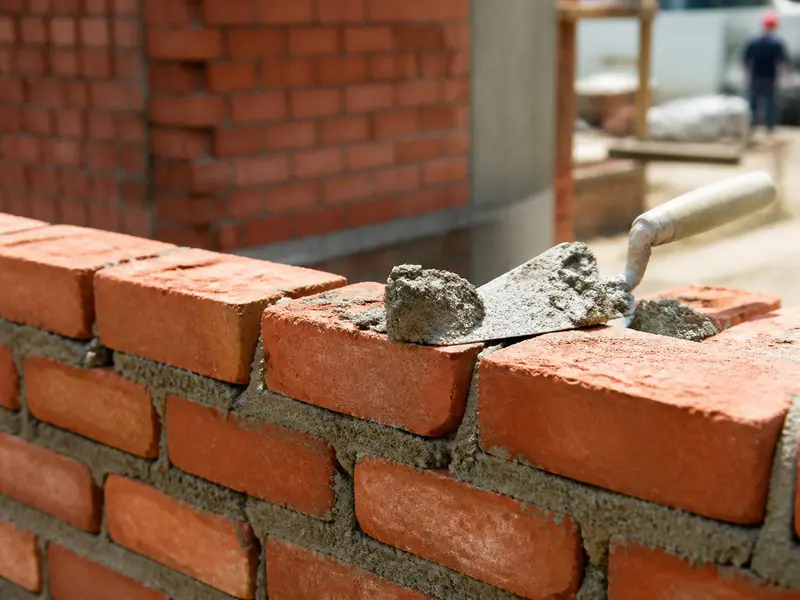
Brick Dimensional Architecture: Standard vs. Nominal Sizes
To calculate material requirements accurately, a civil engineer must distinguish between two primary dimensional profiles: Standard (Modular) Size and Nominal Size.
- Standard / Modular Size: This is the precise, dry structural dimension of the manufacturing mold of the brick itself, without any surrounding cement sand mortar.
- Nominal Size: This represents the combined structural envelope of the physical brick plus the thickness of the surrounding mortar joint on all bedding and vertical faces. The standard structural thickness allowance for a quality mortar joint on Indian and international construction sites is universally fixed at 10 mm (or approximately 1 cm).
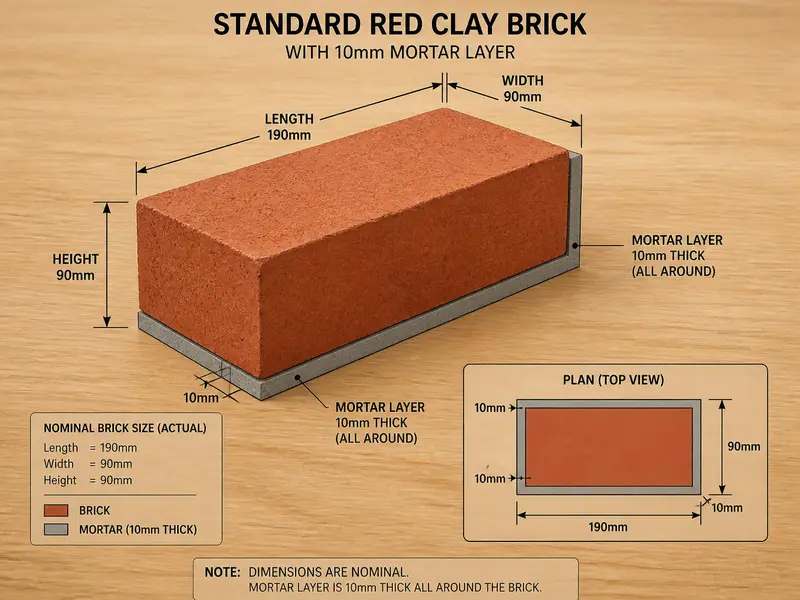
Comparative Dimensional Matrix for Standard Indian Brick Profiles
| Structural Parameter | Modular (Standard) Brick | Non-Modular (Traditional) Brick | Fly Ash Brick (Standard) | AAC Block (Standard Alternative) |
|---|---|---|---|---|
| Length (Without Mortar) | 190 mm (19 cm) | 230 mm (23 cm) | 230 mm (23 cm) | 600 mm (60 cm) |
| Width (Without Mortar) | 90 mm (9 cm) | 110 mm (11 cm) | 110 mm (11 cm) | 200 mm (20 cm) |
| Height (Without Mortar) | 90 mm (9 cm) | 70 mm (7 cm) | 75 mm (7.5 cm) | 200 mm (20 cm) |
| Mortar Joint Thickness | 10 mm (1 cm) | 10 mm (1 cm) | 10 mm (1 cm) | 3 mm to 5 mm (Thin Bed Mortar) |
| Nominal Length (With Mortar) | 200 mm (20 cm) | 240 mm (24 cm) | 240 mm (24 cm) | 603 mm (60.3 cm) |
| Nominal Width (With Mortar) | 100 mm (10 cm) | 120 mm (12 cm) | 120 mm (12 cm) | 200 mm (20 cm) |
| Nominal Height (With Mortar) | 100 mm (10 cm) | 80 mm (8 cm) | 85 mm (8.5 cm) | 205 mm (20.5 cm) |
Core Mathematical Formulas for Brickwork (Plain Text)
To ensure smooth importing into WordPress without breaking the Gutenberg block layout, all engineering estimations are conducted using plain-text mathematical operations.
- Volume of a Single Raw Brick (Without Mortar):
Brick Volume = Length x Width x Height - Nominal Volume of a Single Brick (With 10mm Mortar Joint):
Nominal Brick Volume = (Length + 0.01m) x (Width + 0.01m) x (Height + 0.01m)
(Note: 10 mm converted to meters is 0.01m) - Theoretical Number of Bricks in a Unit Volume:
Number of Bricks = Target Masonry Volume / Nominal Volume of One Single Brick - Total Total Masonry Wall Volume:
Wall Masonry Volume = Overall Length of Wall x Height of Wall x Architectural Wall Thickness - Net Mortar Volume Allocation:
Total Wet Mortar Volume = Total Wall Masonry Volume – (Actual Number of Bricks x Brick Volume Without Mortar) - Dry Mortar Volume Conversion Factor:
Dry Mortar Volume = Total Wet Mortar Volume x 1.33
(Where 1.33 accounts for the volumetric compression of dry sand grains when saturated with water).
Step-by-Step Derivation: How to Calculate Bricks in 1m³
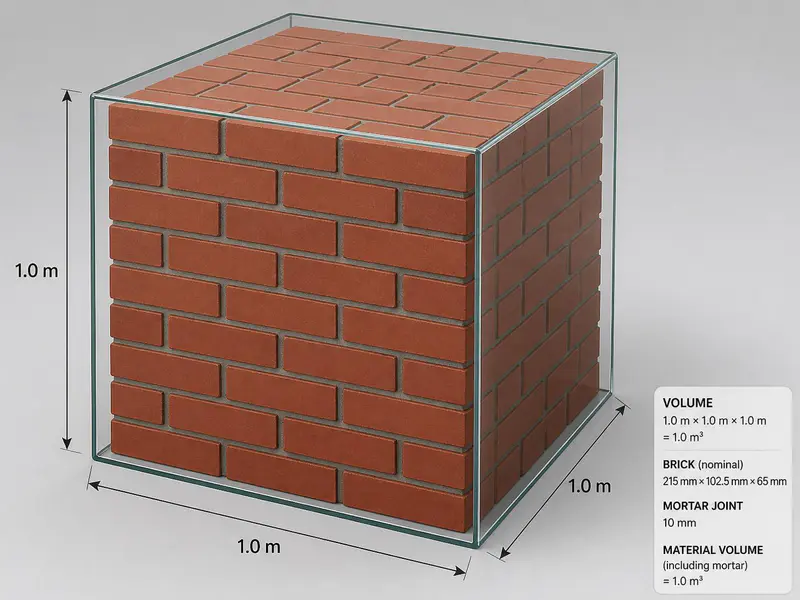
Let us derive the exact number of standard modular bricks contained within a space of exactly one cubic meter (1m³) of finished masonry wall structure.
Step 1: Standard Unit Conversion to Meters
- Length of Modular Brick = 190 mm = 0.19 meters
- Width of Modular Brick = 90 mm = 0.09 meters
- Height of Modular Brick = 90 mm = 0.09 meters
Step 2: Calculate the Nominal Brick Dimensions (Adding 10mm Mortar)
- Nominal Length = 0.19m + 0.01m = 0.20 meters
- Nominal Width = 0.09m + 0.01m = 0.10 meters
- Nominal Height = 0.09m + 0.01m = 0.10 meters
Step 3: Compute the Nominal Volume of One Brick
- Nominal Volume = 0.20m x 0.10m x 0.10m = 0.002 Cubic Meters
Step 4: Divide Total Unit Target Volume by Single Nominal Brick Volume
- Number of Bricks in 1m³ = 1 Cubic Meter / 0.002 Cubic Meters
- Number of Bricks in 1m³ = 500 Bricks
Step 5: Incorporate On-Site Wastage Factor (Engineering Realities)
On real-world jobsites, loading, unloading, sorting, and cutting bricks for structural corners create an average wastage rate of 5% to 10%.
- Design Brick Estimation (with 5% wastage) = 500 x 1.05 = 525 Bricks per 1m³
Real-World Site Examples with Concrete Numbers
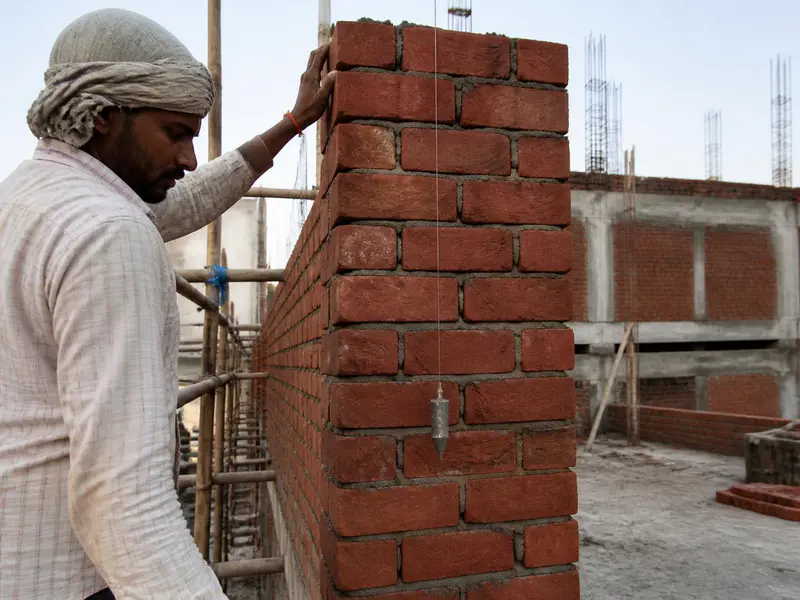
To apply these principles on-site, let us review two practical construction scenarios: a standard 9-inch exterior wall and a 4.5-inch internal partition wall.
Example A: Estimating a 9-Inch (230mm) Thick Exterior Perimeter Brick Wall
Suppose you need to build an exterior perimeter wall with the following dimensions:
- Length of Wall: 5.0 meters
- Height of Wall: 3.0 meters
- Thickness of Wall: 230 mm (Using standard non-modular traditional Indian bricks measuring 23cm x 11cm x 7cm)
Step 1: Calculate Total Masonry Wall Volume
- Thickness in meters = 230 mm / 1,000 = 0.23 meters
- Total Wall Volume = 5.0m x 3.0m x 0.23m = 3.45 Cubic Meters (Cum)
Step 2: Compute Nominal Single Non-Modular Traditional Brick Volume
- Actual Size = 0.23m x 0.11m x 0.07m
- Nominal Size (with 10mm mortar) = (0.23 + 0.01) x (0.11 + 0.01) x (0.07 + 0.01)
- Nominal Size = 0.24m x 0.12m x 0.08m = 0.002304 Cubic Meters
Step 3: Estimate the Base Brick Count
- Base Brick Requirement = 3.45 / 0.002304 = 1,497.39 Bricks
Step 4: Apply 7% Site Wastage Buffer
- Final Bricks to Order = 1497.39 x 1.07 = 1,602.21 -> Rounded up to 1,603 Bricks.
Example B: Estimating a 4.5-Inch (115mm) Thick Internal Partition Wall
Partition walls use a single layer of bricks laid lengthwise (stretcher bond). Let us calculate the materials needed for an interior bathroom partition wall:
- Length of Wall: 4.0 meters
- Height of Wall: 3.0 meters
- Thickness of Wall: 115 mm (Half-brick configuration using standard modular bricks)
Step 1: Calculate Total Volume of Partition Wall
- Thickness in meters = 115 mm / 1,000 = 0.115 meters
- Total Wall Volume = 4.0m x 3.0m x 0.115m = 1.38 Cubic Meters (Cum)
Step 2: Compute Nominal Single Modular Brick Volume
- Nominal Volume (as calculated in Section 3) = 0.002 Cubic Meters
Step 3: Estimate the Base Brick Count
- Base Brick Requirement = 1.38 / 0.002 = 690 Bricks
Step 4: Apply 5% Site Wastage Buffer
- Final Bricks to Order = 690 x 1.05 = 724.5 -> Rounded up to 725 Bricks.
Understanding brick calculation in wall helps engineers estimate materials accurately and plan construction work efficiently.
To understand plaster material estimation, read our guide on Cement Required for Plastering 100 Sq Ft Wall
Critical Engineering Unit Conversions
Material orders for construction sites often use a mix of volumetric measurements. Use this conversion table to verify delivery slips across metric, imperial, and regional Indian units.
Material Metric Transformation Reference Matrix
| Transform From Source | Convert To Target Metric | Exact Multiplier Factor |
|---|---|---|
| Cubic Meter (m³ or Cum) | Cubic Feet (CFT) | Multiply by 35.3147 |
| Cubic Feet (CFT) | Cubic Meter (m³) | Multiply by 0.02831 |
| Brass (Regional India Unit) | Cubic Feet (CFT) | 1 Brass = 100 Cubic Feet (CFT) |
| Brass (Regional India Unit) | Cubic Meter (m³) | 1 Brass = 2.8316 Cubic Meters |
| Square Meter (Sqm) | Square Feet (Sq. Ft.) | Multiply by 10.7639 |
| Average Weight of Red Brick | Kilograms (Kg) | 3.0 Kg to 3.5 Kg per brick |
| Average Density of Red Brick Masonry | Mass per Volume | 1,800 Kg to 1,920 Kg per m³ |
Site Quality Control, Workmanship Checks, & Wastage Mitigation
Even the most accurate calculations can fall short if quality control is neglected on-site. Poor masonry habits can lead to high material waste and structural issues. Enforce these guidelines during your daily site walkthroughs:
On-Site Quality Control Checklists
- The 1-Meter Field Drop Test: Randomly select three red clay bricks from an incoming delivery truck. Raise them horizontally to a height of exactly 1.0 meter and drop them onto a flat, unyielding concrete surface. A high-quality, properly fired structural brick must not break, fracture, or shatter upon impact. If multiple bricks crack open, reject the entire shipment.
- Metallic Ringing Acoustic Sound Verification: Strike two bricks together firmly on-site. They should produce a clear, sharp metallic ringing sound. A dull, heavy thud indicates under-burned clay, which lacks sufficient load-bearing capacity and will absorb too much water.
- Strict Mortar Bed thickness Limitations: Monitor your masonry crew using a sliding caliper or steel rule. Mortar joints must be maintained at a uniform thickness of 10 mm to 12 mm. If joints are allowed to swell to 15mm or 20mm to compensate for uneven brick sizes, the wall loses up to 25% of its structural compressive load capacity. This is because cement mortar is more flexible than fired clay.
- Checking Structural Plumb-Line Alignment: Every three courses, verify the vertical alignment using a heavy steel plumb-bob. A wall that is out-of-plumb requires thick coats of plaster later to look flat, which wastes cement and inflates the finish budget.
Practical Strategies to Minimize Material Wastage
- Pre-Wetting Beds (Frog Facing Upwards): Ensure bricks are laid with their pressed depression indentation (the frog) facing upward. The frog serves as a key for the mortar, providing a strong mechanical bond.
- Thorough Water Saturation Before Laying: Submerge bricks in water tanks for at least two hours before placing them on the mortar bed. Dry bricks absorb water rapidly from fresh mortar, leaving the cement without enough moisture to hydrate properly. This leads to a weak, powdery bond that can cause the mortar joints to crumble.
- Collecting Fallen Mortar (Rebound Control): Lay clean canvas sheets or plastic tarpaulins along the base of the wall being built. Clean mortar that falls during troweling can then be collected and re-mixed immediately, keeping mortar waste below 3%.
Frequently Asked Questions (FAQs) – SEO Feature
Q1: Why do traditional non-modular red bricks require a different calculation than modular bricks?
Modular bricks are designed to fit clean metric dimensions (including a 10mm mortar joint), making them simpler to calculate. Traditional non-modular bricks vary by region across India and international markets to accommodate local manufacturing molds. Because they are typically larger, you must use their specific regional dimensions in your volume calculations to avoid under-ordering materials.
Q2: How many bricks are required for a 100 square foot wall area?
The number of bricks depends entirely on the thickness of the wall. For a standard 4.5-inch thick internal wall, you will need approximately 450 to 500 standard modular bricks. For a 9-inch thick exterior structural wall, that number doubles to between 900 and 1,000 bricks per 100 square feet, plus an allowance for site wastage.
Q3: What is the purpose of the structural indentation (frog) on a brick surface?
The frog serves two key engineering purposes. First, it acts as a mechanical key that locks the mortar bed to the brick, preventing lateral shifting. Second, manufacturers use it to stamp their brand logo or yard name into the brick for quality tracking.
Q4: Can I replace traditional red clay bricks with fly ash bricks using the same formulas?
Yes. The mathematical steps remain identical, but you must plug in the exact physical dimensions of the fly ash bricks you choose. Fly ash bricks are typically more uniform in shape than red clay bricks, which often allows you to reduce your site wastage allowance from 7% down to under 4%.
Q5: How does a high water absorption rate affect brick masonry?
High-quality structural bricks should absorb less than 20% of their dry weight in moisture. Bricks that absorb too much water pull moisture out of fresh mortar, which disrupts the hydration of the cement. This results in a brittle mortar joint, surface efflorescence (salty white patches), and eventual plaster peeling.
According to Bureau of Indian Standards (BIS) guidelines, modular bricks are commonly used in building construction in India.
Conclusion
Accurate brick calculation in wall construction balances engineering theory with practical on-site management. A standard metric calculation shows that 500 modular bricks match exactly one cubic meter (1m³) of finished wall masonry. However, to account for real-world handling and cutting waste, you should apply a 5% to 7% buffer when placing orders.
To keep your project on budget, look beyond simple material calculations. Enforce uniform 10mm mortar joints, pre-wet your bricks thoroughly to ensure a strong bond, and inspect incoming deliveries for durable, well-fired materials. Spending a little extra time on these quality checks creates a solid foundation for a safe, enduring structure.

Shakeel T is a qualified Civil Engineer and Structural Consultant with extensive on-site experience in residential and commercial building construction. Specializing in material estimation, cost budgeting, and structural safety guidelines, he has successfully managed multiple real estate projects from foundation to finishing. Through this blog, Shakeel shares field-tested civil engineering thumb rules, IS Code practices, and practical site tips to help home builders execute their projects efficiently and within budget.
Education: Diploma in Civil Engineering
Expertise: Quantity Surveying, Material Estimation, Structural Design, and Site Management.