
Introduction
Planning to construct your dream home is an exciting milestone, but it quickly introduces a mountain of logistics. One of the most critical questions every homebuilder, contractor, and real estate developer faces during the pre-construction phase is: How many bricks do I need? Overestimating leads to dead capital and cluttered job sites, while underestimating stalls labor, pushes out timelines, and inflates transportation costs through emergency, small-batch material orders.
For a standard 1BHK house with a carpet area of 450 to 500 square feet, you will typically need between 11,000 and 15,000 standard bricks. However, relying purely on broad thumb rules can be dangerous for your project budget.
This comprehensive guide breaks down the precise mathematical formulas, provides a step-by-step real-world calculation example, covers essential unit conversions, and outlines the critical on-site engineering quality checks required to optimize your material procurement.
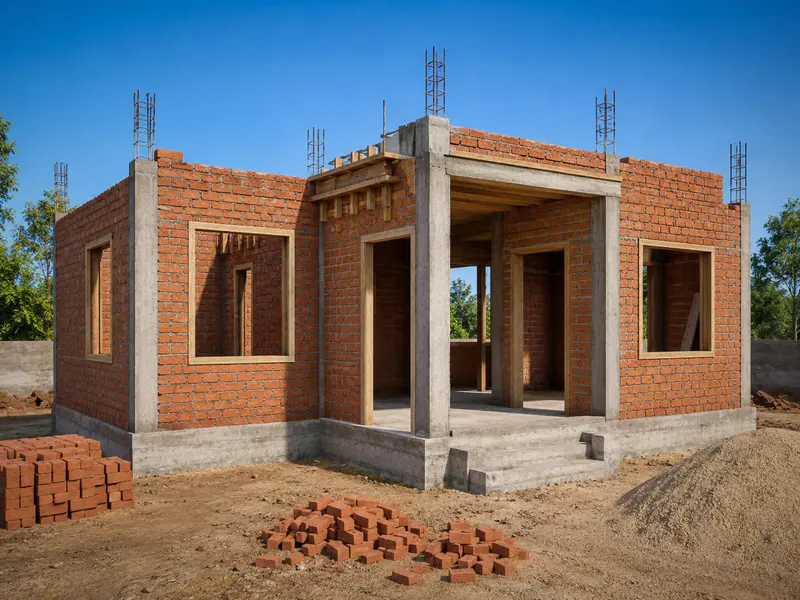
Why Precise Brick Estimation Matters
In masonry construction, bricks form the structural backbone of your building. Even in modern reinforced concrete framework (RCC) structures, infill brick masonry determines the thermal insulation, acoustic performance, dead load calculations, and total cost of the superstructure.
Accurately calculating the Bricks Required for 1BHK House allows you to:
- Control Your Budget: Materials account for up to 60% of total construction costs. Precise numbers prevent overspending.
- Streamline Logistics: Coordinate exact delivery schedules, ensuring your site has adequate storage without blocking workflow paths.
- Determine Mortar Quantities: The number of bricks directly dictates the volume of cement and sand required for the binding mortar.
- Minimize Wastage: Understanding standard handling and cutting wastage protects you from shortfalls.
Read Also 👉 To understand wall volume calculation in detail, you can also read our guide on Brick Masonry Calculator
Read Also 👉 Construction Cost per Sq Ft in India
Technical Specifications: The Dimensions Explained
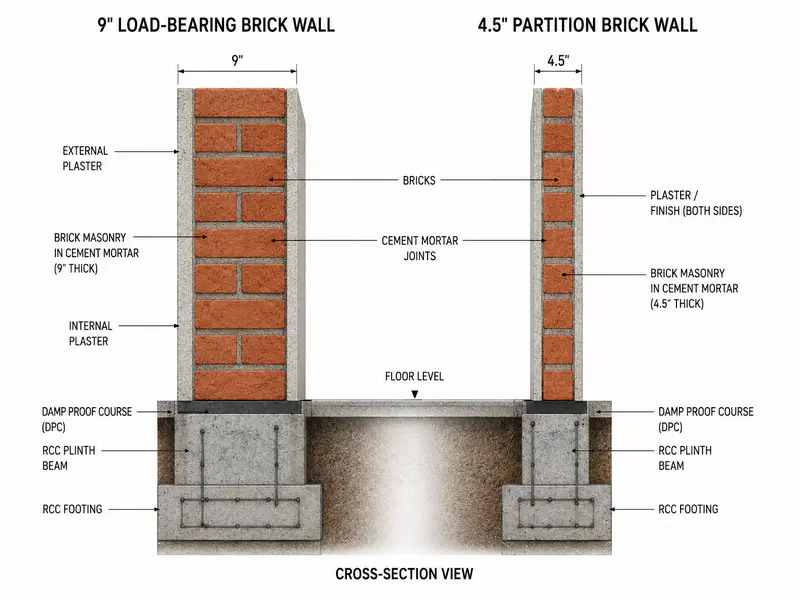
Before diving into equations, we must establish standard dimensions. Across many countries, including India and parts of South Asia, the traditional, non-modular red clay brick remains the baseline standard.
1. Standard Brick Dimensions (Without Mortar)
- Length: 9 inches (228.6 mm or 0.2286 meters)
- Width: 4.5 inches (114.3 mm or 0.1143 meters)
- Height: 3 inches (76.2 mm or 0.0762 meters)
2. Nominal Brick Dimensions (With Mortar)
When laying bricks on-site, a standard mortar joint thickness of 10 mm (approx. 0.4 inches) is maintained between courses. Adding this thickness yields the nominal size used for spatial volume calculations:
- Nominal Length: 9.4 inches (238.6 mm or 0.2386 meters)
- Nominal Width: 4.9 inches (124.3 mm or 0.1243 meters)
- Nominal Height: 3.4 inches (86.2 mm or 0.0862 meters)
Core Mathematical Formulas (Plain Text)
To implement this on your own blueprints, use the following engineering formulas. Note that all dimensions must remain in the same unit family (either entirely metric or entirely imperial) throughout the steps.
Formula 1: Total Wall Volume = Total Wall Length x Wall Height x Wall Thickness

Formula 2: Opening Deductions = Sum of (Door Length x Door Height x Wall Thickness) + Sum of (Window Length x Window Height x Wall Thickness)

Formula 3: Net Masonry Volume = Total Wall Volume - Opening Deductions

Formula 4: Volume of Single Nominal Brick = Nominal Length x Nominal Width x Nominal Height

Formula 5: Initial Brick Quantity = Net Masonry Volume / Volume of Single Nominal Brick

Formula 6: Total Procurement Quantity = Initial Brick Quantity x (1 + (Wastage Percentage / 100))
Use code with caution.
Comprehensive Step-by-Step 1BHK Calculation Example
Let us simulate a real-world civil engineering scenario for a standard 450-square-foot carpet area 1BHK house plan.
Step 1: Establish the Architectural Blueprint Parameters
Assume a typical floor plan layout consisting of one living room, one bedroom, one kitchen, and one attached bathroom. The walls are categorized into load-bearing/outer perimeter walls and interior partition walls.
- Outer Walls Thickness: 9 inches (0.75 feet or 0.2286 meters)
- Inner Partition Walls Thickness: 4.5 inches (0.375 feet or 0.1143 meters)
- Clear Ceiling Height: 10 feet (3.048 meters)
- Total Running Length of Outer Walls: 120 feet (36.576 meters)
- Total Running Length of Inner Walls: 50 feet (15.24 meters)
Step 2: Compute Gross Wall Volumes
We will perform calculations using imperial units (Cubic Feet or CFT) as it is the most common billing metric used by local suppliers.
Outer 9-inch Walls:
- Gross Volume = 120 feet (Length) x 10 feet (Height) x 0.75 feet (Thickness)
- Gross Outer Volume = 900 Cubic Feet (CFT)
Inner 4.5-inch Walls:
- Gross Volume = 50 feet (Length) x 10 feet (Height) x 0.375 feet (Thickness)
- Gross Inner Volume = 187.5 Cubic Feet (CFT)
Total Gross Volume:
- Total Gross Volume = 900 + 187.5
- Total Gross Volume = 1,087.5 CFT
Step 3: Deduct Structural Openings (Doors, Windows, Lintel Beams)
Solid brickwork does not span across window frames, door entries, or structural concrete lintel beams. Leaving these out would over-calculate your materials by 15% to 20%.
Assume the following opening schedule for our 1BHK layout:
- Main Door (1 No.): 3.5 ft x 7 ft x 0.75 ft = 18.375 CFT
- Bedroom Door (1 No.): 3 ft x 7 ft x 0.375 ft = 7.875 CFT
- Bathroom Door (1 No.): 2.5 ft x 7 ft x 0.375 ft = 6.562 CFT
- Living Room Window (1 No.): 4 ft x 4 ft x 0.75 ft = 12.000 CFT
- Bedroom Window (1 No.): 4 ft x 4 ft x 0.75 ft = 12.000 CFT
- Kitchen Window (1 No.): 3 ft x 3 ft x 0.75 ft = 6.750 CFT
- Concrete Lintel Beams (Continuous over walls): Approx. 45 CFT total displacement.
Total Deductions Calculation:
- Total Deductions = 18.375 + 7.875 + 6.562 + 12.000 + 12.000 + 6.750 + 45.000
- Total Volume to Deduct = 108.562 CFT
Step 4: Calculate Net Masonry Volume
- Net Masonry Volume = Total Gross Volume – Total Volume to Deduct
- Net Masonry Volume = 1,087.5 CFT – 108.562 CFT
- Net Masonry Volume = 978.938 CFT
Step 5: Determine Bricks Required Per Unit Volume
Let us convert a single nominal brick size into cubic feet to see how many sit inside one CFT.
- Single Nominal Brick Size = 9.4 inches x 4.9 inches x 3.4 inches
- In feet = (9.4 / 12) x (4.9 / 12) x (3.4 / 12)
- In feet = 0.783 ft x 0.408 ft x 0.283 ft
- Volume of 1 Nominal Brick = 0.0904 Cubic Feet
To find the number of bricks per cubic foot:
- Bricks per 1 CFT = 1 / 0.0904
- Bricks per 1 CFT = 11.06 Bricks (Commonly rounded to 11.1 bricks/CFT in field engineering manuals)
Step 6: Final Quantity Multiplication and Wastage Allocation
Multiply your net masonry volume by the brick density factor:
- Initial Brick Requirement = 978.938 CFT x 11.06 bricks/CFT
- Initial Brick Requirement = 10,827 Bricks
Every construction site experiences structural wastage due to transit fractures, unloading breaks, and cutting bricks into halves or quarters to maintain bond patterns (like the English or Flemish bond). A standard 7% site wastage factor is ideal.
- Final Procurement Quantity = 10,827 x 1.07
- Final Procurement Quantity = 11,584.89 Bricks
- Final Order Rounded Target = 11,600 Bricks
Unit Conversions Matrix
Material billing terminology shifts rapidly depending on your location and supplier networks. Use this reference grid to transform volumetric calculations seamlessly.
| Target Volume Unit | Equivalent in Cubic Feet (CFT) | Equivalent in Cubic Meters (CUM) | Average Bricks Needed (Without Wastage) |
|---|---|---|---|
| 1 Cubic Meter (CUM) | 35.314 CFT | 1.000 CUM | 392 Bricks |
| 1 Cubic Foot (CFT) | 1.000 CFT | 0.0283 CUM | 11 Bricks |
| 1 Brass (Standard Indian Unit) | 100.000 CFT | 2.831 CUM | 1,110 Bricks |
| 1000 Bricks Volume Equivalency | 90.41 CFT | 2.56 CUM | 1,000 Bricks |
Essential Site Quality Controls & Material Checklist
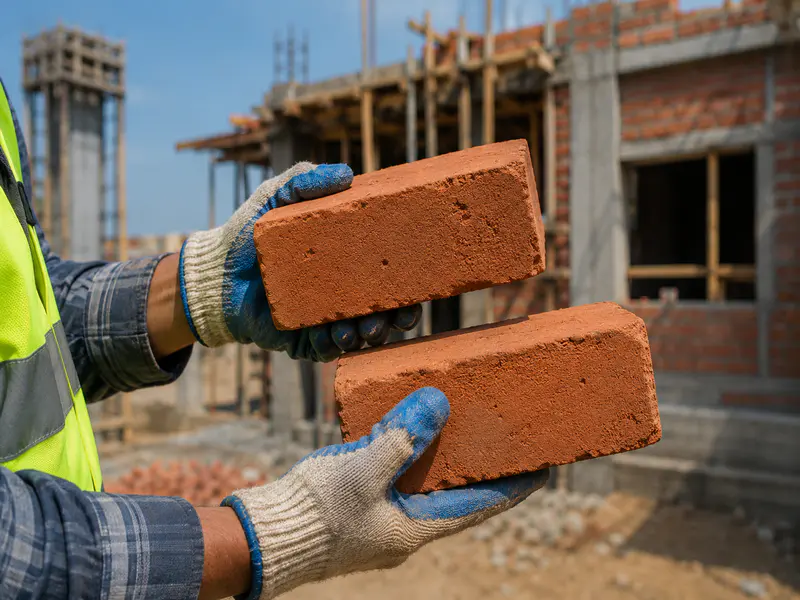
Sourcing the correct quantity of Bricks Required for 1BHK House is only half the battle. If your site team allows subpar materials past the gate, structural integrity compromises instantly. Run these simple, field-tested quality audits when deliveries drop.
1. The Hardness & Metallic Sound Test
Pick up two random bricks from a delivery truck and strike them flat against each other. High-quality, well-burnt Class-A clay bricks must emit a clear, sharp metallic ringing sound. If they produce a dull, thudding sound, it points to under-firing in the kiln. These bricks will crumble easily under loads.
2. The Structural Drop Test
Hold a brick at chest height approximately 1 meter or 3 feet above the ground and drop it flat onto a hard, compacted dirt surface. A structurally sound brick with zero internal micro-cracks or air pockets must survive the impact without snapping or fracturing into fragments.
3. Visual and Dimensional Uniformity Check
A crisp, neat mortar joint relies on uniform brick edges. Line up 10 random sample bricks side by side. Measure variations in length, width, and height. High-grade bricks should not vary by more than 3 mm to 5 mm from one another. Ensure they exhibit sharp, straight edges and are free from deep cracks, organic matter contamination, or large air holes.
4. Water Absorption Test (Laboratory or On-Site Pail Check)
Weigh a dry brick sample on a scale and note its weight as W1. Submerge this brick completely in a bucket of clean water for 24 hours. Remove it, wipe off surface moisture with a cloth, and weigh it again as W2.
Calculate water absorption using this formula:Percentage = ((W2 - W1) / W1) x 100
- First-Class Bricks: Must absorb less than 20% of their dry weight.
- Warning Sign: If the brick absorbs 25% or more, it will suck water away from your wet cement mortar after placement, leaving the joints weak, powdery, and highly prone to future water seepage and dampness.
Frequently Asked Questions (FAQs)
How many bricks are needed for a 1BHK house on average?
On average, a standard 1BHK house with a built-up footprint between 450 and 550 square feet requires 11,000 to 15,000 bricks. This fluctuates based on total ceiling height, the ratio of 9-inch outer walls to 4.5-inch inner partition walls, and the total surface area of your windows and doors.
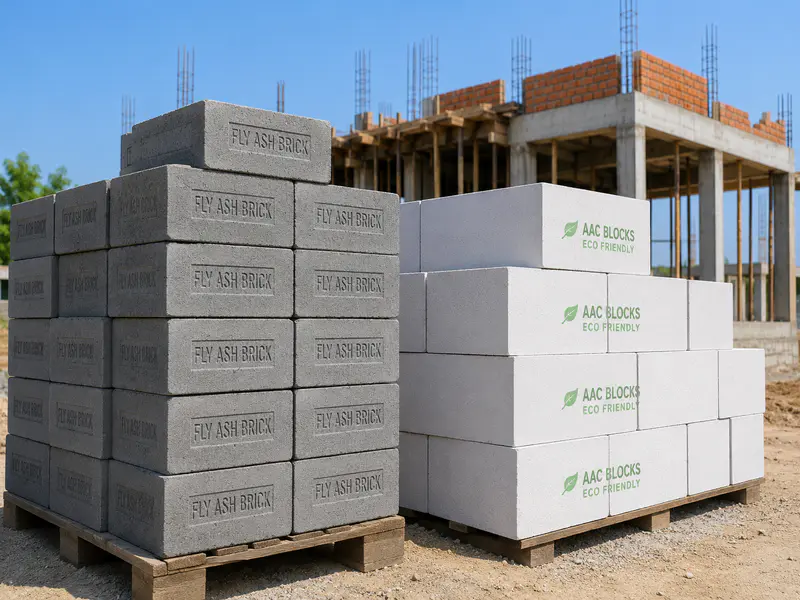
Can I use Fly Ash bricks instead of Red Clay bricks for a 1BHK?
Yes. Fly ash bricks are an excellent, eco-friendly alternative to red clay bricks. They are manufactured uniformly in machine molds, which means they have perfectly straight edges and zero structural warping. This high dimensional accuracy reduces the thickness of the plaster layer needed later, saving you money on cement and sand.
What is the standard ratio of cement and sand mortar for brickwork?
For load-bearing 9-inch thick outer walls, use a 1:6 cement-to-sand ratio (1 part cement mixed with 6 parts clean river or manufactured sand). For thinner 4.5-inch internal partition walls, step up the strength to a 1:4 cement-to-sand ratio to ensure proper structural stability, as these walls are thin and require a stronger internal bond.
How do I calculate the amount of cement and sand required for my brickwork?
As a proven site engineering rule of thumb, mortar occupies roughly 25% to 30% of the total volume of your brick masonry structure. Once you know your net masonry volume, calculate 30% of that figure to find the wet mortar volume. Multiply this value by a dry shrinkage factor of 1.33, and then divide it based on your cement-sand mix ratio to find the exact number of cement bags and sand units needed.
Why do some bricks turn white after construction?
This phenomenon is called efflorescence. It happens when the raw clay used to make the bricks contains high concentrations of soluble salts. When the bricks get wet from rain or plastering, these salts dissolve, migrate to the surface as the moisture evaporates, and crystallize into an unsightly white powder. You can prevent this by running a water quality check and testing your bricks for efflorescence before laying them.
According to the Bureau of Indian Standards (BIS), modular bricks are commonly used in construction in India.
Conclusion
Calculating the precise number of Bricks Required for 1BHK House prevents expensive material management mistakes on-site. By measuring wall volumes, deducting structural window and door openings, and adding a safe 7% allowance for site cutting wastage, you can place material orders confidently. Always combine rigorous math with on-site quality controls like checking for clear metallic sounds and verifying water absorption rates to ensure your building stands strong for generations.

Shakeel T is a qualified Civil Engineer and Structural Consultant with extensive on-site experience in residential and commercial building construction. Specializing in material estimation, cost budgeting, and structural safety guidelines, he has successfully managed multiple real estate projects from foundation to finishing. Through this blog, Shakeel shares field-tested civil engineering thumb rules, IS Code practices, and practical site tips to help home builders execute their projects efficiently and within budget.
Education: Diploma in Civil Engineering
Expertise: Quantity Surveying, Material Estimation, Structural Design, and Site Management.