
Introduction
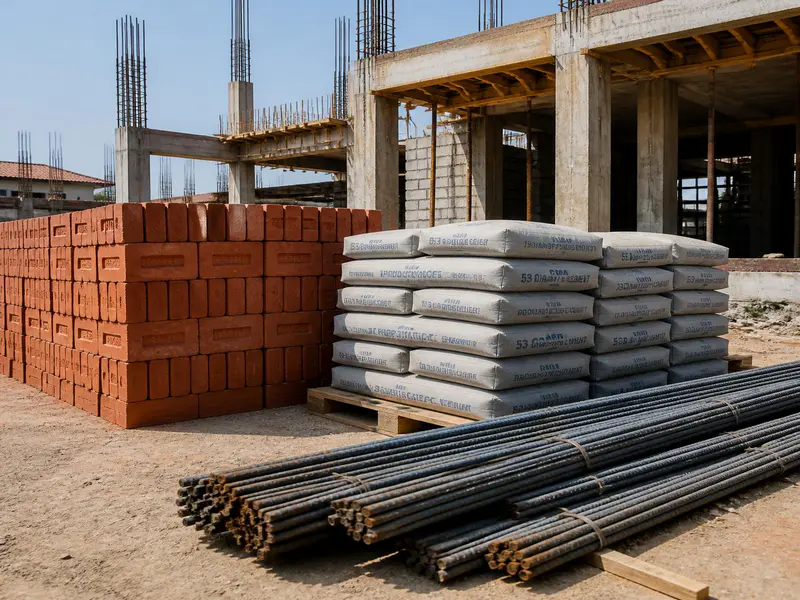
Building a dream home is one of the most significant financial and personal milestones in a person’s life. However, stepping into the construction landscape without a structured plan is a recipe for budget overruns, material delays, and structural compromises. A house is a complex assembly of multiple elements working together to provide safety, durability, and comfort. To execute this assembly flawlessly, you need a comprehensive master plan starting with an exhaustive, highly detailed building materials List for house projects.
As an experienced civil engineer, I have witnessed firsthand how minor oversights in material planning cascade into massive bottlenecks. Ordering the wrong grade of steel, miscalculating concrete volumes, or failing to check basic on-site material quality can stall work and drain your bank account.
This definitive guide acts as your master roadmap. It breaks down every critical component of a standard building materials List for house construction, provides essential mathematical estimation formulas, outlines field testing methodologies, and details critical safety factors to ensure your residential build is structurally sound and financially optimized.
Classification of House Construction Stages
A residential construction project is systematically divided into two major phases: the Grey Structure (Substructure and Superstructure) and the Finishing Stage. Understanding these phases allows you to procure materials progressively, maintaining optimal site inventory levels without tying up all your capital upfront.
Substructure and Superstructure (The Grey Structure)
The grey structure forms the skeleton of your house. It is the most vital phase for long-term structural integrity and includes all works from excavation up to the roof slab casting.
- Cement: The binding agent used in concrete, brickwork mortar, and plastering. Portland Pozzolana Cement (PPC) and Ordinary Portland Cement (OPC 43 and 53 grades) are the standard choices.
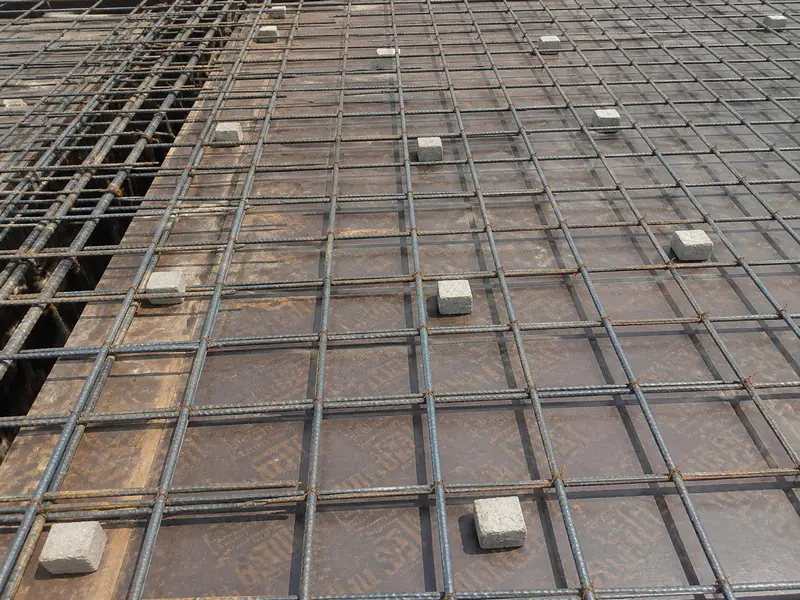
- Reinforcement Steel (Rebars): High-strength steel bars that handle tension forces inside concrete. Thermo-Mechanically Treated (TMT) bars of Fe 500 or Fe 550 grades are industry benchmarks for residential builds.
- Fine Aggregates (Sand): Used in concrete, mortar, and plaster. River sand is traditionally preferred, but Manufactured Sand (M-Sand) is now widely used due to ecological and quality consistency benefits.
- Coarse Aggregates (Crushed Stone): Angular broken stones that provide mechanical interlocking and volume to concrete. Standard structural sizes used are 20mm and 10mm.
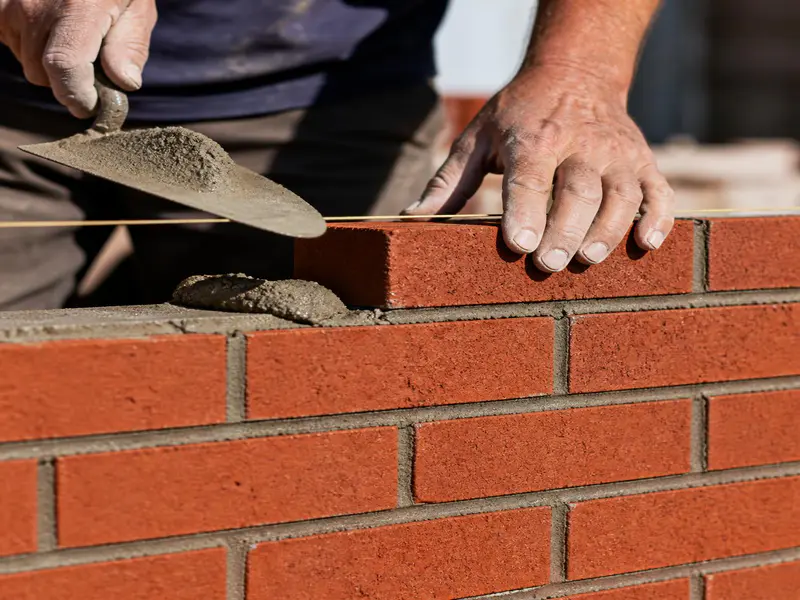
- Bricks or Concrete Blocks: Used for building load-bearing or partition walls. Options include traditional red clay bricks, Fly Ash bricks, or Autoclaved Aerated Concrete (AAC) blocks.
- Binding Wire: Annealed mild steel wire (usually 18-gauge) used to secure intersecting reinforcement bars firmly in position before casting.
- Admixtures: Chemical compounds added to concrete mixes to modify properties, such as water-reducers to increase workability or waterproofers to block capillary action in foundations.
Finishing and Fitting Materials
Once the concrete shell is ready, the finishing phase transforms it into a liveable home. This stage dictates the aesthetic feel and user comfort.
- Flooring Materials: Vitrified tiles, ceramic tiles, natural marble, granite, or wooden laminates.
- Wall Finishes & Paints: Wall putty, primer coatings, interior acrylic emulsions, and weather-proof exterior paints.
- Plumbing Systems: Chlorinated Polyvinyl Chloride (CPVC) pipes for hot/cold internal water supply, PVC pipes for drainage, sanitary ware, and chrome-plated fixtures.
- Electrical Systems: Concealed PVC conduits, Fire-Retardant Low-Smoke (FRLS) copper wiring, distribution boards, MCBs, and modular switches.
- Doors and Windows: Solid timber or flush doors for interiors, reinforced steel or heavy-duty UPVC/aluminum frames for windows, and high-quality hardware locks.
- Waterproofing Compounds: Liquid acrylic or elastomeric coatings applied to roofs, balconies, and bathrooms to eliminate moisture ingress.
Core Mathematical Formulas for Material Estimation
To avoid relying blindly on local contractors, every homeowner and site executive must know how to run foundational material math. Below are the standard plain-text engineering formulas used to estimate essential raw building materials.
Concrete Ingredient Proportions
Concrete is mixed by volume ratios (e.g., M20 mix = 1 : 1.5 : 3). To find the exact bags of cement, sand, and stone needed:
- Total Wet Volume = Length x Width x Depth
- Dry Volume of Concrete = Wet Volume x 1.54
(Note: Ingredients shrink significantly when water is added to a dry mix. 1.54 is the standard constant factor used to compensate for this volume reduction).
Brickwork and Mortar Volumes
- Total Volume of Wall = Length x Height x Thickness
- Dry Volume of Mortar = Wet Volume of Mortar x 1.33
(Note: 1.33 is the volume conversion factor for dry mortar powder to wet paste).
Structural Steel Weight Calculation
- Weight of Steel Bar per Meter = (D x D) / 162
(Where D is the nominal diameter of the steel rebar measured in millimeters. The result yields weight in kilograms per running meter).

Bosch Professional Laser Distance Measurer
Check Price on AmazonDisclosure: This is an affiliate link. If you purchase through this link, CivilGuide.in may earn a small commission at no additional cost to you.
Practical Material Estimation Examples with Real Numbers
Let us apply these formulas to real-world residential scenarios to see exactly how material calculations unfold on a construction site.
Example 1: Estimating Concrete Materials for a Foundation Footing
You need to cast 8 isolated concrete footings for a residential building. Each footing has the following physical dimensions:
- Length = 1.5 meters
- Width = 1.5 meters
- Depth = 0.4 meters
- Concrete Mix Ratio Specified = M20 (1 Part Cement : 1.5 Parts Sand : 3 Parts Aggregate)
Step-by-Step Calculation:
- Calculate Total Wet Volume:
Wet Volume for 1 Footing = 1.5 x 1.5 x 0.4 = 0.9 Cubic Meters (m3)
Total Wet Volume for 8 Footings = 0.9 x 8 = 7.2 Cubic Meters - Calculate Total Dry Volume Required:
Dry Volume = 7.2 x 1.54 = 11.088 Cubic Meters - Sum of the Proportional Parts:
Sum of Ratio = 1 + 1.5 + 3 = 5.5 - Calculate Cement Quantity Needed:
Volume of Cement = (1 / 5.5) x 11.088 = 2.016 Cubic Meters
Since 1 standard bag of cement (50 kg) occupies exactly 0.035 cubic meters:
Total Cement Bags Required = 2.016 / 0.035 = 57.6 Bags (Round up to 58 Bags) - Calculate Sand Quantity Needed:
Volume of Sand = (1.5 / 5.5) x 11.088 = 3.024 Cubic Meters - Calculate Coarse Aggregate Quantity Needed:
Volume of Coarse Aggregate = (3 / 5.5) x 11.088 = 6.048 Cubic Meters
Example 2: Estimating Steel Weight for a Roof Slab Layout
A reinforcement plan for a small room roof slab calls for 60 pieces of 10mm diameter TMT steel bars, with each bar cut to a length of 5.5 meters. You need to order this steel from a supplier who bills strictly by weight.
Step-by-Step Calculation:
- Find the Unit Weight of a 10mm Steel Bar:
Unit Weight = (10 x 10) / 162 = 100 / 162 = 0.617 Kilograms per meter (kg/m) - Calculate Total Length of Steel Required:
Total Length = 60 bars x 5.5 meters = 330 meters - Calculate Total Weight to Order:
Total Weight = 330 meters x 0.617 kg/m = 203.61 Kilograms (or 2.036 Quintals)
Example 3: Estimating Bricks and Mortar for a Partition Wall
You are planning to build a 230mm thick brick wall to divide an indoor space. The dimensions are:
- Wall Length = 6.0 meters
- Wall Height = 3.0 meters
- Wall Thickness = 0.23 meters
- Standard Modular Brick Size = 0.19m x 0.09m x 0.09m
- Nominal Brick Size with 10mm Mortar Joint = 0.20m x 0.10m x 0.10m
- Mortar Mix Ratio = 1 : 4 (1 Part Cement to 4 Parts Sand)
Step-by-Step Calculation:
- Calculate Total Volume of the Wall Structure:
Wall Volume = 6.0 x 3.0 x 0.23 = 4.14 Cubic Meters - Calculate Volume of One Nominal Brick (with mortar):
Nominal Brick Volume = 0.20 x 0.10 x 0.10 = 0.002 Cubic Meters - Calculate Number of Bricks Needed:
Total Bricks = 4.14 / 0.002 = 2,070 Bricks
(Allowing 5% handling/cutting wastage: 2,070 x 1.05 = 2,174 Bricks) - Calculate Net Net Volume of Bricks Without Mortar:
Actual Volume of 2,070 Bricks = 2,070 x (0.19 x 0.09 x 0.09) = 2,070 x 0.001539 = 3.185 Cubic Meters - Calculate Wet Volume of Mortar Paste:
Wet Mortar Volume = Total Wall Volume – Actual Brick Volume
Wet Mortar Volume = 4.14 – 3.185 = 0.955 Cubic Meters - Calculate Dry Volume of Mortar Powder Required:
Dry Mortar Volume = 0.955 x 1.33 = 1.270 Cubic Meters - Calculate Cement Bags for Mortar:
Sum of Ratio = 1 + 4 = 5
Volume of Cement = (1 / 5) x 1.270 = 0.254 Cubic Meters
Total Cement Bags = 0.254 / 0.035 = 7.25 Bags (Round up to 8 Bags) - Calculate Sand for Mortar:
Volume of Sand = (4 / 5) x 1.270 = 1.016 Cubic Meters
Key Material Unit Conversions Reference
Building materials are measured in different metrics. Manufacturers sell cement in bags, steel in metric tons, sand in cubic feet or brass, and tiles in square meters. Master these conversion factors to check supplier delivery slips accurately.
Comprehensive Unit Conversion Table
| From Unit | To Unit | Multiplication Factor | Real-World Application |
|---|---|---|---|
| Cubic Meters (m3) | Cubic Feet (CFT) | 35.3147 | Converting metric blueprint dimensions to local sand truck capacities |
| Cubic Meters (m3) | Brass | 0.3531 | Evaluating large scale excavation, soil, or aggregate supply bills |
| Brass | Cubic Feet (CFT) | 100.00 | Local trade metric where 1 Brass equals exactly 100 CFT |
| Kilograms (kg) | Metric Tons (MT) | 0.0010 | Processing wholesale mill invoices for bulk structural steel reinforcement |
| Kilograms (kg) | Quintals | 0.0100 | Checking weights of local structural steel tie bundles |
| Square Meters (m2) | Square Feet (sq ft) | 10.7639 | Calculating tiling, granite countertops, or plaster painting surface areas |
| Millimeters (mm) | Inches | 0.0393 | Cross-referencing metric tool measurements with imperial pipe sizes |
To make this process easier, the CivilGuide Brick Masonry Calculator helps engineers
On-Site Quality Control Tests and Wastage Management
A material list is only effective if the materials delivered meet standard civil engineering specifications. Here are easy, practical on-site quality tests you can perform without heavy laboratory equipment, along with realistic allowance factors for wastage.
Quick On-Site Material Quality Checks
- The Cement Field Test: Open a random bag of cement and thrust your hand inside. It must feel cool to the touch. Take a pinch of the powder and rub it between your fingers; it should feel smooth like flour, not gritty. Drop a small handful of cement into a bucket of water high quality cement should float momentarily before sinking.
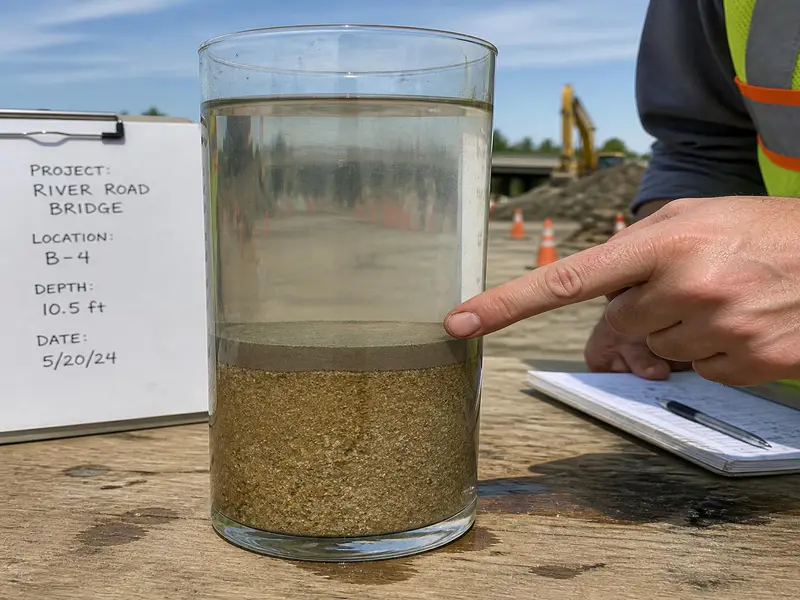
- The Sand Silt Content Test: Sand containing more than 6% to 8% clay or silt weakens concrete and mortar bonds. Take a clear glass measuring cylinder or jar, fill it half with sand, and add clean water along with a pinch of common salt. Shake vigorously and let it settle for 3 hours. The silt layer will form a distinct band on top of the sand layer. Measure its thickness relative to the total sand height.
- The Steel Rebar Bend Test: Take a sample piece of reinforcement steel bar and bend it to 180 degrees. Look closely at the bent outer radius. It should show absolutely no micro-fractures, cracks, or structural tearing. If it cracks, the steel is brittle and unsafe for high-stress zones like columns or beams.
- The Brick Ring Test: Take two raw bricks and strike them against each other firmly. A well-burnt, high-quality clay brick will produce a clear, metallic, high-pitched ringing sound without chipping or cracking.
Standard Material Wastage Control Allowances
Wastage is an inevitable reality on active construction sites due to cutting, transport handling, and storage losses. When budgeting, apply these standard engineering wastage percentages over your net calculated totals:
- Structural Steel (TMT Bars): 3% to 5% (Primarily due to scrap cut-pieces generated during bar bending schedules).
- Ready-Mix or On-Site Concrete: 2% to 3% (Caused by transport spillage, uneven ground leveling, and concrete pump pipe remainders).
- Bricks and Blocks: 5% to 8% (Resulting from drop damage during offloading, manual transit, and cutting half-bricks for edge bonds).
- Fine Sand and Coarse Aggregates: 5% (Due to wind losses, washing out during rain, and mixing into the unpaved site ground soil).
- Ceramic and Vitrified Tiles: 8% to 10% (Caused by structural corner cuts, pattern matching layouts, and handling breaks).
Real-World Engineering Precautions for Storage
- Elevate Your Cement Storage: Never stack cement bags directly on a bare concrete or dirt floor. Moisture travels through ground capillaries, causing the cement to undergo premature hydration (lump formation). Store bags on an elevated wooden platform at least 6 inches off the ground, and keep them 12 inches away from external brick walls.
- Prevent Rebar Corrosion: Store reinforcing steel bars off the ground on concrete sleepers or timber blocks. Cover them with weatherproof tarpaulins if structural casting is delayed by more than two weeks. Superficial light brown rust is acceptable, but deep, flaking rust reduces the structural cross sectional area of the bar.
- Check Batch Variations in Tiles: Always purchase the entire required quantity of flooring tiles or marble blocks from a single production batch or lot. Different manufacturing batches often have subtle color tone or shade variations that become highly noticeable once laid across a wide room floor.
Frequently Asked Questions (FAQs)
What is the difference between OPC and PPC cement, and where should they be used?
Ordinary Portland Cement (OPC) develops strength rapidly and is ideal for fast-paced structural members like columns, beams, and high-rise roof slabs. Portland Pozzolana Cement (PPC) releases less heat during curing, offers high resistance to chemical attacks, and gains strength progressively over time. PPC is highly recommended for residential foundations, brickwork masonry, plastering, and wet areas like bathrooms.
Which grade of steel rebar is best suited for building a house?
For standard residential houses (G+1 or G+2 structures), Fe 500 or Fe 500D TMT bars provide the ideal balance between high yield strength and excellent structural ductility. Higher grades like Fe 600 are typically reserved for heavy commercial or industrial projects, while lower grades lack the tensile capacity required for seismic safety.
Why is Manufactured Sand (M-Sand) growing in popularity over natural river sand?
Natural river sand often contains excessive silt, clay, organic matter, and marine shells, which can compromise concrete strength if left unwashed. M-Sand is manufactured by crushing hard granite stones in controlled factory settings, ensuring zero organic impurities, perfectly cubical particle shapes, and consistent grading zones that result in denser concrete.
How many days should concrete be cured after casting?
Structural concrete elements cast using Ordinary Portland Cement (OPC) must be kept continuously wet for a minimum of 7 to 10 days. If Portland Pozzolana Cement (PPC) or chemical mineral admixtures are used, extend the curing period to 14 days. Proper curing ensures the chemical hydration process continues until the concrete reaches its full target compressive strength.
What are AAC blocks, and can they completely replace traditional red clay bricks?
AAC (Autoclaved Aerated Concrete) blocks are lightweight, precast building materials known for excellent thermal insulation, soundproofing, and fire resistance. Because they are significantly larger than traditional bricks, they speed up wall construction and reduce mortar consumption. They can easily replace red bricks for non-load-bearing partition walls, though structural columns and beams must still handle the primary load.
For standard construction practices and material quality guidelines, you can refer to the Bureau of Indian Standards (BIS) and National Building Code of India.
Conclusion
Procuring materials for a residential construction project requires a balance between technical awareness and strict quality control. By categorizing your material procurement phases, utilizing verified mathematical formulas to prevent supply shortfalls, and enforcing strict field tests on-site, you protect both your investment and the structural safety of your family. Never compromise on the structural core saving money on cheap steel or unwashed sand will lead to costly structural remediation work down the line.

Shakeel T is a qualified Civil Engineer and Structural Consultant with extensive on-site experience in residential and commercial building construction. Specializing in material estimation, cost budgeting, and structural safety guidelines, he has successfully managed multiple real estate projects from foundation to finishing. Through this blog, Shakeel shares field-tested civil engineering thumb rules, IS Code practices, and practical site tips to help home builders execute their projects efficiently and within budget.
Education: Diploma in Civil Engineering
Expertise: Quantity Surveying, Material Estimation, Structural Design, and Site Management.
Hi! This is kind of off topic but I need some advice from
an established blog. Is it hard to set up your own blog?
I’m not very techincal but I can figure things out pretty quick.
I’m thinking about setting up my own but I’m not sure where to start.
Do you have any ideas or suggestions? Cheers
What a information of un-ambiguity and preserveness
of precious experience concerning unexpected emotions.
Great work! That is the type of information that
should be shared across the internet. Disgrace
on Google for no longer positioning this put up higher!
Come on over and talk over with my website . Thanks =)
It is really a nice and useful piece of information. I am satisfied that you just shared this
useful info with us. Please stay us informed like
this. Thank you for sharing.
Hi friends, how is the whole thing, and what
you would like to say concerning this piece of writing, in my view its
actually remarkable in support of me.
Hi to all, how is all, I think every one is getting more from this site, and
your views are nice for new users.
Exceptional post however I was wanting to know if you could write a litte more on this subject?
I’d be very thankful if you could elaborate a little
bit further. Thank you!
In fact when someone doesn’t know afterward its up to other users that they will
assist, so here it happens.
Thank you for the auspicious writeup. It in fact was a amusement account
it. Look advanced to more added agreeable from you!
By the way, how could we communicate?
If you desire to obtain a good deal from this piece of writing then you have to apply such strategies to your won blog.
Thankfulness to my father who shared with me concerning this weblog, this web
site is truly amazing.
Very quickly this web page will be famous amid all blog visitors, due to it’s pleasant articles
Everything is very open with a really clear clarification of the issues.
It was definitely informative. Your site is useful. Thanks for sharing!
I am really impressed with your writing skills and also with the layout on your weblog.
Is this a paid theme or did you modify it yourself? Either way keep
up the excellent quality writing, it’s rare to see a nice blog like this one these
days.
I truly love your site.. Excellent colors & theme.
Did you build this website yourself? Please reply back as I’m attempting to create my
own blog and want to know where you got this from or exactly
what the theme is named. Kudos!
Every weekend i used to pay a quick visit this web
page, because i want enjoyment, since this this web page conations really
good funny data too.
I am really pleased to glance at this webpage posts which includes
plenty of useful facts, thanks for providing these kinds of information.
I was able to find good info from your articles.
naturally like your web-site but you have to take a look at the spelling on several of your posts.
A number of them are rife with spelling issues
and I find it very troublesome to inform the truth however I will definitely
come back again.
Hey very nice website!! Guy .. Beautiful .. Wonderful ..
I’ll bookmark your blog and take the feeds also?
I am happy to seek out a lot of useful info here within the put
up, we need work out more techniques in this regard, thank you for sharing.
. . . . .
I like the valuable information you provide in your articles.
I’ll bookmark your blog and check again here regularly.
I am quite sure I’ll learn plenty of new stuff right here!
Best of luck for the next!
Wow that was unusual. I just wrote an extremely long comment but after I clicked submit my comment didn’t
appear. Grrrr… well I’m not writing all that
over again. Anyways, just wanted to say fantastic blog!
WOW just what I was searching for. Came here by searching
for gaya hidup sehat berikan komentar
I am really inspired with your writing skills and also
with the structure on your blog. Is this a paid topic or did you modify
it your self? Anyway stay up the excellent quality writing, it’s uncommon to peer a great weblog like this one today..
Currently it appears like Expression Engine
is the best blogging platform out there right now.
(from what I’ve read) Is that what you are using on your blog?
Write more, thats all I have to say. Literally, it seems as
though you relied on the video to make your point.
You definitely know what youre talking about,
why throw away your intelligence on just posting videos to
your blog when you could be giving us something enlightening to read?
I’m not sure where you are getting your info, but good topic.
I needs to spend some time learning much more or understanding more.
Thanks for excellent info I was looking for this information for my mission.
You have made some good points there. I looked on the web for more information about the issue and
found most people will go along with your views on this site.