
Introduction
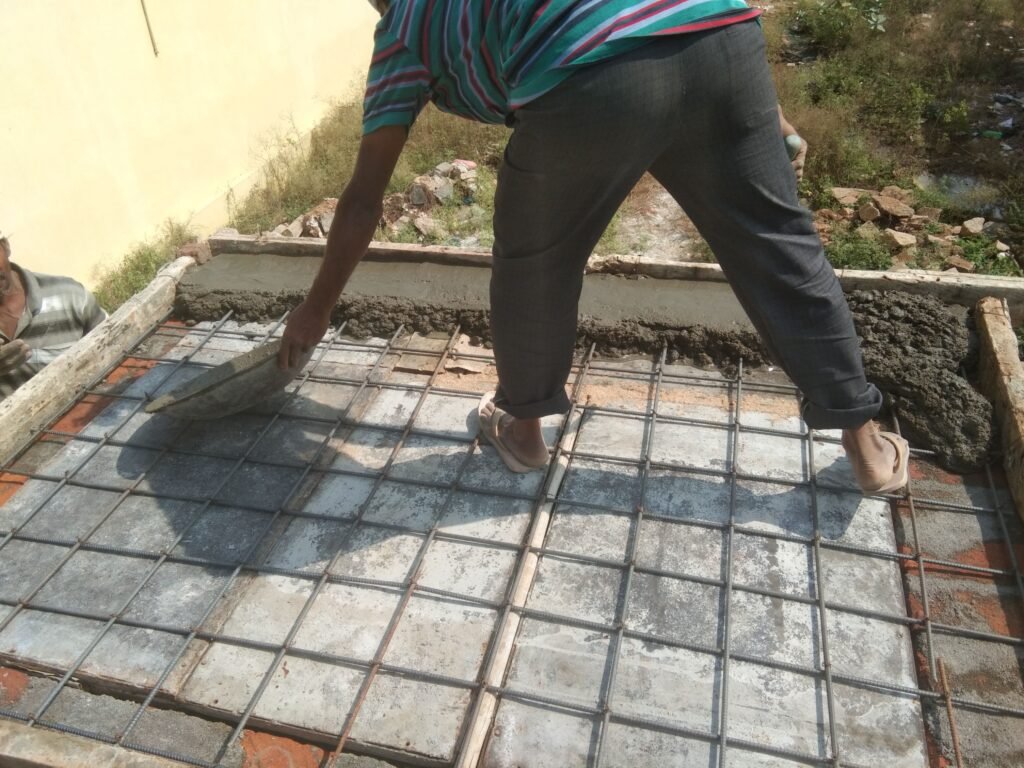
Concrete calculator formula is one of the most useful formulas in civil engineering and house construction. Before starting slab, beam, column, or footing work, engineers must calculate the exact quantity of concrete required. Proper concrete calculation helps in material planning, cost estimation, and avoiding wastage.
If concrete quantity is calculated incorrectly, it may lead to extra cost and delay in construction. That is why every civil engineer, site engineer, and contractor must understand concrete calculator formula clearly. This article explains concrete calculation for slab, beam, column, and footing in simple steps. “This guide explains the complete concrete quantity calculation method for slab, beam, column and footing.”
What is Concrete Calculation?
Concrete calculation is the process of finding the volume of concrete required for construction work. Concrete is measured in cubic meters (m³) or cubic feet (cft).
Concrete is mainly used in:
- Slab
- Beam
- Column
- Footing
- PCC work
Accurate concrete calculation ensures proper material usage and strong construction.
Basic Concrete Calculator Formula
The basic concrete calculator formula is:
Concrete Volume = Length × Width × Height
All dimensions should be in meters.
After calculating volume, materials like cement, sand, and aggregate can be calculated.
Wet Volume vs Dry Volume in Concrete Calculation
While calculating concrete quantity, we must convert wet volume into dry volume.
Dry Volume = Wet Volume × 1.54
The factor 1.54 accounts for:
- Bulking of sand
- Voids in aggregates
- Wastage
Example:
If wet volume = 1 m³
Dry volume = 1 × 1.54 = 1.54 m³
This is the actual volume used for material calculation.
Example for 1 m³ M20 Concrete:
Dry volume = 1.54 m³
Sum of ratio (1 + 1.5 + 3) = 5.5
Cement volume = (1/5.5) × 1.54
= 0.28 m³
1 bag cement = 0.035 m³
Cement required = 0.28 / 0.035
= 8 bags (approx)
Why 1.54 Factor is Used in Concrete Calculation?
The factor 1.54 is used to convert wet concrete volume into dry material volume.
It accounts for:
- 20–30% voids in aggregates
- 10–15% bulking of sand
- 5–10% wastage during mixing
Without applying this factor, material estimation will be incorrect and may cause shortage at site.
This factor is commonly used in manual concrete calculation practice.
Concrete Quantity Calculation for Slab
Let us calculate concrete for slab.
Example:
Slab length = 10m
Slab width = 5m
Slab thickness = 0.15m
Concrete volume = 10 × 5 × 0.15
Concrete volume = 7.5 m³
So, 7.5 cubic meters concrete required for slab.
“Let us calculate concrete for slab.”
For reinforcement quantity calculation, you can also read our detailed Steel Weight Calculation for Slab guide.
Detailed Example: Concrete Calculation for 1000 Sq Ft Slab
Let us calculate concrete quantity for a 1000 sq ft slab with 5-inch thickness.
Step 1: Convert sq ft to sq meter
1 sq ft = 0.093 m²
1000 × 0.093 = 93 m²
Step 2: Convert thickness to meter
5 inches = 0.125 m
Step 3: Wet Volume
Volume = 93 × 0.125
= 11.6 m³
Step 4: Dry Volume
Dry Volume = 11.6 × 1.54
= 17.86 m³
Step 5: Material Calculation (M20 – 1:1.5:3)
Total ratio = 5.5
Cement = (1/5.5) × 17.86 = 3.24 m³
1 bag = 0.035 m³
Cement bags = 3.24 / 0.035
≈ 93 bags
This method helps in accurate site estimation.
Concrete Calculation for Beam
Example:
Beam length = 4m
Width = 0.3m
Depth = 0.45m
Volume = 4 × 0.3 × 0.45
Volume = 0.54 m³
Multiply by number of beams for total quantity.
Detailed Beam Concrete Calculation Example
Example:
Beam length = 4 m
Width = 0.3 m
Depth = 0.45 m
Step 1: Wet Volume
Volume = 4 × 0.3 × 0.45
= 0.54 m³
Step 2: Dry Volume
Dry Volume = 0.54 × 1.54
= 0.83 m³
Step 3: Material Calculation (M20 – 1:1.5:3)
Total ratio = 5.5
Cement = (1/5.5) × 0.83
= 0.15 m³
Cement bags = 0.15 / 0.035
≈ 4 bags
This step-by-step method helps site engineers calculate beam concrete quantity accurately.
Concrete Calculation for Column
Example:
Column size = 0.3m × 0.3m
Height = 3m
Volume = 0.3 × 0.3 × 3
Volume = 0.27 m³
If there are 10 columns:
Total concrete = 0.27 × 10
Total = 2.7 m³
Detailed Column Concrete Calculation
Example:
Column size = 0.3 m × 0.3 m
Height = 3 m
Wet Volume = 0.3 × 0.3 × 3
= 0.27 m³
Dry Volume = 0.27 × 1.54
= 0.41 m³
For M25 concrete:
Material quantities are calculated based on design mix.
Proper column concrete calculation ensures structural strength.
Concrete Calculation for Staircase
Example:
Staircase length = 3 m
Width = 1 m
Thickness = 0.15 m
Volume = 3 × 1 × 0.15
= 0.45 m³
Dry Volume = 0.45 × 1.54
= 0.69 m³
Concrete quantity is calculated similarly using mix ratio.
Staircase concrete calculation is important in duplex and multi-storey buildings.
Concrete Calculation for Footing
Example:
Footing length = 1.5m
Width = 1.5m
Depth = 0.45m
Volume = 1.5 × 1.5 × 0.45
Volume = 1.01 m³
This method is used for all footing calculations.
Detailed Footing Concrete Calculation Example
Example:
Footing size = 2 m × 2 m
Thickness = 0.5 m
Step 1: Wet Volume
Volume = 2 × 2 × 0.5
= 2 m³
Step 2: Dry Volume
Dry Volume = 2 × 1.54
= 3.08 m³
Step 3: Material Calculation (M20 – 1:1.5:3)
Total ratio = 5.5
Cement = (1/5.5) × 3.08
= 0.56 m³
Cement bags = 0.56 / 0.035
≈ 16 bags
Accurate footing concrete calculation ensures strong foundation.
Material Calculation for Concrete
After finding concrete volume, calculate materials.
For M20 concrete (1:1.5:3):
For 1m³ concrete:
- Cement = 8 bags
- Sand = 0.42 m³
- Aggregate = 0.84 m³
Multiply with total concrete volume.
Example:
Concrete volume = 5 m³
Cement = 5 × 8 = 40 bags
Sand = 5 × 0.42 = 2.1 m³
Aggregate = 5 × 0.84 = 4.2 m³
Material Calculation for Concrete
| Grade | Mix Ratio | Use |
|---|---|---|
| M7.5 | 1:4:8 | PCC work |
| M10 | 1:3:6 | Levelling |
| M15 | 1:2:4 | Slabs |
| M20 | 1:1.5:3 | Structural RCC |
| M25 | Design Mix | Heavy load |
Ready Mix Concrete (RMC) vs Site Mixed Concrete
Concrete can be prepared in two ways – Ready Mix Concrete (RMC) and site mixed concrete.
In RMC, concrete is prepared in batching plant and delivered to site using transit mixer. It ensures:
- Better quality control
- Accurate mix proportion
- Faster construction
In site mixing, materials are mixed manually or by mixer machine. It is suitable for small projects but quality depends on supervision.
For large residential and commercial projects, RMC is recommended for better strength and consistency.
Water-Cement Ratio in Concrete
Water-cement ratio plays a major role in concrete strength.
Lower water-cement ratio increases strength but reduces workability.
Higher water-cement ratio improves workability but reduces strength.
For normal RCC work, water-cement ratio is maintained between 0.4 to 0.6.
Proper water control ensures durable concrete.
What is Concrete Grade?
Concrete grade indicates the compressive strength of concrete after 28 days.
For example:
- M20 means 20 N/mm² strength
- M25 means 25 N/mm² strength
Higher grade concrete is used for columns, beams, and heavy load structures. Lower grades are used for PCC and flooring.
Selecting proper grade is important for structural safety.
Importance of Concrete Volume Calculator Formula
Concrete calculator formula helps in:
- Accurate material estimation (For overall house budget planning, check our complete guide on Construction Cost per Sq Ft in India 2026.)
- Cost control
- Avoiding material shortage
- Proper construction planning
- Time saving
- Reducing wastage
Every civil engineer must know this formula.
Concrete Testing Methods
After calculating and placing concrete, quality must be tested.
Common tests include:
- Slump Test – Checks workability
- Cube Test – Checks compressive strength
- Rebound Hammer Test – Surface strength
Concrete strength is usually tested after 7 days and 28 days.
Proper testing ensures structural safety.
Quick Concrete Calculation Tips
- Always measure dimensions correctly
- Convert all units into meters
- Add 5% extra for wastage
- Use proper mix ratio
- Maintain water cement ratio
- Check drawings before calculation
These tips help in accurate concrete estimation.
Site Checklist Before Concreting
Before pouring concrete, ensure:
- Proper shuttering alignment
- Reinforcement placed as per drawing
- Cover blocks provided
- Mix ratio verified
- Water-cement ratio maintained
Proper preparation ensures quality concrete work.
Common Mistakes to Avoid
- Wrong unit conversion
- Ignoring beam and column volume
- Not adding wastage
- Using incorrect mix ratio
- Excess water in concrete
Avoiding these mistakes ensures strong construction.
Concrete calculation is an essential part of every civil engineering project to avoid material wastage and ensure proper budgeting. By using simple formulas, engineers and site supervisors can easily estimate the quantity of concrete required for slabs, beams, and footings. Accurate calculation helps in planning cement, sand, and aggregate requirements efficiently. Always measure dimensions carefully and convert them into cubic meters before applying the formula. Adding a small wastage factor (usually 3–5%) ensures you don’t run short during construction. Proper concrete estimation not only saves cost but also improves work quality and project management, making construction smoother and more professional.
Concrete Wastage Percentage in Construction
While ordering concrete materials, always add 2–5% extra for wastage.
Reasons for wastage:
- Spillage during pouring
- Leakage in shuttering
- Improper handling
- Overestimation of mix water
Adding small extra percentage prevents shortage during concreting.
Common Site Errors in Concrete Measurement
- Not converting inches to meters properly
- Ignoring dry volume factor (1.54)
- Wrong mix ratio usage
- Incorrect slab thickness assumption
- Not adding wastage percentage
Double-check all calculations before ordering materials.
Concrete Quantity per Sq Ft for Slab
For 5 inch (0.125 m) slab:
Concrete per sq ft =
1 sq ft = 0.093 m²
Volume = 0.093 × 0.125
= 0.0116 m³
So approximately 0.012 m³ concrete required per sq ft for 5-inch slab.
Concrete Quantity for Different Slab Thickness
| Structure | Formula | Example Volume |
|---|---|---|
| Slab | L × B × H | 2.5 m³ |
| Beam | L × B × D | 0.54 m³ |
| Column | L × B × H | 0.27 m³ |
| Footing | L × B × H | 2 m³ |
| Slab Thickness | Concrete per Sq Ft |
|---|---|
| 4 inch | 0.009 m³ |
| 5 inch | 0.012 m³ |
| 6 inch | 0.014 m³ |
As per IS 456:2000 (Plain and Reinforced Concrete Code), concrete mix design and structural calculations must follow standard guidelines.
Concrete Cost Estimation per Cubic Meter
Concrete cost per cubic meter depends on:
- Cement price
- Steel reinforcement
- Labour cost
- Transportation
Approximate cost of M20 concrete may range between ₹5000–₹7000 per m³ depending on location.
Understanding concrete cost helps in total construction budgeting.
Frequently Asked Questions (FAQs)
- How to calculate concrete quantity?
Concrete quantity = Length × Width × Thickness. - Why multiply by 1.54 in concrete calculation?
To convert wet volume into dry volume. - How many cement bags required for 1 m³ concrete?
Approximately 8 bags for M20 concrete. - What is standard slab thickness?
Generally 4 to 6 inches for residential buildings.
Importance of Concrete Curing
Curing is the process of maintaining moisture in concrete after placing.
Proper curing:
- Improves strength
- Prevents cracks
- Increases durability
Concrete should be cured for at least 7 days (for OPC) and 10–14 days in hot weather conditions.
Poor curing may reduce concrete strength by up to 20–30%.

Why Concrete Quantity Calculation is Important
Accurate concrete quantity calculation helps in avoiding material shortage and budget overruns. Proper estimation ensures smooth construction execution.
Concrete volume calculation formula is widely used in construction projects to estimate slab, beam, column, and footing concrete quantities accurately.
Conclusion
Concrete calculator formula is essential for every civil engineer and construction professional. By using simple length × width × height formula, you can easily calculate concrete for slab, beam, column, and footing. Accurate concrete calculation helps in proper estimation, budgeting, and quality construction.
Understanding concrete calculation improves site management and reduces cost. Every civil engineering student and site engineer should practice this formula regularly for successful construction projects.
“By understanding the correct concrete quantity calculation formula, engineers can estimate materials accurately and reduce construction wastage.”

Shakeel T is a civil engineering enthusiast and founder of CivilGuide.in. He specializes in construction estimation, quantity surveying, and practical civil engineering calculations. Through CivilGuide, he shares real-world construction knowledge, calculators, and step-by-step guides to help students and site engineers improve their technical skills.