
Introduction
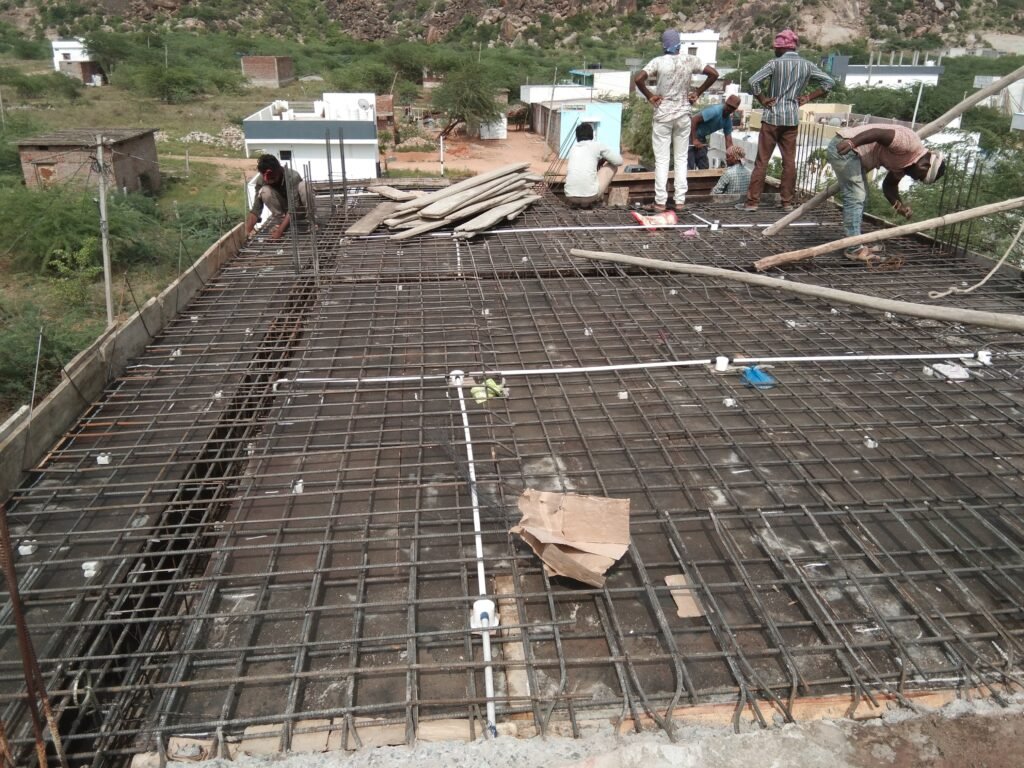
Steel weight calculation for slab is one of the most important skills every civil engineer, site engineer, and contractor must know. Before concreting a slab, accurate steel quantity must be calculated to ensure proper budgeting, material planning, and smooth execution at site.
Steel is one of the costliest materials in building construction. If steel is ordered less, work will stop. If ordered excess, money gets blocked. That is why proper steel weight calculation for slab is essential in residential as well as commercial projects.
In this detailed guide, you will learn:
- Basic steel weight formula
- One-way slab calculation
- Two-way slab calculation
- Thumb rules
- Cost estimation
- Wastage consideration
- Common mistakes
Let us understand step by step.
Why Steel is Used in Slab?
Concrete is very strong in compression but relatively weak in tension. When slab carries load (live load + dead load), tension develops at the bottom portion of slab.
Steel reinforcement is provided to:
- Increase tensile strength
- Prevent cracks
- Improve load carrying capacity
- Increase durability
- Ensure structural safety
Without proper steel reinforcement, slab will fail under tension.
Basic Steel Weight Formula
The standard formula used in construction sites:
Steel Weight (kg) = D² / 162 × Length (meter)
Where:
D = Diameter of bar in mm
Length = Total length of bar in meters
Why D² / 162?
Steel density = 7850 kg/m³
After unit conversion and simplification, the formula becomes:
D² / 162
This formula is universally used for steel weight calculation.
Steel Grade Used in Slab Reinforcement
Most residential buildings use Fe415 or Fe500 grade TMT bars.
- Fe415 – Yield strength 415 N/mm²
- Fe500 – Yield strength 500 N/mm² (more strength, commonly used)
Higher grade steel provides better strength with slightly reduced quantity in some structural designs. However, exact steel requirement must always follow structural drawing.
Steel Weight Chart (Quick Reference)
| Diameter | Weight per meter |
|---|---|
| 8 mm | 0.395 kg |
| 10 mm | 0.617 kg |
| 12 mm | 0.888 kg |
| 16 mm | 1.58 kg |
| 20 mm | 2.47 kg |
This table helps in quick site calculation.
Example 1: One-Way Slab Steel Calculation
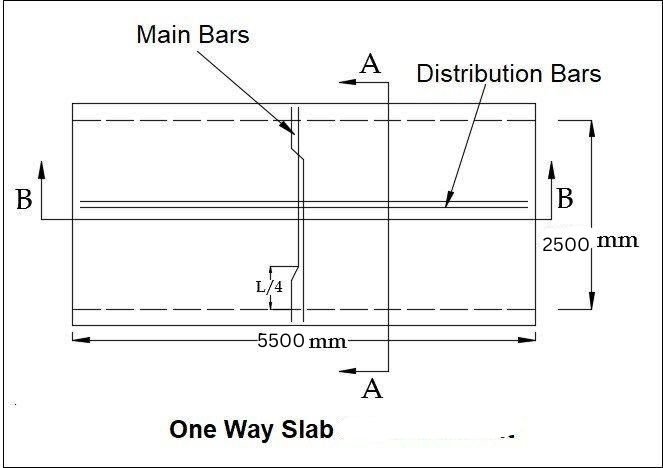
Given:
Slab size = 20 ft × 20 ft
Bar diameter = 10 mm
Spacing = 6 inches (0.15 m)
Step 1: Convert into Meters
20 ft = 6.1 m
Slab size = 6.1 m × 6.1 m
Step 2: Number of Main Bars
Spacing = 0.15 m
Number of bars = 6.1 / 0.15
= 40.6 ≈ 41 bars
Length of each bar = 6.1 m
Total length = 41 × 6.1
= 250 m (approx)
Step 3: Steel Weight (Main Bars)
Weight = (10² / 162) × 250
= (100 / 162) × 250
= 0.617 × 250
= 154 kg
Step 4: Distribution Bars
Same process:
Total length ≈ 250 m
Weight = 0.617 × 250
= 154 kg
Total Steel Required
Main bars = 154 kg
Distribution bars = 154 kg
Total = 308 kg
Add Wastage (5%)
308 × 5% = 15 kg
Final Steel Required ≈ 323 kg
Summary of Steel Calculation:
| Item | Value |
| Main Bars Weight | 154 kg |
| Distribution Bars Weight | 154 kg |
| Total Steel | 308 kg |
| Wastage (5%) | 15 kg |
| Final Steel Required | 323 kg |
Hook Length in Slab Reinforcement
While calculating steel weight, hook length must also be considered.
For 90° bend, hook length ≈ 9D
For 180° bend, hook length ≈ 16D
Where D = Diameter of bar
Example:
For 10 mm bar, 90° hook length = 9 × 10 = 90 mm
Hook length increases total cutting length, so it must be included in Bar Bending Schedule.Bar Bending Schedule
Example 2: 1000 Sq Ft Slab Steel Calculation (Thumb Rule Method)
Quick estimation method used at site:
Steel required per sq ft (Residential) = 3 to 4 kg
1000 sq ft × 4 kg
= 4000 kg
= 4 tons steel
This method is useful during planning stage.
Example 3: Two-Way Slab Steel Calculation (Step-by-Step)
In a two-way slab, reinforcement is provided in both directions because the longer span to shorter span ratio is less than 2.
Given:
Slab size = 12 ft × 14 ft
Slab thickness = 150 mm
Bar diameter = 10 mm
Spacing = 6 inches (0.15 m)
Clear cover = 20 mm
Step 1: Convert Dimensions into Meters
12 ft = 3.66 m
14 ft = 4.27 m
So slab size = 3.66 m × 4.27 m
Since ratio = 4.27 / 3.66 = 1.16 (< 2)
👉 This is a Two-Way Slab.
Step 2: Calculate Number of Bars in Shorter Direction
Spacing = 0.15 m
Number of bars = Longer span / Spacing
= 4.27 / 0.15
= 28.46 ≈ 29 bars
Length of each bar = 3.66 m
Total length = 29 × 3.66
= 106.14 m
Step 3: Calculate Number of Bars in Longer Direction
Number of bars = Shorter span / Spacing
= 3.66 / 0.15
= 24.4 ≈ 25 bars
Length of each bar = 4.27 m
Total length = 25 × 4.27
= 106.75 m
Step 4: Total Steel Length
Total length = 106.14 + 106.75
= 212.89 m
Step 5: Calculate Steel Weight
Formula:
Steel Weight (kg) = D² / 162 × Length
For 10 mm bar:
D² / 162 = 100 / 162 = 0.617 kg/m
Steel weight = 0.617 × 212.89
= 131.3 kg
Step 6: Add 5% Wastage
Wastage = 131.3 × 5%
= 6.56 kg
Final steel required ≈ 138 kg
Summary of Two-Way Slab Steel Calculation
| Item | Value |
|---|---|
| Total Steel Length | 212.89 m |
| Steel Weight | 131 kg |
| Wastage (5%) | 7 kg |
| Final Steel Required | 138 kg |
Important Notes
- Two-way slabs require reinforcement in both directions.
- Steel quantity slightly increases compared to one-way slabs.
- Exact steel requirement must follow structural drawing.
- Always check minimum reinforcement as per IS 456.
One-Way Slab vs Two-Way Slab
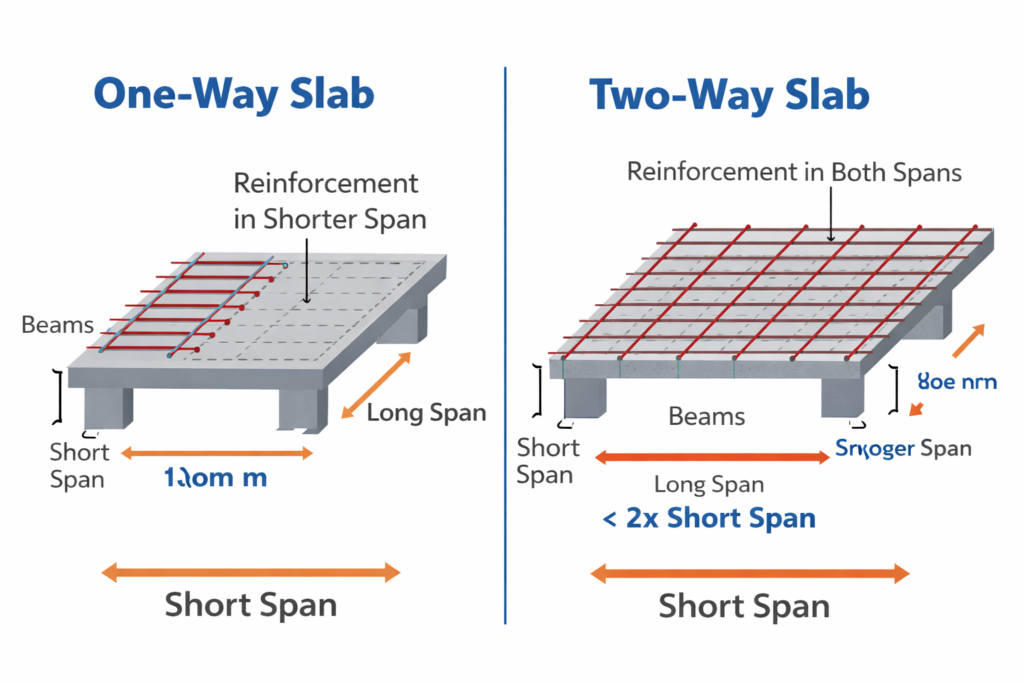
One-Way Slab
- Longer span / shorter span ratio > 2
- Steel mainly provided in one direction
Two-Way Slab
- Ratio < 2
- Steel provided in both directions equally
- Requires more reinforcement
Two-way slab consumes slightly more steel compared to one-way slab.
Factors Affecting Steel Quantity in Slab
Steel requirement depends on:
- Slab thickness
- Span length
- Live load
- Building type
- Structural design
- Earthquake zone
Commercial buildings require more steel than residential buildings.
Cost of Slab Steel
Assume steel rate = ₹65/kg
If total steel = 4000 kg
Cost = 4000 × 65
= ₹2,60,000
Steel cost forms major portion of slab cost.
Bar Bending Schedule (BBS) Importance
Before ordering steel, Bar Bending Schedule must be prepared.
BBS includes:
- Bar diameter
- Shape
- Cutting length
- Number of bars
- Total weight
BBS avoids steel wastage and improves accuracy.
Development Length in Slab
Development length (Ld) is the minimum length of bar required to transfer stress safely between steel and concrete.
Generally:
Ld ≈ 40D to 50D (depends on steel grade and concrete grade)
Example:
For 10 mm bar → Ld ≈ 400 mm to 500 mm
Providing proper development length helps ensure structural safety and prevents the reinforcement bars from pulling out of the concrete.
Lap Length in Slab Reinforcement
Lap length is provided when one bar length is insufficient and another bar is joined.
Generally:
Lap Length ≈ 50D (for tension zone)
Example:
For 10 mm bar → Lap length = 50 × 10 = 500 mm
Incorrect lap length may cause structural weakness. Always follow structural drawing.
Minimum Reinforcement as per IS 456
As per IS 456:2000 (Plain and Reinforced Concrete Code), minimum reinforcement must be provided in slabs to control cracks caused by shrinkage, temperature variation, and long-term effects.
Even if structural design calculations show lesser steel requirement, this minimum reinforcement must be provided to ensure durability and serviceability of the slab.
For Mild Steel Bars:
Minimum reinforcement = 0.15% of gross cross-sectional area of slab
For HYSD Bars (Fe415 / Fe500):
Minimum reinforcement = 0.12% of gross cross-sectional area of slab
This percentage is calculated based on the gross cross-sectional area of concrete (width × effective depth).
Example:
Assume slab thickness = 150 mm
Consider 1 meter width of slab
Gross cross-sectional area =
1000 mm × 150 mm = 150,000 mm²
Minimum reinforcement (HYSD bars) =
0.12% of 150,000
= 0.0012 × 150,000
= 180 mm² per meter width
Therefore, at least 180 mm² steel area must be provided per meter width of slab.
Providing minimum reinforcement helps in crack control, improves durability, and ensures long-term structural performance.
Common Mistakes in Steel Weight Calculation
Many site engineers make these mistakes:
- Not converting units properly
- Forgetting to add wastage
- Using wrong spacing
- Ignoring hooks and bends
- Not checking structural drawing
Always double-check calculations before ordering steel.
Practical Site Tips to Reduce Steel Wastage
- Prepare proper BBS
- Store steel safely
- Avoid unnecessary cutting
- Use correct bar spacing
- Train labor for proper bending
Good planning saves thousands of rupees.
Importance of Steel Calculation in Construction
Accurate steel weight calculation helps in:
- Proper budgeting
- Material planning
- Avoiding shortage
- Preventing delays
- Ensuring structural safety
Every civil engineer must master this skill.
Frequently Asked Questions (FAQs)
1. How much steel is required for 1000 sq ft slab?
Generally, 3 to 4 kg per sq ft. So around 3000 to 4000 kg steel is required.
2. What is the weight of 10mm steel bar per meter?
Weight of 10mm bar = 0.617 kg per meter.
3. Why is 5% wastage added in steel calculation?
Steel is lost during cutting and bending. 5–10% extra steel is added for safety.
4. Which slab consumes more steel?
Two-way slab consumes more steel compared to one-way slab.
5. Can we calculate steel without drawing?
Rough estimation possible using thumb rule. But exact calculation requires structural drawing.
As per IS 456:2000 (Plain and Reinforced Concrete Code), slab reinforcement design must follow structural safety guidelines.
Conclusion
Steel weight calculations for slab is essential for safe and economical construction. By using the formula D²/162, engineers can accurately calculate steel weight for any slab size.
Residential buildings generally require 3 to 4 kg steel per sq ft, but exact quantity depends on design and load conditions.
Proper planning, correct formula, and addition of wastage ensure smooth construction and cost control. Every civil engineer and contractor must understand steel weight calculation to avoid financial loss and structural issues.
Always refer to structural drawings and IS 456 guidelines before finalizing steel quantities to ensure safety and compliance.
You can also read:

Shakeel T is a civil engineering enthusiast and founder of CivilGuide.in. He specializes in construction estimation, quantity surveying, and practical civil engineering calculations. Through CivilGuide, he shares real-world construction knowledge, calculators, and step-by-step guides to help students and site engineers improve their technical skills.