
Transportation Engineering Question Paper 2024
Thiis very useful for Diploma Civil Engineering 4th semester students preparing for exams. This solved paper provides complete 3 marks, 8 marks and 10 marks questions with detailed answers as per C20 syllabus.
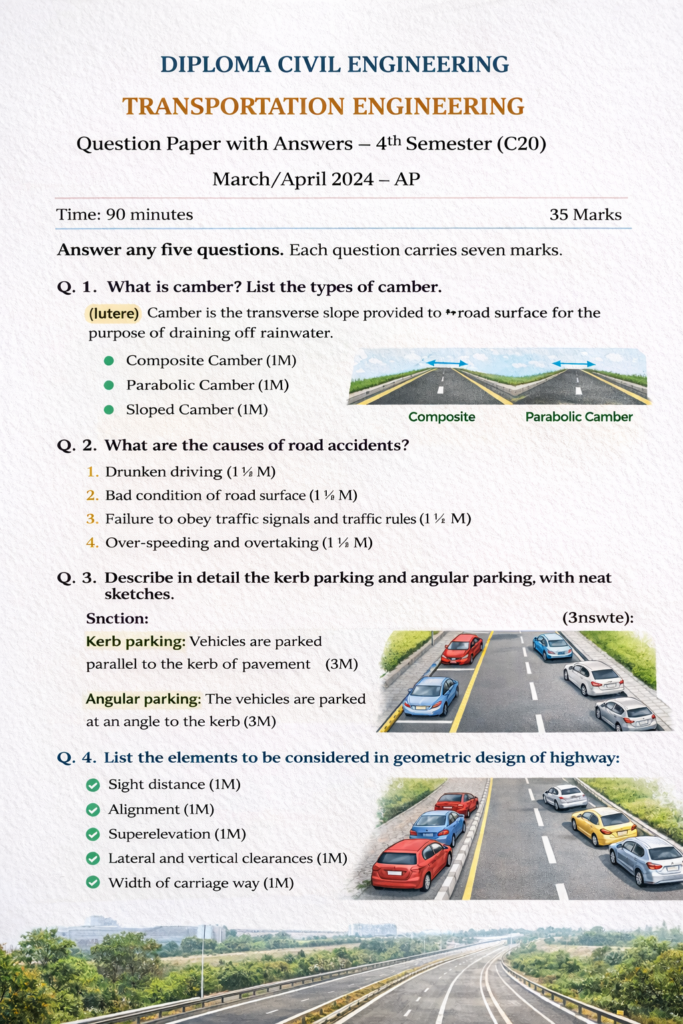
State the classification of roads as per Indian Road Congress.
As per Indian Road Congress (IRC), roads in India are classified into five categories. These are National Highways (NH), State Highways (SH), Major District Roads (MDR), Other District Roads (ODR), and Village Roads (VR). This classification is based on administrative importance and traffic volume. It helps in proper planning and maintenance of road networks.
Define the terms (a) Plasticity and (b) Cohesion.
Plasticity is the property of soil which allows it to undergo deformation without cracking or breaking when water is added. It enables soil to be molded into different shapes under pressure.
Cohesion is the internal molecular attraction between soil particles. It helps the soil particles stick together and provides shear strength even without external pressure.
State the I.S. classification of soils.
According to the Indian Standard (IS) classification system, soils are divided into three main groups. They are coarse-grained soils, fine-grained soils, and highly organic soils. Coarse-grained soils include gravels and sands. Fine-grained soils include silts and clays based on plasticity characteristics.
State three objectives of providing traffic signs.
Traffic signs regulate, warn, and guide road users. They help in reducing accidents and improving road safety. They provide necessary information about road conditions and restrictions. They ensure smooth and systematic movement of traffic.
State the machinery used in the construction of WBM roads.
The machinery used in WBM road construction includes road rollers, stone crushers, water tankers, and graders. A hand roller or power roller is used for compaction. Water tankers are used for sprinkling water during rolling. Screening and binding materials are spread manually or mechanically.
List various tests conducted on bitumen.
The common tests conducted on bitumen are penetration test, ductility test, softening point test, and viscosity test. Flash and fire point tests are also conducted for safety evaluation. These tests determine suitability for road construction. They help in quality control of bitumen.
Write any three functions of railway sleepers.
Railway sleepers maintain the correct gauge between rails. They distribute loads from rails to ballast evenly. Sleepers provide stability to the track structure. They also hold rails firmly in position.
Define gauge and state the classification of gauges.
Gauge is the clear horizontal distance between the inner faces of two rails. In India, gauges are classified as Broad Gauge (1676 mm), Meter Gauge (1000 mm), and Narrow Gauge (762 mm or 610 mm). Broad gauge is widely used for main routes. Gauge selection depends on traffic and economic considerations.
Define the terms (a) Actual nose of crossing and (b) Throat of crossing.
Actual nose of crossing is the exact point where two gauge lines intersect in a railway crossing. It is the sharp meeting point of rails.
Throat of crossing is the distance between the actual nose and the theoretical nose of crossing. It ensures smooth wheel passage over the crossing.
State any three maintenance operations carried out in daily maintenance of railway tracks.
Daily maintenance operations include tightening of loose fastenings and bolts. Packing of ballast under sleepers is also done. Removal of vegetation and cleaning of drains is carried out regularly. Inspection of track alignment and level is also performed.
(a) Explain the factors affecting highway alignment.
Highway alignment refers to the position or layout of the centerline of a road on the ground. Selection of proper alignment is very important for safe and economical road construction. Several factors influence highway alignment and must be considered carefully.
The first factor is traffic volume and type. The alignment should serve present and future traffic needs. Roads should connect important towns, industrial areas, and markets to ensure maximum utility.
The second factor is topography. The alignment should suit the natural features of the land such as hills, valleys, rivers, and forests. In hilly areas, gradients and curves should be carefully designed to ensure safety and economy.
The third factor is soil and geological conditions. Weak soils or marshy lands increase construction and maintenance costs. Alignment should avoid such areas wherever possible.
The fourth factor is drainage and rainfall. Adequate drainage must be provided to avoid water stagnation. Flood-prone areas should be avoided to ensure durability of roads.
The fifth factor is economy. The selected alignment should be economical in construction, maintenance, and operation. Excessive cutting, filling, or bridges should be minimized.
The sixth factor is safety. The alignment should provide good visibility, gentle curves, and proper gradients to reduce accidents.
The final factor is environmental and social considerations. The road should avoid religious places, monuments, and densely populated areas to reduce land acquisition problems.
Thus, proper highway alignment ensures safety, economy, and efficient transportation.
(b) Explain the classification of roads.
Roads are classified based on importance, traffic volume, and administrative control. The Indian Road Congress has classified roads into different categories to ensure systematic planning and development.
The first category is National Highways (NH). These roads connect major cities, capitals, ports, and important economic centers of the country. They carry heavy traffic and are maintained by the central government.
The second category is State Highways (SH). These roads connect district headquarters and important cities within a state. They serve as main arteries of road transport within the state.
The third category is Major District Roads (MDR). These roads connect production areas and markets within districts. They link smaller towns to state highways and national highways.
The fourth category is Other District Roads (ODR). These roads serve rural areas and connect villages to nearby towns and markets. Traffic on these roads is generally low.
The fifth category is Village Roads (VR). These roads connect villages to each other and to main roads. They play an important role in rural development.
Apart from this, roads are also classified as urban roads and rural roads based on location. Urban roads include arterial, sub-arterial, collector, and local streets.
This classification helps in planning, funding, construction, and maintenance of roads efficiently.
(a) Explain the CBR test and its importance.
The California Bearing Ratio (CBR) test is used to determine the strength of subgrade soil for road construction. It is one of the most important tests in highway engineering. The test indicates the load-carrying capacity of soil.
In this test, a soil sample is prepared in a mould at optimum moisture content and maximum dry density. The sample is then soaked in water for four days if required. After soaking, the sample is placed under a loading machine.
A standard plunger of 50 mm diameter is penetrated into the soil at a rate of 1.25 mm per minute. The load required for penetration is recorded at different intervals. The measured load is compared with standard load values.
CBR value is calculated as a percentage ratio of measured load to standard load. Higher CBR value indicates stronger soil. Lower CBR value indicates weak soil requiring improvement.
CBR test helps in designing thickness of pavement layers. It ensures safe and economical pavement design. It also helps in selecting suitable construction materials.
Thus, CBR test plays a vital role in highway pavement design and quality control.
(b) Explain the properties of good road aggregates.
Road aggregates are important materials used in pavement construction. Good quality aggregates ensure strength, durability, and stability of roads.
The first property is strength. Aggregates should be strong enough to resist crushing under traffic loads. Crushing test is conducted to check this property.
The second property is hardness. Aggregates should resist abrasion and wear caused by traffic. Los Angeles abrasion test is conducted to measure hardness.
The third property is toughness. Aggregates should resist impact loads from moving vehicles. Impact test determines toughness of aggregates.
The fourth property is durability. Aggregates should resist weathering and environmental effects. They should not disintegrate due to rain, temperature, or frost.
The fifth property is shape and size. Aggregates should have cubical shape for good interlocking. Flaky and elongated particles should be avoided.
The sixth property is adhesion with bitumen. Aggregates should bond well with bitumen. Poor adhesion leads to stripping and pavement failure.
The seventh property is cleanliness. Aggregates should be free from dust, clay, and organic matter. Impurities reduce bonding and strength.
Thus, selection of good aggregates is essential for long-lasting and strong pavements.
(a) Explain the construction procedure of WBM road.
Water Bound Macadam (WBM) road construction is a common method used in road works. It consists of broken stones bound together by screenings and water.
The first step is preparation of subgrade. The surface is properly shaped and compacted to required camber and gradient. Weak spots are removed and filled.
Next step is spreading of coarse aggregates. Broken stones of specified size are spread uniformly over the prepared surface. The thickness is maintained as per design.
Then rolling is carried out using road rollers. Rolling starts from edges and moves towards center. It ensures proper compaction and interlocking of stones.
After rolling, screenings are spread over the surface. These fill the voids between coarse aggregates. Water is sprinkled to help binding.
Further rolling is done to ensure proper compaction. Binding material such as stone dust may be added if required.
The surface is checked for evenness and camber. Finally, the road is allowed to dry and set properly before opening to traffic.
WBM roads are economical and widely used in rural areas and as base courses.
(b) Explain the types of bituminous roads.
Bituminous roads are flexible pavements constructed using bitumen as binding material. They are widely used due to smooth surface and low maintenance.
The first type is surface dressing. It consists of spraying bitumen over the surface and spreading aggregates. It provides a waterproof and skid-resistant surface.
The second type is penetration macadam. In this method, bitumen is sprayed over compacted aggregates. It penetrates into voids and binds the aggregates.
The third type is premix carpet. Aggregates and bitumen are mixed in a plant and laid on the road surface. It provides smooth and durable surface.
The fourth type is bituminous concrete. It is a high-quality pavement with dense grading. It is used for heavy traffic roads and highways.
The fifth type is built-up spray grout. Alternate layers of aggregates and bitumen are laid and compacted.
Bituminous roads provide smooth riding quality, low noise, and easy maintenance. They are suitable for modern highways.
(a) Explain the components of a flexible pavement.
Flexible pavement is the most commonly used pavement type in highway construction. It is called flexible pavement because it can bend slightly under traffic loads without cracking. Load is transferred to the subgrade through different layers.
The topmost layer is wearing course. It is directly exposed to traffic and weather. This layer provides smooth riding surface and skid resistance. It is usually made of bituminous concrete.
Below the wearing course is the binder course. This layer binds the wearing course with base course. It distributes wheel loads uniformly to the lower layers. It also provides structural strength.
The next layer is the base course. It is the main structural layer of pavement. It distributes traffic loads to sub-base and subgrade. It is usually made of crushed aggregates or WBM.
Below base course is sub-base course. This layer provides additional support and drainage. It prevents entry of water into pavement layers. It also improves load distribution.
The bottom layer is subgrade. It is the natural soil prepared and compacted. It acts as foundation for the entire pavement. Strength of subgrade is very important for pavement design.
Functions of flexible pavement include load distribution, smooth riding surface, and protection of subgrade. Proper compaction and drainage increase pavement life. Flexible pavements are economical and easy to maintain.
Thus, flexible pavement consists of several layers working together to provide safe and durable roads.
(b) Explain the factors affecting design of flexible pavement.
Design of flexible pavement depends on many factors. Proper design ensures durability, safety, and economy of roads.
The first factor is traffic volume. Higher traffic requires thicker pavement layers. Both present and future traffic must be considered.
The second factor is axle load. Heavy vehicles produce more stress on pavement. Pavement thickness increases with increase in axle load.
The third factor is subgrade strength. Weak soil requires thicker pavement. CBR test is used to determine strength of subgrade soil.
The fourth factor is climatic conditions. Temperature and rainfall affect pavement performance. Bitumen properties change with temperature.
The fifth factor is drainage conditions. Poor drainage weakens pavement layers. Proper drainage increases pavement life.
The sixth factor is availability of materials. Local materials reduce construction cost. Quality materials improve durability.
The seventh factor is construction quality. Proper compaction and workmanship increase pavement strength. Poor construction leads to early failure.
The eighth factor is maintenance. Regular maintenance increases service life. Neglect reduces pavement performance.
Thus, all these factors must be considered for proper flexible pavement design.
(a) Explain the components of railway track.
Railway track is a structure consisting of rails, sleepers, ballast, and formation. It provides a safe and smooth path for trains.
Rails are steel sections laid in two parallel lines. They guide train wheels and carry loads. Rails must be strong and durable.
Sleepers are placed perpendicular to rails. They maintain correct gauge and provide support to rails. Sleepers may be wooden, steel, or concrete.
Ballast is broken stone placed below sleepers. It distributes load and provides drainage. It also holds sleepers in position.
Formation is the prepared ground on which track is laid. It includes embankment or cutting. Formation must be strong and well-drained.
Fastenings such as bolts and clips hold rails to sleepers. They prevent movement of rails.
Functions of railway track include guiding trains, carrying loads, and ensuring safety. Proper maintenance ensures smooth running of trains.
Thus, railway track consists of several components working together to support train movement.
(b) Explain the types of railway sleepers and their functions.
Railway sleepers are the backbone of any track. They hold the rails in place and keep the gauge—the distance between rails—just right. You’ll find a few different types used in track construction, each with its pros and cons.
First up are timber sleepers, made from good quality wood. They’re super easy to handle and transport, and they give the track some nice elasticity to handle vibrations. Downside? They don’t last as long, and termites or excess moisture can wreck them over time.
Then there are steel sleepers. These are tough as nails, with a much longer lifespan than wood. They’re reliable for heavy use, but watch out—they can corrode if not protected, especially in wet areas.
Cast iron sleepers come next. They’re heavy and solid, offering great stability. But under really intense loads, they might crack or break.
These days, concrete sleepers rule the tracks. They’re the go-to choice everywhere because of their incredible strength and longevity. Plus, they need way less upkeep.
Sleepers do a ton of jobs: they keep the gauge steady, spread the train’s weight evenly to the ballast below, and make sure the whole track stays stable. They grip the rails tight, soak up shocks and vibrations from passing trains, and overall keep things safe.
Picking the right sleeper comes down to the kind of traffic, local weather, and budget. Regular maintenance is key to avoiding problems and ensuring smooth, safe runs.
In short, sleepers are what make railway tracks reliable and safe—get them right, and the whole system hums along
(a). Explain Diamond Intersection with Sketch
A diamond intersection is a type of grade separated intersection commonly used where a highway crosses another road. In this type of interchange, one road passes over or under another road using a bridge structure. Four ramps are provided in the shape of a diamond to allow vehicles to enter and exit the highway.
In a diamond intersection, the main highway traffic moves without interruption. The cross road traffic uses ramps to merge or diverge from the highway. These ramps are usually simple and direct, which makes this design economical and easy to construct.
The diamond shape is formed by four one-way ramps connecting the two roads. Vehicles exiting the highway take a ramp and meet the cross road at intersections, which are usually signal controlled. This type of interchange requires less land compared to cloverleaf interchange.
Advantages of diamond intersection include low construction cost, simple design, and suitability for moderate traffic volumes. It is widely used in urban and semi-urban areas. Maintenance is also comparatively easy.
However, it may cause congestion at ramp terminals during peak traffic hours. Signal control is often required at ramp intersections.
Simple Sketch Representation:
        ===== Highway =====
           \        /
            \      /
             \    /
              \  /
              /  \
             /    \
            /      \
           /        \
        ==== Cross Road ====
Thus, a diamond intersection provides safe and controlled movement of vehicles with grade separation.
(b). Explain Cloverleaf Intersection with Sketch
A cloverleaf intersection is a type of fully grade separated interchange used where two major highways intersect. It consists of loop-shaped ramps resembling a four-leaf clover. This design allows free movement of traffic without signals.
In a cloverleaf interchange, vehicles turning left use loop ramps. These loops allow vehicles to merge smoothly with the traffic of the intersecting road. Right turning traffic moves through outer ramps.
The main advantage of cloverleaf intersection is that it eliminates traffic signals and allows continuous flow of vehicles. It reduces conflict points and increases safety for high-speed highways.
This type of interchange requires large land area because of its loop ramps. It is suitable for highways carrying heavy traffic volumes. It provides smooth and uninterrupted traffic movement.
However, weaving sections may occur where vehicles entering and exiting the highway cross paths. Proper design is required to minimize weaving problems.
Cloverleaf interchanges are commonly seen on national highways and expressways.
Simple Sketch Representation:
        ( )        ( )
           \      /
            \    /
-------------====--------------
            /    \
           /      \
        ( )        ( )
The loops resemble a clover leaf pattern, allowing vehicles to change direction without stopping.
Thus, a cloverleaf intersection is an efficient solution for high traffic highway intersections.
Read also : building materials list for house construction
Road design standards in India are published by the Indian Roads Congress (IRC).
National highway development policies are managed by the Ministry of Road Transport and Highways.

Shakeel T is a qualified Civil Engineer and Structural Consultant with extensive on-site experience in residential and commercial building construction. Specializing in material estimation, cost budgeting, and structural safety guidelines, he has successfully managed multiple real estate projects from foundation to finishing. Through this blog, Shakeel shares field-tested civil engineering thumb rules, IS Code practices, and practical site tips to help home builders execute their projects efficiently and within budget.
Education: Diploma in Civil Engineering
Expertise: Quantity Surveying, Material Estimation, Structural Design, and Site Management.