
Introduction
Bituminous roads, commonly called BT roads or Black Top roads, are widely used in India for highways, state roads, district roads, urban roads and other flexible pavement applications.
A BT road construction is not simply a layer of bitumen spread over the ground. A properly constructed flexible pavement consists of several layers, with each layer performing a specific function. The strength, durability and riding quality of the road depend on proper preparation of the subgrade, drainage, aggregate quality, compaction, bituminous mix production, laying and rolling.
In India, pavement composition and thickness are selected based on factors such as traffic, subgrade strength, design life, climate, drainage and the applicable project specification. IRC guidance explains that flexible pavements are designed to carry traffic loads over their intended design life, while MoRTH specifications govern construction requirements for many road projects.
What Is a BT Road?
A BT road is a flexible pavement in which bituminous materials are used in the upper pavement layers.
The typical construction sequence can be understood as:
Prepared Subgrade → GSB → WMM → Prime Coat → DBM → Tack Coat → BC → Rolling
However, the exact layers and thicknesses are not identical for every road. They must follow the approved pavement design, drawings, BOQ and applicable specification.
Typical Layers of a BT Road Construction
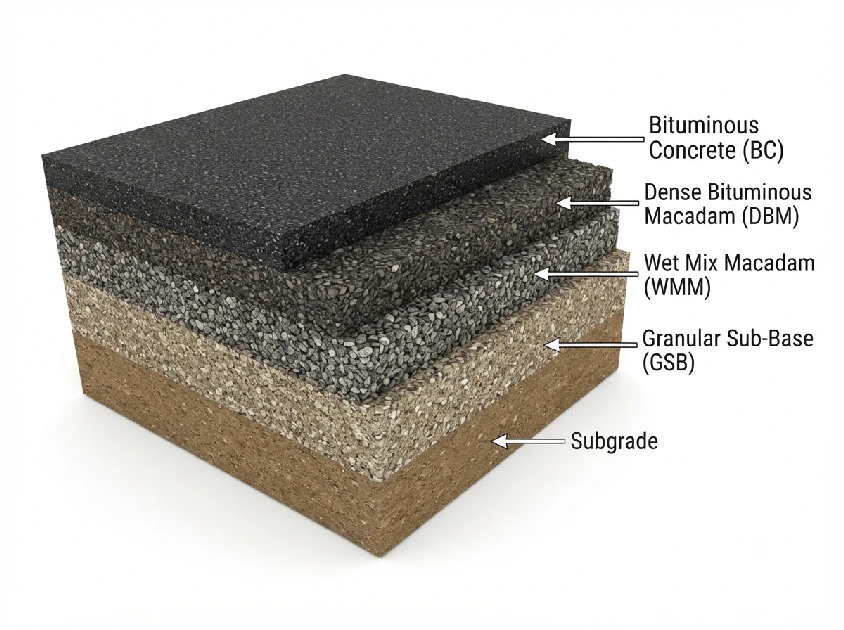
A flexible pavement may contain the following layers:
| Layer | Main Purpose |
|---|---|
| Subgrade | Provides foundation for the pavement |
| GSB | Provides drainage and sub-base support |
| WMM | Provides strong granular base |
| Prime Coat | Seals and prepares granular base for bituminous layer |
| DBM | Provides structural bituminous base/binder layer |
| Tack Coat | Provides bonding between bituminous layers |
| BC | Provides smooth and durable wearing surface |
Not every small road will necessarily use exactly this arrangement. Pavement design determines the required composition.
Site Survey and Setting Out
Before starting road construction, the site is surveyed and the proposed road alignment is established.
The survey team generally checks:
- Existing ground levels
- Road centre line
- Formation width
- Carriageway width
- Shoulder width
- Longitudinal gradient
- Cross fall/camber
- Drainage requirements
- Existing utilities
- Culverts and cross-drainage structures
Reference points and benchmarks are established so that construction levels can be controlled throughout the project.
Why setting out is important
If the centre line or levels are incorrect, the problem can continue through every subsequent layer. This can result in incorrect road width, uneven camber, inadequate drainage and improper final levels.
Clearing and Earthwork
The construction area is first cleared of unwanted vegetation, debris, organic soil and other unsuitable material.
Depending on the project, earthwork may include:
- Excavation
- Filling
- Embankment construction
- Borrow soil placement
- Moisture conditioning
- Layer-wise compaction
Suitable earth material is placed in controlled layers and compacted to the specified requirements.
The final formation should achieve the required line, level, width and cross-section before pavement layers are constructed.
Subgrade Preparation
The subgrade is the prepared soil foundation below the pavement.
This is one of the most important stages of BT road construction because the pavement ultimately transfers traffic loads to the subgrade.
The subgrade is:
- Brought to the required level.
- Shaped to the specified cross fall.
- Moisture-conditioned as required.
- Compacted using suitable equipment.
- Checked for level, width and surface condition.
The subgrade strength is an important input in flexible pavement design. IRC guidance uses pavement design procedures based on factors including traffic and subgrade characteristics.
Site engineer should check
- Required formation level
- Cross fall
- Width
- Surface uniformity
- Compaction
- Soft spots
- Water accumulation
- Drainage
Any weak or yielding portion should be investigated and treated according to the approved method before proceeding.
GSB – Granular Sub-Base
After the subgrade is approved, the Granular Sub-Base (GSB) is constructed where specified.
GSB generally consists of properly graded granular material meeting the project specification.
The material is:
Spread → Watered/Conditioned → Graded → Compacted
A grader is commonly used to achieve the required profile, while rollers are used for compaction.
Purpose of GSB
GSB provides:
- Additional structural support
- Load distribution
- Drainage-related functions where designed
- A stable platform for upper pavement layers
The thickness and number of GSB layers depend on the approved pavement design.
WMM – Wet Mix Macadam
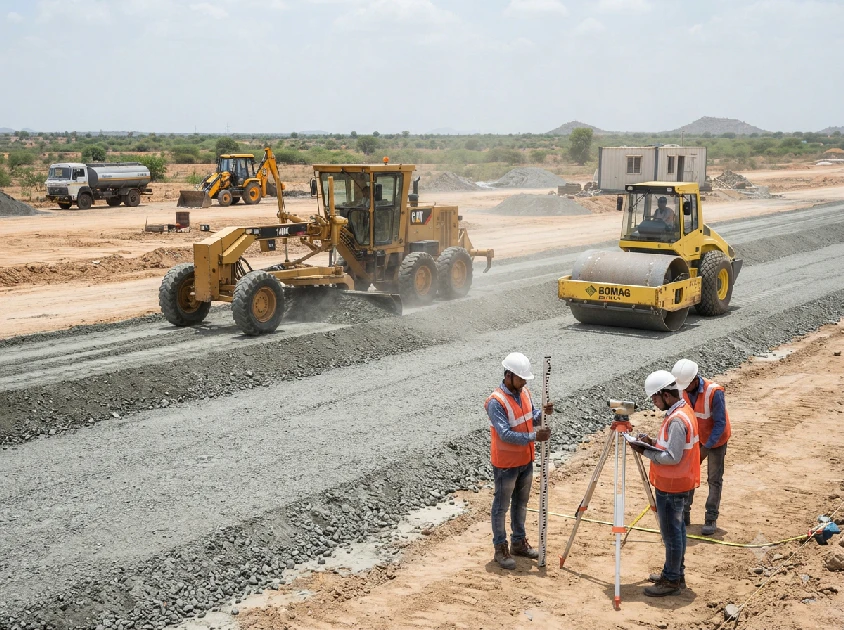
The next major layer in many flexible pavements is Wet Mix Macadam (WMM).
WMM consists of graded crushed aggregates mixed with the required quantity of water in a controlled mixing arrangement.
The process generally involves:
- Producing the specified aggregate gradation.
- Mixing aggregate and water.
- Transporting the mix to the site.
- Spreading it using suitable equipment.
- Achieving the required level and cross fall.
- Compacting with rollers.
- Checking density and surface profile.
WMM provides a strong granular base for the bituminous pavement.
Important checks
The site engineer should check:
- Aggregate quality
- Gradation
- Moisture
- Layer thickness
- Surface level
- Camber
- Compaction
- Width
- Surface defects
The completed WMM surface should be properly compacted and approved before bituminous work starts.
Prime Coat
Once the granular base is properly prepared and approved, a prime coat may be applied where specified.
Prime coat is applied to a prepared granular surface before the first bituminous layer.
Its functions include:
- Penetrating/sealing the granular surface
- Binding loose surface particles
- Preparing the surface for the bituminous layer
- Improving adhesion between the granular base and subsequent bituminous course
The surface should be properly prepared and free from dust and unwanted material before spraying.
The application rate and material should follow the approved specification rather than using a fixed quantity for every project.
Bituminous Mix Production
The bituminous mix is normally produced in a controlled hot mix plant or other approved mixing facility, depending on the project requirements.
Typical materials include:
- Coarse aggregate
- Fine aggregate
- Mineral filler where required
- Bituminous binder
The aggregate and binder are heated and mixed under controlled conditions.
Quality control at the plant is extremely important because improper proportioning, temperature control or mixing can affect the final pavement performance.
The applicable MoRTH specification includes requirements for bituminous mixes such as DBM and other bituminous courses.
DBM – Dense Bituminous Macadam
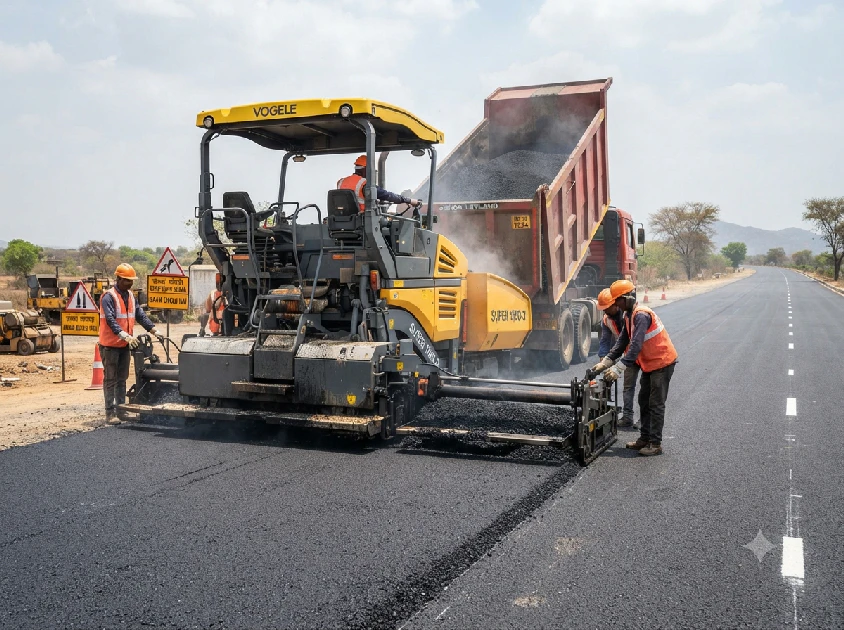
Dense Bituminous Macadam (DBM) is commonly used as a structural bituminous layer in flexible pavements where specified by the pavement design.
DBM provides structural capacity and helps distribute traffic loads through the pavement system.
The general sequence is:
Hot Mix Plant → Tipper → Paver → Initial Rolling → Intermediate Rolling → Final Rolling
The DBM mix is transported from the plant to the site in suitable covered vehicles as required to maintain the required condition.
The surface should be properly prepared before laying.
Tack Coat
Before placing another bituminous layer over an existing bituminous surface, a tack coat is generally applied where specified.
The main purpose of tack coat is to create a bond between the existing and new bituminous layers.
The surface should be:
- Clean
- Free from loose material
- Free from excessive dust
- Properly prepared
Mechanical spraying equipment is commonly used for controlled application.
Poor tack coat application can contribute to inadequate bonding between layers. MoRTH material also emphasizes proper surface preparation and mechanical spraying for relevant bituminous applications.
BC – Bituminous Concrete
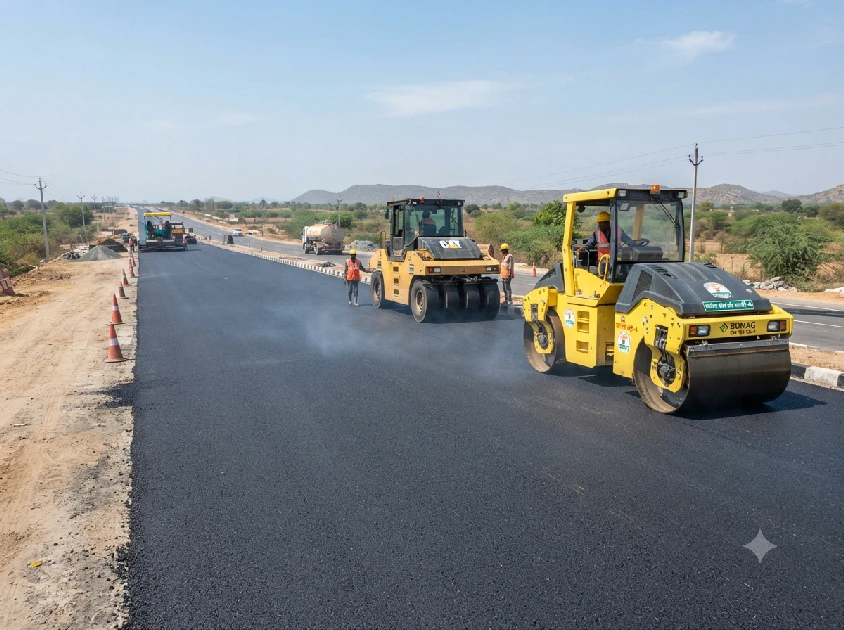
Bituminous Concrete (BC) is generally used as a wearing course where specified.
It forms the uppermost bituminous pavement layer and provides the road’s finished riding surface.
BC should provide:
- Smooth riding quality
- Adequate skid resistance
- Resistance to traffic wear
- Protection to lower pavement layers
- Proper surface profile
The exact BC thickness and mix type depend on the approved pavement design and project specification.
IRC maintains specifications and standards relating to bituminous concrete and flexible pavement construction.
Laying Bituminous Mix Using a Paver
A sensor paver/bituminous paver is generally used to lay the hot mix to the required width, thickness and profile.
The basic process is:
Tipper → Hopper → Conveyor → Screed → Compacted Mat
The paver should be operated continuously as far as practical to maintain a uniform surface.
The site engineer should monitor:
- Laying temperature
- Layer thickness
- Width
- Level
- Cross fall
- Paver speed
- Joint arrangement
- Surface texture
Sudden stoppages can create construction problems and should be avoided where practical.
Compaction and Rolling
Rolling is one of the most critical operations in bituminous road construction.
Typical equipment may include:
- Tandem roller
- Vibratory roller
- Pneumatic tyre roller
The exact rolling sequence depends on the mix, layer, equipment and approved construction methodology.
The general concept is:
Initial Rolling
Begins soon after laying while the mix is at the appropriate temperature.
Intermediate Rolling
Provides further densification of the bituminous layer.
Final Rolling
Removes remaining surface irregularities and provides the required finish.
The objective is to achieve the specified density without causing cracking, displacement or other surface defects.
Temperature Control During Bituminous Work
Temperature is extremely important during production, transportation, laying and compaction of hot bituminous mixes.
If the mix becomes too cold before proper compaction, achieving the required density can become difficult.
Therefore, the project specification and approved mix design should be followed for:
- Aggregate heating
- Binder heating
- Mixing temperature
- Transportation
- Laying temperature
- Rolling temperature
A site engineer should not rely on one universal temperature value for every bituminous mix because the required values depend on the binder, mix type and applicable specification.
Road Camber and Drainage
A good BT road needs an effective drainage system.
Even a properly constructed pavement can deteriorate quickly if water remains on or inside the pavement.
The road cross-section is therefore constructed with the specified camber/cross fall to help drain rainwater.
The project may include:
- Side drains
- Catch drains
- Culverts
- Cross-drainage structures
- Shoulder drainage
- Median drainage
- Kerb drainage in urban roads
Drainage should be considered during the entire road construction process, not only after the BT layer is completed.
Construction Joints
Longitudinal and transverse joints require proper attention.
Poorly constructed joints can lead to:
- Cracks
- Water penetration
- Uneven surface
- Edge deterioration
- Premature pavement failure
At joints, the required alignment, bonding and compaction should be carefully controlled.
The construction methodology should follow the project specification and approved method statement.
Quality Control Tests and Checks
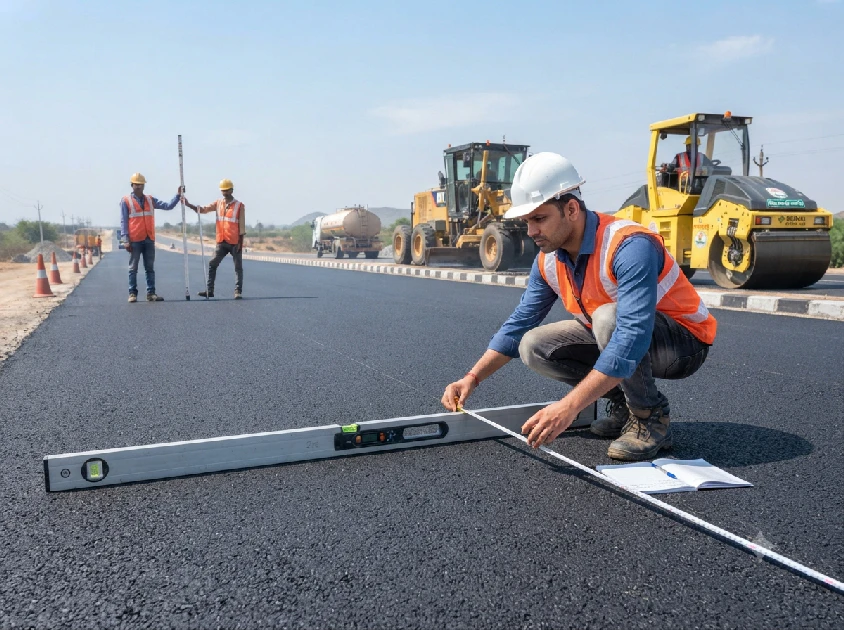
Quality control is carried out at different stages of road construction.
Subgrade
Typical checks may include:
- Field density
- Moisture
- Level
- Cross fall
- CBR or other specified strength-related tests
GSB/WMM
Checks may include:
- Gradation
- Aggregate quality
- Moisture
- Thickness
- Field density
- Level and profile
Bituminous Mix
Depending on the specification and mix design, checks may include:
- Aggregate gradation
- Binder content
- Mix temperature
- Density
- Thickness
- Volumetric properties
- Surface profile
The actual testing frequency and acceptance criteria must be taken from the applicable contract specification and approved quality-control plan.
Common Mistakes in BT Road Construction
Some common site problems include:
1. Poor drainage
Water is one of the major causes of pavement deterioration.
2. Insufficient compaction
If the required density is not achieved, the pavement may develop premature deformation.
3. Dusty surface before tack coat
Dust can reduce bonding between bituminous layers.
4. Improper temperature control
Bituminous mix can become difficult to compact if it cools excessively before adequate rolling.
5. Incorrect layer thickness
Thickness must be controlled according to the approved design and specification.
6. Poor joints
Improper longitudinal or transverse joints can become weak points.
7. Weak subgrade
A strong-looking upper pavement cannot compensate for an untreated weak foundation.
8. Poor level control
Incorrect levels can result in improper camber, drainage problems and uneven pavement.
BT Road Construction Equipment
Common equipment used in bituminous road construction includes:
| Equipment | Main Function |
|---|---|
| Excavator | Earthwork/excavation |
| Motor Grader | Grading and profile formation |
| Water Tanker | Moisture conditioning |
| WMM Plant | Production of WMM |
| Hot Mix Plant | Production of bituminous mix |
| Tipper | Transportation |
| Bitumen Sprayer | Prime/tack coat application |
| Paver Finisher | Laying bituminous mix |
| Vibratory Roller | Compaction |
| Tandem Roller | Finishing/compaction |
| Pneumatic Tyre Roller | Intermediate compaction where specified |
Simple BT Road Construction Sequence
For easy understanding, the complete process can be remembered as:
1. Survey and setting out
↓
2. Earthwork and formation
↓
3. Subgrade preparation and compaction
↓
4. GSB laying and compaction
↓
5. WMM laying and compaction
↓
6. Prime coat
↓
7. DBM laying and rolling
↓
8. Tack coat
↓
9. BC laying
↓
10. Rolling and finishing
↓
11. Level, thickness and quality checks
↓
12. Road opening after meeting project requirements
This sequence can vary depending on the road design and contract specification.
Site Engineer’s BT Road Inspection Checklist
Before approving each layer, the site engineer should check:
Before GSB
- Subgrade level checked
- Width checked
- Camber/cross fall checked
- Subgrade compaction approved
- Soft spots treated
- Drainage arrangements checked
Before WMM
- GSB level checked
- GSB compaction approved
- Material approved
- Required thickness confirmed
Before Prime Coat
- Surface cleaned
- Surface profile checked
- Weather conditions suitable
- Approved material available
- Sprayer calibrated
Before DBM
- Prime coat accepted
- Mix design approved
- Hot mix plant ready
- Paver ready
- Rollers available
- Temperature monitoring arranged
Before BC
- DBM surface accepted
- Surface cleaned
- Tack coat applied as specified
- Paver and rollers ready
- Mix temperature checked
- Level and thickness monitored
Does Every BT Road Have GSB, WMM, DBM and BC?
No.
This is an important point.
A common mistake is to assume that every blacktop road must have exactly the same layers and thicknesses.
Actual pavement composition depends on:
- Traffic loading
- Design life
- Subgrade strength
- Climate
- Drainage
- Road classification
- Pavement design
- Available materials
- Project specifications
IRC’s flexible pavement guidance shows that pavement design is based on traffic and pavement/subgrade characteristics rather than a single universal pavement thickness.
Therefore, the approved pavement drawing, pavement design, BOQ and applicable MoRTH/IRC/project specification should always take priority over generic thickness tables found online.
Frequently Asked Questions
1. What is BT road?
BT road means a road with a bituminous pavement surface. It is generally a flexible pavement system consisting of one or more granular and bituminous layers.
2. What is the difference between DBM and BC?
DBM is generally used as a structural bituminous layer, while BC is generally used as the wearing/surface course.
3. Why is prime coat applied?
Prime coat is used on a prepared granular surface where specified, mainly to penetrate/seal the surface and prepare it for the subsequent bituminous layer.
4. Why is tack coat applied?
Tack coat provides bonding between an existing surface and the new bituminous layer placed over it.
5. Why is rolling important in BT road construction?
Rolling provides compaction and helps achieve the required density, stability and surface finish.
6. Can BT road be constructed during rain?
Bituminous construction generally requires suitable weather and surface conditions. Work should follow the applicable specification and approved construction procedure. Wet or unsuitable surfaces can affect quality and bonding.
7. What determines BT road thickness?
Thickness is determined through pavement design based on factors such as traffic, subgrade strength, design requirements and applicable standards/specifications.
For readers who want standards/reference material, link to the Indian Roads Congress publications and the Ministry of Road Transport & Highways specifications. IRC’s publications catalogue includes road-construction standards covering flexible pavements and bituminous works.
Conclusion
BT road construction is a controlled sequence of earthwork, subgrade preparation, granular layers, bituminous layers, compaction and quality control.
The most important principle for a durable road is that every layer must be properly prepared before the next layer is placed.
A typical sequence is:
Subgrade → GSB → WMM → Prime Coat → DBM → Tack Coat → BC → Rolling → Quality Checks
However, this should be treated as a general construction sequence rather than a universal pavement design. Actual layer composition, thickness, materials, mix requirements, temperature requirements and acceptance criteria must be taken from the approved design and applicable project specifications.
For Indian road projects, engineers should refer to the relevant MoRTH Specifications for Road and Bridge Works and applicable IRC standards/guidelines rather than relying only on generic online values.

Shakeel T is a qualified Civil Engineer and Structural Consultant with extensive on-site experience in residential and commercial building construction. Specializing in material estimation, cost budgeting, and structural safety guidelines, he has successfully managed multiple real estate projects from foundation to finishing. Through this blog, Shakeel shares field-tested civil engineering thumb rules, IS Code practices, and practical site tips to help home builders execute their projects efficiently and within budget.
Education: Diploma in Civil Engineering
Expertise: Quantity Surveying, Material Estimation, Structural Design, and Site Management.