
Introduction

Building a home is one of the most significant financial and emotional milestones in life. In India, the 2BHK (2 Bedroom, Hall, and Kitchen) apartment or independent floor remains the most popular residential layout for middle-class families. However, starting a construction project without clear financial metrics often leads to massive budget overruns, delayed structural handovers, and compromised material quality.
The 2BHK House Construction Cost in India is influenced by fluctuating raw material prices, geographic logistics, statutory compliance fees, and labor dynamics. To navigate these complexities successfully, property owners need more than a generic estimate; they require a rigorous, data-backed structural and financial roadmap.
This comprehensive guide breaks down the financial and engineering variables of building a 2BHK home in India. It includes plain-text mathematical formulas, concrete real-world examples, on-site quality control checklists, and conversion factors to help you manage your budget effectively.
Average 2BHK House Construction Cost in India (By Quality Class)
The cost of construction is determined primarily by the quality classification of the materials used, the complexity of the architectural design, and the location of the project. In the Indian construction market, projects generally fall into one of three classifications:
- C-Class (Budget/Low-Cost): Focuses on basic functionality using economical, locally sourced materials, fly-ash bricks, local stone floorings, and standard utility fittings.
- B-Class (Standard/Medium): The most common choice for middle-class urban and suburban homes. It utilizes branded cement (e.g., UltraTech, Ambuja), TMT steel rebars (e.g., Tata Tiscon, JSW Neo), vitrified tiled floors, and premium modular kitchens.
- A-Class (Luxury/Premium): Features high-end architectural customizations, Italian marble or premium engineered wooden flooring, structural glazing, automated electrical smart grids, and premium sanitary brands (e.g., Kohler, Jaquar).
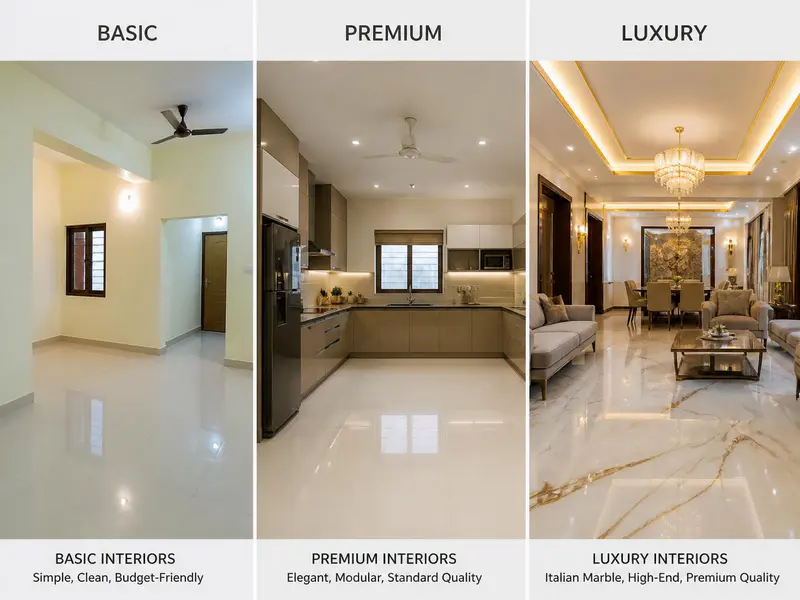
Summary Comparison Table for a 1,000 Sq. Ft. 2BHK House
| Specification Parameter | C-Class (Budget) | B-Class (Standard) | A-Class (Luxury) |
|---|---|---|---|
| Average Cost per Sq. Ft. | Rs. 1,300 to Rs. 1,500 | Rs. 1,600 to Rs. 1,900 | Rs. 2,200 to Rs. 2,800 |
| Total Cost (1,000 Sq. Ft. Plot) | Rs. 13 Lakhs to Rs. 15 Lakhs | Rs. 16 Lakhs to Rs. 19 Lakhs | Rs. 22 Lakhs to Rs. 28 Lakhs |
| Cement Grade Used | PPC (Portland Pozzolana) | OPC 43 / Premium PPC | OPC 53 Grade |
| Steel Reinforcement Type | Local / Fe 415 Grade | Branded Fe 550D TMT | Fe 600 / Corrosion Resistant |
| Flooring Materials | Ceramic Tiles / Local Kota | Vitrified Tiles (Double Charge) | Italian Marble / Granite / Hardwood |
| Window Frame Profiles | Local Hardwood / Aluminum | UPVC Slide Windows | Thermal-Break Aluminum / Bespoke Wood |
| Electrical & Wiring | Standard Non-FR Wires | FR-LSH Wires / Modular Switches | Automation Ready / Shielded Conduits |
To understand how to calculate steel quantity, read our detailed guide on Steel Weight Calculation for Slab.
Structural Component Cost Breakdown (Thumb Rules)
Civil engineering projects rely heavily on resource-allocation thumb rules derived from historical empirical data across Indian construction sites. For a typical B-Class residential building, the overall cost is split systematically between the Substructure (foundation up to plinth beam), the Superstructure (columns, beams, slabs, brickwork), and the Finishing Works (plastering, painting, flooring, plumbing, electrical).
Percentage Allocation of Total Construction Capital
- Labor Wages (Civil + Finishing Teams): 24% of the total budget.
- Cement Supply: 16% of the total budget.
- Steel Reinforcement (TMT bars): 14% of the total budget.
- Bricks / AAC Blocks: 10% of the total budget.
- Fine Aggregate (Sand / M-Sand): 8% of the total budget.
- Coarse Aggregate (10mm / 20mm Stone Crush): 6% of the total budget.
- Finishing Works (Tiles, Paint, Woodwork, Sanitary): 22% of the total budget.
Core Mathematical Calculations & Materials Quantification
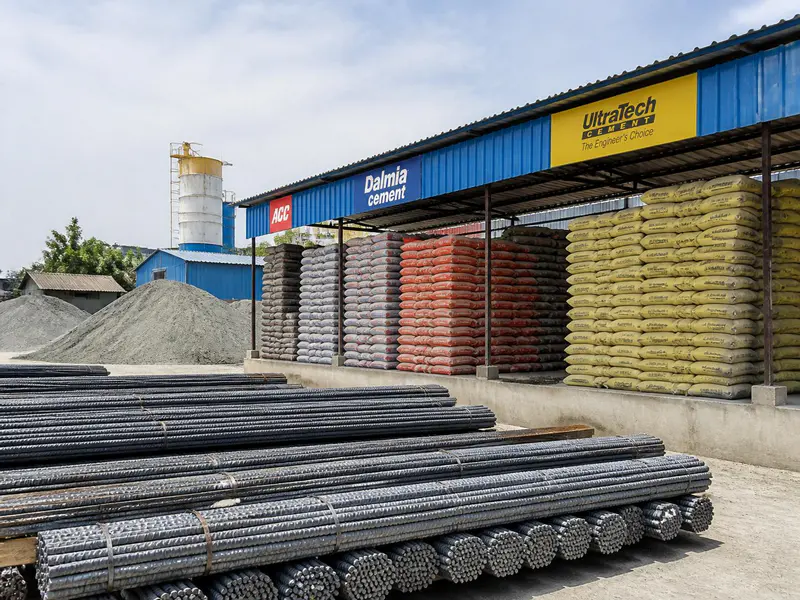
To maintain financial control over your site supervisors and material vendors, you must understand the basic calculations used to estimate materials. Below are the plain-text mathematical formulas used by civil engineers on-site, followed by material consumption estimations for a standard 1,000 sq. ft. built-up 2BHK area.
Core Civil Engineering Material Formulas (Plain Text)
- Total Required Area Calculation:
Built-Up Area = Carpet Area + Wall Thickness Area + Balcony Space - Volume of Concrete Calculation:
Wet Concrete Volume = Length x Width x Element Thickness
Dry Concrete Volume = Wet Concrete Volume x 1.54 - Cement Bag Requirement for Concrete Mix (M20 Grade – 1:1.5:3):
Total Cement Bags = (Dry Volume / Sum of Mix Ratios) x 1 x (Density of Cement / Weight of One Bag)
(Where Density of Cement = 1440 kg per cubic meter, and One Bag = 50 kg) - Steel Reinforcement Structural Weight Estimation:
Total Weight of Steel Rebars = Total Volume of Concrete x Steel Consumption Factor
(Standard residential factor = 2.5 kg to 4.5 kg per sq. ft. of built-up space, or roughly 80 kg per cubic meter of concrete) - Brickwork Masonry Component Volume:
Number of Standard Bricks = (Volume of Wall Masonry x 0.7) / Volume of One Single Brick
Step-by-Step Material Estimation Example (For 1,000 Sq. Ft. 2BHK Home)
Let us calculate the exact, real-world quantities needed for a standard 1,000 square foot built-up single-story 2BHK structural layout:
A. Cement Consumption Estimation
- Thumb Rule Multiplier: 0.4 bags required per square foot of total built-up footprint area.
- Calculation: 1,000 sq. ft. x 0.4 bags/sq. ft. = 400 Bags of Cement.
- Application breakdown: 140 bags for RCC structural elements (foundations, columns, slabs), 110 bags for block work brick walls, and 150 bags allocated for interior/exterior plastering and tile bed mortars. [1]
B. Steel Reinforcement Estimation
- Thumb Rule Multiplier: 4.0 kg of structural TMT steel required per square foot of built-up footprint area.
- Calculation: 1,000 sq. ft. x 4.0 kg/sq. ft. = 4,000 kg (or 4 Metric Tons) of Steel.
- Diameter profiling selection: 8mm and 10mm stirrup rings; 12mm, 16mm, and 20mm load-bearing vertical bars for columns, beams, and structural roof slabs.
C. Fine Aggregate (Sand / Manufactured Sand) Estimation
- Thumb Rule Multiplier: 1.8 Cubic Feet (CFT) required per square foot of built-up footprint area.
- Calculation: 1,000 sq. ft. x 1.8 CFT/sq. ft. = 1,800 CFT of Sand.
- Engineering specification: Use coarse washed M-Sand for structural concrete, and ultra-fine screened plastering sand for smooth wall treatments.
D. Coarse Aggregate (Crushed Stone) Estimation
- Thumb Rule Multiplier: 1.3 Cubic Feet (CFT) required per square foot of built-up footprint area.
- Calculation: 1,000 sq. ft. x 1.3 CFT/sq. ft. = 1,300 CFT of Coarse Aggregate.
- Gradation sizing split: 70% distribution using 20mm stone chips for heavy structural RCC pours; 30% distribution using 10mm chips for thin-profile slabs and structural shelf designs.
E. Bricks / AAC Blocks Matrix Calculation
- Thumb Rule Multiplier: 25 traditional red clay bricks required per square foot of built-up footprint area (accounting for both 9-inch exterior load perimeter walls and 4.5-inch partition walls).
- Calculation: 1,000 sq. ft. x 25 bricks/sq. ft. = 25,000 Red Clay Bricks.
- Modern alternative (Autoclaved Aerated Concrete Blocks): If utilizing 600mm x 200mm x 200mm lightweight AAC blocks instead, you will need approximately 1,200 to 1,350 blocks, which reduces structural deadweight and mortar usage.
Critical Construction Unit Conversions
On an active construction site, procurement invoices use a mix of Imperial, Metric, and regional commercial Indian units. Miscalculating these conversions when ordering bulk materials from commercial yards can lead to significant financial discrepancies.
Standard Construction Unit Conversion Table
| Transform From Unit | Convert To Target Unit | Exact Mathematical Multiplier |
|---|---|---|
| Cubic Meter (Cum) | Cubic Feet (CFT) | Multiply by 35.3147 |
| Square Meter (Sqm) | Square Feet (Sq. Ft.) | Multiply by 10.7639 |
| Metric Ton (MT) | Kilograms (Kg) | Multiply by 1,000 |
| Quintal | Kilograms (Kg) | Multiply by 100 |
| Brass (Regional India Unit) | Cubic Feet (CFT) | 1 Brass = 100 Cubic Feet (CFT) |
| Brass (Regional India Unit) | Cubic Meter (Cum) | 1 Brass = 2.8316 Cubic Meters |
| Running Meter (Rmt) | Running Feet (Rft) | Multiply by 3.2808 |
Site Quality Control, Wastage Mitigation, & Site Tips
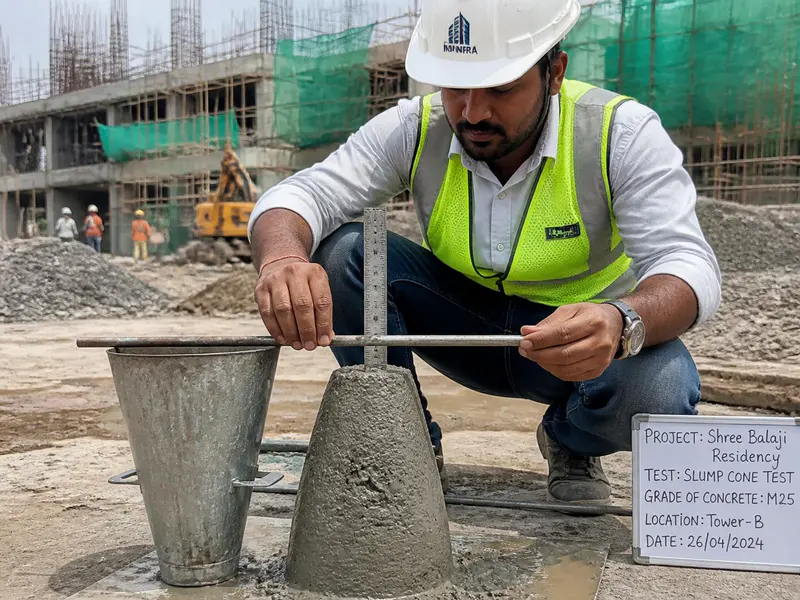
Even a well-calculated budget can fall apart without strict on-site management. Material wastage, poor workmanship, and skipped quality checks frequently lead to structural defects and costly retrofits. Below are real-world, actionable tips from site engineers to help keep your project on budget and structurally sound.
On-Site Material Quality Check Protocols
- Field Slump Testing for Workability: Before pouring any concrete truck or on-site mechanical mixer batch into structural columns or slabs, perform a manual slump cone test. For standard residential RCC structures, maintain a structural slump height of 100mm to 125mm to ensure proper flow without segregation.
- The Steel Rebar Bend Verification Test: Take a sample piece of 12mm TMT steel from your delivery batch. Bend it 180 degrees manually on-site. The outer curved surface must not show any micro-fractures or surface splits. If it does, reject the entire batch immediately, as it indicates high carbon brittleness.
- Field Brick Moisture Saturation Test: Submerge a delivered red clay brick in water for exactly 24 hours. Weigh it before and after. If the wet structural weight increases by more than 20% of its initial dry weight, the brick is too porous and lacks structural strength.
- Silt Content Verification in Fine Sand: Pour sand into a glass measuring cylinder filled with clean water, shake it vigorously, and let it sit for two hours. The thick silt layer resting on top of the clean sand must never exceed 8% of the total sample volume. Excess silt weakens the bonding capacity of cement mortar.
Actionable Strategies to Prevent Material Wastage
- Implement a Staggered Steel Rebar Bar-Bending Schedule (BBS): Ensure your site engineer creates a comprehensive Bar-Bending Schedule before cutting any steel rods. Staggering the cut lengths can reduce steel waste from the typical 8% down to under 2%.
- Proper Cement Storage and FIFO Inventory Management: Store cement bags on raised timber platform pallets at least 30 cm off the ground and 50 cm away from perimeter brick walls. Always use the First-In, First-Out (FIFO) inventory method. Cement stored for more than three months loses nearly 20% to 30% of its compressive strength due to ambient moisture absorption.
- Water Sprinkling During Aggregate Offloading: Ensure fine sand and aggregates are dropped onto heavy-duty tarpaulins rather than bare topsoil. Offloading directly onto bare earth can cause up to a 5% material loss due to soil contamination during shoveling.

Frequently Asked Questions (FAQs) – SEO Feature
Q1: Is it cheaper to build an independent 2BHK house or buy a 2BHK builder floor flat?
Building an independent 2BHK house gives you long-term ownership of the land and complete control over design customization. However, the upfront cost per square foot is generally higher than purchasing a pre-built flat. This is because developers benefit from bulk material purchasing, shared foundation costs across multiple floors, and optimized labor management.
Q2: What are the hidden costs involved in building a 2BHK house in India?
Hidden fees typically account for 10% to 15% of the total project budget. These include architectural blueprint fees, structural engineering layout stamps, municipal building plan approval fees, temporary on-site electrical and water connection installations, borewell drilling, boundary wall construction, and soil excavation tests.
Q3: How long does it typically take to complete a 1,000 sq. ft. 2BHK house?
A standard 1,000 sq. ft. 2BHK independent residential structure typically takes 6 to 9 months to complete. The timeline depends heavily on local weather conditions (construction slows during monsoons), cash flow consistency, material delivery timelines, and labor availability during festive seasons.
Q4: Can I save construction costs by avoiding structural concrete columns?
For small single-story homes, load-bearing masonry walls can be used instead of a reinforced concrete framed structure to save up to 10% on initial steel and formwork costs. However, if you plan to add a first or second floor in the future, a framed structure with proper columns and beams is essential. It provides the structural integrity needed to safely handle seismic forces and vertical loads.
Q5: Which grade of cement should I buy for a 2BHK slab casting?
For structural RCC elements like roof slabs, beams, and columns, use OPC 53 Grade (Ordinary Portland Cement) or premium high-performance PPC (Portland Pozzolana Cement) from reputable brands. OPC 53 provides high early strength development, allowing formwork to be safely removed sooner. For non-structural tasks like wall plastering and brick masonry work, OPC 43 or standard PPC is more economical and easier to work with.
Construction cost trends are influenced by inflation and material prices. According to the Reserve Bank of India inflation reports, construction material prices have increased in recent years.
Conclusion
Successfully managing the construction cost of a 2BHK house in India requires balancing precise engineering estimations with disciplined financial oversight. By keeping target material quantities in mind, using standard conversion rates, and enforcing strict quality checks on-site, you can build a durable, high-quality home without facing unexpected expenses.
Avoid the temptation to cut costs on core structural materials like TMT steel or cement grades. Instead, optimize your budget by managing finishing materials carefully and minimizing on-site waste. A structurally sound foundation and a well-built frame are the most important elements of a home that will last for generations.

Shakeel T is a qualified Civil Engineer and Structural Consultant with extensive on-site experience in residential and commercial building construction. Specializing in material estimation, cost budgeting, and structural safety guidelines, he has successfully managed multiple real estate projects from foundation to finishing. Through this blog, Shakeel shares field-tested civil engineering thumb rules, IS Code practices, and practical site tips to help home builders execute their projects efficiently and within budget.
Education: Diploma in Civil Engineering
Expertise: Quantity Surveying, Material Estimation, Structural Design, and Site Management.
First, thank you for the information, and your extraordinary perspective.
I could value this weblog and specifically this post.
At this point, I feel I misuse much too much of my hours
on the web, examining junk, generally. This was a stimulating switch from what
I’ve known. Nonetheless, I believe reading other people’s valuable ideas is a really vital
investiture of at least a bit of my weekly allotment of amount
of time in my schedule. It’s just like looking into
the chaff to get the treasure chest. Or maybe, whatever illustration will
work for you. Still, sitting in front of the laptop
is probably as bad for you as cigarettes and fried chips.
This blog is not just about the content, but also the community it fosters I’ve connected with so many like-minded individuals here