
Introduction
Quantity Surveying Basics for Beginners is one of the most important topics for civil engineering students, site engineers, and construction professionals. Quantity surveying plays a major role in construction projects by managing costs, quantities, materials, and overall project budgeting. Without proper quantity surveying, any construction project can face financial loss and material wastage.
In this article, you will learn quantity surveying basics in simple language, including roles, skills, and methods used in construction projects.
Quantity surveying basics for beginners include understanding construction drawings, measurement techniques, and cost estimation methods. Learning these fundamentals helps civil engineers manage construction projects efficiently.

What is Quantity Surveying?
Quantity surveying is the process of estimating and managing the cost and quantity of materials required for a construction project. A quantity surveyor calculates materials, labour costs, and total project cost before construction begins.
The main aim of quantity surveying is to complete the project within the budget without compromising quality. It helps builders, contractors, and clients control expenses and avoid unnecessary spending.
Understanding Quantity Surveying Basics for Beginners is very important for civil engineering students who want to build a strong career in construction management.
Quantity Surveying vs Cost Estimation
Quantity surveying and cost estimation are closely related but they are not the same. Quantity surveying focuses on measuring and calculating the quantities of materials required for a construction project based on drawings and specifications.
Cost estimation, on the other hand, involves calculating the total cost of the project using the quantities obtained from quantity surveying. It includes material costs, labor costs, equipment expenses, and contractor overheads.
In simple terms, quantity surveying determines how much material is required, while cost estimation determines how much the project will cost. Both processes are essential for proper project planning and financial management.
Role of a Quantity Surveyor in Construction
A quantity surveyor is responsible for managing all financial and quantity-related aspects of a construction project. From project planning to completion, they play a key role in cost control and material management.
Main responsibilities include:
- Estimating material quantities
- Preparing project cost estimates
- Preparing BOQ (Bill of Quantities)
- Managing contracts and payments
- Checking contractor bills
- Cost control and budget management
- Preparing final project cost report
A quantity surveyor ensures that the construction work is completed within the planned budget and time.
Construction Documents Used in Quantity Surveying
Quantity surveyors rely on several construction documents to calculate material quantities and prepare cost estimates. These documents provide detailed information about building dimensions, materials, and specifications.
Important construction documents include:
• Architectural drawings that show building layout and room dimensions
• Structural drawings that provide details about beams, columns, and foundations
• Electrical and plumbing drawings that indicate service installations
• Material specifications describing quality standards and construction methods
By carefully studying these documents, quantity surveyors can accurately estimate material quantities and project costs.
Importance of Quantity Surveying in Construction
Quantity surveying is essential for every construction project, whether it is a small house or a large building. It helps in proper planning and financial management.
Construction standards in India are defined by the Bureau of Indian Standards (BIS)
1. Cost Control
Quantity surveying helps control project costs by estimating accurate material quantities and labour charges.
2. Budget Planning
It helps in preparing a proper budget before starting construction work.
3. Material Management
Quantity surveyors calculate exact material requirements like cement, steel, sand, and bricks, reducing wastage.
4. Profit Management
Contractors can know their profit or loss through proper quantity surveying.
5. Billing and Payments
Quantity surveyors prepare running bills and final bills for contractors and clients.
Learning Quantity Surveying Basics for Beginners helps civil engineers manage construction projects professionally.
Understanding Types of Foundation in Construction also helps quantity surveyors estimate foundation quantities accurately.
Types of Quantity Surveying in Construction
Quantity surveying can be categorized into different types depending on the stage of construction and the purpose of estimation.
Common types include:
• Preliminary quantity surveying used during the early design stage to estimate approximate project cost
• Detailed quantity surveying performed using complete construction drawings
• Material quantity surveying used to calculate the amount of materials required for construction
• Cost control quantity surveying used during construction to monitor project expenses
Each type helps engineers manage construction costs and resources effectively.
Basic Measurements in Quantity Surveying
In quantity surveying, different construction items are measured using standard units. Some common measurements include:
- Concrete – Cubic meter (m³)
- Brickwork – Cubic meter (m³)
- Plastering – Square meter (m²)
- Flooring – Square meter (m²)
- Steel – Kilograms (kg) or tonnes
- Excavation – Cubic meter (m³)
Understanding these measurements is the first step in quantity surveying.
You can also estimate material quantities using our Concrete Calculator.
Tools Used in Quantity Surveying
Quantity surveyors use different tools and software to measure quantities and prepare cost estimates accurately.
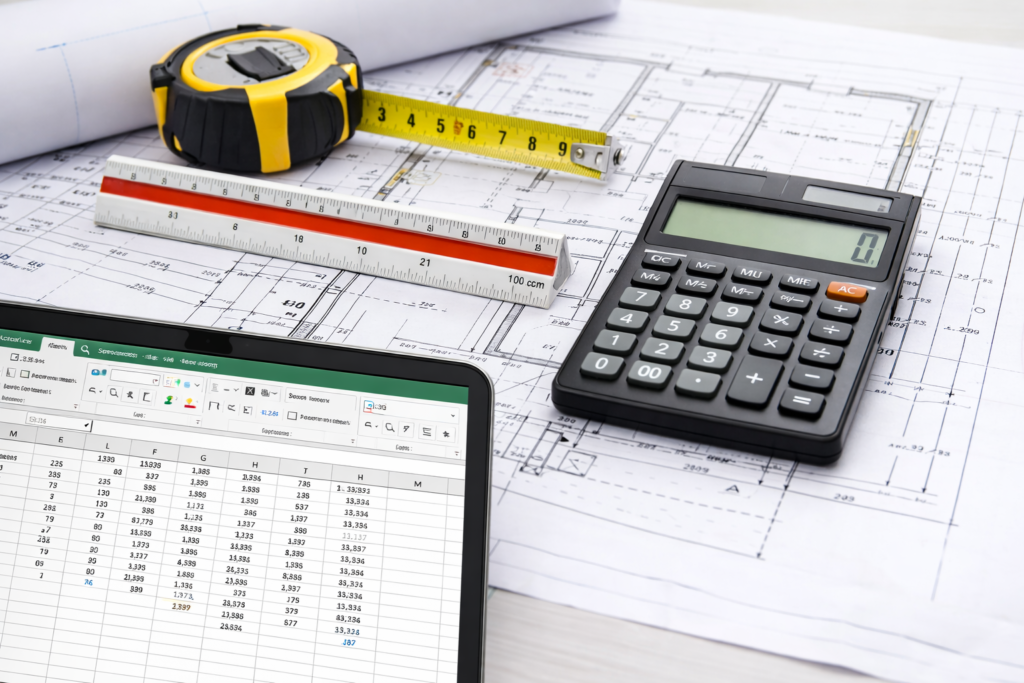
Common tools used in quantity surveying include measuring tape, scale ruler, calculator, and spreadsheets for manual calculations. Modern quantity surveyors also use digital software such as PlanSwift, Autodesk Revit, and Bluebeam for quantity takeoff from drawings.
Using these tools improves accuracy and helps professionals complete quantity calculations faster.
Software Used for Quantity Surveying
Modern quantity surveyors use specialized software to improve the accuracy and speed of quantity calculations. Digital tools help engineers perform quantity takeoff directly from construction drawings.
Some commonly used quantity surveying software includes:
• PlanSwift for digital quantity takeoff
• Autodesk Revit for BIM-based estimation
• Bluebeam for measuring quantities from PDF drawings
• Microsoft Excel for cost calculation and budgeting
Using software tools reduces manual errors and improves efficiency in construction estimation.
Steps in Quantity Surveying Process
1. Study of Drawing
The quantity surveyor first studies architectural and structural drawings carefully.
2. Taking Measurements
Measurements are taken from drawings like length, width, and height.
3. Quantity Calculation
Material quantities are calculated using formulas and standard methods.
4. Rate Analysis
Cost per unit of work is calculated including material, labour, and machinery.
5. Cost Estimation
Total project cost is calculated based on quantities and rates.
6. BOQ Preparation
Bill of Quantities is prepared for project execution and billing.
For detailed measurement techniques, read our guide on Quantity Takeoff from Drawings Step by Step
Skills Required for Quantity Surveyors
To become a successful quantity surveyor, you need some important skills:
- Basic civil engineering knowledge
- Good mathematics skills
- Knowledge of construction drawings
- MS Excel and AutoCAD knowledge
- Estimation and costing skills
- Communication skills
- Attention to detail
Civil engineering students should focus on these skills to build a strong career in quantity surveying.
Challenges Faced by Quantity Surveyors
Quantity surveyors often face several challenges during construction projects. One common issue is incomplete or unclear drawings, which can lead to incorrect quantity calculations.
Frequent design changes during construction can also affect cost estimates and project budgets. In addition, fluctuations in construction material prices can make cost estimation more difficult.
Proper communication between engineers, contractors, and project managers helps quantity surveyors manage these challenges effectively.
Career Opportunities in Quantity Surveying
Quantity surveyors are in high demand in construction companies, real estate projects, and infrastructure projects. Career opportunities include:
- Quantity Surveyor
- Estimation Engineer
- Billing Engineer
- Cost Engineer
- Project Coordinator
Freshers can start as junior quantity surveyors and grow to senior positions with experience.
Professional quantity surveying standards are also guided by the Royal Institution of Chartered Surveyors (RICS)
Future Scope of Quantity Surveying
Quantity surveying is becoming increasingly important as construction projects become more complex and expensive. Accurate cost estimation and project budgeting are essential for successful construction management.
With the growth of infrastructure projects, real estate development, and smart cities, the demand for skilled quantity surveyors is increasing worldwide.
Professionals with strong knowledge of construction drawings, cost estimation, and project management will have excellent career opportunities in the construction industry.
Frequently Asked Questions (FAQ)
1. What is quantity surveying in construction?
Quantity surveying is the process of calculating the quantities and costs of materials required for a construction project. It helps engineers and contractors estimate project costs, control budgets, and manage construction resources effectively.
2. Why is quantity surveying important in construction?
Quantity surveying is important because it helps in cost estimation, budget planning, and financial control of construction projects. Accurate quantity calculations prevent material shortages and reduce unnecessary expenses.
3. What skills are required for a quantity surveyor?
A quantity surveyor should have strong mathematical skills, knowledge of construction drawings, cost estimation ability, and communication skills. Understanding construction materials and project management is also important.
4. What tools are used in quantity surveying?
Quantity surveyors use tools such as measuring tape, scale rulers, calculators, and spreadsheets for manual calculations. Modern professionals also use software like PlanSwift, Autodesk Revit, and Bluebeam for digital quantity takeoff.
5. What is the difference between quantity surveying and cost estimation?
Quantity surveying focuses on calculating material quantities from construction drawings, while cost estimation converts those quantities into the total project cost including materials, labor, and equipment.
Conclusion
Understanding Quantity Surveying Basics for Beginners is essential for every civil engineering student and site engineer. Quantity surveying helps in proper cost estimation, material calculation, and project budget control. It plays a crucial role in successful construction project completion.
If you want a successful career in civil engineering, learning quantity surveying is a must. Start practicing quantity takeoff from drawings and improve your estimation skills to become a professional quantity surveyor in the construction industry.
With proper training and experience, quantity surveyors can play a key role in controlling construction costs and improving project efficiency. Learning quantity surveying basics is an important step for civil engineering students and professionals entering the construction industry.

Shakeel T is a civil engineering enthusiast and founder of CivilGuide.in. He specializes in construction estimation, quantity surveying, and practical civil engineering calculations. Through CivilGuide, he shares real-world construction knowledge, calculators, and step-by-step guides to help students and site engineers improve their technical skills.