
Introduction
Every successful construction project relies on a careful balance between engineering design and financial reality. While structural engineers ensure a building stands, quantity surveyors ensure it can actually be built within a designated budget. For fresh civil engineering graduates and construction beginners, entering the field of quantity surveying can feel like learning a completely new language.
Quantity surveying is not just about counting bricks or measuring concrete volumes. It is a highly strategic role that covers cost management, procurement, contracts administration, and financial auditing from the day a project is conceived until the final keys are handed to the client. This comprehensive guide serves as your foundational roadmap to mastering quantity surveying basics for beginners, packed with real-world site formulas, practical examples, and field-tested quality control tips.

What is Quantity Surveying and Why Does It Matter?
Quantity Surveying (QS) is the professional assessment, management, and control of all costs associated with a construction or civil engineering project. A quantity surveyor manages the project budget, calculates material requirements, handles legal contracts, and protects the financial interests of either the project owner (client-side QS) or the builder (contractor-side QS).
The Strategic Value of a Quantity Surveyor
Without professional quantity surveying, construction projects rapidly descend into financial chaos.
- Feasibility Assessment: Before a single shovel hits the dirt, a quantity surveyor analyzes architectural concepts to determine if the project is economically viable.
- The Guard of Project Margins: Contractor-side quantity surveyors continuously track on-site expenditures against the baseline budget to ensure the construction company maintains its profit margins.
- Contract and Dispute Management: Construction sites are prone to changes, variations, and scope adjustments. The quantity surveyor meticulously documents these deviations to prevent costly legal battles.
Client-Side QS vs. Contractor-Side QS
It is essential for beginners to understand the operational split within this career path:
- Client Quantity Surveyor (PQS): Works directly for the developer or project owner. Their goal is to achieve the best value for money, minimize design changes, and ensure the contractor does not overcharge during monthly progress payments.
- Contractor Quantity Surveyor (SQS): Works for the construction company executing the work. Their focus is on maximizing profit margins, tracking actual on-site waste, sub-contractor procurement, and ensuring every single piece of variation work is billed to the client.
Core Functions of a Quantity Surveyor
To build a successful career in this domain, you must develop deep proficiency in five core operational areas.

[1. Estimation & BOQ] ➔ [2. Procurement & Tendering] ➔ [3. Cost Control] ➔ [4. Contract Admin] ➔ [5. Final Accounts]
1. Material Estimation and Bill of Quantities (BOQ)
This is the most visible function of a beginner quantity surveyor. It involves taking structural, architectural, and MEP (Mechanical, Electrical, Plumbing) drawings and breaking them down into a standardized, itemized list called the Bill of Quantities (BOQ). The BOQ contains a precise description of work items, their corresponding measurement units, and quantities.
2. Tendering and Procurement
Once the BOQ is ready, the quantity surveyor prepares tender packages to invite bids from contractors or sub-contractors. They conduct rigorous commercial evaluations, checking for unbalanced bidding (where a contractor artificially inflates prices for early-stage work like excavation to gain early cash flow).
3. Interim Valuation and Cost Control
Construction projects are paid out in monthly stages. The quantity surveyor goes out to the physical site, measures the actual work completed up to that day, and certifies the value of work for the monthly running bill (RA Bill). They also manage cash flow forecasts to ensure the project does not run out of money mid-way.
4. Variation Management
When site conditions change—such as encountering an unexpected underground rock layer during excavation—the design must adapt. A quantity surveyor calculates the financial impact of these modifications, issues variation orders, and negotiates new unit rates using standard rate analysis.
5. Final Accounts and Auditing
At project completion, the quantity surveyor closes out the financial books. They resolve all outstanding claims, calculate final material balances, deduct retention money held for defect liability periods, and issue the final payment certificate.
Standard Units of Measurement Across Construction Activities

Accuracy in quantity surveying depends entirely on assigning the correct measurement unit to the correct task. The industry follows standard systems of measurement such as NRM (New Rules of Measurement) or POMI. Below is a detailed, skimmable summary table mapping critical structural items to their standardized metric and imperial units.
| Work Classification | Specific Project Activity | Metric Unit | Imperial Unit | Mode of Measurement Basis |
|---|---|---|---|---|
| Site Preparation | Clearing vegetation, topsoil removal | Square Meter (sqm) | Square Foot (sqft) | Surface Area (Depth up to 300mm) |
| Earthwork | Trench excavation, bulk soil cutting, filling | Cubic Meter (cum) | Cubic Yard (cu yd) / CFT | Solid Volume |
| Foundations | Lean concrete mud mats (PCC) | Cubic Meter (cum) | Cubic Foot (CFT) | Solid Volume |
| Superstructure | Reinforced concrete columns, beams, slabs | Cubic Meter (cum) | Cubic Yard (cu yd) | Solid Volume |
| Formwork | Shuttering panels, centering, staging | Square Meter (sqm) | Square Foot (sqft) | Contact Area of concrete |
| Masonry | Thick walls (230mm and above) | Cubic Meter (cum) | Cubic Foot (CFT) | Volume of masonry |
| Partitioning | Thin brick walls (115mm / half-brick) | Square Meter (sqm) | Square Foot (sqft) | Area (Thickness specified) |
| Steel Work | Structural rebar, mesh, structural steel I-beams | Kilogram (kg) / Tonne | Pound (lb) / US Ton | Weight based on standard density |
| Surface Finishes | Internal wall plastering, external painting | Square Meter (sqm) | Square Foot (sqft) | Flat surface area covered |
| Flooring | Marble, vitrified tiling, granite counters | Square Meter (sqm) | Square Foot (sqft) | Net floor area |
| Linear Items | Skirting, PVC conduit lines, expansion joints | Running Meter (rm) | Linear Foot (LFT) | Continuous length along centerline |
| Fixtures | Manholes, doors, gully traps, wash basins | Numbers (Nos) | Each (Ea) | Enumeration / Item count |
Understanding Types of Foundation in Construction also helps quantity surveyors estimate foundation quantities accurately.
Core Mathematical Formulas for Quantity Surveying
You do not need complex mathematics to be an exceptional quantity surveyor. The secret lies in breaking down complex structural shapes into basic geometric components using these plain-text algebraic formulas.
1. Volumetric Quantities (Excavation, Concrete, Masonry)
- Formula: Volume = Length x Width x Depth (or Thickness)
- Application: Rectangular footing pads, slab panels, structural beams, and boundary walls.
2. Area-Based Quantities (Formwork, Plastering, Painting)
- Formula: Area = Length x Width (or Height)
- Application: Shuttering area contact, wall tiles, and ceiling plastering.
3. Trapezoidal Foundations (Combined / Sloped Footings)
- Formula: Total Volume = V1 + V2
- Where V1 (Lower Rectangular Part) = Length x Width x Thickness
- Where V2 (Upper Sloped Frustum Part) = (Height of sloped part / 3) x (Area 1 + Area 2 + Square Root of (Area 1 x Area 2))
- Area 1 = Surface area of the lower rectangular base pad.
- Area 2 = Surface area of the top column-junction concrete face.
4. Materials Consumption in Concrete (Dry Mix Calculation)
- Formula: Dry Volume of Concrete = Wet Volume x 1.54
- This constant accounts for the volume shrinkage that occurs when water is added to dry cement, sand, and coarse aggregates.
5. Reinforcement Steel Weight from Length
- Formula: Weight per Meter = (Diameter x Diameter) / 162
- Total Weight = Weight per Meter x Total Linear Length of the Bar
Practical Step-by-Step Examples with Concrete Numbers
To truly master quantity surveying basics for beginners, let’s analyze three highly detailed, practical on-site calculation scenarios.
Scenario A: Material Estimation for a Brick Masonry Wall
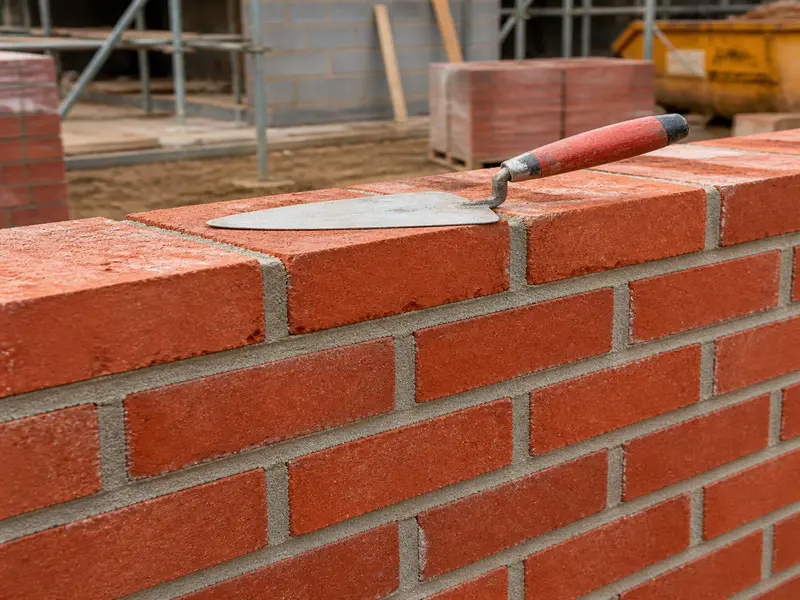
Calculate the exact number of standard bricks, bags of cement, and dry sand required to build a brick wall.
1. Given Parameters:
- Wall Dimensions: Length = 5.0 meters, Height = 3.0 meters, Thickness = 0.23 meters.
- Standard Brick Size (Without Mortar): 0.19m x 0.09m x 0.09m.
- Nominal Brick Size (With Mortar Joints): 0.20m x 0.10m x 0.10m.
- Mortar Mix Ratio: 1:6 (1 Part Cement to 6 Parts Sand).
2. Volume Calculations:
- Total Wet Volume of Brickwork = 5.0m x 3.0m x 0.23m = 3.45 Cubic Meters.
- Volume of 1 Standard Brick with Mortar = 0.20m x 0.10m x 0.10m = 0.002 Cubic Meters.
- Total Number of Bricks Required = 3.45 / 0.002 = 1,725 Bricks.
3. Mortar Quantity Calculations:
- Actual volume of bricks without mortar = 1,725 x (0.19m x 0.09m x 0.09m) = 1,725 x 0.001539 = 2.655 Cubic Meters.
- Wet Volume of Mortar Required = Total Brickwork Volume – Actual Brick Volume
- Wet Volume of Mortar = 3.45 – 2.655 = 0.795 Cubic Meters.
- Convert Wet Mortar to Dry Mortar Volume (apply 1.33 expansion and void factor):
- Dry Mortar Volume = 0.795 x 1.33 = 1.057 Cubic Meters.
4. Cement and Sand Split:
- Sum of Mix Proportions = 1 + 6 = 7 parts.
- Cement Volume = (1 / 7) x 1.057 = 0.151 Cubic Meters.
- Since 1 bag of cement occupies 0.035 cubic meters:
- Number of Cement Bags = 0.151 / 0.035 = 4.31 bags (Round up to 5 bags).
- Sand Volume = (6 / 7) x 1.057 = 0.906 Cubic Meters.
5. Final Material Takeoff Summary for Wall:
- Bricks: 1,725 Pieces
- Cement: 5 Bags
- Sand: 0.906 Cubic Meters
Scenario B: Concrete Mix Proportions for an RC Slab
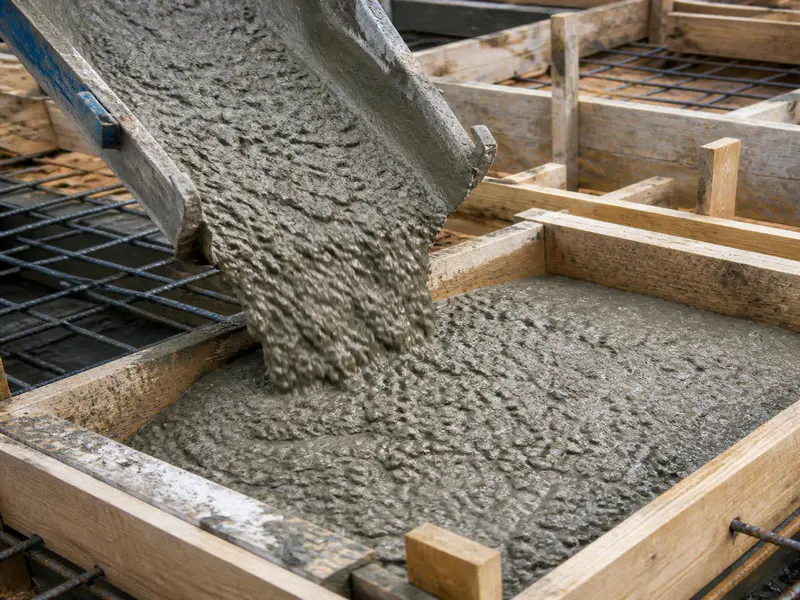
Calculate the quantities of raw materials needed for an M20 grade (Mix Ratio 1:1.5:3) concrete floor slab.
1. Given Parameters:
- Slab Slab Dimensions: Length = 10.0 meters, Width = 6.0 meters, Thickness = 0.15 meters.
- Concrete Grade: M20 (1 Part Cement : 1.5 Parts Fine Aggregate : 3 Parts Coarse Aggregate).
2. Wet and Dry Volume Calculations:
- Total Wet Volume of Concrete = 10.0m x 6.0m x 0.15m = 9.0 Cubic Meters.
- Convert to Dry Volume: Dry Volume = 9.0 x 1.54 = 13.86 Cubic Meters.
3. Component Breakdown:
- Sum of Mix Ratios = 1 + 1.5 + 3 = 5.5 parts.
- Cement Volume = (1 / 5.5) x 13.86 = 2.52 Cubic Meters.
- Cement Bags Required = 2.52 / 0.035 = 72 Bags.
- Sand (Fine Aggregate) Volume = (1.5 / 5.5) x 13.86 = 3.78 Cubic Meters.
- Crushed Stone (Coarse Aggregate) Volume = (3 / 5.5) x 13.86 = 7.56 Cubic Meters.
4. Final Takeoff Summary for Slab:
- Cement: 72 Bags
- Sand: 3.78 Cubic Meters
- Coarse Aggregates: 7.56 Cubic Meters
Scenario C: Rate Analysis for Wall Plastering Work
Determine the unit cost per square meter for 12mm thick internal wall plastering in a 1:4 cement-sand mix.
1. Operational Area Base:
- Assume a standard base study area of 100 Square Meters.
- Plaster Thickness = 12mm = 0.012 meters.
2. Mortar Volume Calculation:
- Net Wet Volume of Plaster = 100 sqm x 0.012m = 1.20 Cubic Meters.
- Add 20% extra volume to fill uneven masonry joints and patches:
- Adjusted Wet Volume = 1.20 x 1.20 = 1.44 Cubic Meters.
- Convert to Dry Mortar Volume (Multiply by 1.33 factor):
- Dry Mortar Volume = 1.44 x 1.33 = 1.915 Cubic Meters.
3. Material Distribution (1:4 Mix, Total Parts = 5):
- Cement Quantity = (1 / 5) x 1.915 = 0.383 Cubic Meters.
- Cement Bags Required = 0.383 / 0.035 = 10.94 Bags (Say 11 Bags).
- Sand Quantity = (4 / 5) x 1.915 = 1.532 Cubic Meters.
4. Financial Cost Sheet Application (Using Sample Local Market Unit Rates):
- Cost of 11 Bags Cement at $8.00 per bag = $88.00
- Cost of 1.532 cum Sand at $25.00 per cum = $38.30
- Mason and Helper Labor Charges for 100 sqm = $120.00
- Total Basic Cost for 100 sqm = $88.00 + $38.30 + $120.00 = $246.30
- Add 1.5% Water Charges and 10% Contractor Profit = $246.30 x 1.115 = $274.62
- Result: Final Unit Rate for Plastering = $2.75 per Square Meter ($274.62 / 100 sqm)
You can also estimate material quantities using our Concrete Calculator.
Critical Engineering Unit Conversions
Quantity surveyors regularly shift between client billing units and vendor supply configurations. Bookmark this conversion cheat sheet to avoid commercial calculation errors.
1. Volumetric Factors
- Cubic Meters to Cubic Feet (CFT): Multiply the cubic meter value by 35.3147.
- Application: Converting structural concrete volumes to local sand/aggregate supply truck measurements.
- Cubic Meters to Brass: Multiply the cubic meter value by 0.3531 (where 1 Brass equals exactly 100 Cubic Feet).
- Application: Used extensively across South Asian markets for bulk earthwork and stone supply tracking.
- Cubic Yards to Cubic Meters: Multiply the cubic yard value by 0.7645.
2. Area Factors
- Square Meters to Square Feet (sqft): Multiply the square meter value by 10.7639.
- Application: Converting drawing dimensions into real estate carpet area listings.
- Square Feet to Square Meters: Multiply the square feet value by 0.0929.
3. Mass and Weight Factors
- Kilograms to Metric Tonnes: Divide the total kilogram value by 1000.
- Application: Bulk procurement orders for reinforcing high-tensile steel bars.
- Kilograms to Pounds (lbs): Multiply the kilogram value by 2.2046.
Site Quality Controls, Wastage Coefficients, and Field Tips
If you order material based strictly on exact drawing dimensions, your site will run out of supplies mid-way through construction. Materials get dropped, broken, cut, or spilled. A successful quantity surveyor must apply realistic material wastage factors based on actual site conditions.
Industry-Standard Material Wastage Coefficients
Add these percentages to your calculated net drawing measurements before issuing commercial purchase orders:
- Ready-Mix Concrete (RMC): Add 2% to 3% (accounts for residues left inside concrete pump pipelines and transit mixer drums).
- Site-Mixed Concrete: Add 5% (accounts for floor aggregate spillage and sub-grade soil absorption).
- Reinforcement Steel Bars: Add 5% to 7% (accounts for short cut-off scrap rebar ends that cannot be reused, and structural overlapping).
- Clay Bricks and ACC Blocks: Add 7% to 10% (accounts for handling damage, transit cracking, and cutting bricks to fit corner closers).
- Vitrified Flooring Tiles: Add 8% to 10% (accounts for cutting around wall perimeters, columns, and structural corners).
- Wall Paint and Primer: Add 10% (accounts for surface absorption, roller dripping, and equipment washing losses).

On-Site Verification and Quality Check Methodologies
As a quantity surveyor, do not rely blindly on paper receipts. Implement these site-level verifications:
- The Steel Rebar Unit Weight Field Check: Before accepting a massive shipment of rebar, cut a random 1-meter sample piece from the truck. Weigh it on a digital scale and verify it against the standard mathematical formula weight (Diameter squared divided by 162). If the sample weighs significantly less, the steel manufacturer has supplied underweight bars with rolling margins that violate structural safety codes.
- Bulking of Sand On-Site Testing: Damp sand expands in volume due to surface moisture tension, which is known as the bulking of sand. If you buy sand by volume during rainy periods, you are buying water pockets. Conduct a quick field cylinder test: fill a graduated cylinder with sand, record the volume, flood it completely with water, shake it, and record the dropped volume. Deduct this bulking percentage (often up to 20-30%) from the supplier’s invoice to avoid overpaying.
- The Plaster Thickness Check: Contractors frequently apply thicker plaster layers (e.g., 25mm instead of the specified 12mm) to cover up poorly aligned, crooked brickwork. This practice doubles your cement consumption. Use a simple depth probe on freshly plastered walls to enforce strict quality control and control material budgets.
Frequently Asked Questions (FAQs)
What is the most critical document in quantity surveying?
The Bill of Quantities (BOQ) is the most critical document. It translates complex drawings into a standardized, line-by-line financial roadmap, allowing owners and builders to price, monitor, and audit project costs transparently.
How does a quantity surveyor handle a “Variation Order”?
When a project scope changes, the quantity surveyor checks the original contract to see if similar work items have established unit rates. If no matching rates exist, they perform a comprehensive rate analysis using raw material costs, current market labor wages, and a standard 10% to 15% contractor profit margin to negotiate a fair price with the client.
What is the difference between an Estimator and a Quantity Surveyor?
An estimator typically operates during the pre-construction bidding phase to calculate total projected costs for a proposal. A quantity surveyor manages the entire financial lifecycle of a project, managing contracts, tracking actual costs, approving progress payments, and finalizing accounts on the active job site.
What is “Retention Money” in construction bills?
Retention money is a percentage of each monthly progress payment (usually 5% to 10%) that the client holds back from the contractor. This money serves as a financial security deposit, ensuring the contractor corrects any structural defects or quality issues that surface during the Defect Liability Period after completion.
Can BIM software replace a quantity surveyor?
No. While BIM (Building Information Modeling) and 5D takeoff software automate basic length and volume extractions, they cannot read vague structural drawing notes, analyze site-specific safety risks, evaluate contractor claims, or manage complex contractual disputes.
Construction standards in India are defined by the Bureau of Indian Standards (BIS)
Conclusion
Quantity surveying serves as the financial engine driving the construction industry. Mastering this field requires a balance of geometric analysis, practical construction awareness, and commercial discipline. By breaking down structural drawings systematically, maintaining a rigorous database of unit conversions, and factoring in realistic material waste, you can deliver accurate, reliable project budgets. Use this guide as a baseline reference to avoid costly errors and establish a strong foundation in your quantity surveying career.

Shakeel T is a qualified Civil Engineer and Structural Consultant with extensive on-site experience in residential and commercial building construction. Specializing in material estimation, cost budgeting, and structural safety guidelines, he has successfully managed multiple real estate projects from foundation to finishing. Through this blog, Shakeel shares field-tested civil engineering thumb rules, IS Code practices, and practical site tips to help home builders execute their projects efficiently and within budget.
Education: Diploma in Civil Engineering
Expertise: Quantity Surveying, Material Estimation, Structural Design, and Site Management.
I was trying to find out if I could increase the RAM on my laptop. While
looking for answers I discovered https://znayka.com.ua.
I couldn’t find detailed specifications on most websites. Many sources were missing key details.
On this site I found useful technical guidance, along with clear diagrams that made everything much easier to understand.
It’s worth visiting this platform if you want reliable information about laptops and hardware upgrades.