
Introduction
Building your dream home is a major life milestone, but funding it can be a complex journey. Unlike a standard home loan used to buy a ready-to-move-in apartment, a house construction loan operates on a completely different framework. Banks do not hand over the entire loan amount in a single lump sum. Instead, funds are released in stages based on physical site progress.
Navigating the house construction loan process in India requires a blend of financial planning, legal verification, and civil engineering knowledge. Missteps in your application or inaccurate cost estimates can stall construction, cause cash flow crunches, and lead to structural compromises.
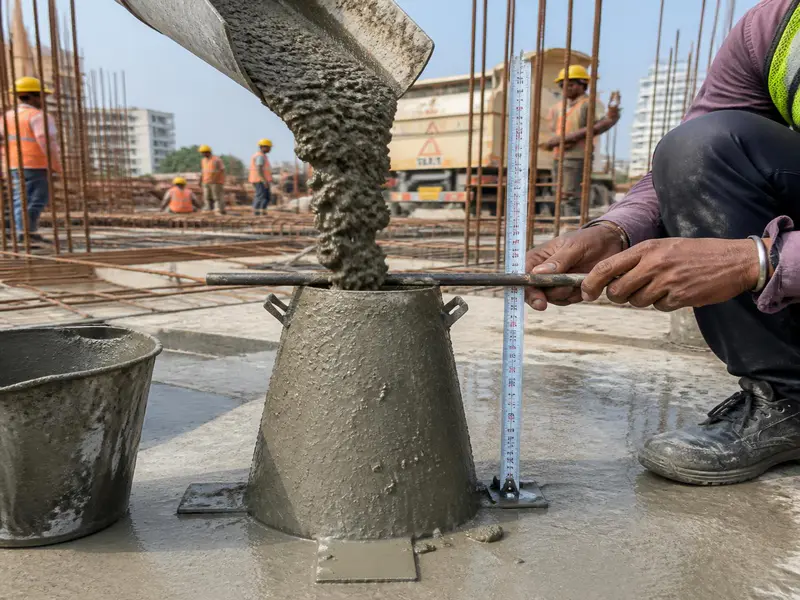
This exhaustive guide breaks down the complete construction loan process for 2026. It covers banking stages, real-world civil engineering calculations, site quality checks, and cost-control strategies to keep your project on track.
Understanding the House Construction Loan Framework
A plot loan or regular home loan cannot be substituted for a self-construction loan. Lenders evaluate both your financial creditworthiness and the technical viability of your construction project.
Key Features of Construction Loans
- Disbursement in Tranches: Funds are released in instalments (usually 4 to 6 stages) matching construction milestones like foundation, plinth, lintel, slab, and finishing.
- Interest-Only Period: During construction, you generally pay Pre-EMI, which is interest only on the amount disbursed, rather than the full principal.
- Technical Audits: Bank-appointed civil engineers visit your site to verify progress before releasing the next financial tranche.
- Time-Bound Execution: Most banks require construction to begin within 6 to 12 months of loan sanction and wrap up within 24 to 36 months.
Core Differences: Regular Home Loan vs. Construction Loan
| Feature | Regular Home Loan | House Construction Loan |
|---|---|---|
| Payout Method | Single lump sum paid directly to the seller. | Staged tranches based on actual site progress. |
| EMI Structure | Full EMI begins immediately next month. | Pre-EMI (interest only) on the disbursed amount. |
| Technical Audit | Single valuation of the finished property. | Repeated site inspections at every major slab level. |
| Documentation | Standard property chain deeds and RERA papers. | Approved structural plans, itemised cost estimates. |
| Margin Money | Paid upfront before the bank releases funds. | Injected in stages alongside bank disbursements. |
Step-by-Step House Construction Loan Process
Step 1: Secure Land Title and Approved Plans
Before approaching a bank, you must hold clear legal title to the plot. You must also obtain a sanctioned building plan from your local municipal corporation, gram panchayat, or town planning authority.
Step 2: Hire a Chartered Engineer / Licensed Architect
Banks require a formal, itemised Construction Cost Estimate formatted to standard specifications. This estimate must be signed and stamped by a registered civil engineer or architect.
Step 3: Financial and Technical Evaluation
The bank reviews your KYC, income proof, and credit score (a CIBIL score above 750 is ideal). Concurrently, the bank’s legal team verifies your land deeds while its technical panel reviews your construction blueprints.
Step 4: Loan Sanction and Margin Money Allocation
Once approved, the bank issues a sanction letter detailing the total loan amount, interest rate, and specific disbursement milestones. You must deploy your own contribution (margin money, typically 20% to 30% of the total estimate) before bank funds kick in.
Step 5: Milestone-Based Disbursements

You submit a “Stage Completion Certificate” signed by your engineer as each construction phase wraps up. The bank sends its technical evaluator to verify the work, and then releases the next tranche directly to your account or contractor.
Engineering Estimation: Quantities and Project Costs
Accurate estimation prevents mid-project budget shortfalls. Bankers review structural estimates closely to ensure material costs align with current market rates.
Below are the foundational engineering formulas used to estimate essential building materials like concrete, steel, and brickwork.
Core Mathematical Formulas (Plain Text)
- Total Built-up Area = Length x Width x Number of Floors
- Concrete Wet Volume = Length x Width x Thickness
- Concrete Dry Volume Requirement = Wet Volume x 1.54
- Cement Bags Needed (for 1:1.5:3 Mix / M20) = (Dry Volume x 1) / (1 + 1.5 + 3) / 0.035
- Number of Bricks (Standard Indian Size) = (Volume of Brickwork x 1) / (0.19 x 0.09 x 0.09) with mortar additions
- Steel Reinforcement Weight = (Diameter x Diameter / 162) x Length per meter
Unit Conversions Reference
- 1 Cubic Meter (Cum) = 35.315 Cubic Feet (CFT)
- 1 Brass (Standard Indian Mining/Masonry Unit) = 100 Cubic Feet (CFT) = 2.831 Cubic Meters
- 1 Metric Ton = 1,000 Kilograms = 10 Quintals
Practical Structural Calculations with Concrete Numbers
Let us walk through a concrete engineering calculation for a real-world site application.
Scenario: Ground Floor Slab Construction

- Slab Dimensions: 12 meters length x 10 meters width
- Slab Thickness: 125 millimetres (0.125 meters)
- Concrete Grade Designated: M20 (Ratio 1 : 1.5 : 3 where 1 part is Cement, 1.5 parts is Sand, and 3 parts is Coarse Aggregate)
Step 1: Calculate the Wet Volume of Concrete
Wet Volume = 12m x 10m x 0.125m = 15 Cubic Meters

Step 2: Convert Wet Volume to Dry Volume (accounts for shrinkage and voids)
Dry Volume = 15 x 1.54 = 23.1 Cubic Meters

Step 3: Calculate Total Parts in M20 Mix
Total Parts = 1 + 1.5 + 3 = 5.5

Step 4: Calculate Volume of Cement Needed
Volume of Cement = (23.1 x 1) / 5.5 = 4.2 Cubic Meters

Step 5: Convert Cement Volume to Standard 50kg Bags (1 Bag = 0.035 Cum)
Total Cement Bags = 4.2 / 0.035 = 120 Bags
Thumb Rules for Overall Material Budgeting
For a standard residential building in India, overall material usage per square foot of built-up area typically balances as follows:
- Cement: 0.4 bags per sq ft
- Steel: 2.5 kg to 3.5 kg per sq ft
- Sand: 1.2 CFT per sq ft
- Aggregates: 1.35 CFT per sq ft
You can also estimate your total construction cost using our Concrete Calculator before applying for a loan.
Site Quality Control and Wastage Mitigations
Bank evaluators can hold up your disbursements if they notice poor construction quality, structural cracks, or significant material waste on site. Use these strict site quality checks to keep your project compliant.
On-Site Quality Checks
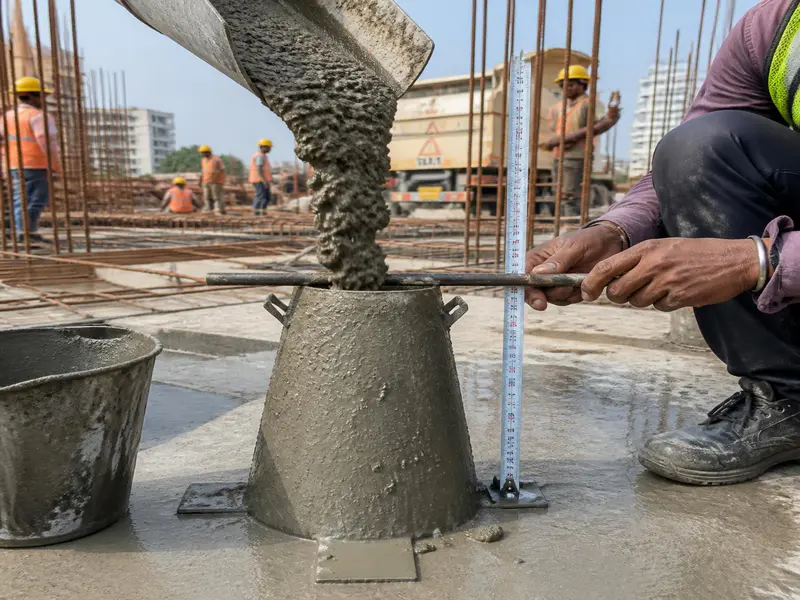
- The Slump Test: Perform this on every fresh batch of concrete before pouring slabs. A slump range between 75mm and 125mm ensures proper workability without excess water reducing structural strength.
- Silt Content Check for Sand: Shake river sand in a graduated cylinder with a mild salt solution. If the visible silt layer sitting on top of the sand exceeds 8%, reject the truck. High silt ruins mortar bonding and causes plaster peeling.
- Cube Compressive Testing: Cast 150mm concrete cubes during major pours. Test them at 7 days (should hit over 65% strength) and 28 days (must clear 100% of designated characteristic strength, e.g., 20 N/mm2 for M20) at a regional lab.
Managing Material Wastage Factors
Incorporate standard structural wastage allowances when planning your bank draws:
- Steel Rebar Cutting Wastage: Budget for 3% to 5% waste. Use a clear structural bar bending schedule (BBS) to optimize cuts and reuse off-cuts for stirrups.
- Brick Breakage: Budget for 5% to 7% waste from transit damage and on-site handling.
- Cement Storage Loss: Keep cement bags stacked away from damp earth on raised wooden planks, spaced at least 30 cm from external masonry walls. Use bags within 90 days of manufacturing to prevent strength loss.
Before applying for a construction loan, it is also important to estimate the construction cost per square foot in India.
Required Document Checklist for 2026 Loan Applications

Organizing your paperwork upfront can cut loan processing times by several weeks.
Legal and Personal Documents
- Signed application form with passport photographs.
- PAN card, Aadhaar card, and valid proof of residence.
- Last 6 months of active bank statements.
- Salaried Applicants: 3 months of salary slips, Form 16, and 2 years of ITR filings.
- Self-Employed Applicants: 2 years of audited business balance sheets, P&L statements, and ITR filings.
Technical and Property Documents
- Original registered sale deed or land allotment certificate.
- Non-Encumbrance Certificate (EC) covering the past 13 to 30 years.
- Land revenue tax receipts and updated mutation certificates.
- Building layout blueprint approved by the local planning authority.
- Itemized construction cost estimate certified by a chartered civil engineer.
Frequently Asked Questions (FAQs)
Can I get a construction loan if the plot is not in my name?
No. Lenders require the primary applicant or co-applicant to hold clear legal title to the land. If the plot belongs to a blood relative, they must join the loan application as a co-borrower.
What happens if construction costs exceed the sanctioned bank estimate?
The bank will not increase your loan amount mid-project. Any cost overruns due to material price inflation, design changes, or delays must be funded entirely out of your own pocket.
How does the bank verify construction progress before releasing tranches?
The bank sends an empanelled technical inspector or civil engineer to your site. This inspector takes photos, verifies structural progress against your approved estimate, and files a milestone verification report.
Is RERA approval mandatory for private residential home construction loans?
RERA approval is generally not required if you are building a single private home on your own independent plot of land. However, municipal building plan approval remains completely mandatory.
Can I claim tax benefits on a self-construction loan during construction?
Tax deductions under Section 80C (principal) and Section 24(b) (interest) can only be claimed starting in the financial year that construction is fully completed. You cannot claim deductions while the property is still under construction.
For official housing loan guidelines and policies, you can also check the National Housing Bank (NHB) website.
Summary Conclusion
Securing a house construction loan in India requires balancing financial milestones with physical site progress. By providing clean property titles, structural designs, and accurate material estimates, you can ensure a smooth loan application process.
Once your loan is sanctioned, focus on strict on-site quality control, managing material waste, and maintaining clear communication with your bank’s technical inspectors. This disciplined approach will help prevent cash flow gaps and ensure your home is built to lasting engineering standards.

Shakeel T is a qualified Civil Engineer and Structural Consultant with extensive on-site experience in residential and commercial building construction. Specializing in material estimation, cost budgeting, and structural safety guidelines, he has successfully managed multiple real estate projects from foundation to finishing. Through this blog, Shakeel shares field-tested civil engineering thumb rules, IS Code practices, and practical site tips to help home builders execute their projects efficiently and within budget.
Education: Diploma in Civil Engineering
Expertise: Quantity Surveying, Material Estimation, Structural Design, and Site Management.