
Introduction
To perform a precise septic tank size calculation for house design plans, you must multiply the total daily wastewater flow by the local detention period and incorporate adequate storage space for accumulated sludge layers. According to the official civil engineering benchmarks specified under Indian Standard IS 2470 Part 1: 1985, a standard family house with 5 members requires a minimum structural liquid capacity of 1,500 litres to operate efficiently without premature backups. This guide provides an exhaustive engineering roadmap to designing, sizing, and building a domestic waste treatment system that lasts for decades.
The Core Engineering Principles of Domestic Septic Systems
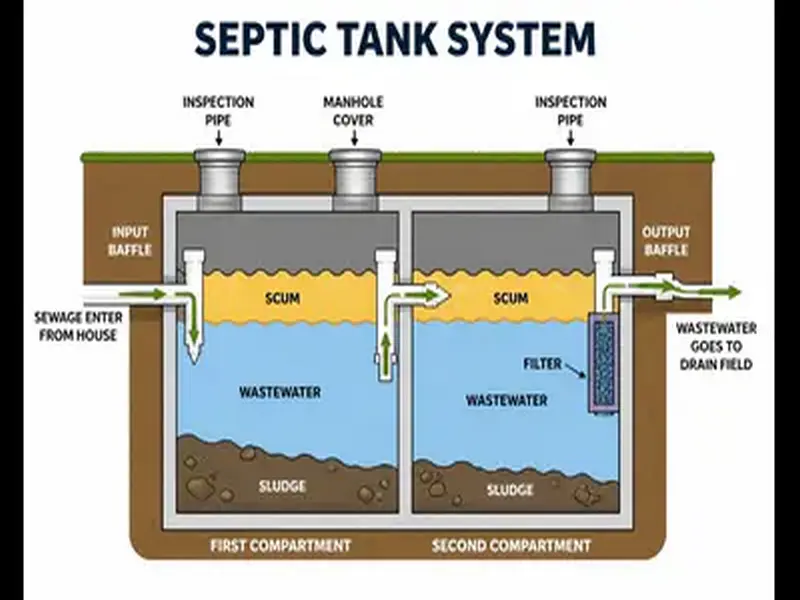
A septic tank functions as a primary, on-site underground sedimentation unit designed to treat raw domestic wastewater using anaerobic biological actions. It separates waste streams into three distinct horizontal structural zones:
- The Sludge Layer: Heavy organic solids drop to the chamber floor, where anaerobic microorganisms slowly decompose them into stable ash compounds and volatile gases. Over months of continuous usage, this layer densifies, requiring structural volume allocation.
- The Scum Layer: Light waste matter like cooking grease, vegetable oils, hair, and household soaps float to the fluid surface to form a thick, protective crust. This crust plays a critical biological role by keeping out oxygen, which allows the anaerobic bacteria underneath to thrive.
- The Effluent Layer: Clarified liquid remains suspended in the center, flowing out directly toward a soak pit or dispersion trench for organic soil filtration.
If your residential sizing properties are inadequate, wastewater passes through too quickly. This structural failure flushes heavy organic solids directly into your drainage field, causing premature soil clogging and expensive repair issues.
Technical Design Criteria for Indian Properties (As Per IS 2470)
The Bureau of Indian Standards enforces exact structural parameters under the statutory code IS 2470 Part 1: 1985 for domestic properties. Your design coordinates must mirror these dimensions:
- Length-to-Width Ratio: The total length of the internal tank structure must be 2 to 3 times its total width dimension to maintain stable flow vectors and prevent raw sewage from short-circuiting the filtration path.
- Liquid Depth Level: The operational liquid working level must never measure less than 1.0 metre (3.3 feet) to ensure adequate vertical separation between scum and sludge.
- Freeboard Clearance: A vacant ventilation cushion of 300 mm to 450 mm must remain between the maximum high-water line and the concrete ceiling slab to hold generated sewer gases safely.
- Hydraulic Detention Period: The retention cycle must span 24 to 48 hours to ensure complete solid-liquid separation before fluid exits the system.
- Desludging Intervals: The physical volume must accommodate accumulated solid sludge storage for 1 to 2 full years before requiring professional pump-out maintenance.
The Step-by-Step Septic Tank Size Calculation for House
The overall volume of a fully functional domestic tank equals the daily wastewater load combined with the accumulated sludge storage volume. Let us systematically calculate the exact dimensions for an average Indian household containing 5 permanent residents.
Step 1: Quantify the Daily Wastewater Inflow
National building data models state that the baseline water allocation per resident equals roughly 135 LPCD (Litres Per Capita Per Day). Out of this volume, approximately 80% exits the household plumbing network as raw wastewater, while the rest is used for gardening, car washing, or evaporation.
- Wastewater Flow Per Person = 135 Litres x 0.80 = 108 Litres Per Day
- Total Daily Inflow for 5 Users = 5 Members x 108 Litres = 540 Litres Per Day
Applying a standard 24-hour hydraulic detention period (1 day):
- Wastewater Design Load = 540 Litres/Day x 1 Day = 540 Litres
Step 2: Calculate the Accumulated Sludge Volume
Indigestible organic matter deposits solid sludge at a standard rate of 30 Litres per resident per year. For this house, we will design for a standard 2-year maintenance cleaning cycle.
- Sludge Volume = 5 Users x 30 Litres Per Year x 2 Years
- Total Sludge Storage = 300 Litres
Step 3: Determine the Total Minimum Tank Capacity
To find the absolute baseline requirement, combine the values from Step 1 and Step 2:
- Total Liquid Volume Needed = 540 Litres + 300 Litres = 840 Litres
Important Structural Note: To absorb sudden structural surge loads (laundry machine drainage, simultaneous toilet flushes) and strictly meet national statutory limits, the structural volume must scale up to an absolute baseline of 1,500 Litres (1.5 Cubic Metres). Sizing a tank exactly at 840 Litres will cause system overflows during festive gatherings or high-use days.
Step 4: Convert Liquid Volume into Physical Structural Dimensions
To convert 1.5 cubic metres of fluid volume into measurable room sizes, we select a standard working water depth of 1.0 metre:
- Required Internal Floor Area = 1.5 Cubic Metres / 1.0 Metre Depth = 1.5 Square Metres
Applying the standard length-to-width ratio where Length = 2.5 x Width:
- Width of the Tank = 0.77 Metres (Rounded up to 0.9 Metres for construction practicality)
- Length of the Tank = 2.5 x 0.77 = 1.92 Metres (Rounded up to 2.0 Metres for construction ease)
Step 5: Incorporate the Gas Freeboard Space
Add a 0.3-metre ventilation space above the maximum high-water line:
- Total Internal Physical Depth = 1.0 Metre Water Depth + 0.3 Metre Freeboard = 1.3 Metres
Final Physical Specifications for a 5-Member House:
- Total Structural Length: 2.0 Metres (Approx 6.5 Feet)
- Total Structural Width: 0.9 Metres (Approx 3.0 Feet)
- Total Structural Depth: 1.3 Metres (Approx 4.3 Feet)
(Suggested Image Placement: Infographic showing dimensions 2.0m x 0.9m x 1.3m)
Master Reference Chart for Indian Household Sizing
For residential properties containing higher occupancy numbers, use this verified design lookup directory:
| Members | Capacity | Length | Width | Depth |
| 5 Members | 1500 Litres | 6.5 Feet | 3.0 Feet | 4.3 Feet |
| 10 Members | 2500 Litres | 8.2 Feet | 3.3 Feet | 4.7 Feet |
| 15 Members | 4000 litres | 10.0 Feet | 4.0 Feet | 5.0 Feet |
| 20 Members | 5500 Litres | 12.0 Feet | 4.5 Feet | 5.3 Feet |
Before selecting septic tank location, it is important to check soil strength near the building. Read our guide on Soil Bearing Capacity for House Construction to understand safe placement zones.
Structural Building Materials and Masonry Requirements
Your physical site structure must withstand heavy underground earth pressures and shifting groundwater loads. Choose one of these two proven construction techniques:
- Traditional Brick Masonry Guidelines
- Ensure all peripheral containment walls use class-1 burnt clay bricks with a minimum thickness of 9 inches (230 mm). Never use 4-inch single brick walls, as they will buckle under soil pressure.
- Mix structural cement mortar using an exact volume proportion of 1:3 or 1:4.
- Apply a uniform 12 mm internal wall plaster coating infused with an approved chemical waterproofing compound to eliminate water leakage risks.
- The floor must feature a 6-inch base layer of plain cement concrete (PCC) with a slight slope directed toward the primary chamber for easier sludge removal during cleaning.
- Monolithic RCC (Reinforced Cement Concrete) Structures
- Utilize a standard M20 concrete grade mix (1 part cement, 1.5 parts sand, 3 parts aggregate stone).
- Cast the floor bed slab and outer wall panels to a uniform structural thickness of 6 inches (150 mm).
- Incorporate steel reinforcement rebars (8mm or 10mm TMT bars spaced at 150mm centers) to resist external soil shear stress lines in high-groundwater locations.
The Internal Two-Chamber Baffle Wall Layout
To keep solids from flowing into the output pipe, split the tank interior into two distinct treatment zones using a concrete partition wall:
- The First Chamber: Must occupy exactly 2/3rds of the total tank length to catch the bulk of settling sludge and rising surface scum.
- The Second Chamber: Occupies the final 1/3rd of the tank length to gather clear wastewater fluid.
- Baffle Connection Port: Fix a heavy-duty PVC transfer opening in the middle wall precisely 300 mm below the top liquid line to let clear water flow across smoothly without disturbing raw bottom sediment layers.
(Suggested Image Placement: Technical Cross Section of a Two-Chamber Septic Tank)
Statutory Plumbing Rules for Site Engineers
- Inlet-to-Outlet Drop: Build the output exit pipe connection exactly 50 mm to 100 mm lower than the main entry inlet pipe to prevent wastewater blockages in your home’s main drains.
- PVC Tee Installation: Fix structural PVC Tee pipe bends at the entry and exit holes. Extend the lower pipe arms 300 mm deep into the liquid pool to keep the water calm.
- Air Ventilation Setup: Erect a 50 mm wide gas vent line rising at least 2 metres over your building’s roof line, capped with a stainless steel wire screen to vent methane fumes safely.
Troubleshooting Common Septic Tank Operational Issues
Even a perfectly calculated waste treatment system can experience issues if environmental conditions change or incorrect household habits take hold. Understanding these problems early saves money.
- Foul Odors Permeating the Property
When strong sulfur smells escape from under the ground, it indicates a compromised ventilation system or a broken water seal in your household traps. Ensure the vent pipe rises above the roofline and check for cracks along the top concrete manhole covers. Applying a silicone sealant around the manhole edges instantly stops gas leaks. - Slow Draining Toilets and Gurgling Pipes
If toilets take multiple flushes to clear or pipes make a gurgling sound, it means the tank has reached its maximum sludge storage capacity or a clog has formed in the inlet Tee-pipe. If the system has not been cleaned in over two years, call a vacuum tanker service immediately to empty the chambers. - Water Pooling Above the Septic Area
If the ground directly above your underground tank or nearby soak pit remains damp or muddy, the system is overflowing. This happens when the soil loses its percolation capacity, or water table rises during heavy monsoons. Restricting daily water usage during rainy seasons helps the system recover naturally.
Essential Maintenance and Longevity Rules
To ensure your system operates seamlessly without expensive breakdowns, homeowners must practice proactive system care.
- Say No to Harsh Chemicals: Avoid dumping large quantities of chemical bleach, heavy acids, or strong toilet cleaners down the drain. These chemicals kill the beneficial anaerobic bacteria inside the chamber, halting the natural decomposition of sludge. Instead, use biodegradable, enzyme-safe cleaners.
- Keep Non-Biodegradable Items Out: Wet wipes, sanitary napkins, plastic wrappers, and cigarette butts must never be flushed. They do not decompose and will quickly cause severe physical blocks in the internal PVC Tee fittings.
- Avoid Heavy Vehicle Traffic: Do not park cars, trucks, or heavy machinery over a brick masonry tank. The intense surface weight can collapse the top slab or crack the brick walls, leading to groundwater contamination. Keep the surface area clear or build an RCC slab specifically engineered for heavy loads.
- Schedule Regular Inspections: Open the manhole cover once a year to inspect the thickness of the scum layer. If the bottom sludge or top scum occupies more than one-third of the total depth, schedule a professional desludging service.
Estimated Septic Tank Construction Costs in India
The total financial budget to complete your home wastewater setup varies based on your chosen building materials and local labor rates:
- Traditional Brick Masonry Setup: Rs 35,000 to Rs 55,000. It offers adaptable sizing on-site but takes longer to build and plaster.
- Monolithic Cast RCC Tank: Rs 60,000 to Rs 90,000. It provides absolute long-term strength under driveway areas, though it requires skilled steel workers.
- Prefabricated Modular Units: Rs 20,000 to Rs 45,000 (excluding ground digging works). These lightweight FRP/PVC tanks install in just one day and stay completely water-sealed.
- Traditional Brick Masonry Setup: Rs 35,000 to Rs 55,000. It offers adaptable sizing on-site but takes longer to build and plaster.
- Monolithic Cast RCC Tank: Rs 60,000 to Rs 90,000. It provides absolute long-term strength under driveway areas, though it requires skilled steel workers.
- Prefabricated Modular Units: Rs 20,000 to Rs 45,000 (excluding ground digging works). These lightweight FRP/PVC tanks install in just one day and stay completely water-sealed.
For advanced wastewater disposal recommendations, refer CPHEEO Manual on Sewerage and Sewage Treatment published by Government of India.
Conclusion and Professional Advice
Using the correct septic tank size calculation for house planning prevents recurring drainage overflows, limits foul site smells, and shields your home from unexpected repair costs. For standard Indian family plots, establishing a baseline 1,500 Litre structure provides a dependable long-term wastewater solution. Always consult a local civil engineer to evaluate the specific soil type and water table constraints of your site before breaking ground.

Shakeel T is a qualified Civil Engineer and Structural Consultant with extensive on-site experience in residential and commercial building construction. Specializing in material estimation, cost budgeting, and structural safety guidelines, he has successfully managed multiple real estate projects from foundation to finishing. Through this blog, Shakeel shares field-tested civil engineering thumb rules, IS Code practices, and practical site tips to help home builders execute their projects efficiently and within budget.
Education: Diploma in Civil Engineering
Expertise: Quantity Surveying, Material Estimation, Structural Design, and Site Management.