
Introduction
Rainwater harvesting is one of the most effective and sustainable methods of water conservation for residential buildings. With increasing water scarcity, declining groundwater levels, and rising water demand, homeowners are looking for practical solutions to reduce dependence on municipal water supply and borewells.
Rainwater harvesting involves collecting rainwater from rooftops, terraces, and other surfaces and storing it for future use or allowing it to recharge groundwater. A properly designed rainwater harvesting system can significantly reduce water bills, improve groundwater levels, and provide an additional water source during shortages.
In many Indian states, rainwater harvesting has become mandatory for new residential buildings. However, to design an efficient system, it is important to calculate the expected rainwater collection capacity accurately.
This guide explains rainwater harvesting calculations, design principles, formulas, examples, storage tank sizing, recharge pit design, quality control checks, and practical site recommendations for residential buildings.
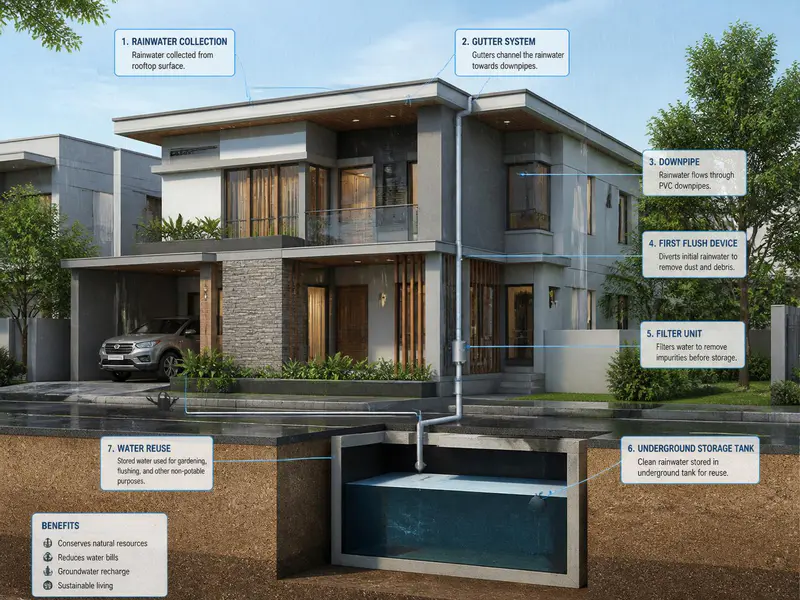
What is Rainwater Harvesting?
Rainwater harvesting is the process of collecting, filtering, storing, and utilising rainwater from roofs and other catchment areas.
The collected water can be used for:
- Gardening
- Toilet flushing
- Washing vehicles
- Cleaning
- Groundwater recharge
- Domestic use after proper treatment
Benefits of Rainwater Harvesting
Water Conservation
Reduces dependence on groundwater and municipal water supply.
Reduced Water Bills
Stored rainwater can replace a significant portion of household water consumption.
Groundwater Recharge
Helps increase groundwater levels and improve borewell performance.
Flood Reduction
Reduces surface runoff and local flooding during heavy rainfall.
Environmental Sustainability
Promotes efficient water resource management.
Components of a Rainwater Harvesting System
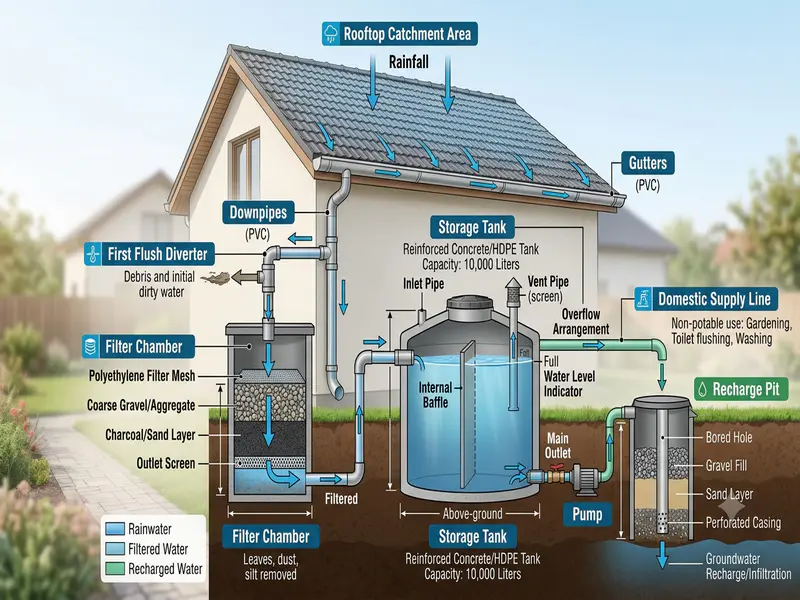
| Component | Function |
|---|---|
| Catchment Area | Collects rainwater |
| Gutters | Convey water from the roof |
| Downpipes | Transport water |
| First Flush Device | Removes initial contaminants |
| Filter Unit | Removes debris and impurities |
| Storage Tank | Stores harvested water |
| Recharge Pit | Recharges groundwater |
| Overflow Arrangement | Prevents overflow damage |
Proper water management is essential for every home. Along with rainwater harvesting, a well-designed septic tank system ensures efficient wastewater disposal and environmental protection.
Basic Formula for Rainwater Harvesting Calculation
The amount of rainwater that can be collected depends on:
- Roof area
- Annual rainfall
- Runoff coefficient
Formula
Harvestable Rainwater (Liters) = Roof Area (sq.m) × Annual Rainfall (mm) × Runoff Coefficient
Runoff Coefficient
The runoff coefficient represents water collection efficiency.
| Surface Type | Runoff Coefficient |
| RCC Roof | 0.8 to 0.9 |
| Metal Roof | 0.85 to 0.95 |
| Tiled Roof | 0.7 to 0.8 |
| Ground Surface | 0.5 to 0.7 |
For residential RCC roofs, a value of 0.85 is commonly used.
Step-by-Step Rainwater Harvesting Calculation Example
Example 1: 100 Square Meter Roof Area
Assume:
- Roof Area = 100 sq.m
- Annual Rainfall = 900 mm
- Runoff Coefficient = 0.85
Step 1: Multiply Roof Area and Rainfall
100 × 900 = 90,000
Step 2: Apply Runoff Coefficient
90,000 × 0.85 = 76,500 Liters
Result
The building can potentially harvest approximately 76,500 liters of rainwater annually.
Example 2: 1500 Sq Ft House
Step 1: Convert Roof Area into Square Meters
1 sq.m = 10.764 sq.ft
Roof Area = 1500 ÷ 10.764
Roof Area = 139.35 sq.m
Step 2: Assume Annual Rainfall
Annual Rainfall = 1000 mm
Step 3: Apply Formula
Rainwater Harvesting Capacity
= 139.35 × 1000 × 0.85
= 118,447 Liters
Result
A 1500 sq.ft house can harvest approximately 1.18 lakh liters of rainwater annually.
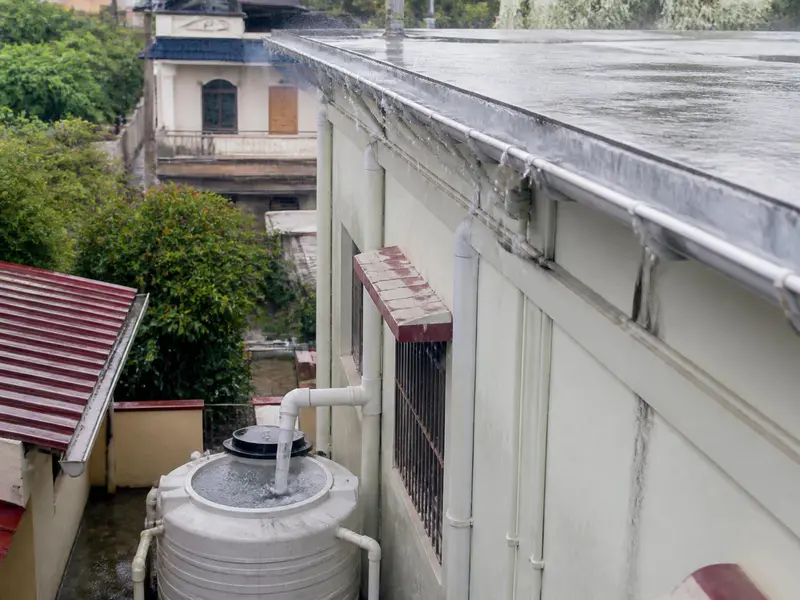
Unit Conversion Table
| Unit | Conversion |
| 1 Cubic Meter | 1000 Liters |
| 1 Cubic Meter | 35.31 CFT |
| 1 CFT | 28.32 Liters |
| 1 Brass | 100 CFT |
| 1 Cubic Meter | 0.353 Brass |
These conversions are useful when designing storage tanks and recharge pits.
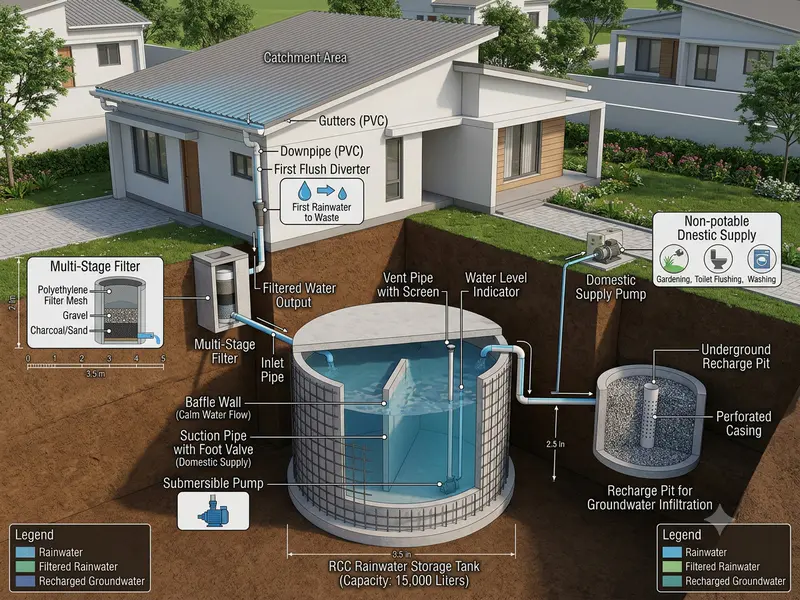
Storage Tank Size Calculation
The storage tank size depends on:
- Daily water demand
- Available rainfall
- Roof area
- Budget
Example
Family Size = 5 Persons
Water Requirement = 135 Liters per Person per Day
Total Daily Requirement
5 × 135
= 675 Liters per Day
If water storage is required for 30 days:
675 × 30
= 20,250 Liters
Recommended Tank Capacity
20,000 to 25,000 Liters
Rainwater harvesting systems add value to residential projects. Check our house construction cost guide to estimate the overall budget for your dream home.
Recharge Pit Design Calculation
A recharge pit helps groundwater recharge.
Typical Residential Recharge Pit Size
| Building Size | Pit Diameter | Pit Depth |
| Small House | 1 m | 2 m |
| Medium House | 1.2 m | 2.5 m |
| Large House | 1.5 m | 3 m |
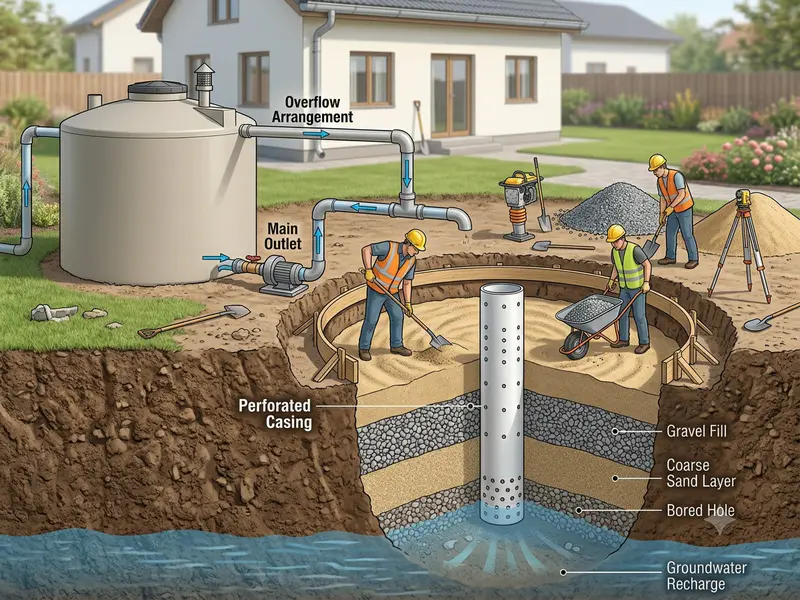
Recharge Pit Volume Calculation
Formula
Volume = 3.14 × Radius × Radius × Depth
Example
Diameter = 1.2 m
Radius = 0.6 m
Depth = 2.5 m
Volume
= 3.14 × 0.6 × 0.6 × 2.5
= 2.83 Cubic Meters
Recharge Capacity
= 2.83 × 1000
= 2830 Liters
Rainwater Harvesting Design for a Residential Building
Step 1: Measure Roof Area
Calculate the total catchment area.
Step 2: Obtain Rainfall Data
Use local annual rainfall statistics.
Step 3: Calculate Harvestable Water
Apply the rainwater harvesting formula.
Step 4: Select Storage or Recharge System
Choose based on water demand and site conditions.
Step 5: Install Filtration Unit
Prevent debris and contaminants from entering storage.
Step 6: Provide Overflow Arrangement
Safely dispose of excess water during heavy rainfall.
Materials Required for Rainwater Harvesting System
| Material | Purpose |
| PVC Gutters | Water collection |
| PVC Downpipes | Water transport |
| Filter Media | Water filtration |
| Storage Tank | Water storage |
| Gravel | Recharge pit filling |
| Coarse Sand | Filtration |
| Pebbles | Drainage layer |
| RCC Covers | Pit protection |
Site Quality Control Checks
Professional engineers should verify the following:
Roof Surface Inspection
Ensure water flows properly toward collection points.
Gutter Alignment
Maintain proper slope for smooth drainage.
Filter Inspection
Check filter media quality and cleanliness.
Leakage Test
Verify that pipes and joints are watertight.
Overflow Testing
Ensure overflow systems function correctly.
Recharge Pit Inspection
Check dimensions and filling materials.
Common Mistakes in Rainwater Harvesting Systems
Undersized Gutters
May cause overflow during heavy rainfall.
Poor Filtration
Leads to contamination of stored water.
Lack of Maintenance
Reduces system efficiency.
Incorrect Tank Sizing
May result in water shortages or overflow.
Improper Recharge Pit Construction
Can reduce groundwater recharge effectiveness.
Maintenance of Rainwater Harvesting Systems
Regular maintenance is essential.
Before Monsoon
- Clean roof surface
- Remove leaves and debris
- Check gutters
- Inspect filters
During Monsoon
- Monitor overflow arrangements
- Check water quality
After Monsoon
- Clean storage tanks
- Inspect recharge pits
- Repair damaged components
Practical Site Tips from Experienced Engineers
- Install leaf guards on gutters.
- Use first-flush devices to discard initial dirty rainwater.
- Keep storage tanks covered.
- Provide mosquito-proof screens.
- Clean filters at least twice a year.
- Design overflow pipes properly.
- Locate recharge pits away from septic tanks.
- Use quality PVC pipes and fittings.
Estimated Rainwater Harvesting Cost in India (2026)
| System Type | Approximate Cost |
| Basic Recharge Pit | ₹10,000 – ₹25,000 |
| Recharge Pit with Filter | ₹20,000 – ₹40,000 |
| Small Storage System | ₹30,000 – ₹60,000 |
| Medium Storage System | ₹60,000 – ₹1,20,000 |
| Large Residential System | ₹1,00,000 – ₹2,50,000 |
Costs vary based on site conditions, storage capacity, and material quality.
Environmental Impact of Rainwater Harvesting
Rainwater harvesting provides several environmental benefits:
- Reduces groundwater depletion
- Improves water table levels
- Conserves natural resources
- Reduces urban flooding
- Supports sustainable construction practices
For residential buildings, it is one of the most cost-effective and environmentally friendly water management solutions.
Frequently Asked Questions (FAQs)
1. What is rainwater harvesting?
Rainwater harvesting is the process of collecting and storing rainwater for future use or groundwater recharge.
2. How much rainwater can a 100 sq.m roof collect?
A 100 sq.m roof in an area receiving 900 mm annual rainfall can collect approximately 76,500 liters of rainwater annually.
3. Is rainwater harvesting mandatory in India?
Many states and municipal authorities require rainwater harvesting systems for new buildings. Local regulations should be checked before construction.
4. Can harvested rainwater be used for drinking?
Yes, but proper filtration and treatment are necessary before drinking.
5. What is the ideal size of a recharge pit?
For most residential buildings, a pit diameter of 1 to 1.5 meters and a depth of 2 to 3 meters is commonly used.
6. How often should the system be maintained?
Inspection and cleaning should be carried out before and after every monsoon season.
7. Does rainwater harvesting increase groundwater levels?
Yes. Properly designed recharge systems help replenish groundwater and improve borewell performance.
The Central Ground Water Board provides valuable information on groundwater recharge methods and rainwater harvesting practices across India.
The Ministry of Jal Shakti promotes water conservation, rainwater harvesting, and sustainable water resource management throughout India.
Conclusion
Rainwater harvesting is a practical and sustainable solution for managing water resources in residential buildings. By collecting and utilising rainwater effectively, homeowners can reduce water bills, improve groundwater levels, and contribute to environmental conservation.
Accurate rainwater harvesting calculations are essential for designing efficient storage tanks and recharge systems. Factors such as roof area, annual rainfall, runoff coefficient, and water demand should always be considered during planning.
With proper design, quality materials, regular maintenance, and professional installation, a rainwater harvesting system can provide reliable benefits for many years while supporting sustainable house construction practices.

Shakeel T is a qualified Civil Engineer and Structural Consultant with extensive on-site experience in residential and commercial building construction. Specializing in material estimation, cost budgeting, and structural safety guidelines, he has successfully managed multiple real estate projects from foundation to finishing. Through this blog, Shakeel shares field-tested civil engineering thumb rules, IS Code practices, and practical site tips to help home builders execute their projects efficiently and within budget.
Education: Diploma in Civil Engineering
Expertise: Quantity Surveying, Material Estimation, Structural Design, and Site Management.
Hurrah! Finally I got a blog from where I be capable of truly take useful information regarding my
study and knowledge.
Hi, I do believe this is an excellent blog. I stumbledupon it 😉 I’m
going to return once again since i have saved
as a favorite it. Money and freedom is the best way to change, may you be rich and continue to
guide other people.
Hi there, I desire to subscribe for this website to get latest updates, so where can i do it please assist.
Article writing is also a fun, if you be acquainted with after that you can write or else it
is complex to write.
Thank you for your kind words! You’re absolutely right—good article writing takes practice and continuous learning. I’m glad you visited my website, and I hope you’ll find my future posts helpful as well. Thanks for your support!
I’ve been surfing online greater than three hours lately, yet I
never found any fascinating article like yours.
It is pretty price sufficient for me. In my view, if
all website owners and bloggers made good content material as you
did, the internet will be a lot more useful than ever before.
certainly like your web-site however you need to take a look at the spelling on quite a few
of your posts. A number of them are rife with spelling issues and I in finding it very bothersome to inform the reality then again I’ll surely come back
again.
Thank you for your feedback! I appreciate you taking the time to share your thoughts. I’ll review my posts carefully and correct any spelling or grammar issues I find. Thanks for visiting, and I look forward to seeing you again!
After going over a few of the articles on your site, I seriously like your technique of
blogging. I saved as a favorite it to my bookmark webpage list and will be checking back in the near future.
Please visit my website too and let me know your opinion.
I’m not that much of a internet reader to be honest but your blogs really nice, keep it up!
I’ll go ahead and bookmark your site to come back down the road.
Many thanks
Wonderful blog! I found it while searching on Yahoo News.
Do you have any suggestions on how to get listed in Yahoo News?
I’ve been trying for a while but I never seem to get there!
Cheers
Great information. Lucky me I found your site by chance
(stumbleupon). I’ve bookmarked it for later!
I think everything said was very logical. But, think on this, what if you added a little information? I am not suggesting your
information isn’t solid., however what if you added a headline that grabbed people’s attention? I mean Rainwater Harvesting for House Construction – Complete Calculation Guide is kinda plain. You should
peek at Yahoo’s home page and watch how they create news titles to grab people to open the
links. You might add a video or a pic or two to grab people excited about what you’ve got to say.
In my opinion, it might make your posts a little bit more interesting.
Thank you for your valuable feedback! I appreciate your suggestions and will certainly consider making my future posts more engaging with better titles and additional visuals. Thanks for your support!
You really make it seem so easy with your presentation but I find this topic
to be actually something which I think I would never understand.
It seems too complex and extremely broad for me.
I’m looking forward for your next post, I’ll try to get the hang of it!
I think the admin of this web page is really working hard in support of his web site,
since here every material is quality based data.
You’ve made some decent points there. I checked on the web to find out more about the issue and found
most individuals will go along with your views on this website.
If you want to obtain much from this article then you have to apply such methods to your won website.
At this time it looks like Movable Type is
the best blogging platform out there right now. (from what I’ve read)
Is that what you’re using on your blog?
I like looking through an article that can make men and women think.
Also, many thanks for allowing me to comment!
Thanks for any other wonderful article. The place else may anybody get that type of information in such a perfect approach of writing?
I have a presentation subsequent week, and I’m
at the search for such info.
Hi, I do believe this is an excellent blog. I stumbledupon it 😉
I will come back yet again since I book marked it. Money
and freedom is the best way to change, may you be rich and continue to guide
others.
Asking questions are genuinely good thing if you are not
understanding anything totally, except this article provides pleasant understanding even.
This is a great tip particularly to those fresh to
the blogosphere. Short but very accurate information… Thanks for sharing
this one. A must read article!
Awesome! Its in fact amazing post, I have got much clear idea on the topic of from this paragraph.
Please let me know if you’re looking for a article writer for your weblog.
You have some really great articles and I feel I would be a good asset.
If you ever want to take some of the load off, I’d really like to write some content for your blog in exchange
for a link back to mine. Please send me an e-mail if interested.
Thank you!
You are so interesting! I do not suppose I’ve read something like that before.
So good to find someone with original thoughts on this subject.
Really.. many thanks for starting this up. This website is something that’s needed on the web,
someone with some originality!
I’m truly enjoying the design and layout of your blog.
It’s a very easy on the eyes which makes
it much more enjoyable for me to come here and visit more
often. Did you hire out a designer to create your theme?
Superb work!
Do you mind if I quote a few of your articles as long
as I provide credit and sources back to your weblog?
My blog is in the exact same niche as yours and my
users would definitely benefit from a lot of the information you present here.
Please let me know if this alright with you. Cheers!
I pay a visit every day some web sites and websites to
read posts, except this web site offers feature based writing.
Helpful info. Lucky me I found your website by accident, and
I’m shocked why this accident didn’t happened in advance!
I bookmarked it.
Superb website you have here but I was wanting to
know if you knew of any community forums that cover the same topics talked about here?
I’d really like to be a part of group where I can get
advice from other knowledgeable individuals that
share the same interest. If you have any suggestions, please let
me know. Appreciate it!
Good way of describing, and pleasant post to get information regarding my presentation subject,
which i am going to convey in academy.
Hello there! This is my first visit to your blog! We are a
collection of volunteers and starting a new project in a community in the same niche.
Your blog provided us valuable information to work on. You
have done a extraordinary job!
Incredible story there. What happened after? Good luck!
Your style is really unique compared to other people I have read
stuff from. Thank you for posting when you’ve got the opportunity, Guess I will just bookmark this page.
I was curious if you ever thought of changing the layout of your website?
Its very well written; I love what youve got to say.
But maybe you could a little more in the way of content so
people could connect with it better. Youve got an awful
lot of text for only having one or 2 images. Maybe you could
space it out better?
Thank you so much for your valuable feedback! I’m glad you enjoyed the content. I appreciate your suggestion about the layout and images. I’ll definitely work on improving the design by adding more visuals and making the content easier to read. Thanks again for taking the time to share your thoughts!
It’s in reality a great and useful piece of info.
I’m satisfied that you shared this useful information with us.
Please keep us up to date like this. Thank you for sharing.
Hi, all is going fine here and ofcourse every one is sharing facts, that’s truly excellent, keep up writing.
My brother suggested I might like this blog.
He used to be entirely right. This publish actually made my day.
You cann’t believe just how much time I had spent for this information! Thank you!
Appreciation to my father who stated to me about this web site, this weblog is actually remarkable.
Howdy would you mind sharing which blog platform you’re using?
I’m going to start my own blog in the near future but I’m having a tough time deciding between BlogEngine/Wordpress/B2evolution and
Drupal. The reason I ask is because your design seems different then most blogs and
I’m looking for something unique. P.S Sorry
for being off-topic but I had to ask!
Thanks for asking! I’m using **WordPress** for my blog.
Woah! I’m really digging the template/theme of this website.
It’s simple, yet effective. A lot of times it’s challenging to get that “perfect balance” between superb
usability and visual appeal. I must say that you’ve done a awesome job with
this. Additionally, the blog loads very quick for me on Opera.
Exceptional Blog!
Normally I do not learn post on blogs, however I would like to say that this write-up very forced me
to try and do it! Your writing style has been surprised me.
Thanks, quite nice post.
This is really attention-grabbing, You are an overly
skilled blogger. I have joined your feed and look forward
to searching for more of your wonderful post. Additionally, I have
shared your web site in my social networks
A fascinating discussion is worth comment. I think that you ought to publish more about this topic, it might
not be a taboo subject but typically people don’t speak about these topics.
To the next! Cheers!!
Hi there! Do you use Twitter? I’d like to follow you if that
would be ok. I’m definitely enjoying your blog and look forward
to new updates.
Hey! This is my first visit to your blog! We are a collection of volunteers and
starting a new initiative in a community in the
same niche. Your blog provided us beneficial information to work
on. You have done a wonderful job!
I’m not that much of a internet reader to be honest but your blogs really nice, keep it up!
I’ll go ahead and bookmark your site to come back down the road.
Many thanks
Excellent write-up. I certainly appreciate this site.
Thanks!
I delight in, cause I found exactly what I was having a look for.
You’ve ended my 4 day lengthy hunt! God Bless you man. Have a great day.
Bye
When I initially commented I appear to have clicked the -Notify me when new
comments are added- checkbox and now whenever a comment is
added I recieve 4 emails with the same comment.
There has to be an easy method you can remove
me from that service? Kudos!
Hi,
We have checked our website and couldn’t find any issue with the comment notification system. We also don’t currently offer a comment subscription option. If you’re receiving duplicate emails, it may be related to your email service or a previous subscription. Please try using the Unsubscribe link (if available) in the email or let us know the email address you used so we can investigate further. Thank you.
Marvelous, what a weblog it is! This web site provides helpful data to us,
keep it up.
It’s hard to come by knowledgeable people about this subject, however,
you seem like you know what you’re talking about!
Thanks
I don’t even know how I ended up here, but I thought
this post was good. I don’t know who you are but certainly you are going to a
famous blogger if you aren’t already 😉 Cheers!
Yes! Finally something about health tips leave a
comment.
There is certainly a lot to find out about this subject.
I like all of the points you made.
Hi, I desire to subscribe for this blog to get
latest updates, therefore where can i do it please help.
Thank you for your interest! You can subscribe to our blog by entering your email address in the subscription form (if available) on our website. Once subscribed, you’ll receive notifications whenever we publish new content. We appreciate your support!
Wow, that’s what I was seeking for, what a data! present here at this webpage, thanks
admin of this site.
I used to be able to find good information from your articles.
I simply couldn’t depart your website prior to suggesting that I extremely enjoyed the usual information an individual
provide on your guests? Is gonna be back steadily to check up on new posts
I blog frequently and I truly appreciate your information.
Your article has really peaked my interest. I’m
going to book mark your blog and keep checking for new information about once
per week. I opted in for your Feed as well.
This site certainly has all of the information and facts
I wanted concerning this subject and didn’t know who
to ask.
bookmarked!!, I really like your website!
Hiya very cool web site!! Man .. Excellent .. Wonderful ..
I will bookmark your web site and take the feeds additionally?
I am satisfied to seek out a lot of helpful information right here within the post, we’d like work out extra strategies on this regard, thanks for sharing.
. . . . .
What’s up to all, how is everything, I think every one is getting more from this website, and your views are pleasant for new users.
Thankfulness to my father who told me concerning this weblog, this weblog is genuinely remarkable.
Wow, that’s what I was searching for, what a
stuff! existing here at this website, thanks admin of this web page.
Great web site you have got here.. It’s difficult to find good quality writing like yours nowadays.
I truly appreciate people like you! Take care!!
I seriously love your site.. Very nice colors & theme.
Did you make this site yourself? Please reply back as I’m
attempting to create my own personal blog and would like to know where you got this from or just what the theme is
called. Cheers!
I enjoy, result in I discovered just what I was
taking a look for. You’ve ended my four day long hunt! God Bless you man. Have a nice day.
Bye
It’s awesome to pay a visit this website and reading
the views of all mates on the topic of this post, while I am also eager of getting
knowledge.
Thank you a lot for sharing this with all of us you actually recognise
what you’re talking approximately! Bookmarked.
Please also discuss with my website =). We may have a link alternate contract among us
Hello are using WordPress for your blog platform? I’m new
to the blog world but I’m trying to get started and create my own. Do you require any coding expertise to make your
own blog? Any help would be really appreciated!
I think the admin of this website is actually working hard for his web site,
for the reason that here every stuff is quality based information.
Just wish to say your article is as surprising. The clarity in your publish is simply
nice and that i could think you are knowledgeable in this subject.
Fine along with your permission allow me to snatch
your feed to stay updated with imminent post. Thank
you one million and please carry on the rewarding
work.
I’m not that much of a online reader to
be honest but your sites really nice, keep it up!
I’ll go ahead and bookmark your site to come back
later on. All the best
Very shortly this web page will be famous among all blogging and site-building visitors, due to it’s nice content
I seriously love your site.. Great colors & theme. Did you make
this website yourself? Please reply back as I’m trying to create my own website and would love
to learn where you got this from or just what the theme is
called. Cheers!
Good day! This is my first visit to your blog! We are
a group of volunteers and starting a new project in a
community in the same niche. Your blog provided us beneficial information to work on. You
have done a outstanding job!
We stumbled over here different website and thought I
may as well check things out. I like what I see so now i am
following you. Look forward to looking at your web page again.
Excellent web site. A lot of useful information here.
I’m sending it to several friends ans also sharing in delicious.
And certainly, thank you to your effort!