
Introduction
To perform an accurate load calculation for residential building designs, you must calculate the dead loads of structural elements, super-imposed live loads, and regional wind or seismic forces. According to national structural engineering standards outlined in the National Building Code (NBC 2016) and IS 875 (Parts 1-3), residential slabs must be designed for a minimum structural live load capacity of 2.0 kN/m² (approx. 200 kg/m²) [1, 2]. Calculating these demands ensures your pillars, beams, and foundation never settle or crack over time.
The Core Engineering Principles of Structural Building Loads
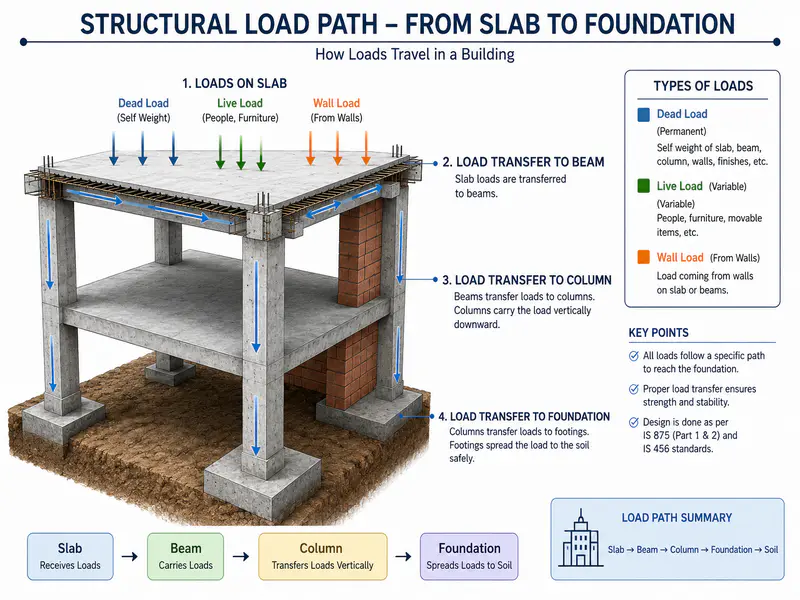
A residential building skeleton must be calculated to resist a variety of internal and external forces. These forces push downward, push sideways, or pull upward on the structural frames. Engineers categorize these into three primary structural weight types:
- Dead Loads (DL): The permanent, stationary weight of the building materials themselves. This includes concrete slabs, columns, beams, brick masonry walls, plastering, flooring tiles, and fixed permanent utility pipes.
- Live Loads (LL): The temporary, moving weights that occupy the building over time. This includes human occupants, furniture, loose household appliances, and stored items that change positions.
- Environmental Loads: External forces applied by nature. This includes lateral Wind Loads (WL) pushing against tall walls or horizontal Seismic/Earthquake Loads (SL) shaking the foundation base.
If your structural load calculation configurations are inadequate, the columns will deflect under the combined weight. This stress line causes visible masonry cracks, sagging beam lines, or catastrophic foundation settlement failures.
Technical Design Criteria for Indian Properties (As Per IS 875)
The Bureau of Indian Standards enforces specific structural calculation weights under the code series IS 875 for domestic buildings. Your structural design parameters must utilize these benchmark material densities:
- Reinforced Cement Concrete (RCC) Unit Weight: Standard concrete containing steel rebar reinforcement weighs exactly 25 kN/m³ (approx. 2500 kg per cubic metre) as per IS 875 Part 1.
- Plain Cement Concrete (PCC) Unit Weight: Non-reinforced concrete mixes weigh roughly 24 kN/m³.
- Traditional Brick Masonry Unit Weight: Standard country burnt brick walls weigh between 18.8 kN/m³ to 20 kN/m³ depending on the mortar richness.
- Structural Live Load Allocation: According to IS 875 Part 2, typical bedrooms, living rooms, and kitchens require a 2.0 kN/m² layout, while staircases and balconies must scale up to 3.0 kN/m².
The Step-by-Step Load Calculation for Residential Building
The total load acting on an individual structural member transfers sequentially from the roof slab, down into the supporting beams, through the vertical columns, and into the foundation soil. Let us calculate the exact load metrics for a typical residential room frame.
Step 1: Quantify the Structural Slab Load
Assume a standard ceiling slab panel size measuring 4.0 metres long by 3.0 metres wide, featuring an engineered concrete thickness of 125 mm (0.125 metres).
- Slab Dead Load = Thickness x Unit Weight of RCC = 0.125m x 25 kN/m³ = 3.125 kN/m²
- Floor Finish Load = 1.0 kN/m² (Accounting for cement mortar bed and heavy vitrified tiles)
- Total Dead Weight on Slab = 3.125 + 1.0 = 4.125 kN/m²
- Statutory Live Load = 2.0 kN/m²
- Total Design Pressure on Slab Area = 4.125 + 2.0 = 6.125 kN/m²
Step 2: Calculate the Supporting Beam Load
Beams carry the load transferred from the adjacent slabs along with their own structural dead weight and the weight of the brick walls sitting directly on top of them.
- Beam Self-Weight Calculation: For a standard beam size of 230mm x 450mm (0.23m x 0.45m):
- Self-Weight = Width x Depth x Concrete Density = 0.23m x 0.45m x 25 kN/m³ = 2.58 kN/metre length.
Step 3: Determine the Brick Masonry Wall Load
Let us calculate the weight of a standard 9-inch thick external brick wall built to a common residential ceiling height of 3.0 metres.
- Wall Weight = Thickness x Height x Brick Density = 0.230m x 3.0m x 20 kN/m³ = 13.8 kN/metre length.
- Plastering Weight = 1.0 kN/metre (Accounting for 12mm cement plaster on both faces).
- Total Wall Load Pushing Down on Beam = 13.8 + 1.0 = 14.8 kN/m.
Step 4: Convert Combined Loads into Total Vertical Column Point Load
Columns compile all incoming line loads from the beams and slabs above them. For a multi-story building frame, engineers apply a simple rule of thumb for initial column estimation:
- Single Storey (Ground Floor Only) Column Load Range: Approximately 10 to 15 kN per square metre of area carried.
- Two Storey (G+1 Duplex) Column Base Load Range: Approximately 25 to 30 kN per square metre of tributary structural area.
Step 5: Incorporate the Ultimate Factor of Safety
To account for material variations, construction inaccuracies on-site, or unexpected heavy furniture loads, structural designers apply a strict safety multiplier:
- Ultimate Design Load = Calculated Total Load x 1.5 Safety Factor (As per Limit State Design methodology).
Final Structural Guidelines for a Standard Column Base:
- Minimum Pillar Size for G+1 House: 230mm x 300mm using M20 Grade Concrete.
- Main Steel Reinforcement: Minimum 4 bars of 12mm Fe500 TMT steel bars.
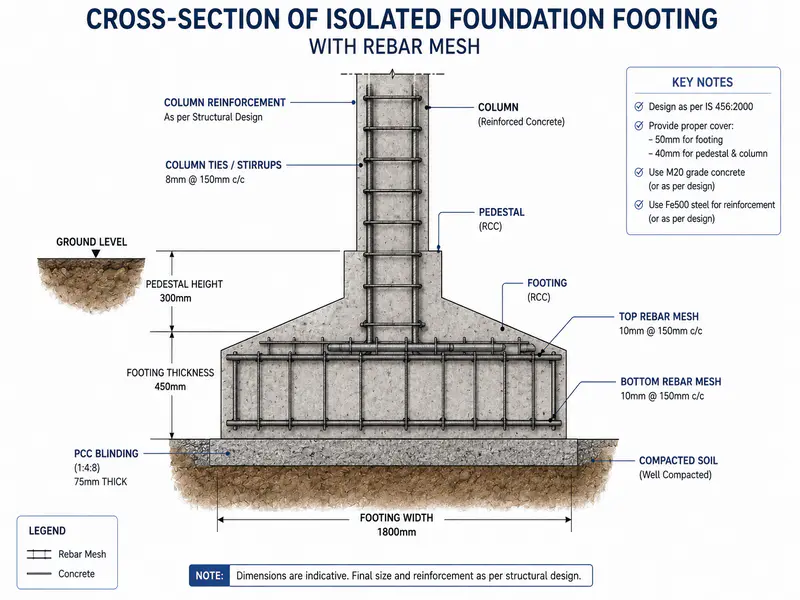
- Lateral Ties/Stirrups: 8mm steel rings spaced at 150mm centers to resist buckling forces.
After calculating structural loads, selecting proper footing size becomes essential for safe load transfer to soil. Check our step-by-step guide on footing size calculation for residential buildings.
Slab thickness directly influences slab load calculation in residential structures. Learn recommended values in our article on RCC slab thickness for residential building construction.
Master Reference Chart for Indian Building Load Distributions
For planning residential properties with different floor layouts, use this quick reference lookup directory for standard dead and live weight structural assumptions:
| Structural Element | Dead Load | Live Load | Finish Load |
|---|---|---|---|
| Roof Slab Layer | 3.125 kN/m² | 1.5 kN/m² | 1.0 kN/m² |
| Standard Bedroom Floor | 3.125 kN/m² | 2.0 kN/m² | 1.0 kN/m² |
| Balcony and Stairs Area | 3.750 kN/m² | 3.0 kN/m² | 1.0 kN/m² |
| Internal 4-inch Partition Wall | 4.5 kN/m Line Load | 0.0 kN/m | 0.5 kN/m Finish Load |
| External 9-inch Boundary Wall | 13.8 kN/m Line Load | 0.0 kN/m | 1.0 kN/m Finish Load |
Structural Building Configurations and Safety Protocols
Your physical building components must balance internal stress vectors to maintain static equilibrium. Choose your building materials carefully based on these two essential components:
- High-Performance Concrete Matrix Guidelines
- Ensure all main load-bearing members like pillars, roof slabs, and beams utilize a concrete mix grade no less than M20 (1 part cement, 1.5 parts sand, and 3 parts stone aggregate).
- Keep the water-to-cement ratio strictly between 0.45 to 0.50 to maximize structural strength and prevent micro-cracks.
- Cure all freshly cast concrete elements with water for at least 7 to 10 days to help the concrete reach its full design strength.
- Steel Reinforcement and Placement Precision
- Use only high-ductility Fe500 or Fe550 TMT steel rebar to ensure the frame stays strong against seismic forces.
- Maintain a clear concrete cover thickness of 40mm for columns, 25mm for beams, and 20mm for slabs to shield the inner steel from rusting.
The Mechanics of Foundation Load Transfer to Soil
The ultimate target of a complete load estimation is sizing the underground concrete footings so they safely spread the building’s weight over the earth without sinking.
- Evaluate Soil Bearing Capacity (SBC): Before excavation, a local site test determines how many kilograms of weight each square metre of soil can carry. Typical hard rocky soil holds high weight, while soft clay fields require wider bases.
- Footing Size Estimation Rule: Divide the factored column point load by the soil’s safe bearing capacity to find the required footing base area. For an average G+1 structure on medium soil, an isolated footing measuring 4 feet by 4 feet is a common starting dimension.
Statutory Site Inspection Rules for Construction Management
- Beam-Column Junction Lapping: Never lap main column reinforcement bars right at the floor beam junction line. Keep all rebar lap joins in the middle half of the column height where bending stress is lowest.
- Stirrup Hook Detailing: Ensure all structural stirrup rings feature a 135-degree hook bend inside the concrete core. Standard 90-degree straight hooks can open up under intense earthquake shaking forces.
- Shuttering Removal Timelines: Keep the bottom wooden or steel support shuttering under ceiling slabs intact for at least 14 days for spans up to 4.5 metres to prevent premature deflection cracks.
Estimated Engineering Layout Fees in India
The cost to get a professional structural layout blueprint made depends on your total built-up floor space and local consultant rates:
- Basic 2D Structural Blueprint Service: Rs 3 to Rs 5 per square foot. Includes precise steel schedules and column placement layouts.
- Comprehensive Engineering Package: Rs 8 to Rs 15 per square foot. Includes soil analysis reviews, 3D frame layouts, plumbing line maps, and column load maps.
- Prefabricated Structural Frame Consulting: Rs 15,000 to Rs 35,000 fixed charge per building block plan. Ideal for verifying standard residential layouts.
Residential building load calculations in India are commonly based on recommendations provided by the Bureau of Indian Standards under IS 875 guidelines. You can understand load classification concepts from the BIS official standards framework.
Conclusion and Professional Advice
Utilizing an accurate load calculation for residential building framework protects your family, ensures long-term building durability, and saves money by avoiding over-engineering or wasting steel. For typical Indian residential plots, implementing the IS 875 material weights and live load configurations ensures your structure stays safe for generations. Always consult a licensed structural engineer to evaluate your site’s specific soil properties before pouring concrete.

Shakeel T is a qualified Civil Engineer and Structural Consultant with extensive on-site experience in residential and commercial building construction. Specializing in material estimation, cost budgeting, and structural safety guidelines, he has successfully managed multiple real estate projects from foundation to finishing. Through this blog, Shakeel shares field-tested civil engineering thumb rules, IS Code practices, and practical site tips to help home builders execute their projects efficiently and within budget.
Education: Diploma in Civil Engineering
Expertise: Quantity Surveying, Material Estimation, Structural Design, and Site Management.
This is my first time pay a quick visit at here and i am in fact
pleassant to read everthing at alone place.
Thanks in support of sharing such a pleasant opinion, piece of writing is pleasant,
thats why i have read it completely
I was suggested this website by my cousin. I’m not sure whether
this post is written by him as no one else know
such detailed about my trouble. You’re wonderful!
Thanks!
Great info. Lucky me I recently found your blog by chance (stumbleupon).
I have saved as a favorite for later!