
Introducation
The reinforced cement concrete (RCC) slab is arguably the most critical component of a residential superstructure. It acts as the horizontal floor or roof system that directly supports the live loads of residents, furniture, and partitions. Yet, during structural design and site execution, determining the correct slab thickness is a frequent point of confusion.
Choosing an incorrect RCC slab thickness for residential building construction leads to major structural penalties. If the slab is too thin, it suffers from excessive deflection, unsightly ceiling cracks, sagging, and progressive structural failure. Conversely, an over-designed, excessively thick slab adds unnecessary dead load to the beam-column framework, forcing foundations to be oversized and driving up material costs exponentially.
This exhaustive structural guide breaks down standard thumb rules, international code requirements, exact mathematical calculations, material estimation workflows, and site-level quality control checklists for residential RCC slabs.
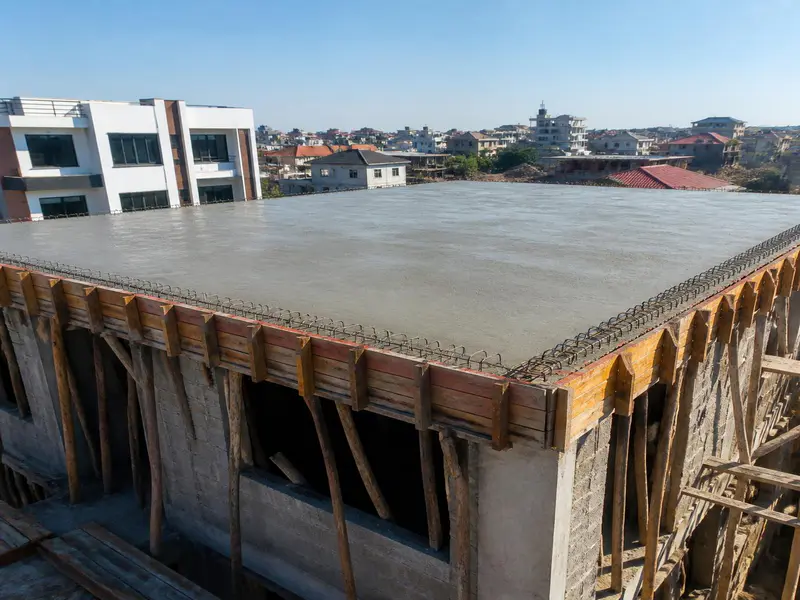
What is an RCC Slab? Fundamental Structural Typologies
A Reinforced Cement Concrete (RCC) slab is a flat, horizontal structural element made of concrete reinforced with steel bars. In residential spaces, these slabs generally range between 100 mm and 150 mm in thickness. Before analyzing thickness rules, an engineer must distinguish between the two primary layout behaviors defined by building codes (such as IS 456:2000, ACI 318, and Eurocode 2).
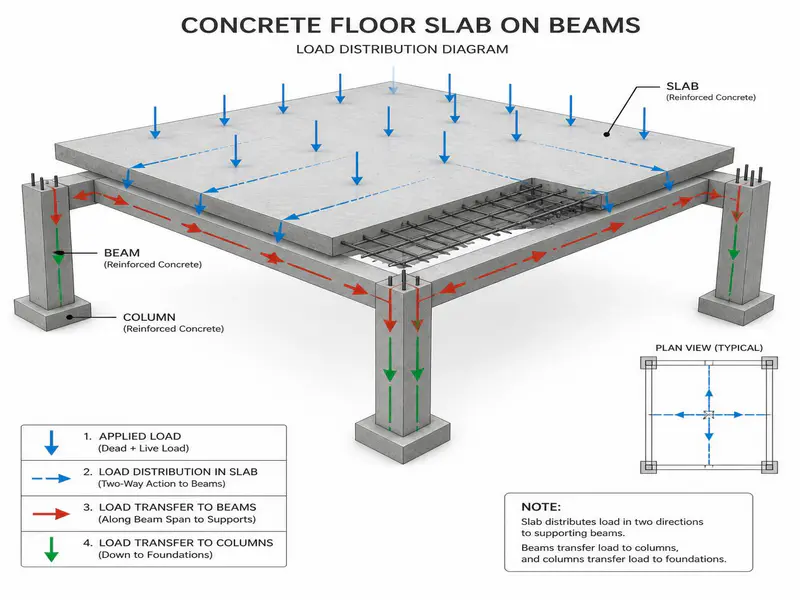
One-Way Slabs
A slab is considered a one-way slab when the ratio of its longer span (Ly) to its shorter span (Lx) is greater than or equal to 2.
- Formula Condition: Ly / Lx >= 2
- Load Distribution: The structural loads are transferred primarily along one direction (the shorter span) to the supporting parallel beams.
- Example: Long corridors, verandas, and narrow balcony projections.
Two-Way Slabs
A slab is considered a two-way slab when the ratio of its longer span (Ly) to its shorter span (Lx) is less than 2.
- Formula Condition: Ly / Lx < 2
- Load Distribution: Bending moments occur in both orthogonal directions, meaning structural loads are transferred to all four supporting perimeter beams.
- Example: Standard square or near-rectangular residential bedrooms, living rooms, and dining halls.
Standard RCC Slab Thickness Rules for Residential Buildings
For standard residential buildings (G+1, G+2, G+3) under ordinary loading conditions (live load of 2.0 kN per square metre to 3.0 kN per square metre), global building codes establish clear minimum thresholds.
The Absolute Minimum Limit
- Absolute Minimum Thickness: 125 mm (5 inches).
- Under no structural circumstances should a structural roof or intermediate floor slab in a residential building be cast below 100 mm (4 inches). Slabs under 100 mm are highly susceptible to severe thermal cracking, water seepage, acoustic vibrations, and premature structural failure.
Standard Application Matrix
- Standard Interior Rooms (Bedrooms, Kitchens, Bathrooms): 125 mm to 150 mm (5 to 6 inches). This is the optimal industry-standard zone.
- Heavy-Load Residential Areas (Slabs holding large water tanks, heavy terrace gardens): 175 mm to 200 mm (7 to 8 inches).
- Cantilever Slabs (Balconies, Chajjas, Porch overhangs): 125 mm tapering down to 100 mm at the free edge, or a uniform 150 mm depending on the projection length.
Deflection-Based Span-to-Depth Ratio Code Rules (IS 456)
To control serviceability deflection limits, the basic span-to-effective-depth (L/d) ratios for spans up to 10 metres are defined as:
- Cantilever Slabs: L / d = 7
- Simply Supported Slabs: L / d = 20
- Continuous Slabs: L / d = 26
Structural Reinforcement Specifications
An optimal RCC slab thickness is ineffective without a properly engineered steel reinforcement skeleton. The embedded steel absorbs tensile stresses while the concrete handles compressive forces.
Minimum Reinforcement Ratio
- Mild Steel Bars: 0.15% of the total cross-sectional gross area.
- High-Strength Deformed Bars (Fe500/Fe550 TMT): 0.12% of the total cross-sectional gross area.
Bar Diameters for Residential Slabs
- Main Tension Bars: 8 mm, 10 mm, or 12 mm deformed TMT bars. (10 mm is the most common residential choice).
- Distribution Bars: 8 mm TMT bars.
Maximum Permissible Spacing Limits
- Main Bars: Must not exceed 3 times the effective depth of the slab, or 300 mm, whichever value is smaller.
- Distribution Bars: Must not exceed 5 times the effective depth, or 450 mm, whichever value is smaller.
- Standard Practice: For a 125 mm slab, a grid spacing of 125 mm to 150 mm center-to-center is standard.
Concrete Clear Cover
- A minimum clear cover of 20 mm (0.75 inches) must be maintained at the top and bottom of the steel grid to prevent atmospheric moisture oxidation and concrete spalling.
Core Plain-Text Mathematical Formulas for Material Estimation
To execute a residential slab project on-site, a site engineer must calculate the exact quantities of raw cement, sand, coarse aggregates, and steel reinforcement. Below are the standard plain-text engineering formulas used for material estimation.
Volume and Material Equations
- Total Wet Volume of Slab Concrete = Clear Length x Clear Width x Thickness of Slab
- Dry Volume of Concrete = Total Wet Volume x 1.54
Note: The multiplier 1.54 is the standard compaction factor that accounts for the volumetric shrinkage that occurs when dry cement, sand, and aggregate particles are mixed with water.
Nominal Mix Proportioning (For M20 Grade Concrete – 1:1.5:3 Ratio)
- Sum of Mix Parts = 1 + 1.5 + 3 = 5.5
- Volume of Cement = (1 / 5.5) x Dry Volume of Concrete
- Total Cement Bags = Volume of Cement / 0.0347 (Since 1 standard 50 kg cement bag occupies exactly 0.0347 cubic metres)
- Volume of Fine Aggregate (Sand) = (1.5 / 5.5) x Dry Volume of Concrete
- Volume of Coarse Aggregate (Stone Chips) = (3 / 5.5) x Dry Volume of Concrete
Steel Reinforcement Weight Formulas
- Weight of Steel Bar per Metre = (Diameter x Diameter) / 162
- Total Reinforcement Steel Weight = Weight per Metre x Total Running Length of Bars (inclusive of crank lengths, hooks, and laps)
- Slab Steel Rule of Thumb: For standard residential structures, steel consumption ranges from 80 kg to 100 kg per cubic metre of concrete volume.
Practical Step-by-Step Estimation Examples
Let us apply these formulas to a real-world residential construction scenario with concrete dimensions and loads.
Example 1: Concrete Material Quantities for a Standard Room Slab
Suppose we are casting an intermediate floor slab for a residential master bedroom. The clear dimensions between supporting beams are 5.0 metres in length and 4.0 metres in width. The structural designer specifies an RCC slab thickness of 125 mm (0.125 m) using an M20 grade concrete mix.
Step 1: Calculate the Wet Concrete Volume
- Wet Volume = Length x Width x Thickness
- Wet Volume = 5.0 m x 4.0 m x 0.125 m
- Wet Volume = 2.50 Cubic Metres (m3)
Step 2: Convert Wet Volume to Dry Volume
- Dry Volume = Wet Volume x 1.54
- Dry Volume = 2.50 x 1.54 = 3.85 Cubic Metres (m3)
Step 3: Determine the Cement Quantity
- Cement Volume = (1 / 5.5) x 3.85 = 0.70 Cubic Metres
- Total Bags of Cement = 0.70 / 0.0347 = 20.17 Bags
- Site Procurement Order: Round up to 21 Bags of Cement.
Step 4: Determine the Fine Aggregate (Sand) Quantity
- Sand Volume = (1.5 / 5.5) x 3.85 = 1.05 Cubic Metres
- Converting to Cubic Feet: 1.05 x 35.314 = 37.08 Cubic Feet (CFT)
Step 5: Determine the Coarse Aggregate Quantity
- Coarse Aggregate Volume = (3 / 5.5) x 3.85 = 2.10 Cubic Metres
- Converting to Cubic Feet: 2.10 x 35.314 = 74.16 Cubic Feet (CFT)
Example 2: Reinforcement Steel Weight Quantities
Using the same 5.0 m x 4.0 m x 0.125 m room slab volume (2.50 m3 wet concrete volume), let us compute the steel consumption using the structural engineering rule-of-thumb method for average residential density (estimated at 90 kg per cubic metre).
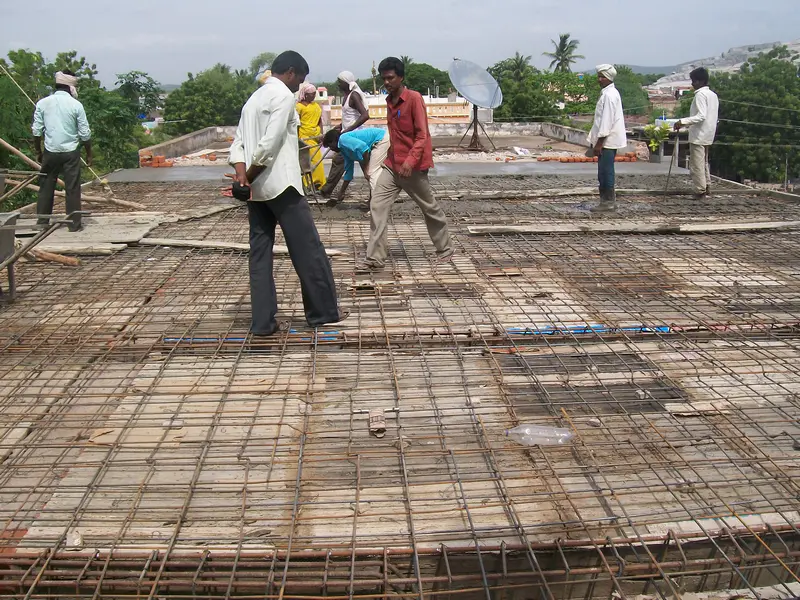
Step 1: Calculate Basic Steel Weight
- Total Steel Weight = Wet Concrete Volume x Density Factor
- Total Steel Weight = 2.50 m3 x 90 kg/m3
- Total Steel Weight = 225.0 Kilograms (kg)
Step 2: Extract Bar Breakdowns (Typical 60% Main Bars and 40% Distribution Bars)
- Weight of Main Bars (10 mm diameter) = 225.0 x 0.60 = 135.0 kg
- Weight of Distribution Bars (8 mm diameter) = 225.0 x 0.40 = 90.0 kg
Materials Unit Conversions & Quick Reference Table
Slab construction materials are quantified, procured, and billed across different units depending on local markets. Use the conversion rules below to verify material orders.
Material Unit Conversion Reference
- 1 Cubic Metre (m3) = 35.314 Cubic Feet (CFT)
- 1 Brass (Standard local commercial unit) = 100 Cubic Feet (CFT) = 2.831 Cubic Metres (m3)
- 1 Metric Ton = 1000 Kilograms (kg) = 10 Quintals
Material Consumption Master Table for a 125 mm Thick Slab
This reference table outlines the structural material quantities required to cast a standard 125 mm (5-inch) thick RCC slab using an M20 Concrete Mix (1:1.5:3) across various floor areas.
| Slab Floor Area (Sq. Metres) | Wet Concrete Volume (m3) | Wet Concrete Volume (CFT) | Cement Bags Needed (M20) | Sand Needed (CFT) | Coarse Aggregates (CFT) | Estimated Steel Weight (kg) |
|---|---|---|---|---|---|---|
| 20 Sq.m | 2.50 m3 | 88.28 CFT | 21 Bags | 37.08 CFT | 74.16 CFT | 225.00 kg |
| 50 Sq.m | 6.25 m3 | 220.71 CFT | 51 Bags | 92.70 CFT | 185.40 CFT | 562.50 kg |
| 100 Sq.m | 12.50 m3 | 441.43 CFT | 101 Bags | 185.41 CFT | 370.82 CFT | 1,125.00 kg |
| 150 Sq.m | 18.75 m3 | 662.14 CFT | 151 Bags | 278.11 CFT | 556.22 CFT | 1,687.50 kg |
| 200 Sq.m | 25.00 m3 | 882.85 CFT | 201 Bags | 370.82 CFT | 741.64 CFT | 2,250.00 kg |
Site Quality Controls, Wastage Factors, and Checklist
An accurate design thickness on paper is only effective if executed properly on-site. Below is an expert site checklist to ensure structural conformity.

Formwork and Shuttering Verification
- Zero Leakage: Ensure all joints in the plywood or steel shuttering sheets are sealed with foam tape or structural putty. Slurry leakage reduces concrete strength at the slab joints, causing honeycombing.
- Propping Stability: Ensure the vertical props (steel pipes or wooden jacks) are placed securely on a solid, non-yielding surface. They must be cross-braced to prevent buckling during concrete pouring.
- Camber Provision: Provide an upward structural camber of 1 in 500 of the span at the center of the slab formwork to offset initial dead-load deflections.
Slab Level and Thickness Control Markers
- The Level Peg Method: To guarantee a uniform 125 mm or 150 mm thickness across the entire floor area, fix level markers using steel rods or mortar patches throughout the slab layout before casting.
- Dip-Stick Check: During concrete pouring, the site supervisor must use a calibrated metal dip-stick to verify the concrete depth matches the design thickness across all interior zones.
Material Wastage Calculations
- Concrete Wastage: Add a 5% structural wastage margin to your aggregate and cement calculations to account for mixing errors, transit spillages, and structural variations in the formwork layout.
- Steel Wastage: Factor in a 10% structural steel wastage allowance to account for lap splices, bending hooks, and trimmed bar ends.
Concrete Compaction and Curing
- Compaction: Use a 40 mm mechanical needle vibrator along with surface plate vibrators. Do not allow the vibrator needle to touch the steel reinforcement bars directly, as this breaks the bond with adjacent, partially set concrete.
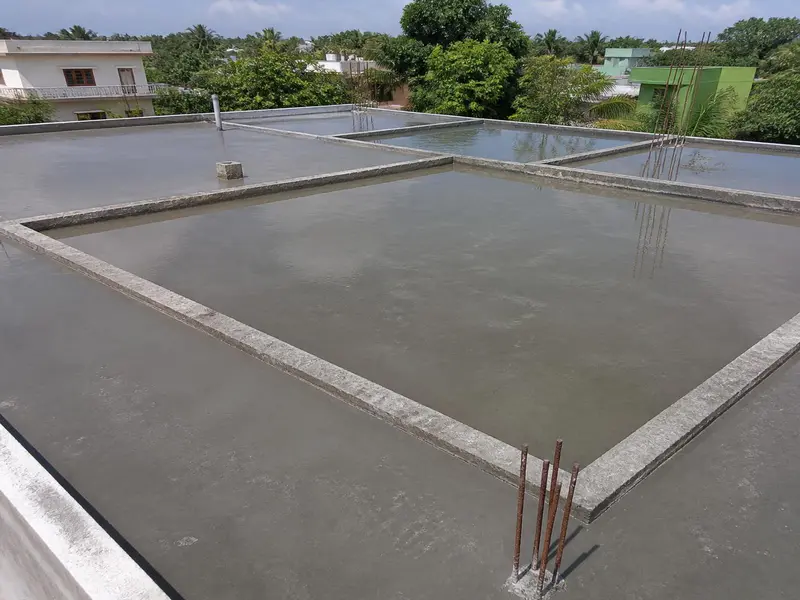
- Ponding Curing: Once the concrete sets (approximately 12 to 24 hours after pouring), create small clay or mortar bounds across the slab surface. Fill these squares with water to a depth of 25 mm. Maintain this ponding water continuously for a minimum of 10 to 14 days to maximize design compressive strength.
Frequently Asked Questions (FAQs)
Q1. Can we cast a 100 mm (4-inch) thick RCC slab for a residential house?
While 100 mm is technically permissible for very small spans under 3 metres (such as small bathrooms or utility passages), it is not recommended for master bedrooms or main living spaces. A 100 mm slab is highly susceptible to thermal expansions, excessive deflection, acoustic vibrations, and water seepage. A minimum thickness of 125 mm is recommended for residential construction.
Q2. How long should the formwork shuttering remain under a newly cast residential slab?
The removal time for slab shuttering depends entirely on the clear span length and ambient temperature:
- For slab spans up to 4.5 metres: Shuttering props can be safely removed after 7 days.
- For slab spans exceeding 4.5 metres: Shuttering props must remain in place for 14 days.
- Note: Supporting beam soffits must remain prop-supported for 14 to 21 days depending on the structural span length.
Q3. What is a crank bar in an RCC slab, and why is it used?
A crank bar (bent-up bar) is a main reinforcement steel bar bent at a 45-degree angle near the supporting beams. It transitions from the bottom of the slab profile to the top profile. It is designed to resist the negative bending moment (hogging stress) that develops over continuous support zones and to counteract shear stresses near the beam junctions.
Q4. How does slab thickness affect the acoustic insulation of a residential building?
Thicker concrete slabs provide better sound insulation. A standard 125 mm to 150 mm thick concrete slab acts as an effective acoustic mass barrier, dampening impact noises (footsteps) and airborne sounds between floors. Slabs under 100 mm often require additional acoustic insulation treatments.
Q5. Can M15 grade concrete be used to cast an RCC residential floor slab?
No. Modern international and national structural building codes (including IS 456) mandate a minimum concrete grade of M20 (1 part cement : 1.5 parts sand : 3 parts coarse aggregate) for all reinforced cement concrete (RCC) structural elements to prevent carbonation, structural failure, and reinforcement rust.
Bureau of Indian Standards (BIS) provides standard codes and guidelines used in civil engineering design and construction in India.
Conclusion
Determining and executing the correct RCC slab thickness for residential building construction requires a balance of code requirements, proper material specification, and diligent on-site quality control. For standard residential designs, keeping your slab thickness within the 125 mm to 150 mm zone, coupled with M20 grade concrete and proper steel clear covers, ensures structural durability and eliminates long-term cracking and serviceability deflection issues.

Shakeel T is a qualified Civil Engineer and Structural Consultant with extensive on-site experience in residential and commercial building construction. Specializing in material estimation, cost budgeting, and structural safety guidelines, he has successfully managed multiple real estate projects from foundation to finishing. Through this blog, Shakeel shares field-tested civil engineering thumb rules, IS Code practices, and practical site tips to help home builders execute their projects efficiently and within budget.
Education: Diploma in Civil Engineering
Expertise: Quantity Surveying, Material Estimation, Structural Design, and Site Management.