
Introduction
Every durable residential structure starts below the ground. If you compromise on the depth of your foundation, the entire structure is at risk. Cracks in walls, sinking floors, and structural failure often trace back to a single mistake: an incorrectly calculated foundation depth.
Determining the minimum depth of foundation for residential building projects is not a matter of guesswork or following what the neighbour did. It is a precise engineering calculation that balances soil mechanics, structural loads, environmental factors, and safety codes.
As a site engineer or builder, understanding this layout phase prevents costly structural remedial work. This comprehensive guide covers the engineering principles, mathematical formulas, real-world examples, and on-site quality controls required to establish a secure foundation.
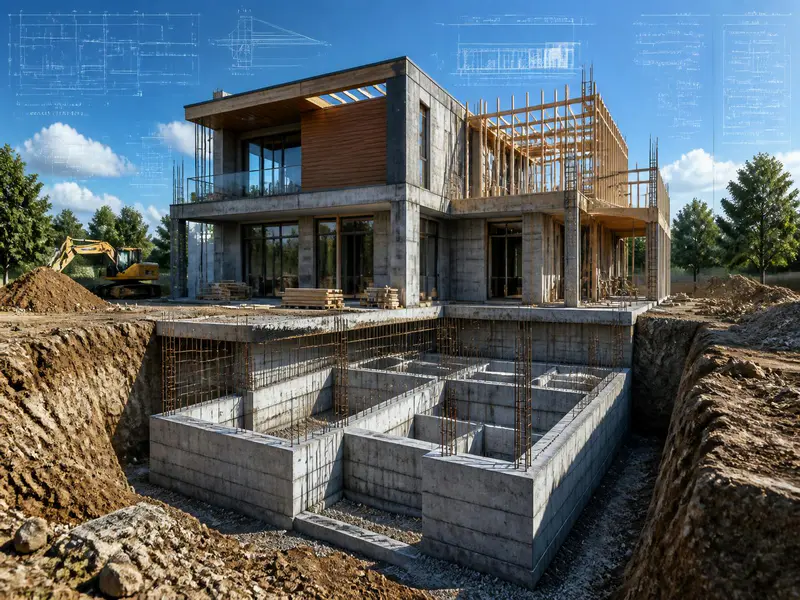
Why Foundation Depth Matters: The Engineering Fundamentals
The primary objective of a foundation is to transfer the dead loads, live loads, and wind loads of a building safely to the underlying soil. The depth at which you place the footing determines whether the soil can handle these loads without excessive settlement.
+---------------------------------------------------------+

|                  RESIDENTIAL BUILDING                   |
+---------------------------------------------------------+

                             |
                             v  [Loads: Dead, Live, Wind]
                  +---------------------+
                  |   Plinth / Column   |
                  +---------------------+

                             |
                             v
                  +---------------------+
                  |  FOUNDATION FOOTING |
                  +---------------------+

                             |
     ~~~~~~~~~~~~~~~~~~~~~~~~v~~~~~~~~~~~~~~~~~~~~~~~~  <-- Ground Level (GL)
     |                                               |
     |        MINIMUM DEPTH OF FOUNDATION (Df)       |  <-- Must bypass loose topsoil
     |                                               |      & frost/scour zones
     ~~~~~~~~~~~~~~~~~~~~~~~~~~~~~~~~~~~~~~~~~~~~~~~~~
                             |
                             v  [Distributed Pressure]
               ==============================
               BEARING STRATA (Firm Subsoil)
               ==============================
1. Reaching Stable Bearing Strata
The top layer of soil (organic topsoil) contains decomposed organic matter, roots, and loose pockets. This layer is highly compressible and cannot support structural loads. The foundation depth must penetrate through this loose layer to rest on firm, unweathered subsoil with an acceptable Safe Bearing Capacity (SBC).
2. Bypassing Seasonal Volume Changes
Cohesive soils, particularly Black Cotton Soil or highly plastic clays, experience significant volumetric changes. They swell when wet and shrink when dry. If a footing is placed within this active zone (usually the top 1.0 to 1.5 metres), the upward swelling pressure and downward shrinkage settlement will cause severe structural cracking. The foundation must be deep enough to sit in a zone of constant moisture content.
3. Frost Action Prevention
In colder regions, water in the soil pores freezes and expands, causing a phenomenon known as frost heave. This lifts the foundation upward. When the ice melts, the soil softens, leading to sudden foundation settlement. The minimum depth must always extend below the local frost line.
4. Scour and Erosion Control
For residential structures built near sloping terrains, water bodies, or areas experiencing heavy surface runoff, the topsoil can wash away over time. Extending the foundation deep enough ensures that the structural support remains intact even if surface erosion occurs.
General Rules of Thumb vs. Code Requirements
While mathematical checks are mandatory for final designs, standard building codes provide absolute minimum boundaries based on global empirical data.
- Absolute Structural Minimum: Across major international building codes (including IS 1904, NBC, and IBC), the absolute minimum depth of foundation for any load-bearing or framed residential building is 0.50 metres (approx. 20 inches or 1.64 feet) from the natural ground level. However, this is only applicable to rock or exceptionally firm soils.
- Standard Residential Practice: For typical single-story to three-story residential buildings on normal sandy or loamy soils, the practical minimum depth ranges between 1.0 metre to 1.5 metres (3.3 feet to 5.0 feet).
- Rock Formations: If hard rock is encountered at a shallower depth, the foundation can be terminated earlier, provided it is properly anchored or socketed into the rock by at least 0.25 metres.
Understanding foundation depth is an important part of the overall building process. You can also read our detailed guide on Building Construction Process Step by Step to understand each stage of residential construction.
Core Mathematical Formulas for Foundation Depth
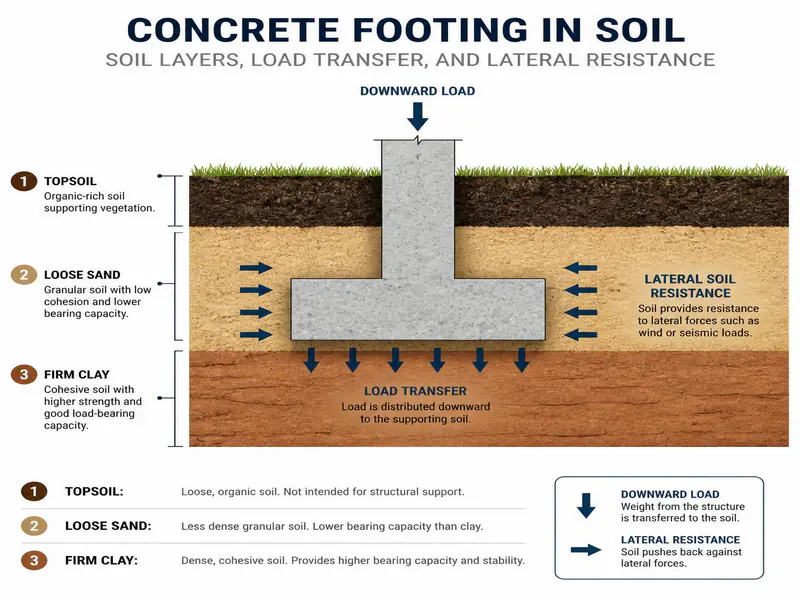
To design with precision, engineers rely on analytical soil mechanics formulas. The most widely accepted structural engineering formula for minimum foundation depth is Rankine’s Formula.
Rankine’s Formula for Minimum Depth
Rankine’s formula calculates the minimum depth required to develop sufficient passive earth pressure to resist the lateral squeezing out of soil from beneath the footing.
Formula:
Minimum Depth (Df) = (SBC / w) x (((1 – sin(phi)) / (1 + sin(phi))) raised to the power of 2)
Where:
- Df = Minimum depth of foundation (in metres)
- SBC = Safe Bearing Capacity of the soil (in kilonewtons per square metre, kN/sq.m)
- w = Unit weight or density of the soil (in kilonewtons per cubic metre, kN/cu.m)
- phi = Angle of internal friction of the soil (in degrees)
Understanding the Variables
- Safe Bearing Capacity (SBC): The maximum intensity of pressure that the soil can safely support without undergoing shear failure or excessive settlement.
- Unit Weight of Soil (w): The weight of the soil per unit volume. Typical dry or moist soil ranges from 16 kN/cu.m to 20 kN/cu.m.
- Angle of Internal Friction (phi): A measure of the shear strength of soil due to friction between particles. Clean sand has a high phi value (30 to 40 degrees), while soft clay has a very low value close to 0 degrees.
Practical Step-by-Step Design Examples
Let us calculate the minimum foundation depth for different soil profiles using concrete numbers.
Example 1: Residential Footing on Firm Sandy Soil
Imagine you are building a two-story residential villa on a plot composed of firm sand. A geotechnical report provides the following soil parameters:
- Safe Bearing Capacity (SBC) = 150 kN/sq.m
- Unit Weight of Soil (w) = 18 kN/cu.m
- Angle of Internal Friction (phi) = 30 degrees
Step 1: Calculate the Friction Factor Component
- sin(30 degrees) = 0.5
- Factor = (1 – 0.5) / (1 + 0.5) = 0.5 / 1.5 = 0.3333
Step 2: Square the Friction Factor
- (0.3333) raised to the power of 2 = 0.1111
Step 3: Apply the Load and Weight Component
- SBC / w = 150 / 18 = 8.3333
Step 4: Compute the Final Minimum Depth (Df)
- Df = 8.3333 x 0.1111 = 0.925 metres
Engineering Decision: The mathematical minimum is 0.93 metres. Adjusting for practical construction margins and seasonal moisture changes, the site engineer should specify a minimum design depth of 1.00 metre.
Example 2: Residential Footing on Loose Sandy-Silt Soil
Now, consider a site closer to a river basin with lower soil strength and a lower friction angle:
- Safe Bearing Capacity (SBC) = 100 kN/sq.m
- Unit Weight of Soil (w) = 16 kN/cu.m
- Angle of Internal Friction (phi) = 20 degrees
Step 1: Calculate the Friction Factor Component
- sin(20 degrees) = 0.3420
- Factor = (1 – 0.3420) / (1 + 0.3420) = 0.6580 / 1.3420 = 0.4903
Step 2: Square the Friction Factor
- (0.4903) raised to the power of 2 = 0.2404
Step 3: Apply the Load and Weight Component
- SBC / w = 100 / 16 = 6.2500
Step 4: Compute the Final Minimum Depth (Df)
- Df = 6.2500 x 0.2404 = 1.502 metres
Engineering Decision: Due to the weak nature of the soil, the footing must be deeper to avoid lateral failure. The design depth should be rounded up to 1.55 metres.
Foundation Volume Calculations & Material Quantifications
Once the depth is established, you need to calculate the excavation volume and the materials required for the structural concrete footing and the Mud Mat (Plain Cement Concrete – PCC).
The Scenario
- Footing Dimension: Length = 1.5 metres, Width = 1.5 metres
- Depth of Foundation (Df): 1.2 metres
- Thickness of Structural RC Footing: 0.3 metres
- Thickness of Bottom PCC Layer (Mud Mat): 0.1 metres
+-------------------------------------------------------------+

|               EXCAVATION & FOOTING PROFILE                  |
+-------------------------------------------------------------+

       Natural Ground Level (GL)
  ==================|                     |==================

                    |                     |
                    |  Excavation Pit     |
                    |  (1.7m x 1.7m)      |  Total Depth (Df)
                    |                     |  = 1.2 Metres
                    |   +-------------+   |
                    |   |  Column     |   |
                    |   +-------------+   |
                    |---|-------------|---|
                    |   |  RCC        |   |  RC Footing Thickness
                    |   |  Footing    |   |  = 0.3 Metres
                    |===|=============|===|
                    |     PCC Layer       |  PCC Mud Mat = 0.1 Metres
                    +---------------------+

                    |     Firm Strata     |
                    +---------------------+
1. Excavation Volume Calculation
To construct a 1.5m x 1.5m footing, the excavation pit must be slightly larger to allow workers to install shuttering formwork and bind steel reinforcement. Add 0.1 metres of working space on all four sides.
- Excavation Length = 1.5 + 0.1 + 0.1 = 1.7 metres
- Excavation Width = 1.5 + 0.1 + 0.1 = 1.7 metres
- Excavation Depth = 1.2 metres
- Total Excavation Volume = Length x Width x Depth
- Total Excavation Volume = 1.7 x 1.7 x 1.2 = 3.468 Cubic Metres (cum)
2. PCC (Plain Cement Concrete) Volume
The PCC layer matches the full width of the excavation or acts as a offset bed under the footing. Let us assume it fills the base area of 1.7m x 1.7m at a thickness of 0.1m.
- PCC Volume = 1.7 x 1.7 x 0.1 = 0.289 Cubic Metres
3. Structural RCC Footing Volume
- RCC Volume = Footing Length x Footing Width x Concrete Thickness
- RCC Volume = 1.5 x 1.5 x 0.3 = 0.675 Cubic Metres
Proper footing design also depends on correct structural calculations. Our article on Footing Size Calculation for Residential Building explains how engineers determine safe footing dimensions.
Unit Conversions for Site Managers
Material suppliers, excavators, and local brass-rate contractors rarely talk in clean cubic metres. You must be able to convert these volumes into commercial units immediately on-site.
Conversion Factors to Know:
- 1 Cubic Meter (cum) = 35.3147 Cubic Feet (CFT)
- 1 Brass = 100 Cubic Feet (CFT) = 2.8317 Cubic Meters
- 1 Cubic Meter of Concrete weighs approximately 2.4 Tons (depending on reinforcement density)
Volumetric Conversion Summary Table
| Work Item | Volume in Cubic Metres (cum) | Volume in Cubic Feet (CFT) | Volume in Brass | Weight estimate (Tons) |
|---|---|---|---|---|
| Earthwork Excavation | 3.468 | 122.47 | 1.225 | Not Applicable |
| PCC Bed Concrete | 0.289 | 10.21 | 0.102 | 0.694 |
| Structural RCC Footing | 0.675 | 23.84 | 0.238 | 1.620 |
On-Site Quality Control & Real-World Construction Tips
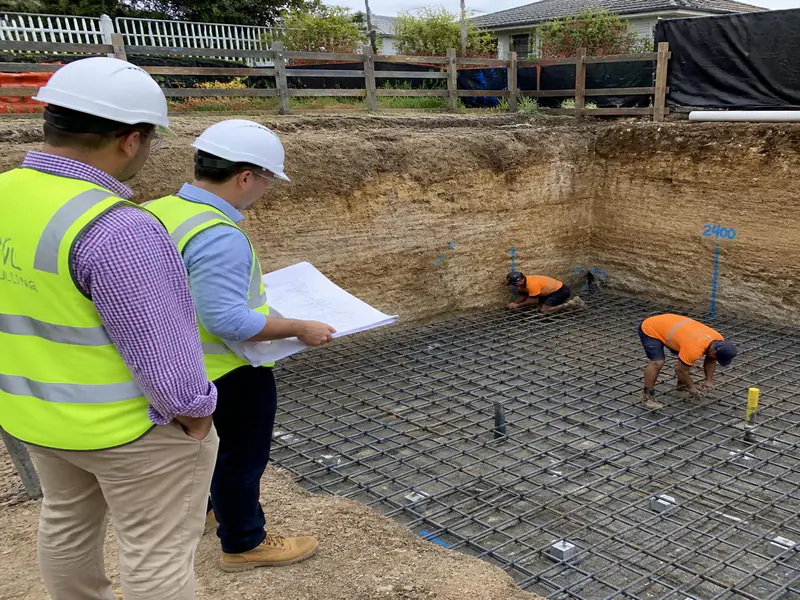
Determining the depth on a blueprint is only half the battle. Executing it safely on-site requires field expertise. Here are professional tips from years of site management:
1. Managing Material Wastage Factors
When ordering concrete and materials for foundations, never order the exact theoretical volume.
- Earthwork Backfill Wastage: Excavated soil expands when dug up (bulking factor of 10% to 20%). When backfilling the foundation pit, soil must be compacted in 150mm layers with water. Budget for a 15% volume drop due to compaction.
- Concrete Wastage: Concrete poured against uneven soil surfaces or rough shuttering fills irregular voids. Always add a 5% to 8% concrete wastage factor to your calculations when ordering ready-mix concrete (RMC) or site-mixing raw materials.
2. The Core-Cutter & SPT Verification Method
Do not assume the soil matching your calculation is uniform across the entire footprint of the residential building.
- Run a quick Standard Penetration Test (SPT) or a dynamic cone penetration test at the corners of the plot.
- If a pocket of soft slushy clay is found in one corner at the designated 1.2m depth, you must continue excavating that specific pocket until you hit firm soil. Fill that extra depth with lean PCC (M10 grade) rather than extending the structural RCC footing down, which saves money while ensuring uniform settlement.
3. Dewatering the Foundation Pit
If the water table is high and water seeps into the excavated pit, it will ruin the water-cement ratio of your PCC and structural concrete.
- Implement continuous dewatering using submersible sludge pumps.
- Never pour concrete into standing water unless you are using specific underwater tremie concrete methods, which are unnecessary and expensive for regular residential builds.
4. Shuttering and Reinforcement Alignment Checks
- Ensure that the bottom reinforcement mesh has clear concrete cover blocks of 50mm minimum. Foundations are exposed to soil moisture and aggressive chemicals; a thick concrete cover prevents groundwater from corroding the steel rebars.
- Check the verticality (plumb) of the column starter bars originating from the footing before casting concrete. Once the footing sets, correcting an off-centre column starter bar requires breaking the foundation.
Frequently Asked Questions (FAQs) for SEO Features
1. What is the absolute minimum depth of foundation for a 2-story residential building?
For a standard 2-story (G+1) residential building, the minimum practical depth of foundation is 1.2 metres to 1.5 metres (4 to 5 feet) in normal soils. If hard rock is available at a shallower depth, it can be reduced to 0.9 metres, provided it is properly keyed into the rock strata.
2. Can we determine the foundation depth without a soil test report?
While highly discouraged, for small low-load residential buildings where a soil test is completely unavailable, engineers use empirical local data and traditional trial pits. The excavation is continued until a bright, unweathered soil layer with high resistance to pickaxe penetration is found, ensuring it sits at least 1.0 metre below natural ground level.
3. How does Black Cotton Soil affect the minimum depth of foundation?
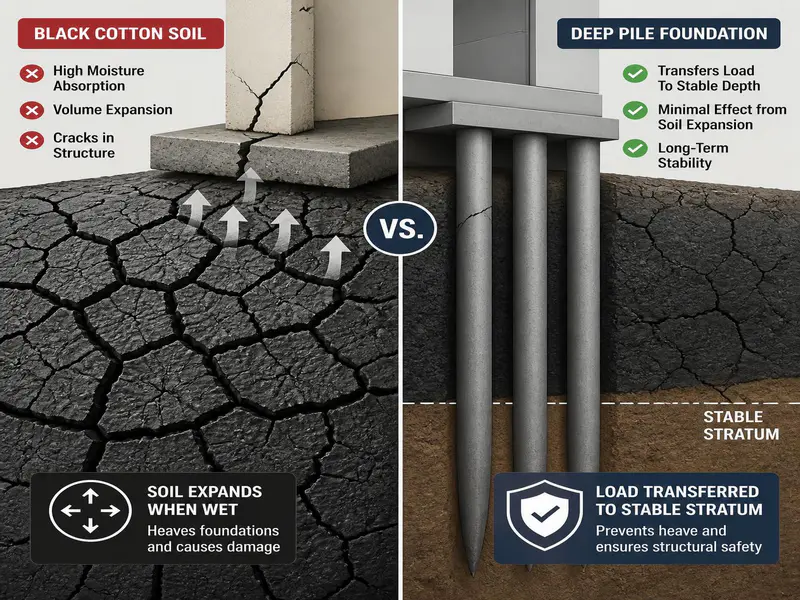
Black Cotton Soil undergoes heavy swelling and shrinking. Foundations in such soils must bypass the active zone completely. The minimum depth for residential foundations in deep expansive clay should be 1.5 metres to 2.0 metres. Alternatively, specialized under-reamed pile foundations or raft foundations are used instead of open isolated footings.
4. Is the depth of a foundation measured from the Plinth Level or Ground Level?
The depth of the foundation (Df) is always calculated and measured from the Natural Ground Level (GL) or the final graded ground level, whichever is lower. The plinth level is typically raised 0.45m to 0.9m above the ground level to prevent surface water entry, but this plinth height is not counted towards the structural depth of the foundation.
5. What happens if the foundation depth is kept too shallow?
If the foundation depth is too shallow, the structure can suffer from differential settlement, soil shear failure, frost damage, or lifting due to soil swelling. Visually, this manifests as diagonal stepping cracks in brickwork, jamming doors and windows, and in extreme cases, the tilting or partial collapse of the residential building frame.
Foundation design in India is usually based on guidelines published by the Bureau of Indian Standards (BIS). You can visit the official BIS website to explore Indian Standard codes related to building construction and structural design.
Engineers often use reliable engineering resources for formulas and technical data during design. The Engineering ToolBox website provides useful engineering references, calculators, and technical information used in construction and engineering fields.
Conclusion
Calculating and executing the correct minimum depth of foundation for residential building construction ensures structural longevity. Using mathematical approaches like Rankine’s formula removes the risk of structural failure, ensuring that the footing bypasses volatile weather zones, organic topsoils, and frost lines to rest comfortably on strong bearing strata.
When executing on-site, combine these mathematical frameworks with strict quality controls: account for concrete wastage, ensure a proper 50mm reinforcement cover, and verify that the base soil layer matches the expected safe bearing capacity before pouring the first layer of concrete. A home built on a precise, well-engineered foundation stands safe for generations.

Shakeel T is a qualified Civil Engineer and Structural Consultant with extensive on-site experience in residential and commercial building construction. Specializing in material estimation, cost budgeting, and structural safety guidelines, he has successfully managed multiple real estate projects from foundation to finishing. Through this blog, Shakeel shares field-tested civil engineering thumb rules, IS Code practices, and practical site tips to help home builders execute their projects efficiently and within budget.
Education: Diploma in Civil Engineering
Expertise: Quantity Surveying, Material Estimation, Structural Design, and Site Management.
Pingback: Standard Plinth Height for House in India – Minimum Plinth Level Accurate Complete Guide-2026