
Introduction
An undersized footing is a silent structural disaster waiting to happen. While a building’s beam or column failure shows immediate signs of distress, a footing failure occurs deep beneath the soil surface. By the time structural cracks manifest in walls or door frames begin to jam, the ground has already shifted, and the foundation has settled unevenly.
Determining the correct size of a foundation base requires clear engineering calculations. Accurate footing size calculation for residential building designs bridges the gap between the superstructure’s weight and the load-bearing capacity of the earth. Guessing these values based on “local practice” without engineering justification leads to two outcomes: dangerous structural settlement or expensive over-engineering that wastes tons of concrete and steel.
This comprehensive engineering guide breaks down the physics, formulas, real-world step-by-step examples, and practical on-site quality controls required to compute and execute perfect footing sizes for multi-story residential buildings.
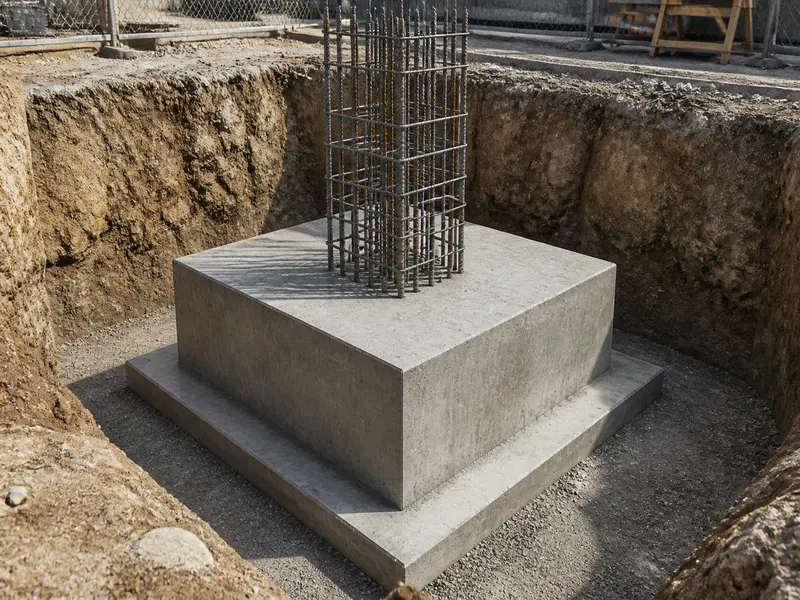
The Engineering Physics of Footings: Why Size Matters
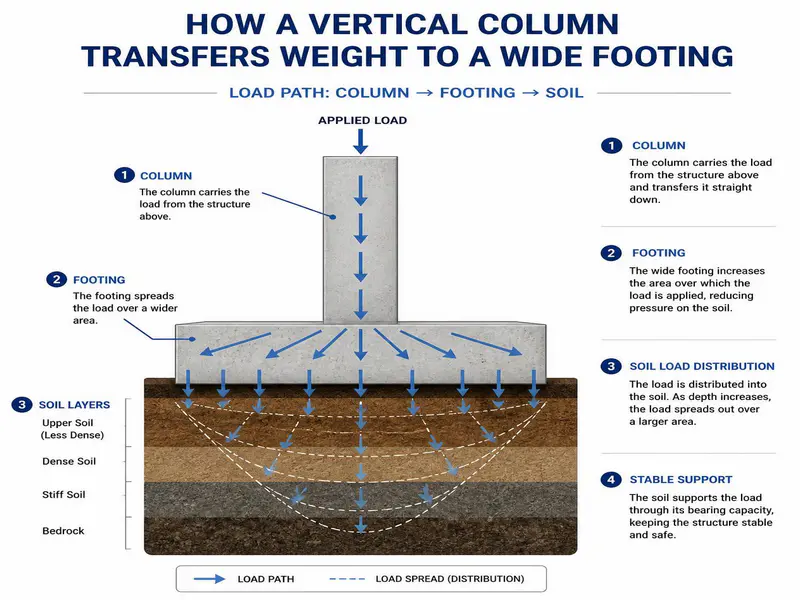
A column concentrates hundreds of kilonewtons of structural load onto a very small surface area. If this column directly touches bare soil, it will pierce it like a needle puncturing fabric. A footing acts as a load distributor, spreading that concentrated vertical force across a wider horizontal surface area.
1. Stress, Load, and Area Equilibrium
The fundamental law governing foundation design is that the pressure exerted by the footing base must never exceed the Safe Bearing Capacity (SBC) of the soil.
- Applied Soil Pressure = Total Vertical Load / Contact Area of Footing
To lower the stress applied to the ground, you must increase the contact area of the footing.
2. Preventing Uniform vs. Differential Settlement
- Uniform Settlement: The entire building sinks downward by a few millimetres simultaneously. This causes minor issues with utility pipe entries but rarely causes structural collapse.
- Differential Settlement: One specific footing settles significantly deeper than an adjacent footing. This induces massive secondary shear stresses, bending moments, and tension cracks in the beams, slabs, and brick masonry walls above. Proper sizing ensures all footings exert a balanced pressure on the soil, eliminating differential settlement.
3. Overcoming Punching Shear
The thickness and size of the footing must resist the tendency of the column to punch a hole straight through the concrete base. This requires computing not just the horizontal surface dimensions (length and width), but also a proportionate structural depth.
Read Also: Building Construction Process Step by Step
Core Mathematical Formulas for Footing Sizing
To calculate structural dimensions without breaking WordPress Gutenberg layouts with complex formatting, we express all engineering relationships in plain text format.
Formula 1: Total Design Load on Soil
Before calculating the surface area, the structural engineer must compile all structural loads acting on the column and add a safety allowance for the weight of the footing itself and the soil backfill sitting on top of it.
- Total Design Load (T) = Axial Column Load (P) + Self-Weight of Footing and Soil Overburden
The 10% Engineering Rule of Thumb: The self-weight of the concrete footing and the soil sitting on top of its base is generally taken as 10% of the axial column load.
- Total Design Load (T) = Column Load (P) x 1.10
Formula 2: Required Footing Area
Once the total load and the soil’s Safe Bearing Capacity are known, the minimal horizontal surface area is established.
- Required Area of Footing (A) = Total Design Load (T) / Safe Bearing Capacity of Soil (SBC)
Formula 3: Determining Linear Dimensions (Length & Width)
For a Square Footing:
Since length equals width, the dimension is the square root of the required area.
- Side of Square Footing (B) = Square Root of Area (A)
For a Rectangular Footing:
If a property line or an oblong column shape forces a rectangular footprint:
- Width of Footing (W) = Square Root of (Area / Aspect Ratio)
- Length of Footing (L) = Width (W) x Aspect Ratio
Practical Step-by-Step Calculation Examples
Let us look at two real-world design scenarios with concrete numbers to see how site engineers apply these principles.
Example 1: Isolated Square Footing for a 2-Story (G+1) Home Column
Consider an interior column of a typical G+1 residential building. The structural analysis software reveals that the column transfers a total axial working load of 450 kN. The geotechnical investigation report specifies the soil as medium dense sand.
- Axial Column Load (P): 450 kN
- Safe Bearing Capacity of Soil (SBC): 150 kN/sq.m
Step 1: Account for Footing Self-Weight
Apply the 10% safety allowance for the concrete footing’s dead weight.
- Self-Weight Allowance = 450 kN x 0.10 = 45 kN
- Total Design Load (T) = 450 kN + 45 kN = 495 kN
Step 2: Compute the Minimum Footing Area
- Required Area (A) = Total Design Load (T) / Soil SBC
- Area (A) = 495 / 150 = 3.30 square metres
Step 3: Find the Dimensions for a Square Footing
- Side Dimension (B) = Square Root of 3.30
- Side Dimension (B) = 1.816 metres
Step 4: Rounding up for Practical Construction Execution
On a live construction site, masons cannot work easily with fractions like 1.816 metres. Engineers round up dimensions to the nearest standard 50mm or 100mm increment.
- Final Specified Footing Size: 1.85 metres x 1.85 metres (or 1.90m x 1.90m for an added safety buffer).
Example 2: Rectangular Footing for a 3-Story (G+2) Frame on Weaker Silt Soil
Consider a corner column of a heavier G+2 residential structure where a nearby boundary wall limits layout space, requiring a rectangular footing with an aspect ratio of 1.5 (Length = 1.5 x Width).
- Axial Column Load (P): 750 kN
- Safe Bearing Capacity of Soil (SBC): 110 kN/sq.m (Silt-clay mix)
- Desired Aspect Ratio: 1.5
Step 1: Calculate Total Design Load
- Self-Weight Allowance = 750 kN x 0.10 = 75 kN
- Total Design Load (T) = 750 kN + 75 kN = 825 kN
Step 2: Compute the Required Area
- Required Area (A) = 825 / 110 = 7.50 square metres
Step 3: Calculate Rectangular Width and Length
Using the aspect ratio variation of the formula:
- Width (W) = Square Root of (7.50 / 1.5)
- Width (W) = Square Root of 5.0 = 2.236 metres
- Length (L) = 2.236 metres x 1.5 = 3.354 metres
Step 4: Site Rounding
- Final Specified Footing Size: 2.25 metres Width x 3.40 metres Length
Volume and Material Take-Off Calculations
Once the length and width dimensions are set, you must calculate the concrete volume to estimate material procurement costs.
Scenario Profiles for Quantities:
- Footing Size: 1.85m x 1.85m
- Structural Footing Base Thickness (D): 0.40 metres
- Underlying PCC Mud Mat Thickness: 0.10 metres (with a 100mm horizontal offset projection on all sides)
1. Excavation Volume
To provide room to position wooden shuttering panels, add a 150mm (0.15m) clear working margin on all four sides of the footing base.
- Excavation Length = 1.85 + 0.15 + 0.15 = 2.15 metres
- Excavation Width = 1.85 + 0.15 + 0.15 = 2.15 metres
- Depth of Excavation (Assume 1.50 metres below GL)
- Total Excavation Volume = 2.15 x 2.15 x 1.50 = 6.934 Cubic Metres (cum)
2. PCC Mud Mat Volume
The mud mat layer uses a lean concrete mix (M10 grade) to create a level working surface. It mirrors the offset dimensions of the footing base.
- PCC Length = 1.85 + 0.10 + 0.10 = 2.05 metres
- PCC Width = 1.85 + 0.10 + 0.10 = 2.05 metres
- PCC Thickness = 0.10 metres
- Total PCC Volume = 2.05 x 2.05 x 0.10 = 0.420 Cubic Metres (cum)
3. Structural RCC Concrete Volume
This is the high-strength concrete (M20 or M25 grade) structural footing element.
- Total RCC Volume = 1.85 x 1.85 x 0.40 = 1.369 Cubic Metres (cum)
Engineering Unit Conversions for Procurement
Construction procurement relies heavily on regional units. Use this quick summary conversion table to move between structural designs and material bills of quantities.
Key Factors:
- 1 Cubic Metre (cum) = 35.3147 Cubic Feet (CFT)
- 1 Brass = 100 Cubic Feet (CFT)
- 1 Cubic Metre of Reinforced Concrete = 2.45 Metric Tons (approximate mass weight)
Volumetric and Weight Conversion Summary Table
| Concrete Structural Component | Volume (Cubic Metres – cum) | Volume (Cubic Feet – CFT) | Volume in Commercial Brass | Total Mass Weight (Tons) |
|---|---|---|---|---|
| Excavation Pit Space | 6.934 | 244.87 | 2.449 | Not Applicable |
| PCC Leveling Bed | 0.420 | 14.83 | 0.148 | 0.966 |
| Structural RCC Footing | 1.369 | 48.35 | 0.484 | 3.354 |
On-Site Quality Control & Engineering Precautions
An accurate calculation on paper can be undone by poor execution in the field. These five verified field protocols ensure your foundations perform exactly as designed:
1. Applying Real-World Material Wastage Factors
Never order the exact theoretical volume derived from structural drawings.
- Concrete Volume Spillages: Concrete poured into ground excavations can seep into loose earth walls or uneven surfaces. Always apply a 5% to 7% wastage factor to your final calculations when ordering raw aggregate stocks or Ready-Mix Concrete (RMC) batches.
- Soil Bulking and Compaction: Soil expanded during excavation takes up more volume. When backfilling, compact the earth in steps of 150mm layers using mechanical ramming plates. Expect an effective volume decrease of nearly 15% due to compaction.
2. The Pocket Penetrometer Test
Before casting the lean PCC layer, verify that the soil at the base of the excavation pit matches the design Safe Bearing Capacity (SBC). Use a handheld Pocket Soil Penetrometer or arrange a quick Dynamic Cone Penetration Test (DCPT). If the instrument registers lower values than the design SBC, stop work immediately. You must either dig deeper to find firmer soil or expand the footing surface area to compensate for the weaker earth.
3. Enforcing Proper Reinforcement Clear Cover
Foundations are continuously exposed to soil acids, fluctuating moisture levels, and potential groundwater intrusion.
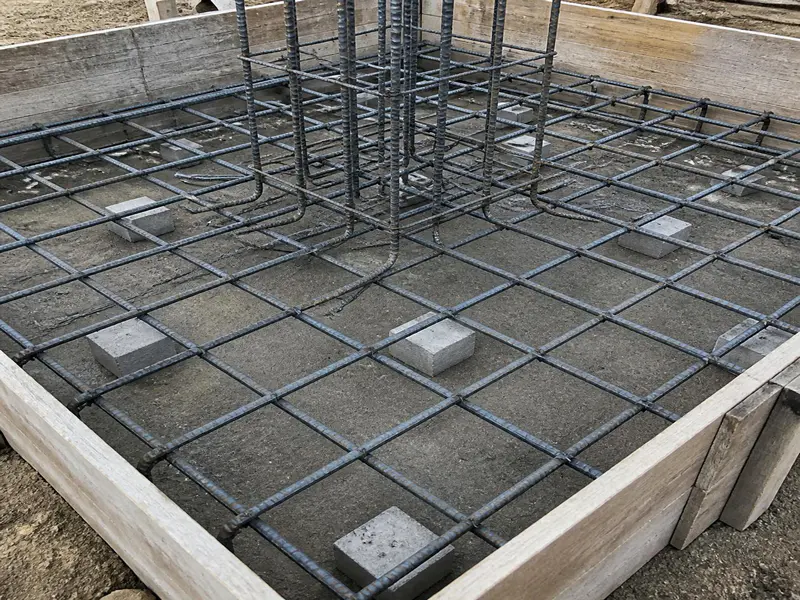
- Never compromise on the 50mm clear concrete cover for the bottom and sides of footing rebar mats.
- Use factory-manufactured concrete cover blocks of identical strength (M20/M25). Do not use loose site stones, broken bricks, or wood scraps as makeshift rebar supports.
4. Setting Proper Formwork Shuttering Stability
Avoid pouring concrete directly against raw earth excavation walls unless the soil is exceptionally cohesive and perfectly cut. Raw earth absorbs moisture from fresh concrete mixes, reducing structural strength. Use rigid plywood or steel shuttering panels to prevent honeycombing and concrete deformation along the footing edges.
Frequently Asked Questions (FAQs) for SEO Features
1. What is the standard minimum footing size for a single-story (G+0) house?
For a single-story residential build on average soil (SBC around 150 kN/sq.m), the standard minimum size for an isolated concrete footing is 1.0 metre x 1.0 metre (3.3 feet x 3.3 feet) with a minimum base structural thickness of 300mm.
2. How does a high groundwater table affect my footing size calculation?
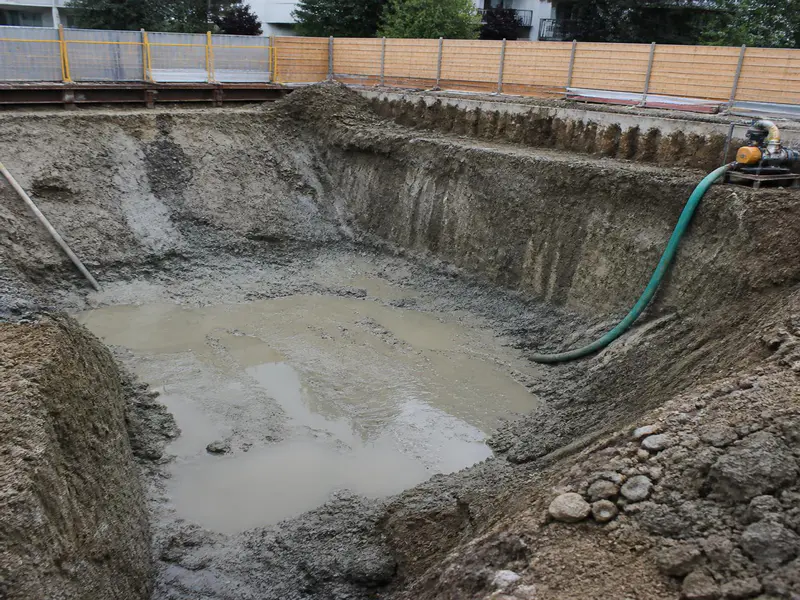
A high water table reduces the effective bearing capacity of sandy and silty soils by up to 50% due to buoyancy effects. If the water table rises above the foundation level, the engineer must either double the footing area to compensate for the lower SBC or implement an active dewatering system during construction while redesigning the concrete mix to resist chemical attack.
3. Can I use the same footing size for all columns in a residential building?
While using a uniform footing size across the entire grid simplifies on-site execution and shuttering work, it can lead to unnecessary material costs. Corner and perimeter columns typically carry lower axial loads than center columns. Engineers group columns into specific load bands and design two or three distinct footing sizes to save money while preventing differential settlement.
4. What grade of concrete should be used for structural residential footings?
Structural design standards specify a minimum grade of M20 (1 part cement : 1.5 parts sand : 3 parts stone aggregate) or M25 concrete for structural foundations. For the underlying lean leveling bed (PCC), an M10 (1:4:8) or M15 (1:2:4) mix is acceptable.
5. What happens if a footing is sized too small for the load?
If a footing is too small, the pressure on the underlying soil exceeds its safe bearing capacity, leading to soil shear failure. The footing settles unevenly into the ground, causing structural cracks in beams, buckling walls, jammed windows, and potential structural failure of the building.
In India, structural design and construction standards are usually based on guidelines provided by the Bureau of Indian Standards. You can visit the official BIS website to access Indian Standard codes and technical guidelines related to building construction and structural design.
Conclusion
Accurate footing size calculation requires careful balancing of column structural loads and soil bearing capacity. By using Rankine’s formulas, adjusting for self-weight allowances, and rounding sizes up for real-world execution, builders can construct durable homes free from the risk of foundation failure.
Combine your calculations with strict quality control protocols: use a 50mm clean rebar cover, confirm the base soil capacity before casting, and include a 5% to 7% concrete volume allowance for site wastage. Building on a properly sized foundation ensures your home stands safe for generations.

Shakeel T is a qualified Civil Engineer and Structural Consultant with extensive on-site experience in residential and commercial building construction. Specializing in material estimation, cost budgeting, and structural safety guidelines, he has successfully managed multiple real estate projects from foundation to finishing. Through this blog, Shakeel shares field-tested civil engineering thumb rules, IS Code practices, and practical site tips to help home builders execute their projects efficiently and within budget.
Education: Diploma in Civil Engineering
Expertise: Quantity Surveying, Material Estimation, Structural Design, and Site Management.