
Introducation
Accurate material estimation is the foundational cornerstone of any successful civil engineering project, residential development, or commercial construction venture. In the realm of structural development, underestimating your material quantities invariably causes costly project delays, fractured supply chains, and unexpected emergency delivery fees. Conversely, overestimating leads to unnecessary financial expenditures, logistical site management bottlenecks, and material degradation due to prolonged environmental exposure.
This comprehensive, ultra-detailed guide is specifically designed to master the process of Sand Calculation for Construction. Whether you are a professional civil engineer, an on-site supervisor, a quantity surveyor, or a homeowner managing a self-build project, this article provides the exact mathematical formulas, physical principles of material behavioral changes, and practical real-world examples required to execute error-free onsite estimations.
Why Accurate Sand Calculation Matters
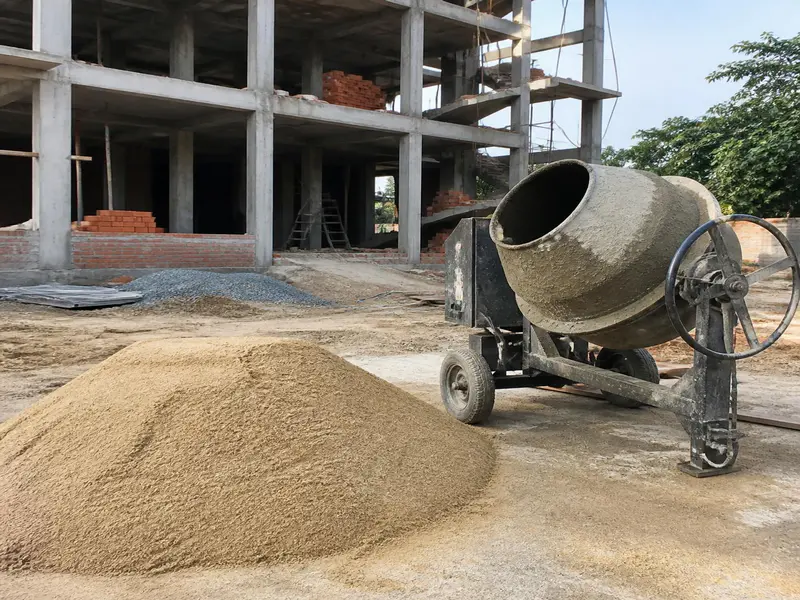
In professional construction management, sand serves as the critical fine aggregate within concrete mixes, brick masonry mortar, and interior/exterior wall plastering. Sand bridges the microscopic structural voids between coarse aggregates, acting as a structural filler while binding seamlessly with cement paste to form a dense, homogenous matrix.
From a structural engineering perspective, calculating sand requires understanding the material’s physical properties. Failing to account for these specific characteristics results in immediate structural deficiencies:
1. Dry Volume vs. Wet Volume Discrepancy
When dry sand, cement, and coarse aggregates are mixed together with water, a drastic reduction in total volume occurs. This happens because the microscopic water molecules lubricate the particles, forcing the fine sand grains to pack tightly into the natural voids and air gaps between the larger coarse aggregates. Therefore, the volume of the raw, dry materials you purchase must always be significantly higher than the finished, compacted wet volume of the structural element.
2. The Phenomenon of Bulking of Sand
Environmental moisture poses a massive hidden challenge for material management on active job sites. When dry river sand comes into contact with atmospheric humidity or rainwater, a thin film of water forms around each individual sand grain. This surface tension drives the sand particles apart, causing a massive, artificial volumetric expansion known as the Bulking of Sand. Depending on the exact moisture content (typically peaking between 4% to 5% moisture by weight), the physical volume of damp sand can increase by an astonishing 25% to 30% compared to completely dry sand. Knowing how to measure and adjust for this phenomenon prevents structural weakness caused by accidental cement-starved mixes.
The Core Formulas for Comprehensive Material Estimation
To successfully calculate the exact quantity of sand required for any building component, you must systematically move through three core mathematical phases.
Phase 1: Calculating the Pure Wet Volume (Geometric Volume)
The first step requires calculating the physical volumetric dimensions of the planned structural element (such as a slab, beam, column, or brick wall). This is derived purely from your architectural blueprints or site measurements:
- Wet Volume = Length x Width x Thickness (or Height)
Note: Ensure all physical dimensions are completely converted into a single unified unit of measurement (such as all meters or all feet) before multiplying.
Phase 2: Converting Wet Volume to Total Dry Volume
To compensate for the compaction, void filling, and structural shrinkage that occurs when water meets raw dry ingredients, civil engineers utilize specific, empirically proven conversion safety factors:
- For Concrete Work (Slabs, Beams, Columns): The dry volume is roughly 54% greater than the wet volume. Therefore, the dry volume factor is 1.54.
- Dry Volume for Concrete = Wet Volume x 1.54
- For Mortar and Plastering Work: The material shrinkage is slightly less but still highly significant, requiring a multiplier factor of 1.33.
- Dry Volume for Mortar or Plaster = Wet Volume x 1.33
Phase 3: Isolating the Sand Component via Mix Ratios
Every structural element utilizes a specific predefined mix ratio (e.g., Cement : Sand : Coarse Aggregate). To isolate the precise fractional volume belonging solely to the sand, use this universal ratio formula:
- Volume of Sand = (Ratio Part of Sand / Sum of Total Ratio Parts) x Total Calculated Dry Volume
Part 1: Comprehensive Example for Concrete Slab Construction
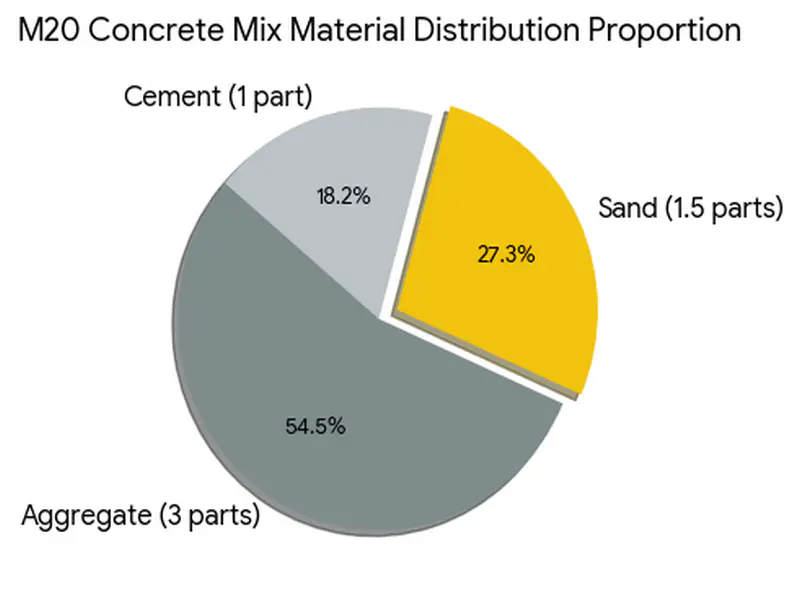
Let us execute a complete, end-to-end practical calculation for a standard residential concrete floor slab. We will assume the project requires an M20 Grade Concrete mix design, which is the standard benchmark for structural slabs, following a nominal volumetric mix ratio of 1 : 1.5 : 3 (1 part Cement, 1.5 parts Sand, and 3 parts Coarse Aggregate).
Project Specifications & Input Dimensions:
- Total Slab Length: 15.0 meters
- Total Slab Width: 8.0 meters
- Total Slab Thickness: 0.15 meters (equivalent to 150 mm or approximately 6 inches)
- Concrete Grade Mix Ratio (M20): 1 : 1.5 : 3
Step-by-Step Mathematical Breakdown:
Step 1: Calculate the Finished Wet Volume of Concrete
Multiply the length, width, and thickness of the slab layout to determine the total physical space the wet concrete will occupy once poured into the formwork:
- Wet Volume = 15.0 x 8.0 x 0.15 = 18.0 cubic meters (m3)
Step 2: Convert the Wet Volume into Total Required Dry Volume
To determine how much bulk, dry raw materials must be ordered from the supply yard to yield 18.0 m3 of finished wet concrete, apply the concrete safety multiplier (1.54):
- Dry Volume = 18.0 x 1.54 = 27.72 cubic meters (m3)
Step 3: Calculate the Sum of the Mix Ratio Parts
Add together the distinct proportional parts of the M20 grade concrete mix structure:
- Sum of Ratio = 1 (Cement) + 1.5 (Sand) + 3 (Coarse Aggregate) = 5.5
Step 4: Extract the Exact Sand Volume Requirement
Using the mathematical proportion of sand (1.5 parts out of a total 5.5 parts), multiply by the total dry volume calculated in Step 2:
- Volume of Sand = (1.5 / 5.5) x 27.72
- Volume of Sand = 0.272727 x 27.72 = 7.56 cubic meters (m3)
Part 2: Comprehensive Example for Brick Masonry Wall Mortar
Sand calculation is not limited exclusively to concrete. Let us look at a highly common site scenario: calculating the precise sand required to bind a brick wall. Mortar mixes typically use a 1 : 4 or 1 : 6 ratio (1 part cement to 4 or 6 parts sand). For this example, we will calculate the sand needed for a standard brick wall using a 1 : 6 Mortar Mix.
Project Specifications & Input Dimensions:
- Total Wall Length: 20.0 meters
- Total Wall Height: 3.0 meters
- Total Wall Thickness: 0.23 meters (Standard 9-inch brick wall)
- Standard Modular Brick Size: 0.19m x 0.09m x 0.09m
- Brick Size with Mortar Joints (10mm thickness): 0.20m x 0.10m x 0.10m
- Mortar Mix Ratio: 1 : 6
Step-by-Step Mortar and Sand Breakdown:
Step 1: Calculate Total Brickwork Volume
- Total Wall Volume = 20.0 x 3.0 x 0.23 = 13.80 cubic meters (m3)
Step 2: Calculate the Volume of a Single Brick Without Mortar
- Volume of 1 Brick = 0.19 x 0.09 x 0.09 = 0.001539 m3
Step 3: Calculate the Volume of a Single Brick With Mortar Joints
- Volume with Mortar = 0.20 x 0.10 x 0.10 = 0.002 m3
Step 4: Determine the Total Number of Bricks Required
- Number of Bricks = Total Wall Volume / Volume with Mortar = 13.80 / 0.002 = 6900 Bricks
Step 5: Calculate Total Solid Volume of Bricks Alone
- Solid Brick Volume = 6900 x 0.001539 = 10.619 m3
Step 6: Extract the Wet Volume of Mortar Required
Subtract the solid brick volume from the total structural wall volume to isolate the exact space filled by mortar:
- Wet Volume of Mortar = 13.80 – 10.619 = 3.181 m3
Step 7: Convert Wet Mortar Volume to Dry Mortar Volume
Apply the standard mortar dry conversion factor (1.33):
- Dry Volume of Mortar = 3.181 x 1.33 = 4.231 m3
Step 8: Calculate Sand Volume for the 1:6 Mortar Mix
- Sum of Mortar Ratio = 1 + 6 = 7
- Volume of Sand = (6 / 7) x 4.231 = 0.8571 x 4.231 = 3.626 cubic meters (m3)
Part 3: Comprehensive Example for Wall Plastering Work
Wall plastering is another critical structural finish requiring precision sand mapping. Let us calculate the sand needed to plaster a large interior wall surface with a standard 12mm thickness using a premium 1 : 4 Plaster Mix Ratio.
Project Specifications:
- Total Plaster Area: 100 square meters (m2)
- Plaster Thickness: 12 mm = 0.012 meters
- Plaster Mix Ratio: 1 : 4 (1 part Cement, 4 parts Sand)
Step-by-Step Plaster Calculation Breakdown:
Step 1: Calculate the Wet Volume of Plaster
- Wet Volume = Area x Thickness = 100 x 0.012 = 1.20 cubic meters (m3)
Step 2: Add Joint Filling and Surface Unevenness Factor
In real-world construction, brick walls are never perfectly flat. To account for mortar joint depressions and wall unevenness, civil engineers add a standard 20% extra volume to the wet calculation:
- Adjusted Wet Volume = 1.20 x 1.20 = 1.44 cubic meters (m3)
Step 3: Convert to Dry Volumetric Requirements
Multiply the adjusted wet volume by the standard mortar multiplier (1.33):
- Dry Volume of Plaster = 1.44 x 1.33 = 1.915 cubic meters (m3)
Step 4: Calculate Final Sand Quantity for Plastering
- Sum of Plaster Ratio = 1 + 4 = 5
- Volume of Sand = (4 / 5) x 1.915 = 0.80 x 1.915 = 1.532 cubic meters (m3)
Converting Sand Volume into Commercial and Local Market Units
Building material suppliers across global markets rarely sell or invoice river sand or manufactured sand (M-Sand) in pure cubic meters. Instead, they trade using local commercial weight or volumetric metrics.
Let us convert our three primary calculations (Concrete Slab: 7.56 m3, Brickwork Mortar: 3.626 m3, and Plastering: 1.532 m3) into the three most dominant commercial units: Cubic Feet (CFT), Metric Tons, and Brass.
Volumetric Unit Transformation Constants:
- 1 Cubic Meter (m3) = 35.3147 Cubic Feet (CFT)
- 1 Brass = 100 Cubic Feet (CFT) = 2.8317 Cubic Meters
- Average Compacted Bulk Density of Construction Sand = 1600 kg/m3
Also check our brick calculation article to learn how sand is used in masonry work along with bricks and cement.
Complete Commercial Material Order Matrix
| Construction Element | Calculated Volume (m3) | Volume in Cubic Feet (CFT) | Weight in Metric Tons (t) | Quantity in Local Brass |
|---|---|---|---|---|
| 1. Concrete Floor Slab | 7.56 m3 | 7.56 x 35.3147 = 266.98 CFT | (7.56 x 1600) / 1000 = 12.10 Tons | 266.98 / 100 = 2.67 Brass |
| 2. Brickwork Mortar | 3.626 m3 | 3.626 x 35.3147 = 128.05 CFT | (3.626 x 1600) / 1000 = 5.80 Tons | 128.05 / 100 = 1.28 Brass |
| 3. Wall Plastering | 1.532 m3 | 1.532 x 35.3147 = 54.10 CFT | (1.532 x 1600) / 1000 = 2.45 Tons | 54.10 / 100 = 0.54 Brass |
Professional Site Quality Controls and Field Adjustments
To ensure your calculations match real-world execution perfectly, always apply these critical engineering field rules:
1. Perform an On-Site Bulking Field Test
Never trust visual sand volume if your stockyard supply is damp. Always conduct this quick field verification:
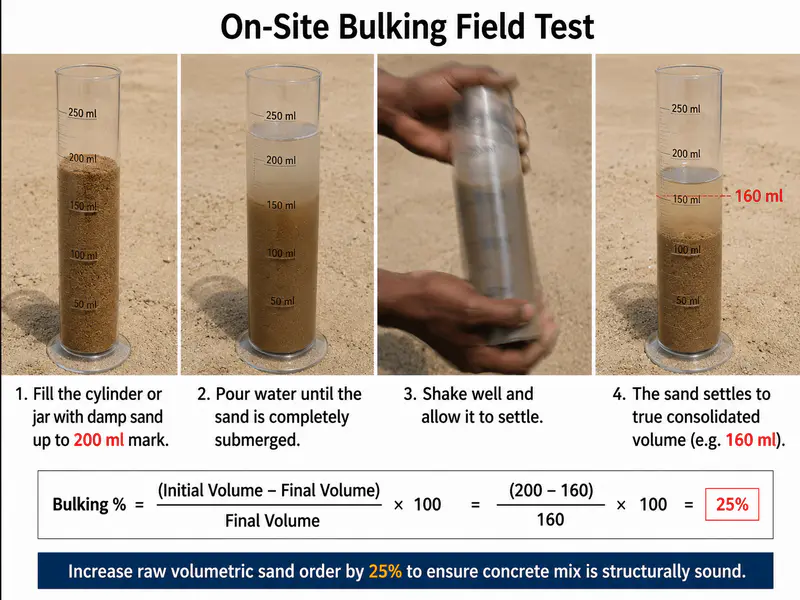
- Fill a transparent graduated cylinder or glass jar with damp sand up to the 200 ml mark.
- Pour water into the jar until the sand is completely submerged and saturated.
- Shake well and allow it to settle. The water will eliminate the surface tension film, causing the sand to drop to its true consolidated volume (e.g., settling down to the 160 ml mark).
- Calculate the exact bulking percentage: ((200 – 160) / 160) x 100 = 25%. Increase your raw volumetric sand order by exactly 25% to ensure your structural concrete mix ratio does not end up structurally deficient.
2. Factor in Structural Handling Wastage
No construction site experiences zero material loss. Sand spills during tractor offloading, blows away during high winds, gets tracked away on heavy machinery tires, or gets mixed into the soil floor of the stockyard. Always append a safety wastage margin based on your site conditions:
- Highly Controlled Sites / Pre-cast Yards: Add a 2% to 3% wastage margin.
- Standard Residential / Remote Manual Sites: Add a 5% structural wastage allowance to your final material order list.
3. Silt Content Threshold Verification
High-quality construction sand must have less than 5% total silt content by volume. If your sand contains excessive mud, silt, or organic clay particles, it prevents the cement matrix from adhering to the aggregate surface. This structural flaw causes major long-term issues, such as internal delamination, deep shrinkage cracks, and a drastic drop in the overall compressive strength of the structural elements over time. Always wash or screen your sand if it fails basic onsite sedimentation jar tests.
Frequently Asked Questions (FAQs)
Q1: What is the standard dry volume conversion factor for sand calculation?
For concrete structural elements, the industry-standard dry conversion factor is 1.54. For masonry mortar and wall plastering mixes, the dry factor is 1.33. These factors account for the volumetric reduction that happens when fine aggregates pack into coarse aggregate air voids upon adding water.
Q2: How does the bulking of sand affect material calculation?
Bulking occurs when moisture forms a thin film around sand grains, pushing them apart and increasing the overall bulk volume by up to 25% to 30%. If you use damp sand without adjusting for bulking, you will end up adding less actual sand than required, leading to a cement-starved, structurally weak mix.
Q3: Can I use Manufactured Sand (M-Sand) instead of River Sand?
Yes. Manufactured Sand (M-Sand) is an excellent, eco-friendly alternative to river sand. The calculation process remains exactly identical. However, ensure that the M-Sand is properly crushed and free from excessive quarry dust before site batching.
Q4: How many cubic feet (CFT) are in 1 Brass of sand?
In commercial construction trade metrics, 1 Brass is exactly equal to 100 Cubic Feet (CFT) or approximately 2.83 cubic meters.
Q5: What happens if the silt content in sand exceeds 5%?
When silt content exceeds 5%, it severely reduces the bonding strength between the cement paste and aggregates. This results in heavy surface peeling, poor structural durability, and the formation of shrinkage cracks over time.
You can also use Engineering Toolbox for additional formulas and conversion tools related to construction calculations.
Conclusion
Executing a precise Sand Calculation for Construction is a fundamental technical skill that protects your financial budget while securing the long-term durability of your structure. By mastering the geometric calculation of wet volume, applying the correct scientific dry multipliers (1.54 for concrete and 1.33 for mortar), and accurately factoring in site realities like sand bulking and transport wastage, you eliminate guesswork entirely.
Whether you are casting a foundation slab, raising brick walls, or applying final wall plaster, precision at the estimation stage is what guarantees structural excellence on-site. Always run routine jar tests for silt content and check your sand’s moisture levels to ensure your real-world mixtures perform exactly as engineered.

Shakeel T is a qualified Civil Engineer and Structural Consultant with extensive on-site experience in residential and commercial building construction. Specializing in material estimation, cost budgeting, and structural safety guidelines, he has successfully managed multiple real estate projects from foundation to finishing. Through this blog, Shakeel shares field-tested civil engineering thumb rules, IS Code practices, and practical site tips to help home builders execute their projects efficiently and within budget.
Education: Diploma in Civil Engineering
Expertise: Quantity Surveying, Material Estimation, Structural Design, and Site Management.