
Introduction
Sand is a key material in construction. It is used in concrete, plastering, and masonry work, and calculating the right quantity is important to prevent wastage and unnecessary costs.
In this guide, you will learn sand calculation for construction step-by-step with simple formulas and practical examples.
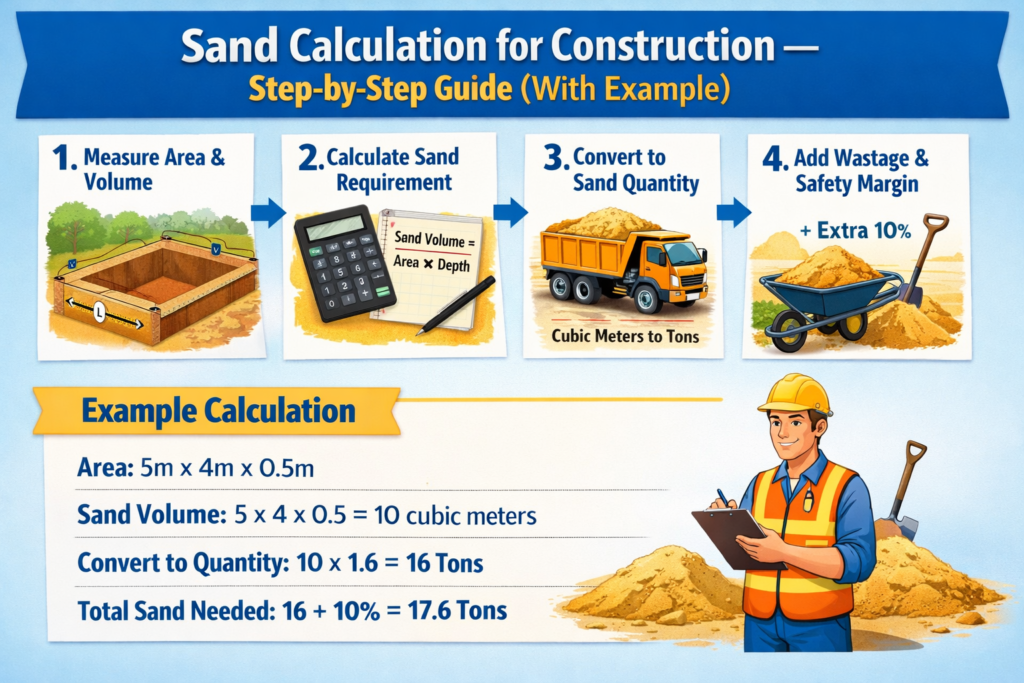
📌 Why Sand Calculation is Important
- Prevents material wastage
- Helps in accurate cost estimation
- Ensures proper mix ratio
- Avoids construction delays
📐 Basic Formula for Sand Calculation
The basic formula used for sand calculation is:
Volume of Sand = (Dry Volume (x) Sand Ratio) / Total Ratio
🧮 Step-by-Step Sand Calculation (Concrete Example)
👉 Example:
Determine the quantity of sand needed for 1 cubic meter of M20 grade concrete.
🔹 Mix Ratio:
M20 = 1 : 1.5 : 3
(Cement : Sand : Aggregate)
🔹 Step 1: Calculate Dry Volume
Wet volume = 1 Cum
Dry volume = (1 x 1.54) = 1.54 Cum
🔹 Step 2: Total Ratio
Total = (1 + 1.5 + 3)s = 5.5
🔹 Step 3: Sand Quantity
Sand = (1.54 × 1.5) / 5.5
Sand = 0.42 Cum
🔹 Step 4: Convert to Cubic Feet
1 m³ = 35.3147 cft
Sand = 0.42 × 35.3147 = 14.83 cft
📊 Final Answer:
👉 Sand required for 1 m³ concrete ≈ 0.42 m³ (14.8 cft)
🧱 Sand Calculation for Plastering
👉 Example:
Plastering area = 100 sq ft
Thickness = 12 mm (0.012 m)
🔹 Step 1: Convert Area to m²
100 sq ft = 9.29 m²
🔹 Step 2: Wet Volume
Volume = Area × Thickness
= 9.29 × 0.012 = 0.111 m³
🔹 Step 3: Dry Volume
= 0.111 × 1.27 = 0.141 m³
🔹 Step 4: Mix Ratio
1 : 4
Total = 5
🔹 Step 5: Sand Quantity
Sand = (0.141 × 4) / 5
= 0.112 m³
🔹 Convert to CFT
= 0.112 × 35.3147 = 3.95 cft
📊 Final Answer:
👉 Sand required for 100 sq ft plastering ≈ 4 cft
🧱 Sand Calculation for Brick Masonry
👉 Example:
1 m³ brickwork
🔹 Standard Sand Requirement:
👉 Sand required ≈ 0.30 m³ per 1 m³ brickwork
👉 In CFT:
= 0.30 × 35.3147 = 10.6 cft
📊 Final Answer:
👉 Sand required for brickwork ≈ 0.30 m³ (10–11 cft)
📐 Sand Calculation for Slab (Detailed Example)
👉 Example:
Slab size = 10 ft × 10 ft
Thickness = 5 inches
🔹 Step 1: Convert into meters
10 ft = 3.048 m
Volume = 3.048 × 3.048 × 0.127
= 1.18 m³
🔹 Step 2: Dry Volume
Dry volume = 1.18 × 1.54
= 1.81 m³
🔹 Step 3: Mix Ratio
For M20 concrete → 1 : 1.5 : 3
Total ratio = 5.5
🔹 Step 4: Sand Quantity
Sand = (1.81 × 1.5) / 5.5
= 0.49 m³
🔹 Convert to cubic feet
= 0.49 × 35.3147
= 17.3 cft
📊 Final Answer:
👉 Sand required for a 10 × 10 slab ≈ 17–18 cft
📉 Sand Wastage Calculation
In construction, a certain amount of material loss is unavoidable because of handling and site conditions.in co
👉 Standard wastage values:
- Concrete → 5%
- Plastering → 8%
- Brickwork → 10%
🔹 Example:
Required sand = 100 cft
Wastage (5%) = 5 cft
👉 Total sand to order = 105 cft
📐 Mortar is used to bind bricks together, and sand plays a major role in it.Calculate Sand for Different Mix Ratios
In construction, mix ratios are chosen based on the required strength, and the amount of sand changes according to the selected ratio.
🔹 Common Mix Ratios:
- 1:2:4 → Used for PCC (Plain Cement Concrete)
- 1:1.5:3 → Used for RCC (Reinforced Cement Concrete)
- 1:4 → Used for plastering
- 1:6 → Used for brick masonry
👉 Example (1:2:4 Mix)
Let us calculate sand for 1 m³ concrete
Step 1: Dry Volume
= 1 × 1.54 = 1.54 m³
Step 2: Total Ratio
= 1 + 2 + 4 = 7
Step 3: Sand Quantity
Sand = (1.54 × 2) / 7
= 0.44 m³
👉 In cubic feet:
0.44 × 35.3147 = 15.5 cft
📊 Conclusion:
👉 For 1:2:4 mix, sand required ≈ 0.44 m³ (15–16 cft)
🧱 Sand Calculation for Mortar (Brickwork Detailed)
Mortar is used to join bricks together, and sand is a key component in it.
👉 Example:
1 m³ brick masonry
🔹 Step 1: Volume of mortar
Approximately 25–30% of brickwork volume
Assume = 30%
Mortar volume = (1 × 0.30) = 0.30 m³
🔹 Step 2: Dry Volume
= 0.30 × 1.33 = 0.399 m³
🔹 Step 3: Mix Ratio
1 : 6
Total = 7
🔹 Step 4: Sand Quantity
Sand = (0.399 × 6) / 7
= 0.34 m³
🔹 Convert to CFT
= 0.34 × 35.3147
= 12 cft
📊 Final Answer:
👉 Sand required for 1 m³ brick masonry ≈ 10–12 cft
🧮 Unit Conversion for Sand Calculation
Understanding unit conversion is very important in construction calculations.
🔹 Basic Conversions:
- 1 cubic meter (cum) = 35.3147 cubic feet (cft)
- 1 cubic foot (cft) = 0.0283 m³
- 1 brass (India) = 100 cft
👉 Example:
If sand required = 200 cft
👉 In brass = 200 / 100 = 2 brass
📊 Why This Matters:
- Contractors often order sand in brass or truck loads
- Proper conversion helps in ordering correct quantity
🚚 Sand Quantity in Truck Loads
In practical construction, sand is usually ordered in truck loads instead of cubic meters.
🔹 Standard Truck Capacity:
- Small truck → 100 cft
- Medium truck → 200 cft
- Large truck → 300–400 cft
👉 Example:
Required sand = 350 cft
👉 You can order:
- 2 medium trucks (200 + 200 = 400 cft)
📌 Tip:
Always order slightly more sand to account for wastage and variation.
🧱 Types of Sand Used in Construction
Different types of sand are used in construction depending on the work. Choosing the correct type of sand is as important as calculating the right quantity.
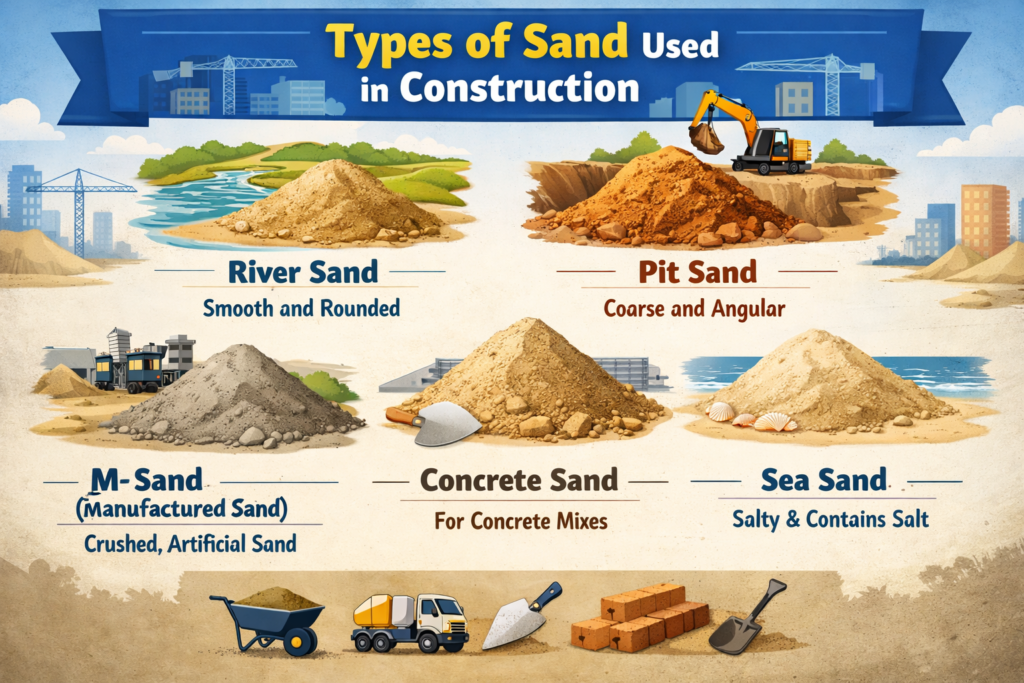
🔹 River Sand
River sand is naturally obtained from river beds.
- It has a smooth texture
- Ideal for concrete and plastering work
- Provides good strength and durability
👉 Disadvantage: It is usually more expensive and less available.
🔹 M Sand (Manufactured Sand)
M sand is produced by crushing hard stones in machines.
- Uniform particle size
- Lower cost compared to river sand
- Eco-friendly option
👉 Nowadays, M sand is widely used in modern construction projects in India.
👉 For official standards and construction practices, you can refer to the Bureau of Indian Standards (BIS) website which provides guidelines for material usage and mix design.
🔹 Pit Sand
Pit sand is obtained by digging the ground.
- Has a rough texture
- Suitable for masonry work
👉 Not recommended for high-strength structural works.
👉 You can read our detailed guide on concrete calculation to understand how sand fits into the overall mix. This will help you estimate cement, sand, and aggregate together.
🧮 Quick Sand Calculation Table
| Work Type | Sand Required |
|---|---|
| 1 m³ Concrete | 0.42 m³ |
| 100 sq ft Plaster | 4 cft |
| 1 m³ Brickwork | 10–11 cft |
| 1000 Bricks | ~3 cft |
🏗️ Practical Site Tips
- Always measure sand in dry condition
- Moisture in sand affects volume and accuracy
- Follow the correct mix ratio strictly
- Store sand properly to avoid contamination
- Avoid mixing soil or debris with sand
👉 Also check our brick calculation article to learn how sand is used in masonry work along with bricks and cement.
⚠️ Advanced Concept: Bulking of Sand
Bulking of sand is a very important concept in construction.
👉 When sand contains moisture, its volume increases.
- Fine sand → 20% to 30% increase
- Medium sand → 10% to 20% increase
- Coarse sand → 5% to 10% increase
👉 This can lead to incorrect quantity estimation.
✔ Always check moisture content before measurement
✔ Adjust quantity if sand is wet
📋 Factors Affecting Sand Quantity
- Mix ratio
- Type of work (slab, plaster, brickwork)
- Wastage (5–10%)
- Moisture content
- Site conditions
⚠️ Common Mistakes in Sand Calculation
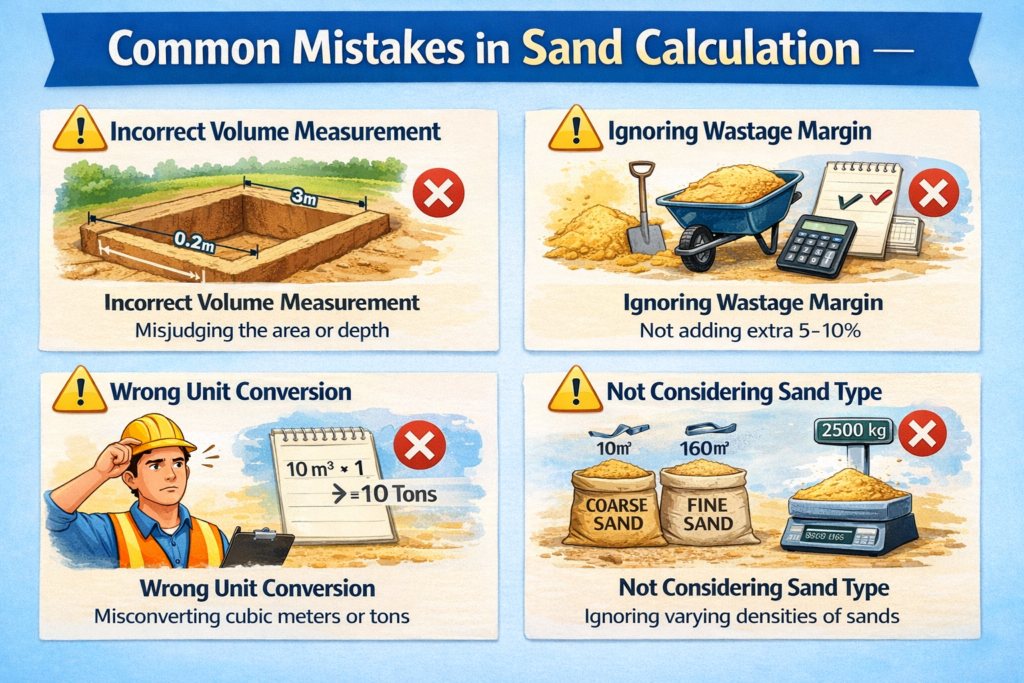
- Ignoring dry volume factor
- Wrong mix ratio usage
- Not converting units properly
- Ignoring wastage
- Using wet sand directly
📊 Sand Requirement for Different Construction Works (Quick Guide)
Understanding approximate sand requirements for different construction activities helps in quick estimation at site. Instead of calculating every time, you can use these standard values as a reference.
- Concrete Work (RCC)
For 1 cubic meter of M20 concrete, sand required is approximately 0.42 m³ (14–15 cft). - Plastering Work
For 100 square feet of plastering with 12 mm thickness, sand required is around 4 cft. - Brick Masonry
For 1 cubic meter of brickwork, sand required is approximately 10–12 cft. - Flooring Work
For floor bedding and tile work, sand requirement depends on thickness, but generally 3–5 cft per 100 sq ft is used.
🏗️ Importance of Proper Sand Quality
Apart from quantity, the quality of sand also plays a major role in construction strength and durability.
- Clean sand ensures proper bonding with cement
- Well-graded sand improves workability of concrete
- Avoid sand with clay, silt, or organic impurities
- Use sieved sand for plastering to get smooth finish
👉 Poor quality sand can reduce the strength of concrete and lead to cracks or surface defects.
🎯 Final Tip for Accurate Estimation
Always combine proper calculation + quality material + correct mix ratio to achieve the best construction results.
👉 Even a small mistake in sand estimation can affect both cost and structural performance.
❓ FAQs
1. How much sand is required for 1 m³ concrete?
👉 Approximately 0.42 m³ (14.8 cft) sand is required for M20 concrete.
2. How to calculate sand for plastering?
👉 Multiply area by thickness to get volume, convert to dry volume, and apply mix ratio.
3. What is dry volume in sand calculation?
👉 Dry volume is calculated by multiplying wet volume with a factor (1.27–1.54) to account for voids and wastage.
4. How much sand is required for 100 sq ft plastering?
👉 Around 4 cft sand is required for standard plastering.
5. Why is sand calculation important?
👉 It helps reduce wastage, save cost, and ensure proper mix quality.
👉 You can also use Engineering Toolbox for additional formulas and conversion tools related to construction calculations.
🏁 Conclusion
Sand calculation for construction is a very important step in any building project. By using the correct formulas and understanding the mix ratios, you can accurately estimate the required quantity of sand for concrete, plastering, and brickwork.
Always remember to consider dry volume and wastage to get precise results. Proper calculation not only saves money but also ensures the strength and durability of the structure.

Shakeel T is a civil engineering enthusiast and founder of CivilGuide.in. He specializes in construction estimation, quantity surveying, and practical civil engineering calculations. Through CivilGuide, he shares real-world construction knowledge, calculators, and step-by-step guides to help students and site engineers improve their technical skills.