
Introduction
Soil bearing capacity is one of the most important factors in house construction. Before constructing a building, engineers must check whether the soil can safely support the weight of the structure.
If the soil is weak and cannot carry the building load properly, the structure may experience settlement, cracks, or even structural failure. That is why soil investigation and proper foundation design are very important for safe construction.
In residential buildings, soil bearing capacity determines the size and depth of the foundation, the type of footing, and the load distribution of the structure.
Understanding soil bearing capacity helps civil engineers design foundations that transfer the building load safely to the ground without causing excessive settlement.
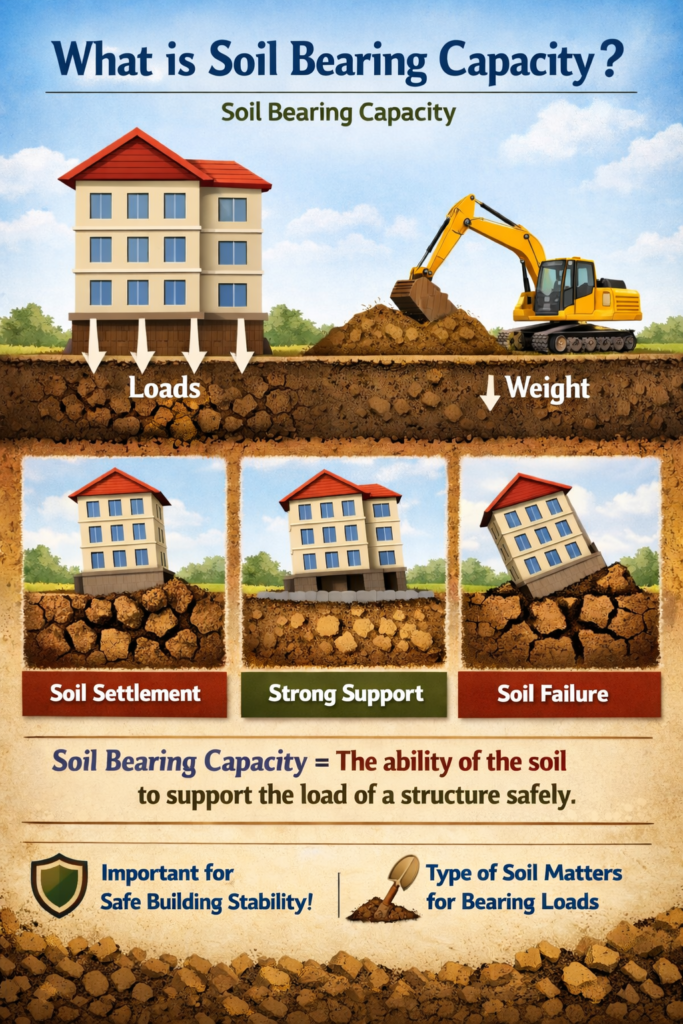
What is Soil Bearing Capacity?
Soil bearing capacity is the maximum load that soil can safely support per unit area without failure or excessive settlement.
It is usually expressed in:
- kN/m²
- kPa
- Ton per square meter
In simple words, soil bearing capacity tells us how much weight the soil can carry safely.
For example:
If the soil bearing capacity is 200 kN/m², it means the soil can safely support 200 kilonewtons load per square meter.
If the building load exceeds this value, the soil may fail or settle.
Why Soil Bearing Capacity is Important in House Construction
Soil bearing capacity plays a major role in foundation design. Without knowing the soil strength, the foundation cannot be designed properly.
Some important reasons include:
1. Safe Foundation Design
The foundation must distribute the building load according to the soil strength.
2. Prevents Building Settlement
Weak soil can cause uneven settlement, which leads to cracks in walls and slabs.
3. Determines Foundation Size
Higher soil strength means smaller footing size, while weaker soil requires larger footings.
4. Improves Structural Stability
Correct foundation design ensures long-term structural safety.
Types of Soil and Their Bearing Capacity
Different soil types have different strengths. Some soils can carry heavy loads, while others are weak.
Typical soil bearing capacities are:
| Soil Type | Safe Bearing Capacity |
|---|---|
| Hard rock | 600 – 1000 kN/m² |
| Gravel | 300 – 600 kN/m² |
| Sand | 200 – 300 kN/m² |
| Clay | 100 – 200 kN/m² |
| Soft clay | 50 – 100 kN/m² |
Rock and gravel soils are usually stronger, while clay and loose soils have lower bearing capacity.
Methods to Determine Soil Bearing Capacity
Civil engineers use different methods to determine soil bearing capacity before construction.
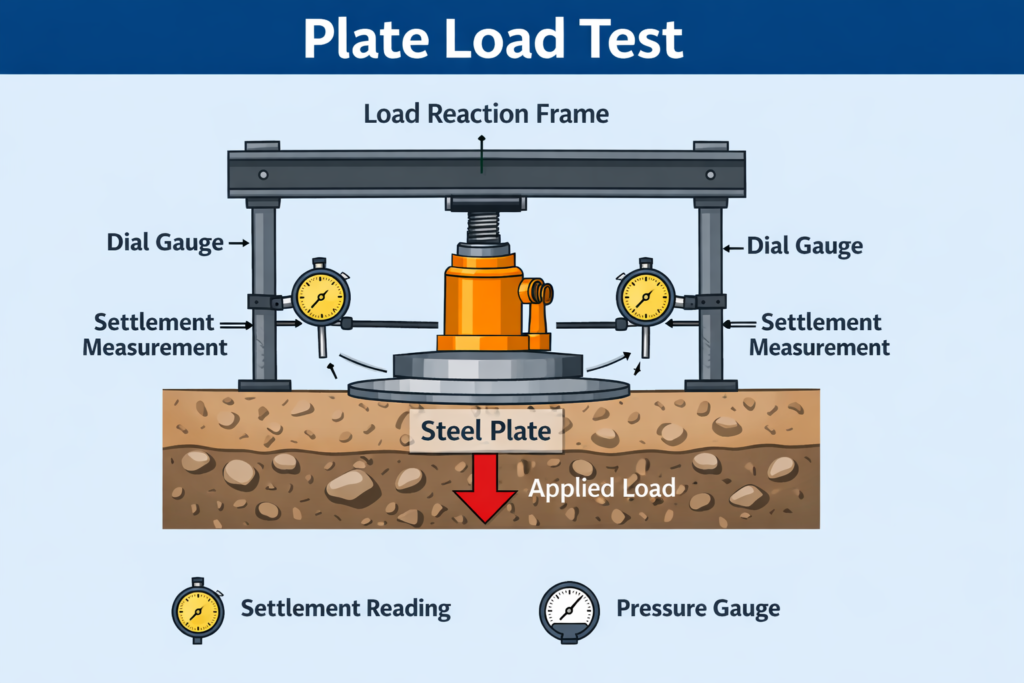
1. Plate Load Test
Plate load test is one of the most common methods used at construction sites.
In this test:
- A steel plate is placed on the soil surface
- Load is applied gradually
- Settlement is measured
Based on settlement values, engineers calculate soil bearing capacity.
2. Standard Penetration Test (SPT)
This test is usually conducted during soil investigation.
A sampler is driven into the soil using a hammer, and the number of blows required is recorded.
Higher blow counts indicate stronger soil.
3. Soil Investigation Report
Before constructing large buildings, geotechnical engineers conduct soil tests and provide a soil investigation report.
This report includes:
- Soil type
- Bearing capacity
- Groundwater level
- Foundation recommendations
Safe Bearing Capacity of Soil for Residential Buildings
For most residential houses, the safe bearing capacity usually ranges between:
100 kN/m² to 200 kN/m²
Typical assumption values used in small residential construction are:
| Soil Condition | SBC Value |
|---|---|
| Soft soil | 75 kN/m² |
| Medium soil | 150 kN/m² |
| Hard soil | 200 kN/m² |
However, exact values should always be confirmed through soil testing.
Before designing the footing, it is important to understand how footing size is calculated based on column load and soil strength. Read our detailed guide on Footing Size Calculation for Residential Building to learn the step-by-step method.
Soil Bearing Capacity Calculation Example
Let us understand this with a simple example.
Assume:
Load from column = 300 kN
Safe bearing capacity of soil = 150 kN/m²
Foundation area required:
Foundation Area = Load / SBC
Foundation Area =
300 / 150
Foundation Area = 2 m²
If we assume a square footing:
Footing size = √2
Footing size ≈ 1.4 m × 1.4 m
So the footing should be around 1.5 m × 1.5 m for safety.
This example shows how soil bearing capacity directly affects footing size.
Factors Affecting Soil Bearing Capacity
Several factors influence soil bearing capacity.
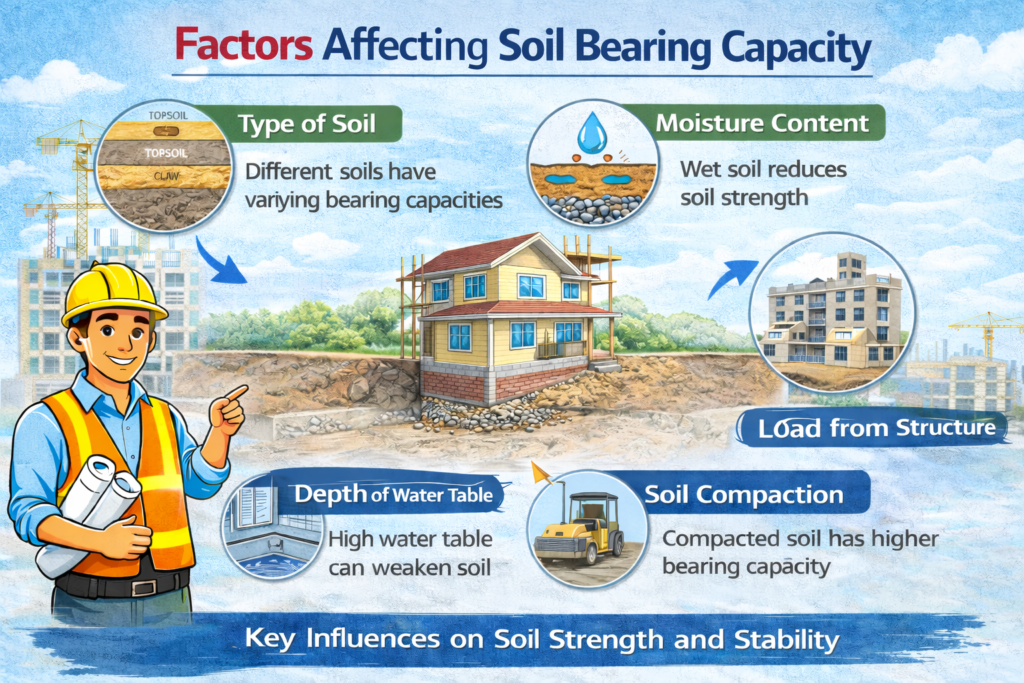
Soil Type
Different soils have different strengths.
Moisture Content
Excess water reduces soil strength.
Soil Density
Dense soil has higher load carrying capacity.
Depth of Foundation
Bearing capacity increases with foundation depth.
Groundwater Level
High groundwater can reduce soil strength.
How Soil Bearing Capacity Affects Foundation Design
Soil bearing capacity directly affects the design of building foundations. When engineers design a foundation, they must ensure that the load from the structure is safely transferred to the soil without causing failure or excessive settlement.
If the soil has high bearing capacity, the foundation size can be smaller because the soil can safely support higher loads. This helps reduce construction cost because less excavation and less concrete are required.
However, if the soil has low bearing capacity, engineers must increase the foundation area so that the load is distributed over a larger surface. Increasing the footing size reduces the pressure acting on the soil and prevents settlement.
In some cases where soil is extremely weak, engineers may use special foundation types such as raft foundations or pile foundations to transfer loads to deeper and stronger soil layers.
Therefore, understanding soil bearing capacity is essential for designing safe and economical foundations.
Practical Example from Construction Site
In many village house constructions, soil testing is not conducted. Engineers often assume SBC values based on experience.
For example:
If the soil is medium dense sand, engineers may assume SBC around 150 kN/m².
Based on this value, footing size is designed to safely carry the column load.
However, for large buildings, proper soil investigation is always recommended.
Engineering Toolbox provides useful engineering formulas, soil mechanics concepts, and technical data that help engineers understand soil properties and foundation design principles.
Common Mistakes in Soil Bearing Capacity Estimation
Many construction problems occur due to incorrect assumptions about soil strength.
Some common mistakes include:
Ignoring soil testing before construction
Assuming soil strength without proper investigation
Using small footing size for heavy structures
Constructing foundations on loose soil
Not considering groundwater conditions
Avoiding these mistakes helps ensure safe building construction.
Foundation depth also depends on soil strength and soil conditions. Our guide on Minimum Depth of Foundation for Residential Building explains how engineers determine the correct depth for safe construction.
Difference Between Ultimate Bearing Capacity and Safe Bearing Capacity
In soil mechanics, engineers often refer to two types of bearing capacity: ultimate bearing capacity and safe bearing capacity.
Ultimate bearing capacity is the maximum load that soil can carry before failure occurs. At this stage, the soil may collapse or experience large settlement.
Safe bearing capacity, on the other hand, is the maximum load that soil can safely support without risk of failure. Engineers apply a factor of safety to the ultimate bearing capacity to determine the safe bearing capacity.
For example:
If the ultimate bearing capacity of soil is 450 kN/m² and the factor of safety is 3, then the safe bearing capacity will be:
Safe Bearing Capacity = 450 / 3
Safe Bearing Capacity = 150 kN/m²
Using safe bearing capacity ensures that the foundation remains stable even under varying load conditions.
Soil Investigation Before House Construction
Soil investigation is a very important step before starting house construction. It helps engineers understand the soil properties and determine the correct foundation design.
During soil investigation, engineers collect soil samples from different depths and test them in a laboratory. These tests help determine soil characteristics such as strength, density, moisture content, and shear strength.
The soil investigation report usually includes important information such as:
Soil profile at different depths
Safe bearing capacity of soil
Groundwater level
Recommended foundation type
Allowable settlement values
For small residential houses, basic soil tests or experience-based assumptions may be used. However, for larger buildings and multi-storey structures, detailed soil investigation is always recommended.
Proper soil investigation ensures safe foundation design and prevents structural problems in the future.
FAQs
What is soil bearing capacity in construction?
Soil bearing capacity is the maximum load that soil can safely support without failure or excessive settlement.
What is the safe bearing capacity for residential buildings?
For most residential buildings, soil bearing capacity usually ranges between 100 kN/m² and 200 kN/m².
How is soil bearing capacity tested?
It can be determined using tests such as plate load test, standard penetration test, and soil investigation reports.
Why is soil testing important?
Soil testing helps engineers design safe foundations and prevents settlement or structural failure.
The Bureau of Indian Standards provides official guidelines and standards related to foundation design, soil testing, and structural safety used in Indian construction projects.
Conclusion
Soil bearing capacity is one of the most critical factors in house construction. It determines how much load the soil can safely carry and directly influences the design of foundations.
Proper understanding of soil strength helps engineers design safe, stable, and durable buildings. Conducting soil tests before construction is always recommended to ensure that the foundation can safely transfer the building load to the ground.
A well-designed foundation based on correct soil bearing capacity ensures long-term structural stability and prevents settlement problems in residential buildings.

Shakeel T is a civil engineering enthusiast and founder of CivilGuide.in. He specializes in construction estimation, quantity surveying, and practical civil engineering calculations. Through CivilGuide, he shares real-world construction knowledge, calculators, and step-by-step guides to help students and site engineers improve their technical skills.