
Introduction
Staircase calculation for house construction is an important topic in civil engineering. Proper staircase design ensures comfortable movement between floors and improves the safety of a building. Incorrect staircase dimensions can cause inconvenience and even accidents.
In residential buildings, civil engineers and site engineers must perform accurate staircase calculation for house construction to determine the correct number of steps, riser height, tread width, and staircase length. Proper staircase calculation also helps in estimating concrete quantity and material requirements.
In this guide, we will explain staircase calculation for house construction step by step using simple formulas and practical examples.
Staircase construction is an important stage in residential buildings. During the building construction process, staircases are usually constructed after the main structural framework such as columns, beams, and slabs are completed. You can learn more about the complete construction stages in our guide on Building Construction Process Step by Step – Complete Guide for Beginners.
Parts of a Staircase in House Construction
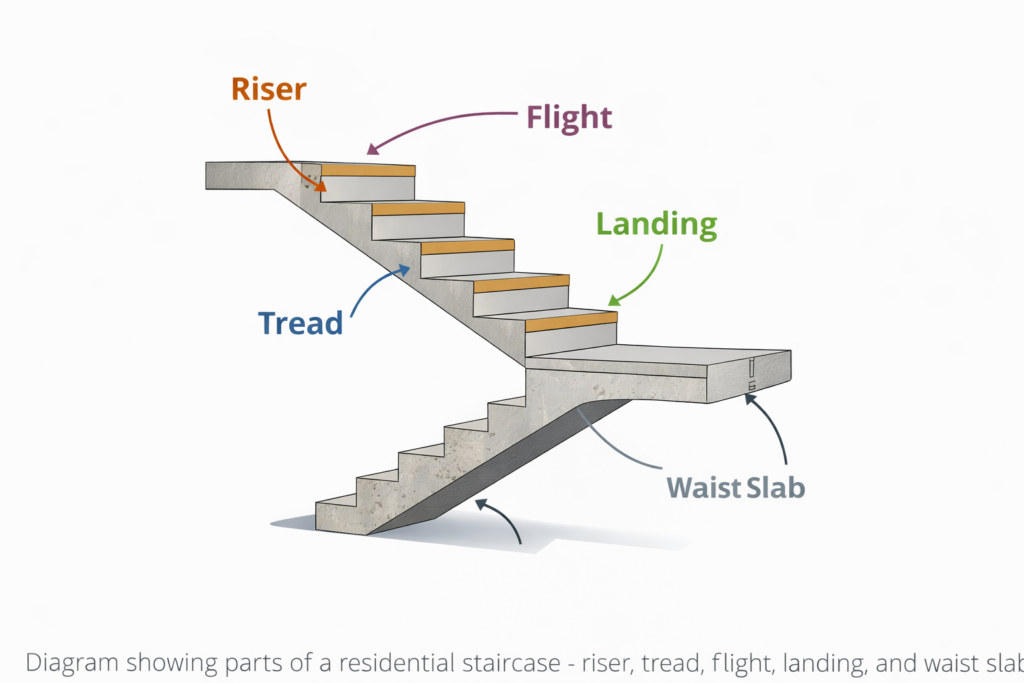
Before performing staircase calculation for house construction, it is important to understand the basic parts of a staircase.
Riser
The vertical portion between two steps is called the riser. It determines the height of each step in staircase calculation for house construction.
Tread
The horizontal portion where a person places their foot is known as the tread.
Flight
A continuous series of steps without interruption is called a flight of stairs.
Landing
A landing is a flat platform provided between 2 flights of stairs.
Waist Slab
The inclined slab supporting the staircase is called the waist slab.
Understanding these parts helps in accurate staircase calculation for house construction.
Standard Staircase Dimensions for Residential Houses
During staircase calculation for house construction, standard dimensions should be followed.
The following table shows the standard staircase dimensions commonly used in residential house construction.
| Staircase Component | Standard Size |
|---|---|
| Riser Height | 150 mm – 175 mm |
| Tread Width | 250 mm – 300 mm |
| Staircase Width | 900 mm – 1200 mm |
| Landing Width | Equal to staircase width |
These dimensions are commonly used in residential house construction.
The standard staircase dimensions used in residential buildings are generally based on recommended construction practices and building standards. According to the National Building Code of India (NBC), proper staircase design is important for safety, accessibility, and comfortable movement between floors.
Staircase Calculation for House Construction (Step by Step)
Let us perform staircase calculation for house construction using a practical example.
Given Data
Floor to floor height = 3 meters
Riser height = 150 mm
Convert the height into millimeters.
3 meters = 3000 mm
Step 1: Calculate Number of Risers
Formula:
Number of Risers = Total Height of Staircase ÷ Height of One Riser
Number of Risers = 3000 / 150
Number of Risers = 20
Therefore, the staircase will have 20 risers.
Step 2: Calculate Number of Steps
The number of steps is always one less than the number of risers.
Steps = Risers – 1
Steps = 20 – 1
Steps = 19 steps
Step 3: Calculate Staircase Length
Assume tread width = 250 mm
Formula:
Total Stair Length = Number of Steps × Tread Width
Total Stair Length = 19 × 250
Total Stair Length = 4750 mm
Convert into meters.
4750 mm = 4.75 meters
Therefore, the staircase length for house construction is 4.75 m.
Step 4: Staircase Width for House Construction
While performing staircase calculation for house construction, staircase width should be selected carefully.
Typical staircase width for residential buildings:
900 mm – 1200 mm
Most houses use 1000 mm staircase width.
Step 5: Concrete Quantity for Staircase
Staircase calculation for house construction also includes estimating concrete quantity.
Assume:
Staircase length = 4.75 m
Staircase width = 1 m
Waist slab thickness = 0.15 m
Formula:
Concrete Volume = Length × Width × Thickness
Concrete Volume = 4.75 × 1 × 0.15
Concrete Volume = 0.7125 m³
Therefore, approximately 0.71 cubic meters of concrete is required for the staircase.
Concrete quantity calculation is an important step in staircase construction. Civil engineers often estimate concrete using standard formulas. If you want to learn detailed concrete calculation methods, you can read our guide on Concrete Calculator Formula – How to Calculate Concrete for Slab, Beam and Footing.
Types of Staircases Used in House Construction
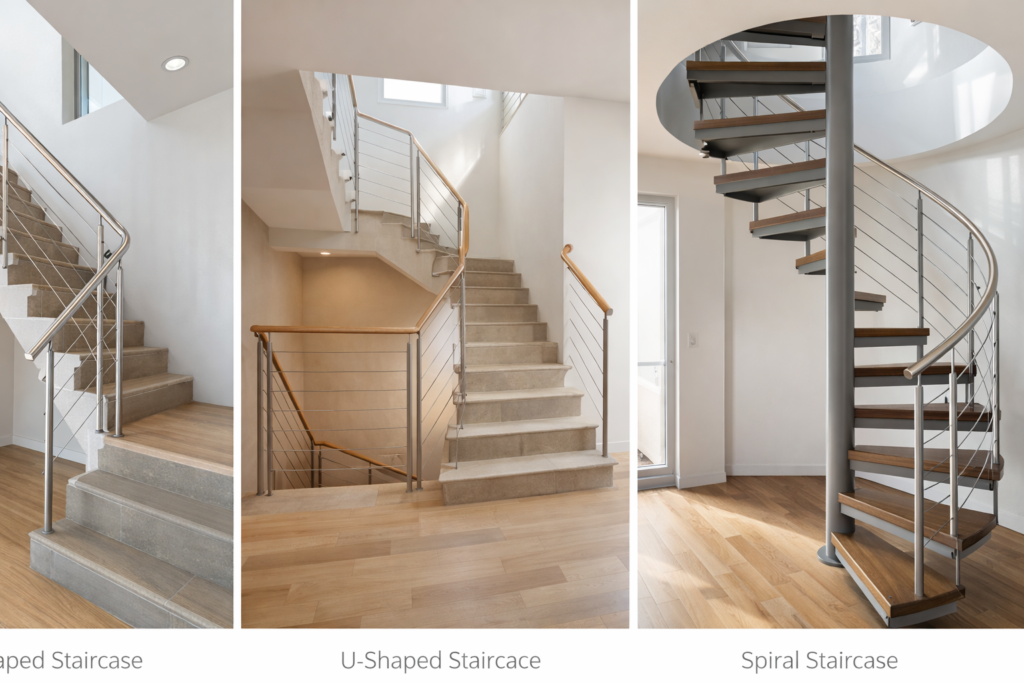
Different types of staircases are used in residential buildings depending on space availability and design requirements.
Straight Staircase
A straight staircase consists of a single continuous flight without any change in direction. It is the simplest staircase design used in small residential houses.
L-Shaped Staircase
An L-shaped staircase changes direction by 90 degrees with a landing between flights. This design is commonly used in modern house construction.
U-Shaped Staircase
A U-shaped staircase turns 180 degrees with two flights running in opposite directions. This design saves space and improves accessibility.
Spiral Staircase
A spiral staircase rotates around a central column. It is mostly used where space is limited.
Staircase Design Rules in House Construction
During staircase calculation for house construction, the following rules should be followed.
Comfortable Step Proportion Rule
The commonly used staircase formula is:
2R + T = 600 mm to 650 mm
Where:
R = Riser height
T = Tread width
This formula ensures comfortable walking on stairs.
Minimum Headroom
Headroom clearance should be at least 2.1 meters to allow safe movement.
Staircase Slope
The ideal staircase slope is between 30° to 40°.
Materials Used in Staircase Construction
Several materials are used in staircase construction depending on design and budget.
RCC Staircase
Reinforced Cement Concrete staircases are the most common type used in residential buildings due to their strength and durability.
Steel Staircase
Steel staircases are often used in commercial buildings and industrial structures.
Wooden Staircase
Wooden staircases are mostly used in interior architectural designs.
Stone Staircase
Granite or marble stone is often used for finishing staircase steps in houses.
Safety Considerations in Staircase Construction
Safety is an important factor in staircase design.
Important safety measures include:
- Provide strong handrails
- Maintain uniform step height
- Avoid slippery flooring materials
- Ensure proper lighting in staircase areas
- Maintain proper staircase width
These measures reduce the risk of accidents.
Common Mistakes in Staircase Construction
During staircase calculation for house construction, several mistakes should be avoided.
Incorrect Riser Height
Too high riser height makes climbing difficult.
Small Tread Width
Small tread width increases the risk of slipping.
Narrow Staircase Width
A narrow staircase restricts movement of people.
Improper Landing
Landing platforms are necessary for long staircases.
Practical Tips for Staircase Construction
Follow these important tips during staircase construction.
- Maintain uniform riser height for all steps
- Provide handrails for safety
- Use anti-slip finishing on steps
- Ensure adequate lighting in staircase area
- Maintain proper headroom clearance
These practices improve staircase safety and usability.
Advantages of Proper Staircase Design in House Construction
Proper staircase design plays an important role in residential building construction. When staircase calculation for house construction is done correctly, it improves safety, comfort, and usability of the building. A well-designed staircase allows people to move easily between floors without discomfort or risk of accidents.
One of the main advantages of proper staircase calculation for house construction is comfortable step height. If the riser height and tread width are calculated correctly, people can climb the stairs easily without feeling tired. Improper staircase dimensions can make climbing difficult, especially for elderly people and children.
Another advantage of correct staircase calculation for house construction is better space utilization. Staircases occupy a significant portion of building space. Proper planning helps use the available space efficiently while maintaining comfortable movement.
Safety is also a major factor in staircase design. When staircase calculation is done correctly, the steps remain uniform in height and width. Uniform steps reduce the chances of tripping or slipping. Proper staircase width also allows safe movement of people and furniture inside the building.
Correct staircase calculation for house construction also helps in estimating construction materials accurately. Civil engineers can determine the required concrete quantity, steel reinforcement, and finishing materials for staircase construction. This helps in proper material planning and cost control during construction.
Another important advantage is structural stability. Staircases are structural components that transfer loads to the building structure. Accurate staircase calculation ensures that the staircase slab and reinforcement are designed properly to support loads safely.
In modern house construction, staircase design also affects the appearance of the building interior. A well-planned staircase can improve the aesthetic appeal of the house. Proper staircase calculation helps maintain balanced proportions and attractive design.
Energy efficiency is another benefit of proper staircase design. Staircases are often placed near ventilation areas or windows. Proper staircase planning allows natural light and airflow inside the house, improving indoor comfort.
Finally, proper staircase calculation for house construction helps civil engineers and architects follow standard building guidelines. Following standard staircase dimensions ensures that the building design meets safety and usability requirements.
Overall, staircase calculation for house construction is an essential step in residential building design. Accurate calculation and proper planning help create safe, comfortable, and durable staircases for houses.
FAQs
What is the standard riser height for staircase in house construction?
The standard riser height used in staircase calculation for house construction is 150 mm to 175 mm.
What is the standard tread width for stairs?
The standard tread width in residential buildings is 250 mm to 300 mm.
How many steps are required for a 3 meter floor height?
For a floor height of 3 meters, staircase calculation usually results in 20 risers and 19 steps.
What is the standard staircase width in residential houses?
The staircase width typically ranges between 900 mm and 1200 mm.
Conclusion
Staircase calculation for house construction is essential for designing safe and comfortable stairs in residential buildings. By calculating riser height, tread width, number of steps, and staircase length correctly, civil engineers can ensure proper staircase design.
Understanding staircase calculation for house construction also helps in estimating concrete quantity and construction materials. By following the step-by-step method explained in this guide, beginners and civil engineering students can easily perform staircase calculations.

Shakeel T is a civil engineering enthusiast and founder of CivilGuide.in. He specializes in construction estimation, quantity surveying, and practical civil engineering calculations. Through CivilGuide, he shares real-world construction knowledge, calculators, and step-by-step guides to help students and site engineers improve their technical skills.