
Introduction
When planning a residential building, finalizing your structural layout schedules is as critical as column or foundation markers. Among these, choosing the correct standard window size for house in India dictates your home’s cross-ventilation efficiency, structural load safety, daytime lighting, and thermal comfort.
As a site engineer, I often see self-builders make the mistake of choosing arbitrary window frames based only on elevation looks. This poor planning leads to dark rooms, high electricity bills, or expensive brickwork modifications on-site later. This comprehensive guide details every recommended standard window size for house in India aligned with the National Building Code (NBC), technical layout rules, and local pricing insights across Indian construction sectors.
NBC 2016 Guidelines for Window Openings and Ventilation
According to the National Building Code (NBC) 2016, the minimum aggregate window opening area for any habitable room in an Indian home must be at least 1/10th of the floor space (which is 10 percent) to guarantee healthy natural light and airflow. However, this configuration varies heavily across regional climatic zones in India:
- Dry and Hot Climates (e.g., Central India, Rajasthan): Aim for a minimum window area of 10 percent of the total floor space. Keeping frame open rates tightly regulated reduces excessive solar heat gain during peak summer months.
- Humid and Coastal Climates (e.g., Andhra Pradesh, Telangana, Tamil Nadu): Increase the aggregate opening area up to 15 percent to 20 percent of the floor space. Continuous convective cooling is required here to lower high humidity levels indoors.
Professional Thumb Rule Calculation Example:
Let us calculate the optimum openings using a standard master bedroom measuring 12 ft x 10 ft, giving a total floor footprint of 120 sq ft.
- Minimum Window Space Required = 120 sq ft x 10% = 12 sq ft
- Recommended Optimum Window Space (Humid Zone) = 120 sq ft x 15% = 18 sq ft
To satisfy this requirement seamlessly on-site, you can install:
- A single wide window unit measuring 5 ft x 4 ft (20 sq ft total opening area).
- Two strategic, opposite-facing window setups measuring 3 ft x 4 ft each (24 sq ft cumulative area).
Room dimensions play an important role in deciding the number and size of windows. Our article on Standard Room Size for House in India explains the common room sizes used in residential house planning.
Room-Wise Standard Window Size for House in India
To streamline masonry layouts and raw material procurement, Indian structural designers follow a strict architectural schedule based on room functions:
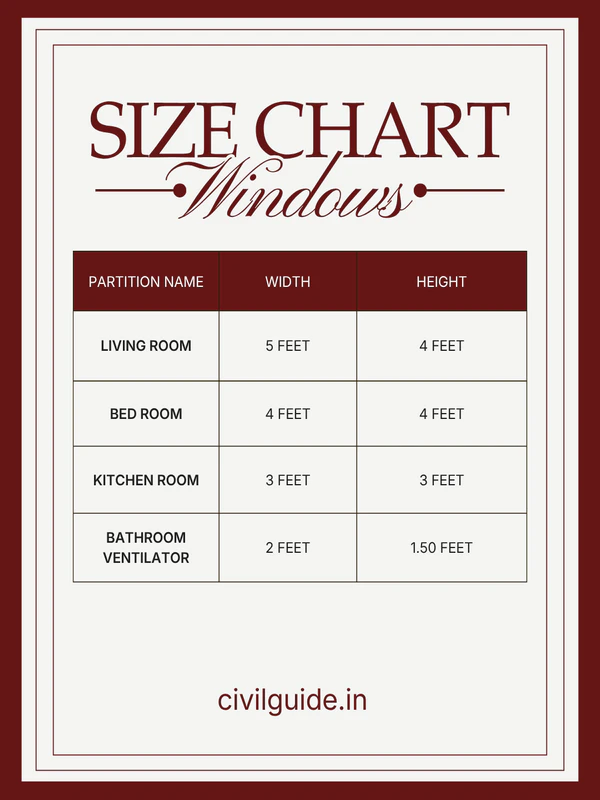
A. Living Room Windows
The living area is the primary social hub. It demands expansive openings to enhance the structural grandeur and brightness of the building elevation.
- Standard Dimension (Width x Height): 5 ft x 4 ft (1500 mm x 1200 mm)
- Large Elevation Dimension: 6 ft x 4 ft (1800 mm x 1200 mm) or 6 ft x 5 ft (1800 mm x 1500 mm)
- Civil Engineer Tip: If your front facade points toward the North or East, consider opting for expansive French windows extending down to the floor line. This placement boosts early morning lumens without trapping high infrared radiation during the hot afternoon hours.
B. Bedroom Windows
Bedroom frame sizes must provide a fine balance between ambient lighting, strict acoustic dampening, and personal privacy.
- Standard Master Bedroom (Width x Height): 4 ft x 4 ft (1200 mm x 1200 mm)
- Guest or Compact Room (Width x Height): 3 ft x 4 ft (900 mm x 1200 mm)
- Placement Rule: For effective draft relief, never position a window squarely behind a bed’s headboard zone. Place it on an adjacent wall opposite the main entry door to keep the air path unblocked.
C. Kitchen Windows
Kitchen structures struggle with continuous grease accumulation, heavy vapor output, and rising temperatures. Effective exhaust dynamics are non-negotiable here.
- Standard Dimension (Width x Height): 3 ft x 3 ft (900 mm x 900 mm) or 4 ft x 3 ft (1200 mm x 900 mm)
- Site Execution Guideline: Ensure the base brick masonry sill stands at least 6 to 8 inches higher than your finished concrete platform top. This spacing prevents grease splatters from clogging window slide channels or muddying the lower tracks.
D. Bathroom and Toilet Ventilators
Bathroom vents prioritize high foul-air removal and privacy retention over lighting concerns.
- Standard Dimension (Width x Height): 2 ft x 1.5 ft (600 mm x 450 mm) or 2 ft x 2 ft (600 mm x 600 mm)
- Structural Elevation: These profiles are mounted high, sitting directly beneath the main ceiling line to release hot water vapors before condensation cycles stain your paintwork.
Door and window planning are closely related in house design. You can read our detailed guide on Standard Door Size for House in India to understand the recommended door dimensions used in residential buildings.
Structural Leveling: Window Sill and Lintel Height Standards
Standardizing the horizontal alignment of window cuts simplifies masonry tasks and balances structural load transfers across the blockwork.
The standard layout measurements include:
- Standard Sill Level: 3 Feet (900 mm) measured from the Finished Floor Level (FFL). This height allows homeowners to place regular furniture like study tables, executive chairs, or side tables against the wall without overlapping the frame openings.
- Standard Lintel Level: 7 Feet (2100 mm) from the FFL. By locking the head profiles of all windows and internal doors to a single horizontal lintel plane, you can cast a single continuous RCC lintel band. This setup reduces structural stress cracks along frame joints.
Window Frame Materials: Pros, Cons and Regional Pricing
The construction material you pick directly alters structural insulation properties and long-term upkeep expenses. Below is an up-to-date cost index reflecting current supplier metrics across tier-1 and tier-2 Indian construction sectors (including Hyderabad, Vijayawada, Bangalore, and Chennai):
A. uPVC (Unplasticized Polyvinyl Chloride)
The current gold standard for urban residential construction projects due to its superior insulation properties.
- Advantages: Exceptional thermal and acoustic dampening, zero moisture bloating, salt-air rustproof, built-in UV stability.
- Disadvantages: Susceptible to slight sagging over decades if internal steel reinforcements are cut corners on by local fabricators.
- Estimated Market Price: 350 to 800 Rupees per sq ft (Depending on premium options like Fenesta or Aparna Venster vs unbranded local vendors).
B. Powder-Coated Aluminum Frames
An excellent material selection for minimalist architectures seeking thin sightlines and wide panoramas.
- Advantages: Superior structural strength-to-weight ratio, slim sash designs, fireproof, budget-friendly.
- Disadvantages: Cheap raw profiles possess poor thermal resistance, allowing outdoor heat to conduct directly into air-conditioned rooms.
- Estimated Market Price: 280 to 550 Rupees per sq ft (Directly linked to structural extrusion gauge thickness, such as 1.2 mm profiles up to heavy-duty 2.0 mm commercial systems).
C. Traditional Teak Wood
Preferred for classical Indian architectural aesthetics and high-heritage elevations.
- Advantages: High aesthetic value, sturdy screw-holding capacity, and natural insulating warmth.
- Disadvantages: Extremely expensive initial outlay, vulnerable to seasonal moisture swelling, and requires periodic anti-termite clear varnishing.
- Estimated Market Price: 1,200 to 3,500 Rupees per sq ft (Subject to wood grading, sourcing, and local carpentry labor charges).
Comprehensive Matrix for Standard Window Size for House in India
Selecting the ideal window schedule requires matching structural properties with regional requirements:
- uPVC Systems: Excellent acoustic dampening (Up to 30-40 dB reduction), 100 percent rust and rot proof, superior insulation efficiency, 25 plus years lifespan, low maintenance.
- Premium Aluminum: Moderate acoustic dampening, rustproof if powder-coated, high thermal conduction, 20 plus years lifespan, low maintenance.
- Traditional Teak Wood: Fair acoustic dampening, vulnerable to rot and fungal stains, natural thermal insulator, 50 plus years lifespan, high maintenance (Requires periodic sealing and varnish).
Engineering Selection Guide: Glazing and Glass Choices
A window opening is only as secure as the glass panel fixed within its sashes. Do not rely on generic glass; use these tailored specifications:
- Float Glass (Standard Clear): Budget-friendly but shatters into sharp shards upon structural impact. Limit its use to small upper ventilators.
- Toughened Glass (Tempered): 4 to 5 times stronger than normal variants. If hit, it breaks into blunt, harmless pebbles. Highly recommended for wider living room sliders or floor-level glass sheets.
- Tinted or Reflective Glass: Coated with special metal oxides to block incoming solar radiation. Essential for west-facing facades to minimize air-conditioning power bills during harsh summers.
Practical Site Execution Checklist (Preventive Quality Measures)
To bypass structural repair costs after the plastering crews finish, hand this execution checklist to your structural contractor:
- Verify Sill Concrete Bands: Never place window bricks directly onto hollow blocks. Always cast a 3-inch thick concrete sill pad reinforced with two 8 mm steel bars along the masonry base. This band safely absorbs structural shear stresses and prevents diagonal settlement cracks from spreading below frame corners.
- Incorporate Weather Chajjas (Sunshades): Ensure all external-facing windows feature an RCC chajja projection extending out at least 1.5 to 2 feet. This overhang keeps monsoon rainwater from pooling on sashes or leaking past frame sealants.
- Insist on 3-Track Profiles: When purchasing sliding aluminum or uPVC units, choose a 3-track system over a standard 2-track build. The extra third line holds a stainless steel mosquito mesh screen, allowing safe night ventilation without letting insects in.
- Polyurethane Foam Application: Reject simple cement mortar packing around installed frames. Ensure the installation technicians seal perimeter gaps using heavy-duty Polyurethane (PU) expansion foam. This step delivers permanent watertight joints and dampens exterior street noise.
Frequently Asked Questions (FAQ)
Q1. What is the ideal cost-effective standard window size for house in India?
For standard budget residences, a dimension of 4 ft x 4 ft (1200 mm x 1200 mm) is the most economical framework choice. It matches readily available factory-made glass panels and pre-cut track sizes, lowering custom sizing overheads.
Q2. How can I protect large glass sliding windows from security break-ins?
Always anchor an independent, heavy-gauge Mild Steel (MS) safety grill into your structural brick openings before starting final plastering. For modern window designs lacking grill spaces, use high-security laminated shatterproof glass integrated with internal multi-point locking locks.
Q3. Is Vaastu compliance affected by choosing a specific standard window size for house in India?
Vaastu focus relies on symmetrical layout placements rather than exact frame sizes. Ensure your North and East walls have a higher total window count and larger dimensions compared to your South and West structures to invite positive morning energies.
The Bureau of Indian Standards provides official building codes and guidelines used in construction projects across India.
Conclusion
Adhering to standard window size practices ensures smoother interior work, cuts down fabrication waste, and avoids expensive design mistakes on-site. For any standard 1000 sq ft residential layout in India, combining local building code logic with the right frame materials secures an energy-efficient, well-ventilated, and asset-appreciating home

Shakeel T is a qualified Civil Engineer and Structural Consultant with extensive on-site experience in residential and commercial building construction. Specializing in material estimation, cost budgeting, and structural safety guidelines, he has successfully managed multiple real estate projects from foundation to finishing. Through this blog, Shakeel shares field-tested civil engineering thumb rules, IS Code practices, and practical site tips to help home builders execute their projects efficiently and within budget.
Education: Diploma in Civil Engineering
Expertise: Quantity Surveying, Material Estimation, Structural Design, and Site Management.
Pingback: 3 BHK Flat for Sale in Guwahati: Vastu & Natural Light Guide