
Introduction
When designing or constructing a residential house in India, the dimensions of your doors play a critical role in structural planning, daily ergonomics, and aesthetic appeal. Choosing the wrong door size can lead to severe site-level errors, such as furniture not fitting through frames, structural load-bearing mistakes, and expensive post-construction alterations.
For civil engineers, architects, and homeowners, understanding the standard door size for house in India according to the National Building Code (NBC) is fundamental. This comprehensive guide details standard dimensions for every room type, structural opening calculations, rough cost and material estimation formulas, and real-world engineering site checklists.
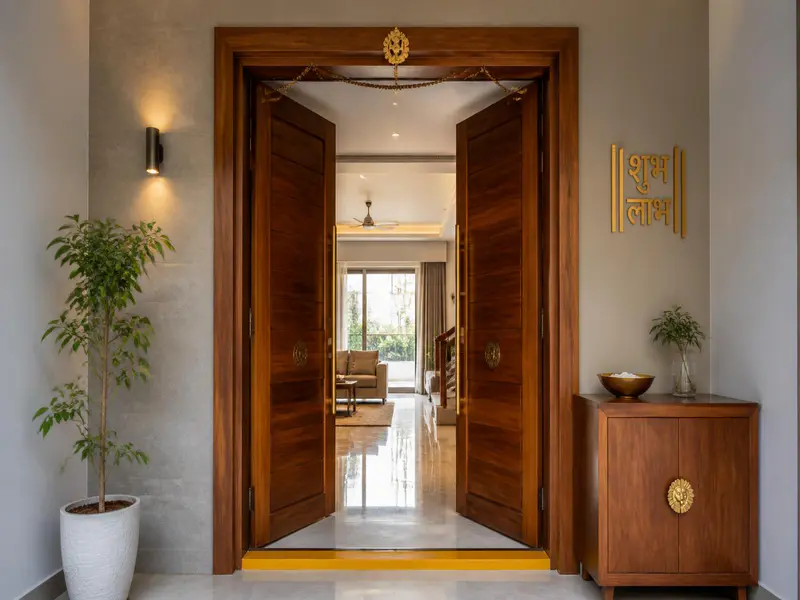
Why Standard Door Sizes Matter in Indian Construction
In India, residential layouts must strike a perfect balance between spatial functionality and traditional architectural guidelines like Vastu Shastra. Standardizing door sizes across a project offers several key benefits:
1. Cost Efficiency & Ready Availability
Ready-made wooden, flush, or PVC doors are manufactured in fixed factory dimensions. Opting for standard sizes allows you to buy off-the-shelf products, which are significantly cheaper and faster to procure than custom-fabricated doors.
2. Smooth Movement of Logistics
Main entrances must be wide enough to easily accommodate heavy appliances, sofas, wardrobes, and beds. Bedrooms and bathrooms require specific clearance spaces to ensure comfortable daily movement without wasting carpet area.
3. Structural Integrity & Lintel Alignment
In brick or block masonry, a concrete lintel beam is cast directly above the door opening to distribute the upper wall load to the side jambs. Standardization ensures that all lintel heights line up perfectly across a floor level, which simplifies formwork and maintains visual uniformity.
Room dimensions play an important role in house planning. You can read our detailed guide on Standard Room Size for House in India to understand the recommended room sizes used in residential buildings.
Standard Door Sizes for Different Rooms in India
Different areas of an Indian home require distinct door sizes based on their operational utility. The table below lists the standard sizes in metric units (millimeters/meters) and imperial units (feet/inches) for standard residential construction.
| Door Location / Type | Width x Height (mm) | Width x Height (Feet/Inches) | Primary Practical Purpose |
|---|---|---|---|
| Main Entrance / Front Door | 1000 x 2100 mm | 3’3″ x 7’0″ Feet | Shifting heavy furniture; grand entry appearance. |
| Luxury / Double Main Door | 1200 x 2100 mm | 4’0″ x 7’0″ Feet | High-end residential bungalows and villas. |
| Internal Bedrooms | 900 x 2100 mm | 3’0″ x 7’0″ Feet | Standard clearance for beds and standard wardrobes. |
| Kitchen / Balcony | 900 x 2100 mm | 3’0″ x 7’0″ Feet | Accommodating large refrigerators and appliances. |
| Bathrooms & Toilets (WC) | 750 x 2100 mm | 2’6″ x 7’0″ Feet | Space-saving design; usually water-resistant PVC/WPC. |
| Pooja Room / Store Room | 750 x 2100 mm | 2’6″ x 7’0″ Feet | Traditional single or double-shutter layout configurations. |
Note: In modern Indian apartments and contemporary designs, the standard height for luxury doors is frequently elevated to 2400 mm (8 Feet) to create a grand sense of volume and space.
Structural Anatomy: Masonry Opening vs. Frame Size vs. Shutter Size
A common point of confusion on construction sites is the difference between the open gap in the brick wall and the actual size of the wooden door flap. Let us clarify these three distinct structural dimensions:
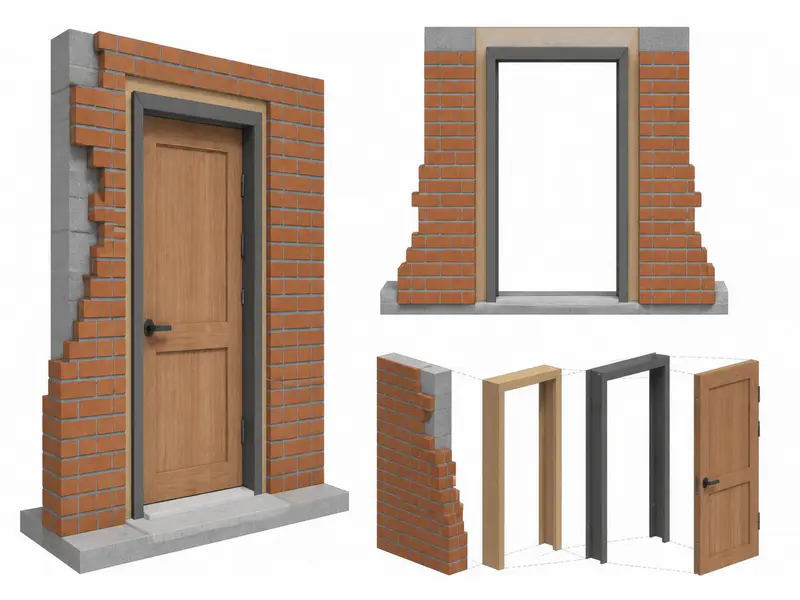
- Masonry Rough Opening: The raw, un-plastered opening left in the brick wall by the mason.
- Door Frame (Chowkhat) Size: The outer dimensions of the wooden, granite, or steel frame secured inside the rough opening. Standard frame thickness in India is usually 75 mm x 100 mm (3″ x 4″) or 65 mm x 125 mm (2.5″ x 5″).
- Door Shutter Size: The actual moving door panel that hinges onto the frame.
Foundation depth is an important factor for structural safety. Our article on Minimum Depth of Foundation for Residential Building explains how engineers determine the correct foundation depth.
Core Technical Formulas for Door Planning & Estimations
To calculate material volumes, wood requirements, and rough opening gaps on-site, engineers use standard geometric formulas.
1. Rough Opening Dimension Formula
- Rough Opening Width = Shutter Width + (2 x Frame Section Thickness) + 10 mm (Clearance Gap)
- Rough Opening Height = Shutter Height + (1 x Frame Section Thickness) + 10 mm (Clearance Gap)
2. Volume of Wood Required for a Door Frame (Chowkhat)
- Total Frame Length = (2 x Frame Height) + (1 x Frame Width)
- Volume of Wood = Total Frame Length x Frame Section Width x Frame Section Thickness
3. Surface Area of Door Shutter (For Painting, Polishing, or Ordering Flush Doors)
- Surface Area = Shutter Width x Shutter Height
Practical Step-by-Step Engineering Calculation Examples
Let us look at two real-world examples with concrete numbers to see how these formulas are applied on an active Indian construction site.
Example 1: Determining the Masonry Rough Opening for a Bedroom Door
An architect specifies a standard bedroom shutter size of 900 mm Width by 2100 mm Height. The wooden frame profile selected is 75 mm thick by 100 mm wide. What exact gap should the brick mason leave in the wall?
Step 1: Identify the variables
- Shutter Width = 900 mm (0.90 meters)
- Shutter Height = 2100 mm (2.10 meters)
- Frame Thickness = 75 mm (0.075 meters)
- Site Clearance Margin = 10 mm (0.010 meters)
Step 2: Calculate the Required Rough Opening Width
- Rough Opening Width = Shutter Width + (2 x Frame Thickness) + Clearance
- Rough Opening Width = 900 mm + (2 x 75 mm) + 10 mm
- Rough Opening Width = 900 mm + 150 mm + 10 mm
- Rough Opening Width = 1060 mm (1.06 meters or 3.47 Feet)
Step 3: Calculate the Required Rough Opening Height
- Rough Opening Height = Shutter Height + (1 x Frame Thickness) + Clearance
- Rough Opening Height = 2100 mm + 75 mm + 10 mm
- Rough Opening Height = 2185 mm (2.185 meters or 7.16 Feet)
Site Directive: The mason must leave a rough masonry opening of 1060 mm x 2185 mm to accommodate the 900 mm x 2100 mm door comfortably.
Example 2: Material Costing & Wood Volume for a Main Entrance Frame
Calculate the total volume of teak wood needed to fabricate a premium main door frame with a width of 1000 mm and a height of 2100 mm. The frame cross-section is 75 mm x 125 mm.
Step 1: Calculate the Total Running Length of the Frame
- Total Length = Left Vertical Post + Right Vertical Post + Top Horizontal Header
- Total Length = 2100 mm + 2100 mm + 1000 mm
- Total Length = 5200 mm = 5.2 meters
Step 2: Convert Cross-Section Dimensions to Meters
- Section Thickness = 75 mm = 0.075 meters
- Section Width = 125 mm = 0.125 meters
Step 3: Calculate the Total Wet Volume of Wood
- Volume = Total Length x Thickness x Width
- Volume = 5.2 meters x 0.075 meters x 0.125 meters
- Volume = 0.04875 Cubic Meters (m3)
Unit Conversions Matrix for Timber Procurement
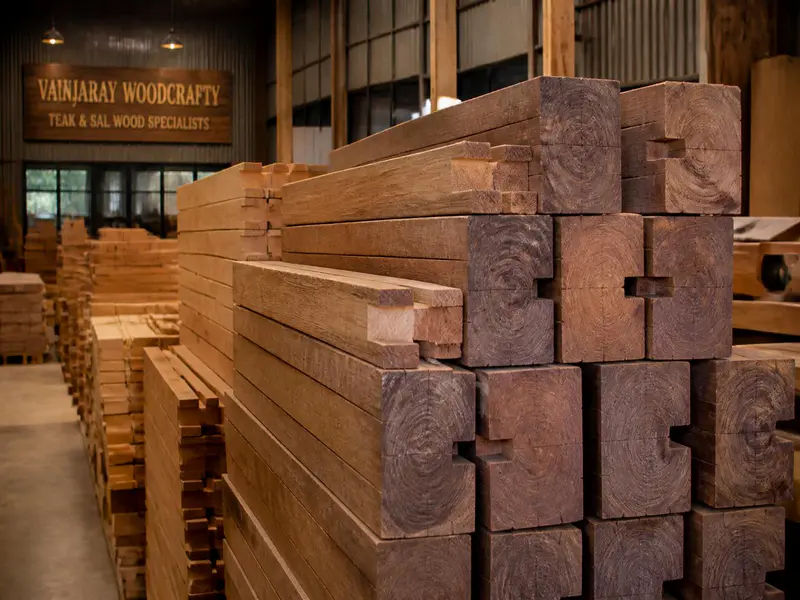
In Indian commercial timber markets (such as those selling Teak, Sal, or Meranti wood), suppliers do not trade in cubic meters. They quote prices in cubic feet (CFT). Use this conversion matrix to ensure you are billed correctly.
| From Unit | To Unit | Multiplication Factor | Commercial Application |
|---|---|---|---|
| Cubic Meter (m3) | Cubic Feet (CFT) | 35.3147 | Buying raw timber logs or cut frame sections. |
| Millimeters (mm) | Inches (“) | 0.03937 | Converting factory metrics to local market sizes. |
| Square Meters (m2) | Square Feet (Sq. Ft.) | 10.7639 | Calculating plywood, laminate, and polish billing. |
| Running Meters (RMT) | Running Feet (RFT) | 3.2808 | Labor calculation for frame carvings or beadings. |
Practical Market Conversion (From Example 2)
Convert the calculated teak wood volume (0.04875 m3) into CFT to get a supplier quotation:
- Volume in CFT = 0.04875 x 35.3147 = 1.721 Cubic Feet (CFT)
- If Teak wood costs Rs. 3,500 per CFT, the raw material cost for this single frame is: 1.721 x 3500 = Rs. 6,023.50.
On-Site Quality Control Checklists & Material Wastage Management
Improper installation can cause doors to sag, scratch the floor, or fail to latch properly. Follow these strict engineering protocols during the execution stage.
Professional Quality Assurance Protocol
1. Plumb Line and Right-Angle Check
Before securing the door frames (chowkhats) with holdfast anchors, check them with a heavy plumb bob or digital spirit level. The vertical frame posts must be completely straight. Check the top corners using a try-square (Milaan) to confirm a perfect 90-degree angle.

2. Clear Floor Space Allowance
Always check the ultimate thickness of your chosen flooring material (granite, vitrified tiles, or marble) along with its mortar bed. Leave a minimum clearance gap of 8 mm to 10 mm between the bottom edge of the door shutter and the finished floor level to prevent the door from scraping the floor.
3. Water Absorption Prevention
Apply a protective coat of anti-termite solution and oil-based primer to any hidden faces of wooden frames that will touch the raw brickwork before fixing them in place. Unprotected wood absorbs moisture from the masonry plaster, leading to warping and fungal decay.
4. Holdfast Anchoring Control
Every door frame must be mechanically anchored into the adjacent wall using iron holdfast bars or heavy-duty anchor fasteners. Use at least 3 holdfast points on each side for a standard 7-foot door. Space them at heights of 300 mm, 1050 mm, and 1800 mm from the floor level.
Material Wastage Factors Matrix
Account for these operational wastage margins when preparing your project’s Bill of Quantities (BOQ):
- Raw Timber for Frames: Add 15% to 20% wastage for cutting, planning, and removing knots.
- Flush Shutters: Add 2% allowance for minor site-level edge trimming.
- Laminates & Veneers: Add 10% wastage due to grain matching and corner trimming losses.
- Hardware Fasteners: Add 3% to 5% buffer for lost or damaged screws and hinges on-site.
Engineering Toolbox provides useful engineering data, formulas, and technical resources related to construction and building design.
Frequently Asked Questions (FAQs)
1. What is the standard door size for a house in India according to the National Building Code (NBC)?
The National Building Code of India specifies that the minimum width for a habitable room door should be 900 mm (3 feet) and the minimum height should be 2000 mm (6 feet 6 inches). For bathrooms and water closets, the minimum allowable width is 750 mm (2 feet 6 inches).
2. What is the standard thickness of an Indian residential door shutter?
The standard thickness for interior bedroom flush doors ranges between 30 mm and 35 mm. Main entrance doors, which are typically made of solid wood or heavy decorative paneling, are usually thicker, ranging from 38 mm to 45 mm to provide better security and structural strength.
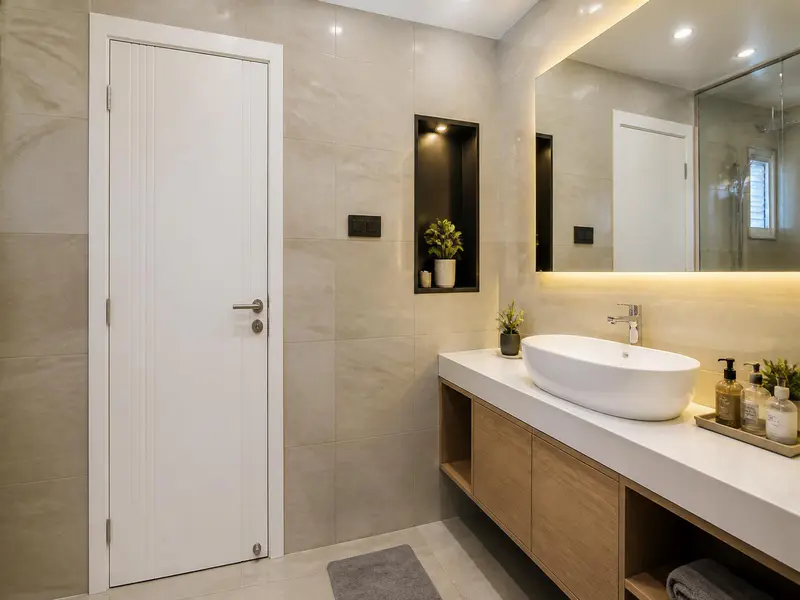
3. Which material is best for bathroom doors to prevent moisture damage?
Avoid using traditional solid wood or cheap commercial flush doors for bathrooms, as they warp quickly when exposed to humidity. WPC (Wood Plastic Composite), PVC (Polyvinyl Chloride), or aluminum frame glass doors are highly recommended because they are 100% waterproof and termite-resistant.
4. How much space should be left between a door frame and the masonry wall?
A uniform gap of 10 mm to 15 mm should be maintained between the outer edge of the frame and the raw masonry surface. This gap allows you to plumb the frame accurately and is later filled completely with non-shrink cement grout or polyurethane expandable foam to ensure a tight seal.
5. Why are main doors designed wider than bedroom doors?
Main doors serve as the primary entry point for everything brought into a home. They require a wider clearance (minimum 1000 mm) to move bulky items like double mattresses, refrigerators, washing machines, and large furniture sets without scratching the walls or damaging the door frame.
Conclusion
Selecting the proper standard door size for a house in India is a fundamental step that ensures your home is functional, cost-effective, and comfortable to live in. Keeping your bedroom doors at 900 mm x 2100 mm and main entryways at a minimum of 1000 mm x 2100 mm creates an optimized flow throughout your home while keeping material costs manageable.
Always cross-verify your masonry rough openings with your intended frame thicknesses before starting brickwork, leave an appropriate gap for flooring materials, and follow a strict on-site checklist to ensure your installations last for decades.

Shakeel T is a qualified Civil Engineer and Structural Consultant with extensive on-site experience in residential and commercial building construction. Specializing in material estimation, cost budgeting, and structural safety guidelines, he has successfully managed multiple real estate projects from foundation to finishing. Through this blog, Shakeel shares field-tested civil engineering thumb rules, IS Code practices, and practical site tips to help home builders execute their projects efficiently and within budget.
Education: Diploma in Civil Engineering
Expertise: Quantity Surveying, Material Estimation, Structural Design, and Site Management.