
Introduction
An improperly designed staircase is more than just an eyesore; it is a permanent daily inconvenience and a severe safety hazard. In residential house construction, staircases are highly complex structural elements that bridge two vertical planes. If the steps are too steep, family members will tire quickly. If the steps are too shallow or uneven, people will trip and fall.
Mastering the precise staircase calculation for house construction is essential for civil engineers, site supervisors, contractors, and independent home builders. Accurate mathematical layout planning ensures maximum walking comfort, regulatory code compliance, and optimal space utilization. Furthermore, calculating the precise quantity of concrete, cement, sand, and aggregate prevents material wastage and keeps project budgets on track.
This ultimate civil engineering guide will take you through standard architectural rules, fundamental dimensions, step-by-step mathematical calculations, real-world examples, and vital on-site quality control checklists.
Technical Terminology Every Builder Must Know
Before picking up a measuring tape or launching a structural design tool, you must understand the industry-standard vocabulary associated with staircase design.
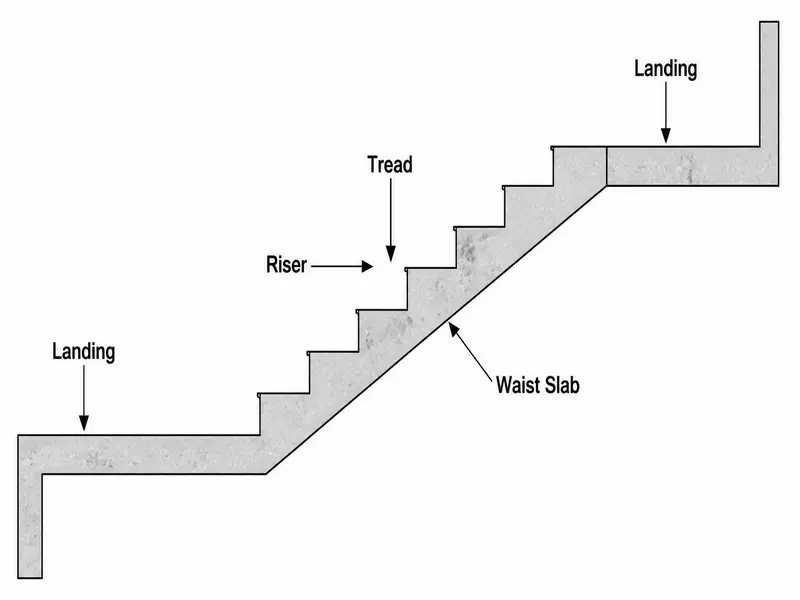
- Tread: The flat, horizontal top surface of a step where a person places their foot while climbing up or down.
- Riser: The vertical face or height between two consecutive horizontal treads.
- Nosing: The small edge or projection of the tread that extends past the riser below it, designed to offer extra foot space.
- Flight: A continuous, unbroken series of steps or risers stretching between floors or landings.
- Landing: The flat structural platform designed between two flights of stairs, allowing users to safely rest, turn, or change direction.
- Going: The actual horizontal distance measured from the face of one riser to the face of the next riser (excluding the nosing).
- Pitch or Slope: The angle of inclination of the staircase relative to the horizontal floor plane.
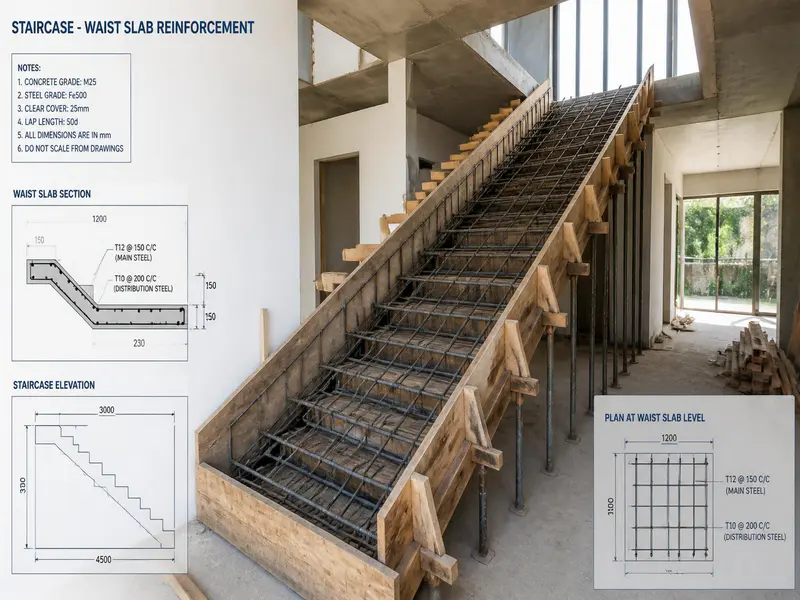
- Waist Slab: The inclined structural reinforced concrete slab that supports the weight of the brick or concrete steps above it.
- Headroom: The clear vertical distance measured from the top edge of a tread to the ceiling or structural beam directly overhead.
Concrete quantity calculation is an important step in staircase construction. Civil engineers often estimate concrete using standard formulas. If you want to learn detailed concrete calculation methods, you can read our guide on Concrete Calculator Formula – How to Calculate Concrete for Slab, Beam and Footing.
Standard Architectural Rules and Dimensions
For standard residential house construction, building codes and structural thumb rules mandate specific dimensional bounds to guarantee maximum safety and ergonomic comfort.
| Staircase Component | Recommended Standard Range (Metric) | Recommended Standard Range (Imperial) |
|---|---|---|
| Riser Height | 150 mm to 180 mm | 6 inches to 7 inches |
| Tread Width | 250 mm to 300 mm | 10 inches to 12 inches |
| Staircase Width (Flight) | 900 mm to 1200 mm | 3 feet to 4 feet |
| Landing Width | Equal to or greater than flight width | Equal to or greater than flight width |
| Pitch / Slope Angle | 25 degrees to 40 degrees | 25 degrees to 40 degrees |
| Minimum Headroom | 2100 mm | 7 feet |

The Golden Ergonomic Rule
To verify if your selected tread and riser dimensions will feel natural and comfortable to a human user, always apply Blondel’s classic staircase comfort formula:
- Comfort Rule = (2 x Riser Height) + Tread Width
For an ideal, ergonomically perfect residential staircase, this calculated value should fall strictly between 600 mm and 640 mm (or 24 inches to 25 inches).
Core Mathematical Formulas for Layout and Materials
To execute a flawless physical layout on a job site, engineers rely on clear, plain-text geometric equations. The formulas below cover structural dimensions, concrete volumes, and weight distributions.
1. Structural Dimensions Formulas
- Total Number of Risers = Total Height of Floor / Height of One Riser
- Total Number of Treads = Total Number of Risers – 1
- Total Horizontal Run Length = Total Number of Treads x Width of One Tread
- Length of Incline Waist Slab = Square Root of ((Total Horizontal Run x Total Horizontal Run) + (Total Vertical Height x Total Vertical Height))
2. Concrete Volume Estimation Formulas
- Volume of Inclined Waist Slab = Length of Waist Slab x Width of Staircase x Thickness of Waist Slab
- Volume of One Triangular Step = 0.5 x Tread Width x Riser Height x Width of Staircase
- Total Steps Concrete Volume = Volume of One Triangular Step x Total Number of Treads
- Volume of Landing Slab = Length of Landing x Width of Landing x Thickness of Landing
- Total Wet Concrete Volume = Volume of Inclined Waist Slab + Total Steps Concrete Volume + Volume of Landing Slab
- Dry Concrete Volume = Total Wet Concrete Volume x 1.54
Staircase construction is an important stage in residential buildings. During the building construction process, staircases are usually constructed after the main structural framework such as columns, beams, and slabs are completed. You can learn more about the complete construction stages in our guide on Building Construction Process Step by Step – Complete Guide for Beginners.
Step-by-Step Practical Calculation Example
Let’s look at a realistic residential scenario to calculate the layout dimensions and the required raw building materials for a dog-legged staircase.
Project Parameters:
- Total Floor-to-Floor Height: 3.3 Metres (3300 mm)
- Staircase Configuration: Dog-Legged (Two flights with an intermediate landing)
- Staircase Width (Flight Width): 1.0 Metre
- Thickness of Waist Slab: 150 mm (0.15 Metres)
- Concrete Mix Design: M20 Grade (Mix Ratio = 1 : 1.5 : 3)
Part A: Calculating Layout Dimensions
Step 1: Establish Riser and Tread Target Dimensions
For a comfortable residential build, we will choose a standard riser height of 150 mm and a tread width of 250 mm.
Let’s verify this using our Golden Ergonomic Comfort Rule:
- Comfort Value = (2 x 150 mm) + 250 mm = 300 mm + 250 mm = 550 mm.
- Optimization Note: Because 550 mm falls slightly below our ideal 600 mm comfort index, we will adjust our tread width to 300 mm to ensure a natural walking rhythm.
- Revised Comfort Value = (2 x 150 mm) + 300 mm = 300 mm + 300 mm = 600 mm (Perfect Ergonomic Fit).
Step 2: Calculate the Total Number of Risers
- Total Number of Risers = Total Floor Height / Height of One Riser
- Total Number of Risers = 3300 mm / 150 mm = 22 Risers.
Since this is a dog-legged staircase with two equal flights:
- Risers per Flight = 22 / 2 = 11 Risers per flight.
Step 3: Calculate the Total Number of Treads
In any single flight of stairs, the final tread merges directly into the landing floor. Therefore, the number of treads is always one less than the number of risers.
- Treads per Flight = 11 Risers – 1 = 10 Treads per flight.
- Total Treads for both flights = 10 x 2 = 20 Treads.
Step 4: Calculate the Total Horizontal Run Length per Flight
- Total Horizontal Run = Number of Treads per Flight x Width of One Tread
- Total Horizontal Run = 10 x 300 mm = 3000 mm = 3.0 Metres.
Step 5: Calculate the Length of the Inclined Waist Slab
To find the precise slope length of the waist slab for one flight, we apply the Pythagorean theorem using the flight’s horizontal run (3.0m) and its vertical rise height.
- Vertical Height per Flight = 11 Risers x 150 mm = 1650 mm = 1.65 Metres.
- Slab Length Squared = (3.0 x 3.0) + (1.65 x 1.65)
- Slab Length Squared = 9.0 + 2.7225 = 11.7225
- Length of Inclined Waist Slab = Square Root of 11.7225 = 3.42 Metres.
Part B: Calculating Concrete Material Quantities
Now we will find the total volume of M20 concrete needed to cast this staircase structure (assuming both flights are identical and adding an intermediate landing slab).
Step 1: Volume of Two Inclined Waist Slabs
- Volume of One Waist Slab = Length (3.42m) x Width (1.0m) x Thickness (0.15m) = 0.513 Cubic Metres.
- Volume of Both Waist Slabs = 0.513 x 2 = 1.026 Cubic Metres.
Step 2: Volume of the Triangular Steps
- Concrete Volume of One Step = 0.5 x Tread (0.3m) x Riser (0.15m) x Width (1.0m) = 0.0225 Cubic Metres.
- Total Volume for 20 Steps = 0.0225 x 20 = 0.450 Cubic Metres.
Step 3: Volume of the Mid-Landing Slab
Assume the intermediate resting landing spans across both flights with a total width of 2.0 metres and a deep resting length of 1.0 metre.
- Volume of Landing Slab = Length (1.0m) x Width (2.0m) x Thickness (0.15m) = 0.300 Cubic Metres.
Step 4: Total Wet Concrete Volume
- Total Wet Volume = 1.026 (Slabs) + 0.450 (Steps) + 0.300 (Landing) = 1.776 Cubic Metres.
Step 5: Convert to Dry Concrete Volume
When dry ingredients (cement, sand, aggregate) are mixed with water, the volume shrinks by approximately 54%. To compensate, we multiply our structural wet volume by a standard dry factor of 1.54.
- Dry Volume Needed = 1.776 x 1.54 = 2.735 Cubic Metres.
Step 6: Individual Materials Breakdown (M20 Grade Mix 1:1.5:3)
The sum of the M20 proportions is 1 + 1.5 + 3 = 5.5 parts.
- Cement Quantity Calculation:
- Cement Volume = (1 / 5.5) x 2.735 = 0.497 Cubic Metres.
- Since 1 cubic metre of cement weighs 1440 kg: 0.497 x 1440 = 715.68 kg.
- Number of standard 50 kg bags = 715.68 / 50 = 14.3 Bags of Cement.
- Sand (Fine Aggregate) Calculation:
- Sand Volume = (1.5 / 5.5) x 2.735 = 0.746 Cubic Metres.
- Converting to Cubic Feet (CFT): 0.746 x 35.314 = 26.34 CFT of Sand.
- Coarse Aggregate (20mm Crushed Stone) Calculation:
- Aggregate Volume = (3 / 5.5) x 2.735 = 1.492 Cubic Metres.
- Converting to Cubic Feet (CFT): 1.492 x 35.314 = 52.68 CFT of Coarse Aggregate.
Vital Material Unit Conversion Rules
On real-world residential construction sites, materials are often ordered using regional trade metrics rather than pure metric units. Use this quick-reference table to seamlessly convert your structural material estimates.
| From (Metric) | To (Site/Trade Units) | Exact Multiplication Factor |
|---|---|---|
| Cubic Metres (cum) | Cubic Feet (CFT) | Multiply by 35.314 |
| Cubic Metres (cum) | Brass (Trade Unit) | Divide by 2.831 |
| Cubic Feet (CFT) | Brass (Trade Unit) | Divide by 100 |
| Cement Volume (cum) | Metric Tons (MT) | Multiply by 1.440 |
| Kilograms (kg) | Metric Tons (MT) | Divide by 1000 |
On-Site Quality Control, Common Pitfalls, & Wastage Factors
Even a flawless mathematical design will fail if it is poorly executed on the construction floor. Below are the critical quality control checkpoints that every site specialist must enforce.
1. Concrete Wastage Allowances
Always add a 5% to 8% wastage factor to your final material orders. Minor spills during transport, uneven structural masonry walls, shuttering boundary deformations, and residue left inside concrete mixer drums will naturally consume extra material.
2. Formwork Shuttering and Rigidity Check
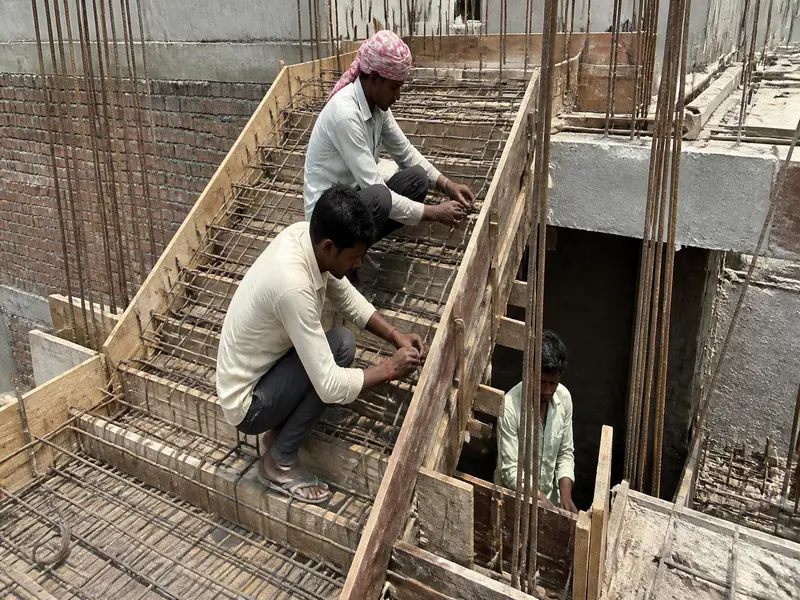
The wooden or steel shuttering underneath the waist slab must be thoroughly propped up with adjustable steel jacks or sturdy wooden posts. Concrete is incredibly heavy when wet. If the formwork lacks structural rigidity, it will sag under the weight, causing the stairs to warp and permanently weakening the bottom tension profile of the slab.
3. Clear Concrete Cover Maintenance
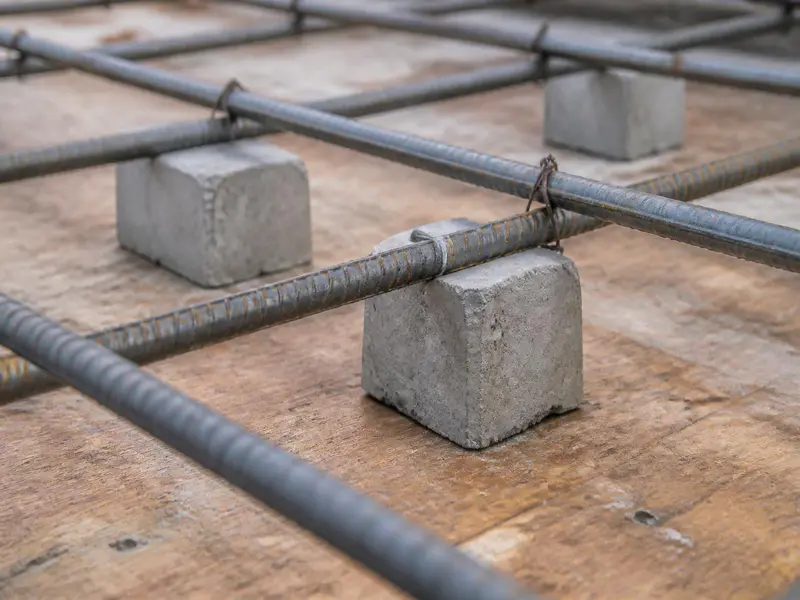
Ensure that a clear concrete cover of exactly 20mm to 25mm is consistently maintained beneath the steel reinforcement mesh inside the waist slab. Use plastic or concrete spacer blocks to keep the steel bars from resting directly against the shuttering sheets. Skipping this step exposes the internal steel to moisture, causing rust and concrete spalling.
4. Reinforcement Detailing at the Joints
The steel bars of the inclined waist slab must anchor deeply into the main floor beams and landing beams. The structural tension steel must extend past the joint boundary into the adjacent support by a calculated development length (typically 50 times the diameter of the bar).
❌ WRONG ANCHORAGE           |   ✅ CORRECT ANCHORAGE

   [Landing Beam]            |      [Landing Beam]
     +---------+             |        +---------+

     |         |             |        |  O O O  |
====/          |             |  ======/--+      |  <-- Bars Extend
Waist/  No     |             |  Waist/   |      |      Deeply With
Slab /  Anchor |             |  Slab /   +------+      Hooked Ends
    /          |             |      /                  For Safety
5. Step Shuttering Verification
Never allow contractors to cast the steps without vertical board shuttering for each individual riser. Some unskilled workers try to shape steps using a thick, semi-dry concrete mix without vertical form boards. This bad practice results in uneven step dimensions and weak, porous concrete.
Frequently Asked Questions (FAQs)
What is the most comfortable riser height for residential homes?
For standard residential house construction, a riser height of 150 mm (6 inches) combined with a tread width of 300 mm (12 inches) is considered the industry gold standard for comfort. It accommodates children, adults, and elderly family members with minimal leg strain.
What happens if my staircase slope angle exceeds 40 degrees?
If your staircase pitch exceeds 40 degrees, the stairs become dangerously steep. It effectively turns into a ladder, making descending unsafe and physically exhausting to climb. If you have limited floor space, consider a spiral layout or an L-shaped staircase with a mid-landing instead of steepening the steps.
Why is the number of treads always one less than the number of risers?
The final step at the top of a flight does not need an individual tread because it sits level with the landing platform or the upper floor slab. The floor slab itself acts as the final horizontal walking tread surface.
Can I mix brick steps on top of a concrete waist slab?
Yes. Many residential structures are built by casting a smooth, flat concrete waist slab first, then constructing the triangular steps out of high-quality burnt clay bricks or fly-ash bricks. While this saves on formwork labor, ensure the bricks are well-soaked and laid with rich cement mortar (1:3 ratio) to prevent eventual loose steps.
How long should the shuttering stay underneath a staircase waist slab?
For standard residential spans, the bottom shuttering supports underneath the inclined concrete waist slab must remain firmly in place for a minimum of 14 days. This gives the concrete structural time to safely gain over 90% of its design compressive strength before taking on weight.
The standard staircase dimensions used in residential buildings are generally based on recommended construction practices and building standards. According to the National Building Code of India (NBC), proper staircase design is important for safety, accessibility, and comfortable movement between floors.
Summary and Conclusion
A safe and comfortable staircase requires balancing precise architectural rules with site level common sense.
- Always aim for a riser height near 150mm and a tread width close to 300mm.
- Never bypass Blondel’s classic comfort formula during the initial drafting stage.
- Maintain strict quality controls on-site, focusing on rigid formwork support, consistent spacer blocks, and thorough wet curing for at least 10 full days.
Using proper mathematical layout techniques helps prevent spatial mistakes that are costly and destructive to fix later. Take your time during the planning phase, double-check your horizontal run boundaries, and always collaborate with a certified structural engineer to review your reinforcement bars before pouring your concrete.

Shakeel T is a qualified Civil Engineer and Structural Consultant with extensive on-site experience in residential and commercial building construction. Specializing in material estimation, cost budgeting, and structural safety guidelines, he has successfully managed multiple real estate projects from foundation to finishing. Through this blog, Shakeel shares field-tested civil engineering thumb rules, IS Code practices, and practical site tips to help home builders execute their projects efficiently and within budget.
Education: Diploma in Civil Engineering
Expertise: Quantity Surveying, Material Estimation, Structural Design, and Site Management.