
Introduction
Understanding the standard plinth height for house construction is very important when designing residential buildings. The plinth level is the portion of a building between the ground level and the finished floor level of the ground floor.
Providing the correct plinth height protects the building from rainwater, dampness, flooding, and soil moisture. It also improves the durability and safety of the structure.
Civil engineers and architects generally follow certain recommended dimensions when deciding the standard plinth height for house construction in residential buildings.
Choosing the correct plinth height helps ensure proper drainage, structural protection, and comfortable house elevation.
Foundation depth and plinth level are closely related in house construction. Read our guide on Minimum Depth of Foundation for Residential Building to understand how engineers determine safe foundation depth.
What is Plinth Level in Construction?
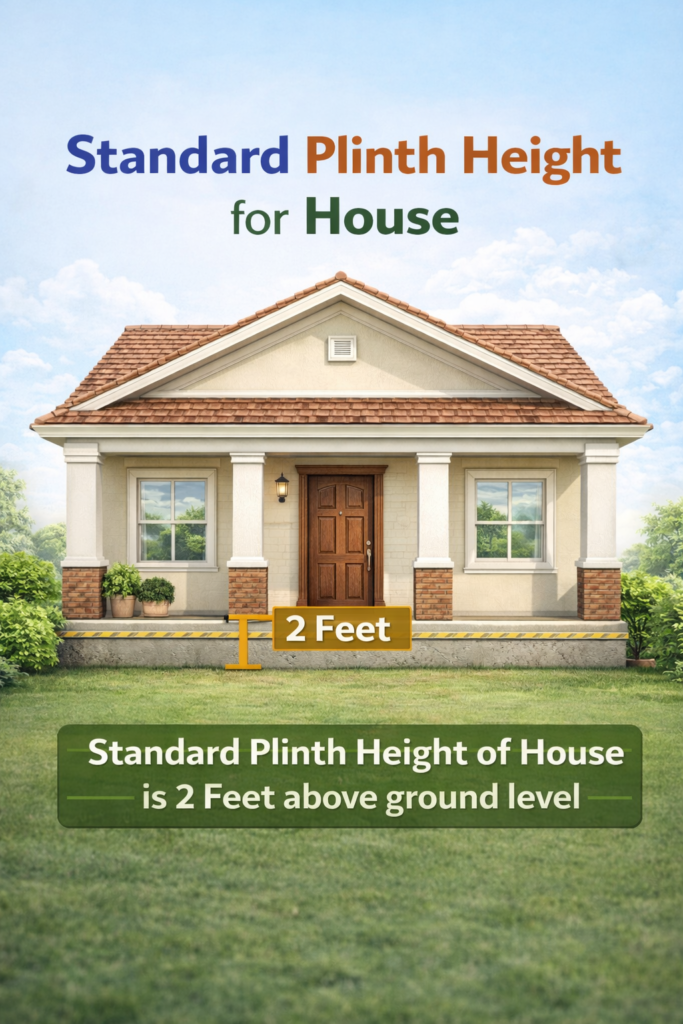
The plinth level is the height between the natural ground level and the finished floor level of the building.
This portion of the structure is usually filled with soil or sand and covered with flooring materials.
The plinth acts as a protective barrier between the building structure and the surrounding ground.
It helps protect the building from:
Rainwater entry
Flood water
Moisture from soil
Termite attacks
Surface drainage problems
Because of these reasons, maintaining the correct standard plinth height for house construction is very important.
Standard Plinth Height for House in India
In most residential buildings, the standard plinth height for house generally ranges between:
1.5 feet to 3 feet (450 mm to 900 mm)
Typical plinth height values used in construction include:
| Building Type | Plinth Height |
|---|---|
| Small houses | 1.5 ft |
| Standard residential houses | 2 ft |
| Flood-prone areas | 2.5 ft – 3 ft |
Providing a plinth height of around 2 feet is commonly considered ideal for residential houses.
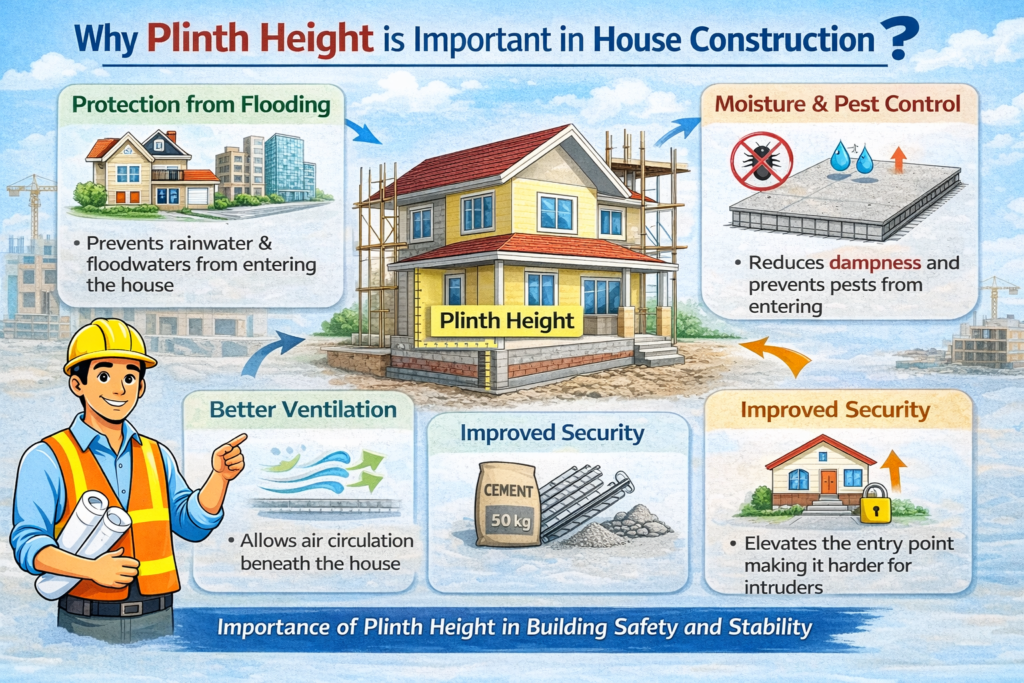
Why Plinth Height is Important in House Construction
The plinth height plays a crucial role in protecting the building structure.
Protection from Rainwater
Higher plinth levels prevent rainwater from entering the house during heavy rainfall.
Protection from Dampness
The plinth helps prevent moisture from the ground from reaching the walls and floors.
Flood Protection
In areas prone to flooding, increasing the plinth height reduces the risk of water entering the house.
Improved Ventilation
A higher plinth level improves airflow under the flooring and reduces moisture problems.
Better Appearance
A proper plinth height also improves the elevation and visual appearance of the building.
Soil strength is an important factor for foundation design. You can read our guide on Soil Bearing Capacity for House Construction to understand how soil affects building stability.
Factors Affecting Plinth Height in Houses
Several factors influence the standard plinth height for house construction.
Local Rainfall
Areas with heavy rainfall require higher plinth levels to prevent water entry.
Ground Level Conditions
If the surrounding ground level is low, the plinth height may need to be increased.
Drainage System
Proper drainage around the building reduces the need for very high plinth levels.
Flood Risk
Flood-prone areas require higher plinth heights for safety.
Road Level
If the road level near the house is high, the plinth level should also be increased.
Plinth Height According to Site Conditions
The standard plinth height for house may vary depending on the conditions of the construction site. While general recommendations suggest a plinth height of around 1.5 to 3 feet, engineers often adjust this value based on the surrounding ground level and environmental conditions.
For example, if the house is located in a low-lying area where rainwater tends to accumulate, the plinth height should be increased to prevent water from entering the building.
Similarly, in areas where the road level is higher than the building plot, the plinth height must be raised to ensure that rainwater from the road does not flow into the house.
In flood-prone regions, the plinth level may be designed even higher than the usual standard to protect the building from flood damage.
Therefore, while the standard plinth height for house provides general guidance, the final height should always consider local site conditions.
Relationship Between Plinth Height and Foundation Depth
Plinth height and foundation depth are closely related in residential construction. The foundation is constructed below the ground level, while the plinth level is provided above the ground.
If the plinth height is increased, the foundation design must also ensure that the building remains structurally stable.
In many residential buildings, the foundation depth is usually between 3 feet and 5 feet, depending on soil conditions and building load.
After constructing the foundation and plinth beam, the area inside the plinth walls is filled with soil or sand. This filling raises the floor level of the building above the ground level.
Maintaining the correct relationship between foundation depth and the standard plinth height for house ensures that the building remains safe and protected from moisture and water infiltration.
Materials Used in Plinth Construction
Several materials are used during plinth construction to ensure strength and durability.
Plinth Beam Concrete
Reinforced cement concrete (RCC) is used for the plinth beam to support the walls and distribute structural loads.
Filling Material
The space inside the plinth walls is filled using materials such as soil, sand, gravel, or murram. These materials are compacted properly to prevent settlement.
Damp Proof Course (DPC)
A damp proof course is provided above the plinth beam to prevent moisture from rising into the walls.
Flooring Materials
After plinth filling, the flooring layer is constructed using materials such as cement concrete, tiles, or stone flooring.
Using proper materials during plinth construction improves the durability and performance of the building.
Tips for Maintaining Proper Plinth Height
While constructing a house, some practical precautions should be taken to maintain the correct plinth height.
Maintain Proper Site Drainage
Good drainage around the building prevents water accumulation near the plinth.
Ensure Proper Compaction
Plinth filling materials should be compacted properly to avoid settlement of the floor.
Follow Building Guidelines
Civil engineers usually follow standard construction guidelines while deciding plinth height.
Consider Future Road Levels
Sometimes road levels increase over time due to resurfacing. Therefore, the plinth height should be slightly higher than the current road level.
Following these tips helps ensure that the standard plinth height for house provides long-term protection and structural stability.
Advantages of Providing Proper Plinth Height

Providing the correct standard plinth height for house offers several advantages for residential buildings. The plinth acts as a protective barrier between the ground and the building structure, helping improve the durability and safety of the house.
One of the major advantages of maintaining proper plinth height is protection from rainwater. During heavy rainfall, water may accumulate around the building. If the plinth level is too low, rainwater may easily enter the house and cause damage to flooring and walls. A higher plinth level prevents this problem.
Another important advantage is protection from dampness. Moisture from the soil can travel upward through walls due to capillary action. Providing sufficient plinth height along with a proper damp proof course reduces this moisture movement and protects the building from dampness.
Proper plinth height also improves the appearance of the house. Houses with slightly elevated plinth levels usually look more attractive and well proportioned. The raised floor level also helps improve ventilation inside the building.
In addition, the plinth level helps protect the house from insects, termites, and small animals that may enter from ground level. Maintaining the recommended standard plinth height for house ensures better structural protection and long-term durability of residential buildings.
Components of a Plinth Structure
The plinth structure includes several important components that help protect the building.
Plinth Beam
A reinforced concrete beam constructed above the foundation that supports the walls.
Plinth Filling
Soil, sand, or gravel is used to fill the area between the foundation walls.
Damp Proof Course (DPC)
A waterproof layer provided above the plinth beam to prevent moisture from entering the walls.
Flooring Layer
The final floor surface is constructed above the plinth filling.
These components together form the plinth structure.
Practical Example of Plinth Height in Residential Buildings
For a typical residential house, the standard plinth height for house may be planned as follows:
Natural ground level – 0 ft
Plinth height – 2 ft
Ground floor level – 2 ft above ground
This height provides sufficient protection against rainwater and improves the building elevation.
Common Mistakes in Plinth Level Construction
Some construction mistakes related to plinth height include:
Providing very low plinth height
Ignoring road level during construction
Poor drainage around the building
Improper plinth filling
Not providing damp proof course
These mistakes can cause moisture problems and water entry into the building.
Engineering Toolbox provides useful engineering formulas and technical resources related to building construction and structural design.
FAQs
What is the standard plinth height for houses in India?
The standard plinth height for house construction in India is usually between 1.5 feet and 3 feet.
Why is plinth height important?
Plinth height protects the building from rainwater, flooding, and soil moisture.
What is the ideal plinth height for a house?
A plinth height of about 2 feet is commonly used for residential buildings.
What happens if plinth height is too low?
Low plinth height may allow rainwater and moisture to enter the house, causing dampness and structural damage.
The Bureau of Indian Standards provides official building codes and construction guidelines used across India.
Conclusion
The standard plinth height for house construction is an important factor in residential building design. Proper plinth height protects the building from rainwater, dampness, and drainage problems.
Civil engineers usually recommend plinth heights between 1.5 feet and 3 feet depending on local conditions and building requirements.
Following the correct standard plinth height for house ensures better durability, safety, and long-term performance of the structure.

Shakeel T is a civil engineering enthusiast and founder of CivilGuide.in. He specializes in construction estimation, quantity surveying, and practical civil engineering calculations. Through CivilGuide, he shares real-world construction knowledge, calculators, and step-by-step guides to help students and site engineers improve their technical skills.