
Introduction
Understanding the standard room size for house in India is very important when planning a residential building. Proper room dimensions improve comfort, ventilation, furniture placement, and overall usability of the house.
In India, architects and civil engineers generally follow certain common room sizes while designing residential buildings. These sizes are based on practical construction experience, furniture space requirements, and building guidelines.
Knowing the standard room size for house in India helps homeowners plan better house layouts and avoid problems related to space planning.
Foundation depth is an important part of safe house construction. Our guide on Minimum Depth of Foundation for Residential Building explains how engineers determine the correct depth for foundations.
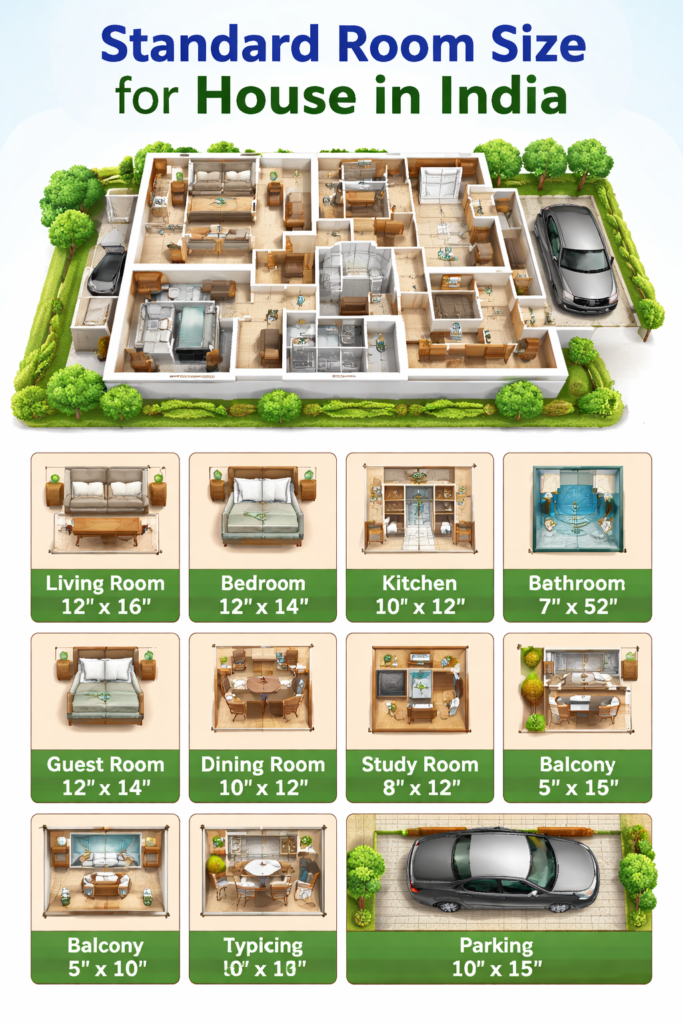
Standard Room Size for House in India – Room Wise Dimensions
Different rooms in a house serve different purposes, so their sizes vary depending on their use. The standard room size for house in India is generally decided based on comfort, furniture placement, and available plot area.
Below are commonly used room dimensions in residential houses.
Standard Living Room Size
The living room is the main space where family members gather and guests are welcomed. In most residential buildings, the standard room size for house in India for a living room is designed to provide enough space for seating arrangements and movement.
Typical living room sizes include:
| Type | Size |
|---|---|
| Small living room | 10 ft × 12 ft |
| Standard living room | 12 ft × 16 ft |
| Large living room | 14 ft × 20 ft |
A well-designed living room usually accommodates:
Sofa set
TV unit
Center table
Walking space
Proper lighting and ventilation are also important for a comfortable living area.
Standard Bedroom Size
Bedrooms should provide comfortable space for sleeping and furniture placement. According to common residential planning practices, the standard room size for house in India for bedrooms is usually between 10 ft × 10 ft and 12 ft × 14 ft.
Typical bedroom sizes are:
| Type | Size |
|---|---|
| Small bedroom | 10 ft × 10 ft |
| Standard bedroom | 10 ft × 12 ft |
| Master bedroom | 12 ft × 14 ft |
A typical bedroom may contain:
Bed
Wardrobe
Side table
Dressing space
Master bedrooms may also include attached bathrooms.
Standard Kitchen Size
The kitchen should be designed to allow smooth movement while cooking. In residential building design, the standard room size for house in India for kitchens usually ranges between 8 ft × 10 ft and 10 ft × 12 ft.
Typical kitchen sizes include:
| Type | Size |
|---|---|
| Small kitchen | 6 ft × 8 ft |
| Standard kitchen | 8 ft × 10 ft |
| Large kitchen | 10 ft × 12 ft |
Modern kitchens often follow the work triangle principle, which connects:
Sink
Stove
Refrigerator
This layout improves cooking efficiency and convenience.
Standard Bathroom Size
Bathrooms require minimum space for sanitary fixtures such as toilet, wash basin, and shower area. While designing residential buildings, engineers also consider the standard room size for house in India for bathrooms to ensure proper functionality.
Typical bathroom sizes include:
| Type | Size |
|---|---|
| Small bathroom | 4 ft × 6 ft |
| Standard bathroom | 5 ft × 7 ft |
| Large bathroom | 6 ft × 8 ft |
Bathrooms must also have proper ventilation to prevent moisture and dampness.
Standard Dining Room Size
The dining room is the space where family members eat meals together. The standard room size for house in India for dining rooms is generally designed to accommodate a dining table and comfortable walking space.
Typical dining room sizes include:
| Type | Size |
|---|---|
| Small dining | 8 ft × 10 ft |
| Standard dining | 10 ft × 12 ft |
| Large dining | 12 ft × 14 ft |
Dining rooms are usually located near the kitchen and living room for convenience.
Minimum Room Size According to Building Guidelines
Building guidelines also specify minimum room sizes to ensure healthy living conditions. These values help maintain proper ventilation, lighting, and movement inside the house.
Typical minimum room sizes include:
| Room | Minimum Area |
|---|---|
| Living room | 120 sq ft |
| Bedroom | 100 sq ft |
| Kitchen | 50 sq ft |
| Bathroom | 30 sq ft |
These values are generally considered while designing residential house plans.
If you are planning to build a house, understanding the overall construction cost is very important. Read our detailed guide on House Construction Cost in India 2026 to estimate your building budget accurately.
Factors Affecting Room Size in House Planning
Several factors influence the standard room size for house in India when designing residential buildings.
Plot Size
The size of the plot plays a major role in determining room dimensions. Smaller plots require compact room planning, while larger plots allow spacious rooms.
Number of Family Members
The number of people living in the house also affects room size. Larger families require more bedrooms and larger living areas.
Construction Budget
Larger rooms require more construction materials such as concrete, bricks, and steel, which increases the overall construction cost.
Furniture Arrangement
Room size must be sufficient to accommodate furniture such as beds, sofas, wardrobes, and dining tables.
Ventilation and Lighting
Proper window placement requires sufficient wall space and affects room dimensions.
Standard Room Size for Small Houses
In many Indian cities and towns, plot sizes are limited. Because of this, houses are often designed with compact room sizes to use the available space efficiently.
For small houses or low-budget homes, the standard room size for house in India may be slightly smaller than typical dimensions but still comfortable for daily living.
Some commonly used room sizes for small houses include:
Living room – 10 ft × 12 ft
Bedroom – 10 ft × 10 ft
Kitchen – 6 ft × 8 ft
Bathroom – 4 ft × 6 ft
These dimensions are often used in 600 sq ft to 800 sq ft houses.
Even though the rooms are smaller, proper planning can make the house comfortable. Using multifunctional furniture, wall-mounted storage, and good ventilation helps improve space utilization.
Proper layout planning is very important in small houses to avoid congestion and maintain comfortable movement.
Standard Room Size for 2BHK Houses
A 2BHK house usually includes a living room, two bedrooms, a kitchen, bathrooms, and sometimes a dining area.
In most residential buildings, the standard room size for house in India for a 2BHK layout may be designed as follows:
Living room – 12 ft × 16 ft
Master bedroom – 12 ft × 14 ft
Second bedroom – 10 ft × 12 ft
Kitchen – 8 ft × 10 ft
Dining area – 10 ft × 10 ft
Bathroom – 5 ft × 7 ft
These room dimensions provide comfortable space for a small family.
In modern house designs, architects also include attached bathrooms, wardrobes, and storage spaces inside bedrooms.
A well-planned 2BHK house provides enough living space while maintaining efficient use of the plot area.
Tips for Planning Comfortable Room Sizes
While designing a house, it is important to follow some basic planning principles to ensure comfortable room sizes.
Allow Proper Walking Space
Furniture placement should not block movement. At least 2 to 3 feet of walking space should be available around furniture.
Provide Proper Ventilation
Every room should have windows for natural light and air circulation. Good ventilation improves indoor comfort.
Consider Future Needs
When planning room sizes, it is important to consider future family needs. For example, children may need study space or additional storage.
Avoid Oversized Rooms
Very large rooms increase construction cost and may not be necessary for small families. Properly balanced room sizes are more practical.
Plan Furniture Layout First
Before finalizing room dimensions, it is helpful to plan furniture placement. This ensures that the room size is adequate for practical use.
Practical Example for a 1000 sq ft House
For a typical 1000 sq ft residential house, the standard room size for house in India may be planned as follows:
Living room – 12 ft × 16 ft
Bedroom 1 – 10 ft × 12 ft
Bedroom 2 – 10 ft × 10 ft
Kitchen – 8 ft × 10 ft
Bathroom – 5 ft × 7 ft
Dining – 10 ft × 10 ft
This type of layout provides comfortable space for a small family while maintaining proper circulation within the house.
Common Mistakes in Room Size Planning
Many homeowners make mistakes while planning room dimensions during house design.
Some common mistakes include:
Designing rooms too small for furniture placement
Ignoring proper ventilation and lighting
Providing insufficient walking space
Poor furniture layout planning
Not considering future family requirements
Avoiding these mistakes helps improve the functionality and comfort of the house.
The Bureau of Indian Standards provides official building guidelines and standards used in construction projects across India.
FAQs
What is the standard bedroom size in India?
The standard bedroom size in India is usually 10 ft × 12 ft, while master bedrooms may be around 12 ft × 14 ft.
What is the minimum kitchen size for a house?
The minimum kitchen size for a small house is usually 6 ft × 8 ft.
What is the standard living room size?
A comfortable living room size is typically 12 ft × 16 ft in most residential houses.
Why are standard room sizes important in house design?
Standard room sizes ensure comfortable movement, proper furniture placement, good ventilation, and better interior planning.
Engineering Toolbox provides useful engineering data, formulas, and construction information related to building design and structural engineering.
Conclusion
Understanding the standard room size for house in India is essential for designing comfortable and functional residential buildings. Proper room dimensions help improve usability, ventilation, and furniture arrangement.
Architects and civil engineers consider several factors such as plot size, family requirements, and construction budget while deciding room sizes. Following the standard room size for house in India helps homeowners create practical and well-planned houses that provide comfortable living spaces.

Shakeel T is a civil engineering enthusiast and founder of CivilGuide.in. He specializes in construction estimation, quantity surveying, and practical civil engineering calculations. Through CivilGuide, he shares real-world construction knowledge, calculators, and step-by-step guides to help students and site engineers improve their technical skills.